TL;DR
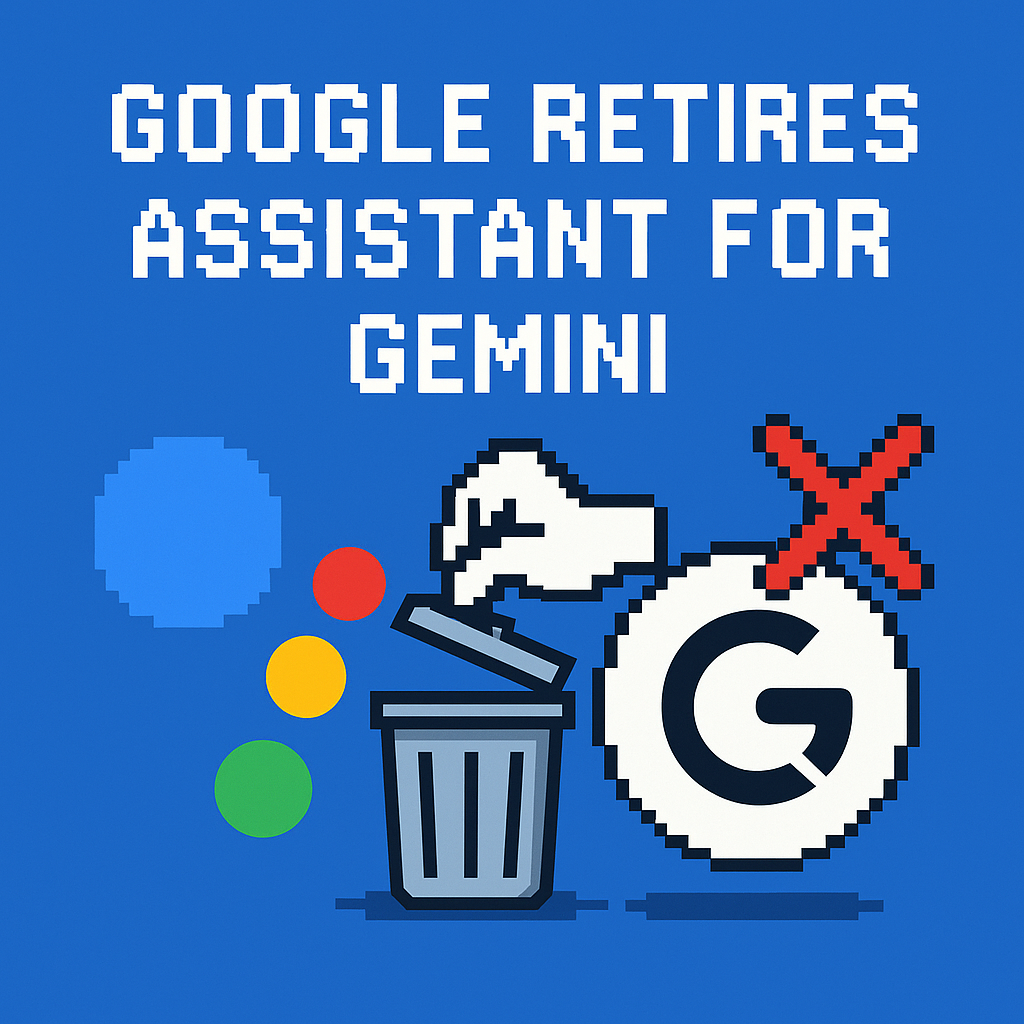
- Google will shut down Google Assistant on Android phones, tablets, and Wear OS starting September 4, 2026; Gemini becomes the default assistant, with removal rolling out over “a few weeks.” [2][3]
- This is a product swap from a deterministic voice UI to a generative AI agent; specific Assistant staples (some news/radio providers and Interpreter mode) remain incomplete in Gemini on mobile. [7][4]
- Ecosystem impact is uneven: Android Auto projected from phones, watches, and headphones lose Assistant, while cars with Google built‑in keep Assistant “for a little longer,” setting up a multi‑year transition. [2][3]
What the source said
Inc., in a piece by Georgia Fearn, reports that Google will retire Google Assistant on Android and Wear OS, with Gemini taking over as the default experience after September 4, 2026. The article spells out which devices change (phones, tablets, Wear OS), how the switch to Gemini works, and how quickly access will be removed after the September date. It cites Google’s migration language about removal beginning on a specific day and continuing over a short window. The piece stays consumer‑focused—covering steps to switch and day‑one gaps rather than corporate strategy. [1]
Why it matters
Android’s 3B+ active devices mean changes to timers, messaging, or navigation affect routines at global scale; Google also says Gemini already serves 900M+ monthly users, so a push into hundreds of millions more shifts behavior from on‑device commands to cloud‑assisted interactions. That raises reliability and latency risks for commuters using Android Auto, runners wearing Wear OS, and anyone trained by Assistant’s crisp, single‑shot responses. [5][6]
OEMs like Samsung and Xiaomi, app providers such as Spotify and Pocket Casts, and automakers will all feel the switch. Android Auto projected from phones, Wear OS watches, and headphones lose Assistant beginning September 4, 2026; vehicles with Google built‑in keep Assistant “for a little longer,” fragmenting experiences by device class and market during the rollout. [2][3]
Original analysis
The Google Assistant shutdown is a platform control play, not just an AI upgrade
The consensus take says Gemini is smarter, so this is a routine retirement; my contrarian read is that Google wants one “assistive entry point” it fully controls across phones, wearables, cars, and home—without the legacy overhead of Assistant’s skills model and permissions plumbing.
- Assistant’s third‑party “Conversational Actions” shut down in 2023, and 2024’s feature trims telegraphed end‑of‑life; Google’s plan to “upgrade” mobile Assistant users to Gemini and remove most mobile access later in the year formalized the path. September 4, 2026 is the cutover for Android and Wear OS, with removals rolling out in waves. [6][4][2][3]
- Gemini is not feature‑identical on day one: Google’s help pages flag gaps in media providers, radio/news streams, and Interpreter mode on mobile, which the company is still closing. [7]
That feels like a downgrade to power users—unless you’re Google. A single agent (Gemini) standardizes UI, telemetry, and monetization across surfaces, and it gives Google one roadmap for agentic behaviors—Gemini Live, “Spark,” and proactive briefs—rather than retrofitting them into Assistant’s deterministic command parser. [6][4]
Back‑of‑envelope: what “full migration” could mean by 2027
- Android active devices: “more than 3 billion.” [5]
- Gemini monthly users today: “more than 900 million.” [6]
If 25% of Android’s active device base not already using Gemini monthly converts by mid‑2027, that’s 0.25 × 3.0B ≈ 750M additional monthly users. Add the current 900M and you get ≈ 1.65B monthly Gemini users—scale that rivals Google’s largest consumer categories outside Search, which explains a forced switch starting September 2026. This is a sizing exercise, not a forecast, but it shows why the migration math works. [5][6]
A 2×2 that explains user pain—and Google’s bet
- Axis 1: Deterministic commands vs. Generative tasks
- Axis 2: On‑device (low‑latency, private) vs. Cloud (context‑rich, agentic)
Assistant lived in the deterministic/on‑device quadrant for alarms, toggles, and local media control, with cloud fallbacks for web lookups. Gemini pushes hard into the generative/cloud quadrant—great for multi‑step queries and cross‑app orchestration, but historically worse for “one‑shot” tasks when latency or hallucinations appear. [4][6]
The short‑term pain you’ll feel on Android Auto or a Pixel Watch comes from this quadrant shift: fewer hard‑coded, instant flows; more flexible, sometimes slower agent behavior. Google is betting faster models and hybrid execution will make generative feel instant, while backfilling deterministic routines where complaints spike first. [4][6]
Named stakeholder breakdown
- Google: Shuts down a fragmented stack and unifies investment behind one AI agent, aiming to grow Gemini well beyond 900M monthly users after the September 2026 cutover. Expect deeper ties to Search, Android, and Home surfaces to follow. [4][6]
- Samsung (and Wear OS OEMs): Faces a 2026–2027 support burden as customers lose familiar Assistant watch behaviors; the upside is new on‑device Gemini models that can headline Galaxy and Pixel hardware in late‑2026 and 2027. [2][4]
- Automakers: Android Auto (projected from phones) loses Assistant in September 2026; cars with Google built‑in keep Assistant longer, creating dual showroom experiences and support complexity by trim and region. Expect upsell pressure toward built‑in systems. [2][3]
- Media partners (news, radio, podcasts): Integrations change or break in Gemini; renegotiations over deep‑linking, playback controls, and attribution are likely as Google patches feature gaps through 2026. [7]
- Amazon Alexa: Gains an opening to reclaim smart‑home usage on Echo‑class devices while Gemini backfills features on Nest displays and third‑party hardware through the fall of 2026. [6][2]
What others are missing
The specific angle most coverage skips is device‑class asymmetry on September 4, 2026: Android and Wear OS lose Assistant first, which also affects headphones and Android Auto projected from phones, while Google TV, Nest Hub–class smart displays/speakers, and Google built‑in cars run on different deprecation clocks. Tom’s Guide and TechRadar cite the September start and carve‑outs, while Google’s blog emphasizes a staged upgrade for home and car without parity dates, guaranteeing mixed Gemini/Assistant households this fall. That fragmentation—Pixel on Gemini, Nest Hub on Assistant, and a split in the garage—is the hidden cost that will test whether Gemini can match “do this now” behaviors across every surface before churn sets in. [3][2][4]
What to watch next
- By October 31, 2026: Google adds at least two missing Assistant staples—either radio/news provider support or Interpreter mode—to Gemini on Android and highlights the change in a Help Center update.
- By December 31, 2026: Google publishes telemetry showing median latency for set‑a‑timer and add‑a‑stop voice tasks on Android Auto is ≤1.2 seconds, documented in an official blog post or support performance note.
- By March 31, 2027: A top‑10 automaker by 2025 sales publicly sets a firm handover date from Google Assistant to Gemini for Google built‑in infotainment, ending the “for a little longer” ambiguity.
My take
Google is right to kill Assistant and wrong to assume users won’t feel it in September 2026. The company can’t ship an agentic future while hauling a decade of Assistant cruft, so it’s ripping off the band‑aid; fair. But if Gemini can’t match one‑command reliability that made Assistant sticky in cars, kitchens, and on wrists, people will defect to simpler options—Alexa at home, hard buttons in the cabin, and zero voice on watches. I’d make the same strategic call and put ruthless focus on low‑latency, offline‑first “do this now” flows; if Gemini nails that by December 31, 2026, complaints fade, and if not, the brand eats months of avoidable pain.
Sources
[1] Google Is Finally Shutting Down the Google Assistant. Here’s What Android Users Need to Know — Inc. (https://www.inc.com/georgia-fearn/google-is-finally-shutting-down-the-google-assistant-heres-what-android-users-need-to-know/91385340) — Establishes the consumer‑side details (devices, dates, and switching steps) from a named reporter.
[2] Google Assistant will shut down for good on Android and Wear OS in September — TechRadar (https://www.techradar.com/ai-platforms-assistants/gemini/google-assistant-will-shut-down-for-good-on-android-and-wear-os-in-september-heres-what-you-need-to-do-next) — Confirms September 4, 2026, the phased removal window, and Android Auto vs. Google built‑in nuances.
[3] Google Assistant dies in September: what you need to know and how to switch to Gemini — Tom’s Guide (https://www.tomsguide.com/ai/google-gemini/google-assistant-dies-in-september-what-you-need-to-know-and-how-to-switch-to-gemini) — Cites Google’s email (“We will begin removing access… starting on September 4”) and lists impacted devices with switching instructions.
[4] The Assistant experience on mobile is upgrading to Gemini — Google (https://blog.google/products-and-platforms/products/gemini/google-assistant-gemini-mobile/) — Google’s official framing of the mobile upgrade and retirement of “classic” Assistant on most mobile devices.
[5] The Android Show I/O 2025: Android now at 3B+ active devices — Google (https://blog.google/products-and-platforms/platforms/android/the-android-show-io-2025/) — Establishes the 3B+ active device base used in the migration sizing.
[6] The Gemini app becomes more agentic, delivering proactive, 24/7 help — Google (https://blog.google/innovation-and-ai/products/gemini-app/next-evolution-gemini-app/) — States “more than 900 million” monthly Gemini users and outlines features like Gemini Live and proactive briefs.
[7] What you can do with your Gemini mobile app (Some features not supported) — Google Help (https://support.google.com/pixelphone/answer/14579631?hl=en-as) — Documents gaps vs. Assistant (media providers, radio/news streams, Interpreter mode) and the status of fixes.
Related update: We recently published an article that expands on this topic: read the latest post.
Related update: We recently published an article that expands on this topic: read the latest post.