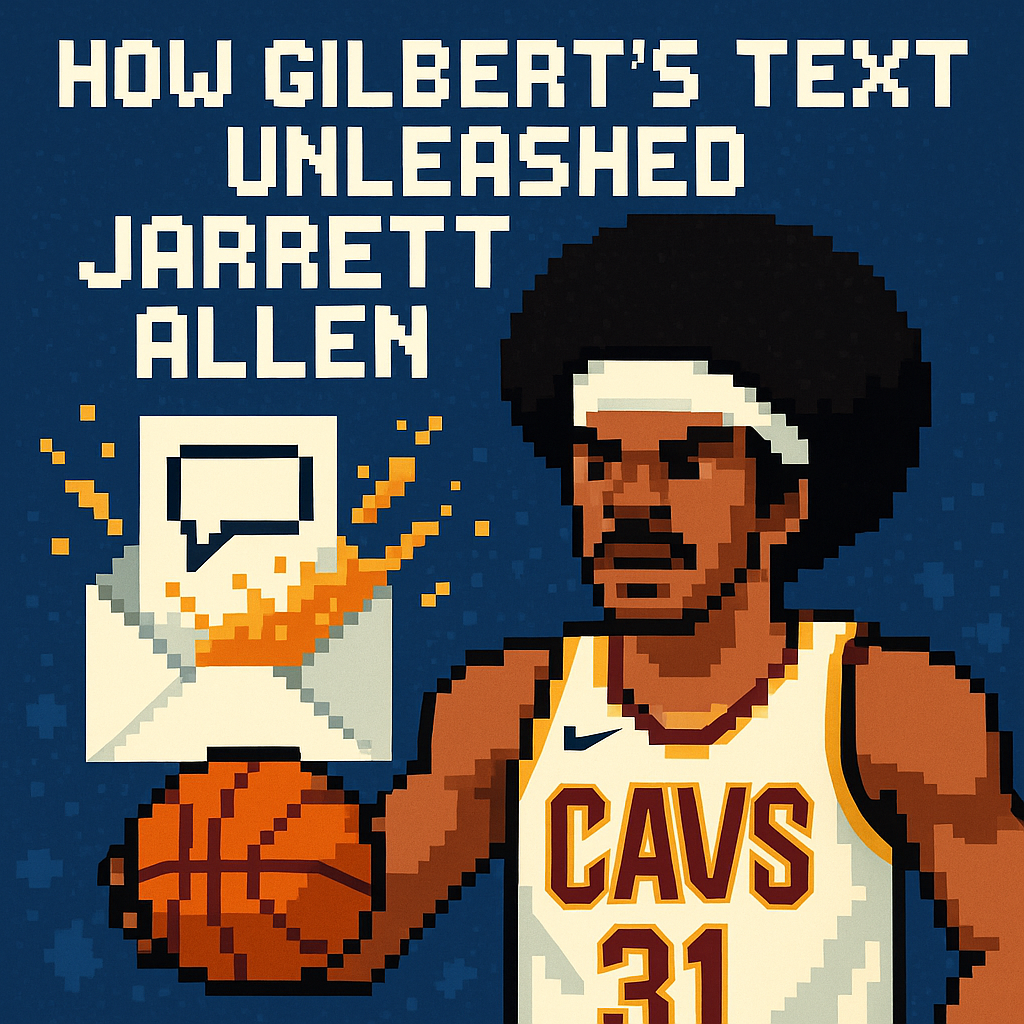
How Gilbert’s Text Unleashed Jarrett Allen | Analysis by Brian Moineau

TL;DR

  • Dan Gilbert’s motivational text message to Jarrett Allen preceded a 23-point, tone‑setting Game 7 from the center as Cleveland routed Detroit 125–94; the Cavs also got an owner‑engineered road‑crowd boost. [1][2][3]
  • The real edge wasn’t mystical “alter ego” stuff; it was organizational design: owner→coach→player alignment (dinner, first play for Allen, clear role) plus 25 buses of fans that muted home‑court. [2][3][8]
  • If Cleveland keeps rewarding Allen early and often, that inside gravity can swing the Knicks series more than any single pep text ever will. [2]

What the source said

Cleveland.com reports that, two hours before Game 7 in Detroit on May 17, 2026, Cavaliers owner Dan Gilbert sent Jarrett Allen a short text—encouraging him to “be you”—that Allen said was the first such message he’d ever received from the boss. Gilbert also surprised the team with an impromptu visit at the Shinola Hotel, near his downtown Detroit headquarters. Allen responded with physical, emotional play in a 125–94 win, and teammates jokingly dubbed his persona “Game 7 J.A.” The piece frames Gilbert’s note as a nudge that brought out Allen’s alter ego and helped Cleveland advance. [1]

Why it matters

Stakeholders here aren’t just Jarrett Allen and Dan Gilbert. Kenny Atkinson (who ran the first play for Allen), Koby Altman (roster architect), and the Eastern‑finals opponent New York Knicks all feel the ripple effects when ownership steps directly into the motivational chain—especially on the road. [2][3]

Cleveland has been starving for post‑LeBron proof of concept. The Cavs just reached the East finals for the first time since 2018, not with a heliocentric scorer but via connectivity—delegated confidence to Allen, interior dominance, and a traveling fan bloc that shaved Detroit’s home‑court advantage. The upside: culture compounds. The downside: if results slip, owner‑coach‑player boundary lines get second‑guessed. [2][3]

Original analysis

Dan Gilbert’s motivational text message to Jarrett Allen was the tip of a larger system

Consensus read: Gilbert’s text “sparked” Allen’s alter ego and flipped Game 7. Contrarian read: The text was symbolic; the win flowed from structural moves—Atkinson’s first‑play call for Allen, a paint‑first script, and a road‑crowd countermeasure that made Little Caesars Arena feel half‑neutral. Atkinson said Gilbert’s Jarrett‑as‑spark comment pushed him to open with Allen; that is process, not magic. [2][3]

Back‑of‑envelope calculation (fan impact)

  • Known inputs:
    • 25 buses of Cavs supporters for Game 7; nearly 1,400 people reported. [3][8]
    • Little Caesars Arena basketball capacity ≈ 20,332. [4]
  • Math:
    • Share of building = 1,400 ÷ 20,332 ≈ 6.9%.
  • Why it matters: Flipping roughly 7% of the bowl to the road team doesn’t erase home‑court, but it narrows the gap in late‑clock noise and momentum. Cleveland ultimately won by 31 (125–94), but the early quiet set the platform for that avalanche. [2][5]

Named‑stakeholder breakdown

  • Dan Gilbert (Cavaliers owner): Proved that targeted, tangible ownership actions (message clarity, fan logistics) can change the temperature of a road Game 7—and buy a mountain of locker‑room trust. [2][3]
  • Kenny Atkinson (head coach): Gained a template—feed Allen early when stakes spike—which he tied directly to Gilbert’s “Jarrett is the spark” prompt; expect him to rinse‑repeat versus New York at Madison Square Garden. [2]
  • Jarrett Allen (center): Delivered 23 points in 25 minutes and became the tactical fulcrum; if he sustains early touches, his rim runs and seals bend coverage for Donovan Mitchell and Sam Merrill. [2][6]
  • New York Knicks (next opponent): Must decide whether to tag Allen harder on the roll (risking spray‑outs to Merrill) or live with contested 2s; either response drags them away from their preferred shell under Tom Thibodeau. [2]
  • League peers (owners/executives): Now have a case study showing “soft‑power” levers—hotel touchpoints, curated fan travel, player‑specific messages—can be both culture and performance tools when used sparingly. [3][8]

One more number ties it together. The Cavs pounded Detroit inside—Allen scored 23, Mobley 21 (44 combined), while Cleveland turned the third quarter into a runway. If you’re New York, you don’t scheme for a text; you scheme for a team that just scored 58 in the paint and dictated first actions to its 5. That’s scouting‑report material. [2][5][7]

2x2 framework: Owner involvement vs. outcome quality

  • Low involvement × Poor outcomes: Drifting model—players hunt their own motivation; no edge in the margins.
  • Low involvement × Good outcomes: Talent carries; culture feels transactional; brittle under stress.
  • High involvement × Poor outcomes: Meddling—unclear roles, mixed messages for coaches, locker‑room cynicism.
  • High involvement × Good outcomes (Cleveland’s Game 7): Targeted involvement aligned with coaching decisions; specific ask to a specific player; tangible fan strategy; no crossing of tactical lines. [2][3]

The most durable lesson is repeatability. Atkinson doesn’t need fresh texts to recreate the effect. He needs first‑five possessions that make Allen the axis. That was the hidden value inside the “alter ego” headline: the Cavs found a playoff identity on May 17, 2026, and it’s translatable to Madison Square Garden. [2]

What others are missing

Coverage gushes about the “Game 7 J.A.” persona, but the overlooked angle is geography as an asset. Gilbert lives and operates businesses in Detroit; the Cavs staged at the Shinola Hotel, footsteps from his HQ. That proximity let ownership collapse the gap between symbolic support and operational execution—showing up at dinner, aligning with Atkinson, and mobilizing buses before tickets disappeared. In a cap‑and‑tax league where roster tweaks are expensive, exploiting off‑court infrastructure (relationships, venue knowledge, ticket channels) is a market inefficiency. Cleveland executed it at scale in a 48‑hour window and walked out with a 31‑point road Game 7. [1][3][8]

What to watch next

  1. By May 25, 2026 (after two games of the East finals), Cleveland will script the first play for Allen in at least one game—watch the opening set for a deep seal or lob to test New York’s rim help. [2]

  2. By the end of the Knicks series (no later than June 5, 2026), Allen will average 10.0+ field‑goal attempts per game—evidence that the Cavs are institutionalizing the Game 7 formula, not chasing an “alter ego” buzz. [2][6]

  3. By the 2026–27 All‑Star break (February 2027), at least two other NBA teams will publicly subsidize 500+ fans for a playoff road game, copying Gilbert’s 25‑bus move as a competitive soft‑edge tactic. [3][8]

My take

I’m not romantic about pep texts. I am bullish on organizations that turn intent into design. Gilbert didn’t draw up horns‑sets; he made Allen matter before the ball went up and made the arena less hostile once it did. Atkinson then cashed it in with that first call and a paint‑first script, and Allen paid it off. If the Cavs keep treating the center as a primary on ramps one through five and keep sweating the margins, they’ll take a bite out of New York’s perimeter. The message that wins isn’t in Gilbert’s phone—it’s in Cleveland’s opening actions.

Sources

Harden’s Collapse Deepens Cavs’ 0–2 Hole | Analysis by Brian Moineau

When a Superstar Stumbles: Harden’s Night to Forget

There’s a peculiar kind of silence that follows a basketball player when everything that can go wrong does. Harden had his worst playoff game as a Cavalier, and you could feel that silence ripple through Little Caesars Arena — then swell into loud, uncomfortable chatter. The Cavs lost Game 2 to the Detroit Pistons, 107–97, and Cleveland heads home staring at a 0–2 hole that suddenly looks much less salvageable.

This wasn’t merely a cold shooting night. It was a collapse built from turnovers, missed looks, and the kind of decision-making that forces coaches to redraw lines mid-series. When a veteran of Harden’s pedigree falters like this, the consequences don’t stop at the box score — they infect chemistry, rotations, and the trust that teams need to climb out of adversity.

Harden had his worst playoff game as a Cavalier

The headline tells a brutally simple story: James Harden, usually one of Cleveland’s reliable playmakers, looked lost. He committed multiple turnovers at critical moments, took contested shots he’d normally avoid, and failed to control the pace when the Cavs needed it most. Those miscues compounded a broader team issue — Cleveland’s perimeter shooting went ice-cold and Detroit executed a game plan that limited easy paint touches.

Meanwhile, Donovan Mitchell tried to counterpunch with a strong scoring night, Jarrett Allen held his own inside, and Evan Mobley offered defensive impact that didn’t fully translate into offensive flow. Yet Harden’s problems loomed larger because he’s the fulcrum of Cleveland’s spacing and late-game orchestration. When that fulcrum bends, the whole axis shakes.

  • Harden’s turnovers exacerbated transition chances for Detroit.
  • Cleveland shot poorly from three (a major theme across the night).
  • The Pistons grabbed momentum and never really surrendered it.

Transitioning from the first half to the final quarter, the Cavs simply could not find the consistent ignition necessary to close out runs. Detroit’s game plan — protect the paint, crowd the ball, and let Cade Cunningham and his supporting cast punish mistakes — worked.

How this game snowballed

At a glance, the storyline is straightforward: missed shots lead to rushed possessions, rushed possessions produce turnovers, and turnovers produce easy points. But the anatomy of this particular collapse is worth a closer look.

First, Harden’s role is twofold: he creates for others and controls tempo. On this night, both responsibilities faltered. Reckless passes and late clock decisions handed the Pistons extra possessions. Second, Cleveland’s shooters — usually reliable enough to keep defenses honest — could not provide exterior relief. Detroit’s defenders sagged into the lane and dared the Cavs to hit threes. They didn’t.

Third, the Pistons imposed physicality and energy. Detroit rebounded with purpose and pushed on transition. That converted missed Cavs looks into momentum and scoreboard pressure. Once the visitors started hitting enough shots to stay ahead, the Cavs’ late possessions felt like they were carved out of desperation.

Consequently, the coaching staff faces uncomfortable questions. Do you ride Harden through a slump hoping the veteran reverts to type? Or do you adjust lineups and usage to limit damage while trying to spark other scorers? Kenny Atkinson hinted at tactical changes after the game — and for good reason. When a series starts trending the wrong way, timely adjustments matter.

What the numbers don’t fully capture

Box scores are efficient but blunt instruments. They show turnovers, shooting percentages, and plus-minus, but they can’t measure the micro-moments that alter a team’s confidence.

  • The timing of Harden’s turnovers mattered more than the raw count.
  • Defensive schemes that forced Cleveland into stagnant possessions don’t show up as a single stat.
  • The psychological weight of “another bad possession” — both for Harden and teammates — is invisible on stat sheets.

That said, the metrics still ring alarm bells. Harden’s playmaking was ineffectual at moments when Cleveland needed clean looks. Plus, the Cavs’ bench barely shifted the needle; missing contributions from role players magnified Harden’s slip.

The Pistons’ blueprint and why it worked

Credit the Pistons for a clear plan. Detroit attacked the Cavs’ weakness: transition and defensive rebounding. They also executed late-game possession discipline and kept Cade Cunningham in control. When an opponent outlines a straightforward game plan and your team provides a series of self-inflicted wounds, the result is predictable.

Importantly, the Pistons didn’t just neutralize Harden — they made the Cavs uncomfortable across positions. They contested shots, doubled selectively, and forced Cleveland into low-percentage plays. That level of consistent pressure over 48 minutes turned a winnable game into a loss.

Where Cleveland can pivot

There are several practical pivots Cleveland can try before Game 3:

  • Reduce Harden’s exposure in high-leverage halfcourt sets and use him instead as a floor spacer in staggered minutes.
  • Increase ball movement through quicker passes and more off-ball screens to free up shooters.
  • Mix defensive looks to disrupt Detroit’s rhythm and force them into uncomfortable possessions.
  • Activate the bench earlier to change pace and take pressure off starters.

All of these are short-term bandages; the long-term fix is consistency. Harden — a veteran pro with championship-caliber chops — will almost certainly get another chance to flip the narrative. But the Cavs must decide whether to shelter him through the slump or adjust aggressively to prevent a 0–3 hole.

My take

This game is a reminder that even experienced stars can have nights that ripple well beyond their own stat lines. Harden had his worst playoff game as a Cavalier, yes — but basketball is stubbornly team-oriented. The loss reflects systemic flaws and timely execution from Detroit as much as it does one player’s lapse.

If the Cavs are to recover, they’ll have to recalibrate usage patterns, find their shooting touch, and restore defensive rebounding margins. The playoffs are a sprint of micro-adjustments; Cleveland’s next moves will tell us whether this series is a temporary stumble or the start of a deeper problem.

Final thoughts

Basketball narratives love redemption arcs, and there’s room for one here. Harden has the experience to respond, and Cleveland has enough talent to shift momentum. Yet the clock is unforgiving: being down 0–2 in a best-of-seven—or worse, 0–3—changes the shape of a series. For now, the Cavs must own the discomfort, correct the mistakes, and return with a sharper plan. Otherwise, Harden’s worst playoff game as a Cavalier will be remembered not as an oddity, but as a turning point.

Sources


Related update: We recently published an article that expands on this topic: read the latest post.


Related update: We recently published an article that expands on this topic: read the latest post.

Cavs Assert Control, Halt Knicks Sweep | Analysis by Brian Moineau

Cavs snap the sweep: how Cleveland stifled the Knicks in a 109-94 statement win

There was a midweek hum at Rocket Mortgage FieldHouse — not the usual buzzy, frantic kind, but the calm confidence of a team that feels itself coming together. The Cleveland Cavaliers weren’t just trying to avoid an ugly statline; they were putting a stake in the ground. On Tuesday night, they did that and more, handing the New York Knicks a 109-94 loss and keeping their season series from ending in a sweep.

Why this mattered

  • The Cavs and Knicks sit shoulder to shoulder in the East standings, and these matchups carry tiebreaker implications and playoff-pacing significance.
  • Cleveland entered with momentum (winning form recently) and used this game to show they can control a heavyweight opponent when it counts.
  • For New York, the loss exposed offensive dryness and a nightmare third quarter that flipped the game.

Game snapshot

  • Final score: Cavaliers 109, Knicks 94 (Feb 24, 2026).
  • Cleveland led 60-54 at halftime, then turned the heat up in the third quarter, outscoring New York 23-11.
  • Donovan Mitchell led Cleveland with 23 points; James Harden added 20. Jarrett Allen finished with 19 points and 10 rebounds.
  • Jalen Brunson had 20 and Mikal Bridges 18 for the Knicks. Mitchell Robinson grabbed 15 rebounds.
  • The Knicks shot 35-of-86 overall (around 40.7%) and struggled from deep (10-of-37, 27%). Their third quarter was brutal: 3-of-24 from the field.

The turning points

  • Third-quarter suffocation: Cleveland held the Knicks to just three field goals in the period. That defensive spasm wasn’t accidental — it was a mix of active help, contesting perimeter shots, and closing driving lanes when Brunson tried to create.
  • Harden + Mitchell in late game flow: Both stars paced the offense through the stretch run. Harden’s ability to control tempo and Mitchell’s scoring on drives and pull-ups kept New York from mounting a comeback.
  • Jarrett Allen’s inside presence: Between scoring and rim protection/rebounding, Allen anchored the paint and limited second-chance opportunities that the Knicks often rely on.

What the numbers tell us

  • Knicks 3-point woes: 10/37 is a killer against a team that has been vulnerable defending the arc. Cleveland’s ability to contest and force tougher looks tilted the efficiency scale.
  • Run timing: Cleveland’s 13-2 burst late in the third into the fourth created a gap New York couldn’t close. When a team converts pressure into a decisive run at that moment, the psychological edge often follows the scoreboard.
  • Standings context: Both teams were 37-22 after the game, but New York would hold the head-to-head tiebreaker if they finished tied after taking two of three meetings. That detail adds late-season significance to the matchup outcomes.

Matchup takeaways

  • Cleveland’s defense showed up when it mattered. They took away New York’s rhythm in the third and prevented the Knicks from finding consistent clean looks.
  • The Cavs’ depth and two-headed scoring (Mitchell + Harden) allow offensive variety; when one draws attention, the other benefits.
  • New York’s late-game issues and cold shooting from three are worrisome signs for a team trying to secure a top-tier playoff seed. They need consistency from their creators and better contingency offense when threes aren’t falling.

What this means next

  • Both teams head to Milwaukee (Knicks Friday, Cavs Wednesday) for important matchups against a conference contender. How each responds on the road will hint at their resilience and playoff readiness.
  • For Cleveland, the win continues a hot stretch (they’d won eight of nine), reinforcing their belief they can be one of the East’s toughest outs down the stretch.
  • For New York, it’s a reminder that margin for error is small — especially in head-to-head series against direct rivals.

My take

This was a classic-leveling moment. The Cavs didn’t merely “escape” with a win; they asserted defensive control at a point in the game when the Knicks have often leaned on offense to stay afloat. Cleveland’s balance — interior toughness from Allen, shot creation from Harden and Mitchell, and timely stops — was the difference. The Knicks will live to play another day, but they can’t afford more quarters like that third if they truly want to run with the East’s elite.

Sources


Related update: We recently published an article that expands on this topic: read the latest post.


Related update: We recently published an article that expands on this topic: read the latest post.

Mitchell, Harden Lift Cavs to Road | Analysis by Brian Moineau

A thriller in Denver: Mitchell and Harden seal a statement road win for the Cavs

There are games that feel like a turning point — the kind that leave you buzzing on the flight home and convinced you just watched a team discover a new gear. Monday night’s 119-117 Cleveland win over the Denver Nuggets at Ball Arena was one of those games. Donovan Mitchell’s late composure and James Harden’s improbable step-back three turned what looked like another uphill battle into a punctuation mark on a long, successful road trip.

Hook: the scene in the final minute

With 32 seconds left, the Cavs trailed and the scoreboard read tension, not confidence. Harden — in just his second game with Cleveland — drilled a contested, step-back three to knot the game at 117. Then, with .9 seconds remaining, Mitchell drew a foul on Jamal Murray and calmly sank two free throws. Cue pandemonium: Cavaliers 119, Nuggets 117, and an exhale that felt like the whole roster owed it to the fans.

Why this mattered beyond two points

  • This wasn’t just another win on the road. It was the finish of a five-game Western road trip that Cleveland completed with grit and poise.
  • Harden’s arrival (acquired Feb. 4) has not been incremental — it’s reshaped Cleveland’s late-game profile and playmaking in a matter of nights.
  • Beating the reigning-champion-core Nuggets in Denver is no small feat; Nikola Jokic still posted a triple-double, but the Cavs answered with balanced star power and timely defense.

The context: what Kenny Atkinson meant when he said he “knew what Cleveland was up against”

Cavs coach Kenny Atkinson’s comment before the game underlined the obvious: Denver is heavy on experience, size and playoff toughness. Nikola Jokic is a walking mismatch, Jamal Murray can hit shots from anywhere, and the Nuggets have a playoff DNA that pushes opponents to the brink. Atkinson’s warning wasn’t fear — it was respect. He knew his team would have to absorb pressure, survive runs, and then impose its own late-game identity. That’s exactly what Cleveland did.

  • Cleveland leaned on Donovan Mitchell’s fearless creation: 32 points and 10 assists, including the free throws that decided the game. Mitchell is still the team’s engine.
  • Jarrett Allen was a force inside (22 points, 13 rebounds), providing finishing and rim protection against a tough matchup.
  • Harden brought spacing, craft and a veteran cold-bloodedness that altered the Nuggets’ end-of-game calculus.

Key observations from the game

  • Late-game duo work: Mitchell and Harden already look like a complementary clutch pairing — Mitchell creates and finishes, Harden spaces, rebounds and makes plays under pressure.
  • Depth and role clarity: Beyond the stars, guys like Jarrett Allen and the role players stepped up at crucial moments, which is crucial for playoff durability.
  • Defense still matters: Jokic still had a triple-double (22/14/11), but turnovers and missed outside shots by Denver opened the window for Cleveland’s comeback.
  • Coaching and adjustments: Atkinson’s game plan navigated Denver’s threats and kept the Cavs composed in the final possessions — a small coaching win that matters down the stretch of a season.

Memorable sequence (play-by-play feel)

  • Cavs claw back from an 11-point deficit in the fourth after methodical offense and strong interior play.
  • Allen’s lob dunk off Mitchell’s pass swung momentum and tightened the gap.
  • Harden’s step-back three with 32 seconds left — contested, improbable, and perfectly timed — tied the game.
  • Mitchell drew the foul with under a second remaining and hit both free throws. Jokic missed a buzzer-beating three. Final: 119-117.

What this suggests about Cleveland’s trajectory

This game isn’t a silver bullet, but it is the kind of chemistry-accelerator win that elevates belief. Harden’s addition was always about more than numbers — it was about late-game gravity and veteran instincts. When those traits combine with Mitchell’s explosiveness and Allen’s interior presence, the Cavs look like a multi-dimensional team capable of surviving hostile environments and closing out tight games. If they want to be taken seriously in the conference picture, wins like this are how they prove it.

My take

If you asked me which Cavs snapshot I’d frame from the last few nights, it’d be Harden stepping back with a hand in his face and Mitchell calmly sinking the pressure shots. The roster shifts this month were dramatic, but chemistry sometimes happens in a single play — and Cleveland got a handful of them in Denver. That’s the sort of game that can cement trust between new teammates, and between a team and its coach. Atkinson said he knew what they were up against; what he might not have known is how quickly this group would start answering that challenge.

Final thoughts

Wins like this do more than pad the standings. They teach a roster how to win together under duress. The Cavs leave Denver with a narrow road victory, renewed momentum, and a clearer sense of identity that could matter when the real stakes arrive in the spring.

Sources


Related update: We recently published an article that expands on this topic: read the latest post.


Related update: We recently published an article that expands on this topic: read the latest post.

Four takeaways from the Cavs comeback victory over the Knicks – Fear The Sword | Analysis by Brian Moineau

Four takeaways from the Cavs comeback victory over the Knicks - Fear The Sword | Analysis by Brian Moineau

The Art of the Comeback: Lessons from the Cavs' Thrilling Victory Over the Knicks

In a world where everything seems to be a race against time, there's something magical about the Cleveland Cavaliers' recent comeback victory over the New York Knicks. It's a reminder that sometimes, all it takes is a solid half-hour to turn a game—and perhaps even a day—around. In a thrilling display of skill, strategy, and sheer willpower, the Cavs only needed 24 stellar minutes to secure a resounding win against the Knicks, leaving fans both ecstatic and slightly awestruck.

Takeaway 1: The Power of Momentum

Momentum in sports is like catching a wave in surfing—once you're on it, the ride can be exhilarating. The Cavs demonstrated this beautifully. After a sluggish start, Cleveland turned up the heat, showing that the power of momentum is not just a sports cliché but a tangible force. This victory serves as a poignant reminder of the importance of maintaining focus and seizing the moment, whether you're on the court or in an office meeting.

Takeaway 2: Teamwork Makes the Dream Work

Basketball is often seen as a showcase for individual talent, with players like LeBron James and Stephen Curry frequently taking the spotlight. However, the Cavs' victory was a textbook example of how teamwork can be a game-changer. With every player contributing, the team's synergy was palpable. This is reminiscent of the recent NASA Artemis I mission, where collaboration across different sectors and expertise led to a successful launch, proving yet again that cohesive teamwork can achieve remarkable feats.

Takeaway 3: Resilience is Key

The Cavs' performance was a testament to resilience—a trait that has been particularly highlighted in recent times. From frontline workers hustling through the pandemic to communities rebuilding after natural disasters, resilience has been our global mantra. Cleveland's ability to shake off a rough start and charge back into the game mirrors the resilience many have had to muster in their own lives.

Takeaway 4: The Influence of Leadership

Coaching plays an indispensable role in sports, much like leadership in any organization. J.B. Bickerstaff, the Cavs' head coach, has been instrumental in creating a culture of perseverance and adaptability. His leadership style resonates with that of leaders in various fields, who inspire their teams to overcome challenges and strive for excellence. It's a reminder that the right guidance can turn potential into performance.

Final Thought: Beyond the Scoreboard

This game was more than just a win; it was a narrative of hope, teamwork, and tenacity. As the Cavaliers continue their season, they offer lessons that extend beyond basketball, touching on elements of life that matter most. Whether you're a die-hard fan or a casual observer, there's something to be gleaned from their story—a testament to the fact that sometimes, it's not about how you start, but how you finish.

In the grand tapestry of sports and life, the Cavs' comeback is a vibrant thread that encourages us all to keep pushing forward, no matter how daunting the odds may seem. Here's to more exhilarating moments and lessons learned on and off the court!

Read more about AI in Business

Read more about Latest Sports Trends

Read more about Technology Innovations