TL;DR
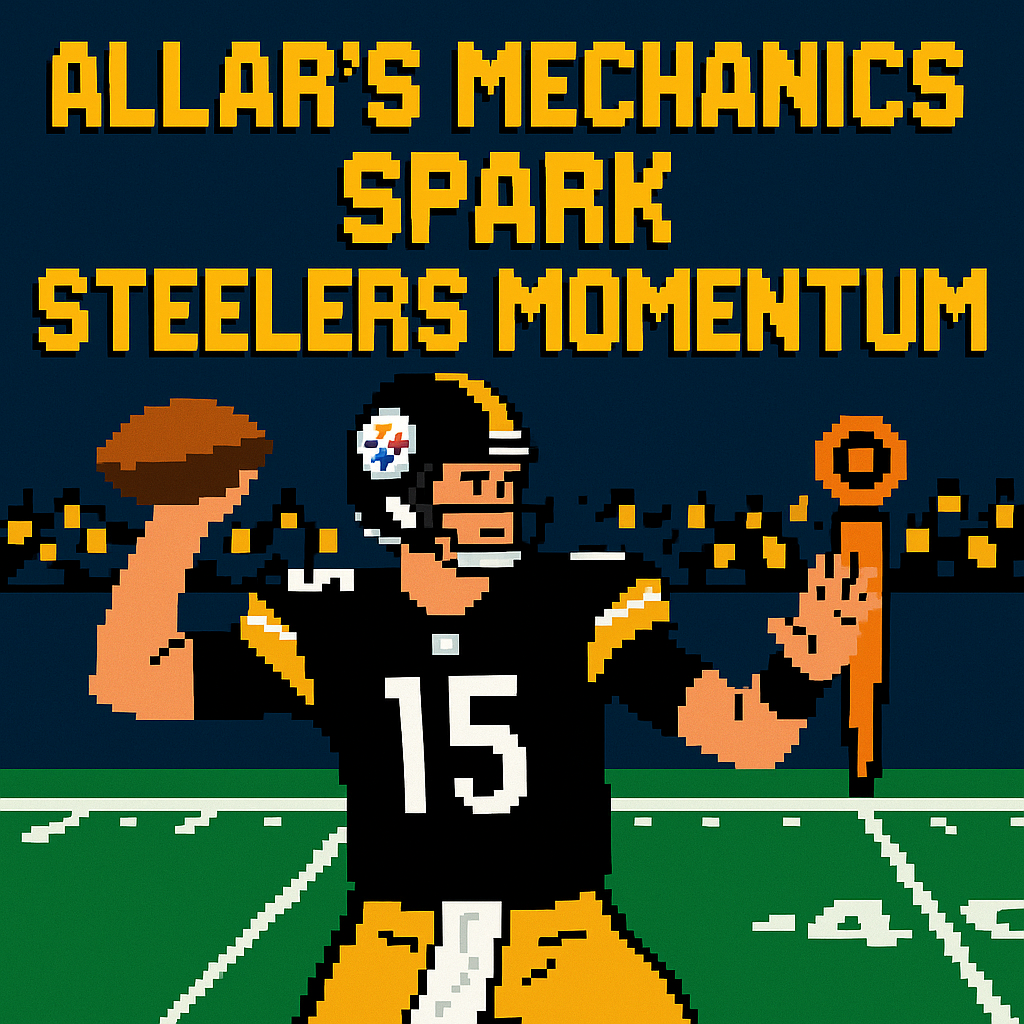
- Drew Allar’s preseason debut for the Pittsburgh Steelers produced three touchdown drives in three second‑half possessions, but the more meaningful win was cleaner footwork under head coach Mike McCarthy and quicker, calmer decisions under duress. [1] (nfl.com)
- In a quarterback room topped by a 42‑year‑old Aaron Rodgers who has said 2026 is his last ride, Allar’s jump from “rebuild the mechanics” to “run the offense” reframes Pittsburgh’s succession plan from 2028 insurance to 2027 contention. [6] (nfl.com)
- Because the opponent and context matter, I treat Allar’s three TD drives as a diagnostic, not a coronation: proof the floor is rising fast enough that he can be a useful NFL backup immediately and a viable 2027 starter if the arc holds. [2][4] (nfl.com)
What the source said
Steelers Depot reported that third‑round rookie Drew Allar, whose feet and consistency dogged him at Penn State and early camp, strung together three second‑half touchdown drives in his preseason debut vs. Green Bay. Beat writer Mark Kaboly told 93.7 The Fan that Allar flashed accuracy, pocket movement, and decision‑making that weren’t present “three months ago” or even “a week ago.” The piece credits Pittsburgh’s “tear it down to the studs” approach under head coach Mike McCarthy for the mechanical cleanup, especially footwork, which had driven ball‑placement issues. Film work by Josh Carney echoed that the improved base led to more consistent throws, even if the night wasn’t perfect. [1]
Why it matters
The real stakeholders are (1) the 2026 Steelers front office that must balance Rodgers’ now‑or‑never window with 2027–2029 roster value, and (2) the AFC North’s defensive coordinators evaluating whether Pittsburgh’s developmental depth can actually win games if Rodgers misses time. If Allar is already a functional backup in August, Omar Khan can roster‑build more aggressively at premium positions (corner, pass‑rush) instead of hunting veteran QB insurance at the trade deadline. [6][7] (nfl.com)
Fans are stakeholders too, but less for hype than for signal. On August 13, 2026, Pittsburgh beat Green Bay 28–9 at Acrisure Stadium; the score will fade, the tape won’t. The Steelers need a post‑Rodgers identity that coheres with McCarthy’s structure‑and‑rhythm offense; Allar’s debut suggested he can execute a pared‑down version of that identity without the latent chaos that marred his Penn State film. [2][5] (nfl.com)
Original analysis
Drew Allar’s preseason debut: signal vs. noise
The consensus read: “It’s only preseason; Allar picked on third‑stringers.” True and lazy. The question for a developmental QB isn’t who he beat, but how: base, sequencing, timing, and answers versus simple post‑snap movement. You can’t fake those, even against vanilla Cover‑3.
What changed Thursday was less the stat line and more the operating system. The Steelers drafted Allar 76th overall as a traits bet—arm talent without repeatable feet—and immediately put him in a demolition‑and‑rebuild under McCarthy’s staff. Seeing three consecutive end‑zone trips led by that same player, within a pro progression structure, is strong evidence that the new biomechanics are sticking under live bullets. That carries predictive weight across opponent tiers. [3][4] (steelers.com)
-
A contrarian read
Consensus: “No takeaways until he faces starters.” My case: mechanics are opponent‑agnostic. If your base width is consistent and your stride lands on‑line, your ball arrives on time, regardless of CB3 vs. CB1. The opponent calibrates the ceiling; the base establishes the floor. Allar’s floor rose Thursday because the link between feet and ball stayed intact under NFL timing. That matters more than who wore the green dot. [1] -
A 2×2 that actually predicts outcomes
Axes: Mechanics (clean ↔ messy) vs. Processing (fast ↔ slow).• Clean/Fast: Rodgers (2026), the model for McCarthy’s offense. [6] (nfl.com)
• Clean/Developing: Allar (post‑rebuild). This is where Thursday’s tape placed him—cleaner base and a first‑read rhythm that looked coached, not improvised. [1]
• Messy/Fast: Young arms who create but spray—where Allar lived too often at Penn State. [1]
• Messy/Slow: Camp‑arm purgatory.Movement across quadrants is rare mid‑camp; Allar appeared to jump one box right (messy→clean) and a half box up (slow→developing). If he locks that in through August 2026, he becomes a playable QB2 by November 2026, independent of opponent quality.
-
Back‑of‑envelope calculation
Suppose footwork cleanup trims an illustrative 5 percentage points from Allar’s off‑target rate when he becomes a starter in 2027 (e.g., 15% → 10%). Over 350 attempts, that’s ~17–18 fewer uncatchable balls. If even a third convert into first downs at ~0.6 WPA on fourth‑quarter scoring drives over a season, you bank ~3–4 win‑swinging plays—exactly the margin that turns a 9–8 wild card into an 11–6 division shot in the AFC North. That’s the scale of value footwork fixes can produce in McCarthy’s structure. -
Named‑stakeholder breakdown
• Mike McCarthy: Proof of concept that his staff can accelerate QB development without live‑game chaos. That strengthens his case to keep a “four QBs we love” room intact through Week 1. [7] (nfl.com)
• Aaron Rodgers: A clearer runway to manage reps and preserve arm health if the staff trusts Allar with second‑half preseason and emergency regular‑season snaps during his final campaign. [6] (nfl.com)
• Omar Khan (GM): Optionality. If Allar is real QB2 by October 2026, Khan can spend mid‑round capital on OL depth or CB rather than a veteran backup rental.
• Mason Rudolph: The steady bridge. If he holds QB2 early, Allar’s rise still pressures the staff to tilt QB3 packages or two‑minute drills toward the rookie by preseason Week 3. [7]
• Will Howard: The developmental clock speeds up. If Allar’s baseline is higher than expected, Howard’s August must produce a counter‑thesis—pocket command or red‑zone sequencing—or he risks becoming the odd man out in weekly actives. [7]
Bottom line: The debut did not crown a starter; it validated a process. In an organization that just changed head coaches and doubled down on a veteran starter for one last run, that’s the “win behind the win.” [2][4][6] (nfl.com)
What others are missing
The real lens is scheme carryover. McCarthy’s pass game still majors in timing—quick perimeter access throws and high‑percentage ISO routes married to under‑center play‑action. That world demands two things from a young QB: controlled lower‑half and willingness to be on‑schedule. Media recaps of Allar’s touchdowns fixate on outcomes, not the machinery: consistent base width on quick game, a hitch that doesn’t drift the launch point, and resets that keep shoulders square on extended plays. Those traits travel week to week; they don’t depend on whether the corner is Green Bay’s CB2 or CB6. If they persist vs. the Jets and at the Bills this month, Pittsburgh can treat Allar as a live NFL option sooner than planned. [8] (steelers.com)
What to watch next
- By August 21, 2026, Allar gets the first full third quarter vs. the Jets and produces at least one scoring drive built on a 6‑plus‑play sequence, not a single shot play. [8] (steelers.com)
- By August 27, 2026, at Buffalo, Pittsburgh tests Allar with at least three under‑center snaps and two designed movement throws (boot/play‑action), a litmus for scheme carryover. [8] (steelers.com)
- By Week 6 of the regular season (October 2026), the Steelers keep four quarterbacks on the 53 at least twice, signaling organizational commitment to in‑house succession over a veteran rental. [7] (nfl.com)
My take
I’m buying the signal. Three touchdown drives don’t change a quarterback’s destiny; three mechanically clean touchdown drives do. In one August night, Drew Allar moved from “traits bet that needs a redshirt” to “functional backup with a 2027 starter’s path,” and that’s a massive strategic shift for Pittsburgh. With Rodgers publicly on the clock and McCarthy rebuilding the room in his own image, the Steelers don’t need Allar to be a revelation; they need him to be repeatable. If this is the new baseline, he should be QB2 by Halloween 2026 and the unquestioned heir by spring 2027. [6] (nfl.com)
Sources
-
‘Stuff You Didn’t See From Him’: Beat Writer Evaluates Drew Allar’s Debut — Steelers Depot (https://steelersdepot.com/2026/08/drew-allar-showed-stuff-you-didnt-see-from-him-consistently-a-week-ago-in-debut-beat-writer-says/) — The starting point: Kaboly’s on‑air assessment and Steelers Depot’s framing of Allar’s mechanical progress.
-
Packers at Steelers, 2026 Preseason Week 1 — NFL.com Game Center (https://www.nfl.com/games/packers-at-steelers-2026-pre-1) — Confirms the Aug. 13 game at Acrisure Stadium and the 28–9 final.
-
Steelers select Allar in third round — Pittsburgh Steelers (https://www.steelers.com/news/steelers-select-allar-in-third-round) — Official confirmation that Pittsburgh drafted Drew Allar No. 76 overall in 2026.
-
Steelers to hire Mike McCarthy as next head coach — NFL.com (https://www.nfl.com/news/steelers-plan-to-hire-mike-mccarthy-as-next-head-coach) — Establishes McCarthy’s arrival in January 2026 and the organizational context.
-
Packers finalize preseason schedule (Week 1 at Steelers, Aug. 13) — Packers.com (https://www.packers.com/news/packers-finalize-preseason-schedule-2026) — Verifies opponent, date, and venue from the Green Bay side.
-
Steelers’ Aaron Rodgers says 2026 will be final season — NFL.com (https://www.nfl.com/news/steelers-aaron-rodgers-says-zero-debate-2026-will-be-final-season-in-nfl) — Documents Rodgers’ stated timeline, the backdrop for Pittsburgh’s succession plan.
-
Mike McCarthy: “Steelers have four QBs that we love” — NFL.com (https://www.nfl.com/news/mike-mccarthy-steelers-have-four-qbs-that-we-love) — Confirms the room composition (Rodgers, Rudolph, Howard, Allar) and the developmental intent.
-
Steelers 2026 Schedule (preseason vs. Jets, at Bills) — Pittsburgh Steelers (https://www.steelers.com/schedule/?campaign=pit-tg-iw-edi-2071459) — Establishes the rest of the August test cases that contextualize Allar’s next reps.
Related update: We recently published an article that expands on this topic: read the latest post.
Related update: We recently published an article that expands on this topic: read the latest post.