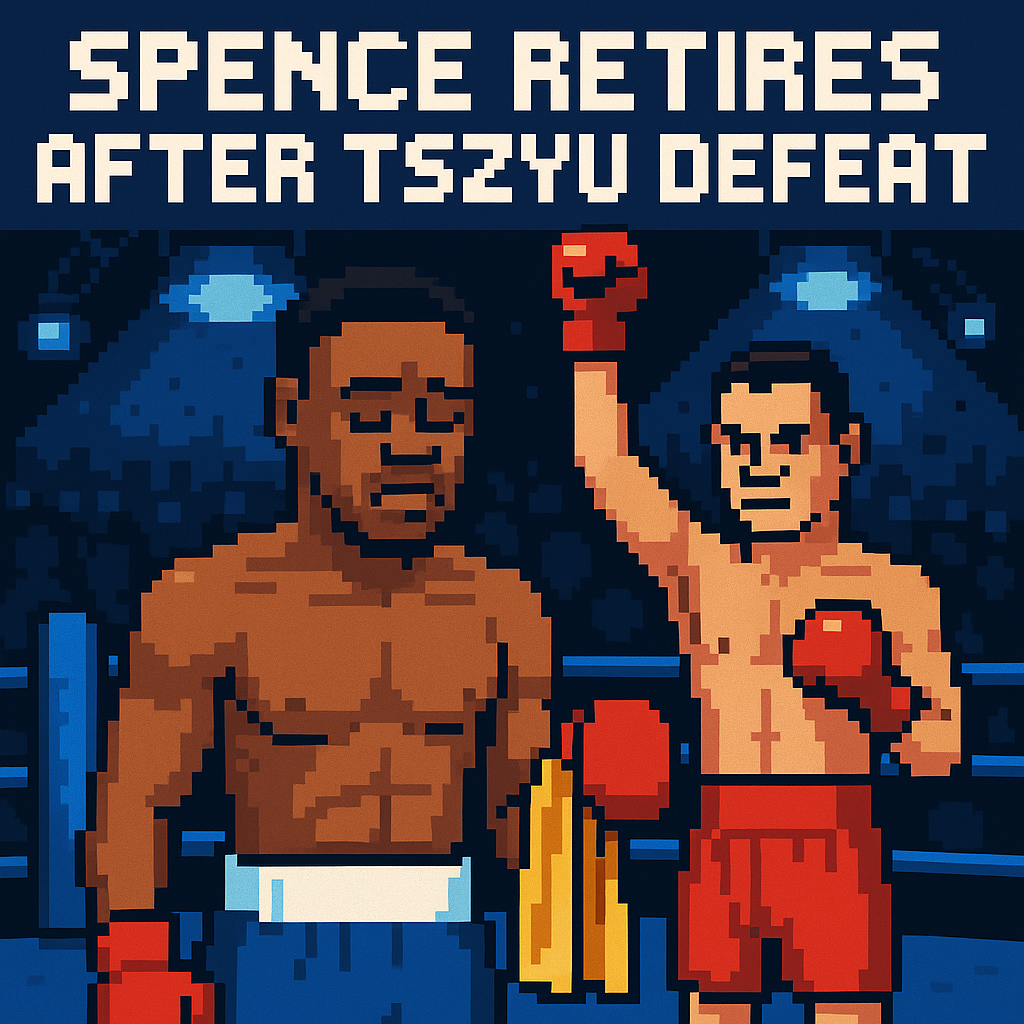
Spence Retires After Tszyu Defeat | Analysis by Brian Moineau

TL;DR

  • Errol Spence Jr. retired in the ring after Tim Tszyu outpointed him 118-110, 117-111, 117-111 at Qudos Bank Arena in Sydney; it caps a 14-year pro run shaped by a 2019 Dallas car crash, a 2021 retina tear, and the 2023 Crawford TKO9 loss [1][5][6].
  • Tszyu’s relaunch at 160 pounds is less about dominance and more about brand repair and matchmaking bargaining power in a division with aging titlists and accessible mandatories, including the WBA route via Erislandy Lara [2][3][9].
  • The business told its own story: a Sydney card packaged for a 9 p.m. ET start and priced at $79.99 on Prime Video (with DAZN carriage noted) signals PBC’s PPV pipeline now prioritizes U.S. primetime even from Australia [3][8][4].

What the source said

Bad Left Hook reported that Tim Tszyu (31) beat Errol Spence Jr. (36) by unanimous decision in Sydney after Spence returned from a three-year layoff and jumped two divisions from 147 to 160 pounds; the judges’ cards were 117-111, 117-111, and 118-110 [1]. Tszyu said 160 is now his home and that beating Spence “tops any world title,” while Spence praised Tszyu and said it was “time to go home… and start a new life,” confirming retirement with an emphasis on health and finances being intact [1]. The piece framed the result as clear and dignified rather than brutal and argued there was no responsible case to urge Spence to continue [1].

Why it matters

The stakeholders extend beyond Spence and Tszyu to rights-holders who need credible PPV main events and to Australia’s No Limit ecosystem that can stage arena shows locally while feeding a U.S. 9 p.m. ET primetime window on Prime Video/DAZN [4][8][3]. Spence’s exit removes a proven U.S. PPV A-side from rotation, creating room—and pressure—to elevate Tszyu as a middleweight draw capable of cross-market events between Sydney and U.S. buyers [4][8].

For fighters in their mid-30s weighing comebacks, Spence’s retirement is a rare health-first precedent in a sport that often pushes “one more payday”; his 2019 Ferrari crash in Dallas, 2021 detached retina, and 2023 TKO9 to Terence Crawford make a 2026 exit both pragmatic and humane [5][6][1].

Original analysis

What Errol Spence’s retirement signals for boxing’s risk-reward math

The consensus read says, “Spence stayed too long and Tszyu retired him.” My contrarian view: Spence timed his exit correctly, and Tszyu’s win is more about narrative repair than an elite 160-pound breakthrough.

  • Spence’s arc—near-fatal car crash in 2019, a retina injury in 2021, and a ninth-round TKO to Crawford in 2023—put him on a narrow ledge where diminishing returns met escalating risk; stepping away at 36 with a 28-2 (22 KOs) ledger and clear speech on camera is the rare smart choice in modern boxing, especially for a former three-belt welterweight unified champion who already headlined a 2023 super fight [5][6][1][2].

  • Tszyu needed a clean, professional win to reset at 160; he got it with wide cards (118-110, 117-111, 117-111) against a smaller opponent moving up two divisions on return from a three-year layoff, which is strong brand maintenance but not proof he rules a division that still includes active beltholders like WBA’s Erislandy Lara in his 40s [1][9][2].

Named-stakeholder breakdown (what this means for them):

  • PBC/Prime Video: Proof-of-concept for international PPV slotted to U.S. primetime (9 p.m. ET) at $79.99, a replicable template for Australia-based shows that feel like U.S. Saturday nights without U.S. venue costs [8][4].
  • No Limit Boxing (Australia): With Tszyu’s local drawing power and Qudos Bank Arena (Sydney SuperDome) capacity around 18,000 for sport (up to ~21,000 for concerts), their events can “travel” via PPV while preserving the Australian gate and sponsorship upside [7][2].
  • WBA/Erislandy Lara: A Tszyu shot at 160 pounds is suddenly marketable; Lara remains an active titlist, and a “name vs. name” title fight is the most makeable near-term play for Tszyu’s 160 campaign [9][2].
  • Terence Crawford: Spence’s retirement further burnishes the finality of Crawford’s 2023 TKO9; as Spence exits, that result reads as decisive prime-vs-prime separation on a Nevada commission ledger [6].

Back-of-envelope calculation:

  • If Tszyu vs. Lara lands on U.S. Prime PPV at $79.99 and does a conservative 200,000 U.S. buys, top-line PPV revenue is about $16.0 million (200,000 x $79.99 ≈ $15,998,000) before splits, fees, foreign rights, and gate; that level greenlights older-name matchmaking at 160 even without a U.S. arena sellout [8].
  • Arena + time-zone arbitrage: Qudos Bank Arena’s sports capacity is ~18,000 (concert max ~21,000); a healthy Sydney gate layered on top of a 9 p.m. ET PPV can outperform a lukewarm U.S. gate at a smaller venue while keeping production anchored to Australia’s cost base [7][8].

2×2 risk-mileage typology (age vs. accumulated damage):

  • Younger/Lower mileage: Tim Tszyu (31) at 160 after an active 2024–2026 run; commercial upside with measured opposition [2][3].
  • Younger/Higher mileage: N/A among named principals here; this quadrant usually houses pressure fighters with recent wars.
  • Older/Lower mileage: Erislandy Lara (in his 40s) with a controlled, economical style that has aged better than most at 160 [9].
  • Older/Higher mileage: Errol Spence Jr. (36) given the 2019 crash, 2021 retina, and 2023 TKO9, which heighten risk beyond typical mid-30s decline [5][6].

Historical analogue:

  • Sugar Ray Leonard’s late-era returns—Terry Norris in 1991 and Hector Camacho in 1997—show how legends get lured back, then battered into retirement, again; Spence’s immediate “for sure” retirement in Sydney in 2026 tracks closer to Andre Ward’s 2017 exit at age 33 than to Leonard’s yo-yo comebacks at 34 and 40 [1][10][11].

What others are missing

The specific, under-discussed angle is PPV time-zone engineering: this Sydney show was built to start at 9 p.m. ET and retail at $79.99 on Prime in the U.S. (with DAZN carriage noted), which means daytime Australia production was calibrated for U.S. nighttime monetization; Australia supplies the gate, local broadcast partners, and scenic staging, while the U.S. gets a prime-time PPV SKU without paying U.S. arena rent—cost discipline masquerading as global reach [8][3][4].

What to watch next

  1. By March 2027, Tszyu fights for a middleweight world title—most likely the WBA belt versus Erislandy Lara—rather than pursuing the toughest unified path at 160.
  2. Through July 2027, Spence remains retired with no licensed pro bout announced and appears in on-camera or advisory roles instead of entering a training camp.
  3. By mid-2027, PBC/Prime schedules at least one more Australia-based PPV calibrated to a 9 p.m. ET start, featuring Tszyu or another Oceania headliner.

My take

Spence chose dignity over delusion in 2026, and that reads as the right call after Crawford’s TKO9 in 2023 under the Nevada commission’s record [6]. Sydney did not “retire” him; life and timing did, and he listened on the first try [1]. Tszyu proved he can headline a 160-pound PPV business plan built on smart matchmaking, time-zone math, and a capable brand, but true validation means chasing a live belt that talks back—Lara’s WBA version at 160 pounds [9][8]. The ledger is simple: Tszyu repaired his commercial value, and Spence preserved his health; that outcome is rare in boxing’s 2020s incentive structure [2][4].

Sources

  1. ‘Time to go home’: Errol Spence announces retirement after loss to Tim Tszyu — Bad Left Hook (https://www.badlefthook.com/boxing-results/117511/time-go-home-errol-spence-announces-retirement-after-loss-tim-tszyu-boxing-news-2026) — Ringside report with scorecards, ages, quotes, and immediate retirement confirmation.
  2. Errol Spence Jr announces retirement after Tim Tszyu claims biggest career win in Sydney — Sky Sports (https://www.skysports.com/boxing/news/12183/13567040/errol-spence-jr-announces-retirement-after-tim-tszyu-claims-biggest-career-win-in-sydney) — Confirms scores, venue, and Tszyu’s stated move to 160 as his new home.
  3. Tim Tszyu wins a battle of broken soldiers, and Errol Spence Jr heads into the sunset — The Guardian (https://www.theguardian.com/sport/2026/jul/26/tim-tszyu-errol-spence-fight-retirement) — Analytical recap noting PPV pricing/platforms and post-prime context.
  4. Prime Video and Premier Boxing Champions announce new multiyear rights agreement beginning in 2024 — PBC Press Center (https://www.presscenter.premierboxingchampions.com/press-releases/prime-video-and-premier-boxing-champions-announce-new-multiyear-rights-agreement) — Establishes Prime Video’s PPV distribution role for PBC in the U.S. rights stack.
  5. Errol Spence Jr. seriously injured in Dallas car crash — ESPN (https://www.espn.com/boxing/story/_/id/27812496/errol-spence-jr-seriously-injured-dallas-car-crash) — Documents Spence’s 2019 Ferrari crash and hospitalization in Texas.
  6. Boxing show results, July 29, 2023 (Crawford TKO9 Spence) — Nevada State Athletic Commission (https://boxing.nv.gov/uploadedFiles/boxingnvgov/content/results/2023_Results/07-29-23_Redacted.pdf) — Official bout result underpinning the Crawford–Spence outcome in Las Vegas.
  7. Sydney SuperDome (Qudos Bank Arena) capacity profile — Austadiums (https://www.austadiums.com/stadiums/sydney-superdome) — Provides the ~18,000 sports capacity and ~21,000 concert maximum for venue economics.
  8. Prime Video PPV listing: Spence Jr. vs. Tszyu — Amazon (https://www.primevideo.com/detail/0QCQ2WIJDYKSCHZGUIQ4I8FPGT) — Confirms 9 p.m. ET timing and $79.99 PPV pricing for the U.S. SKU.
  9. Lara retains WBA middleweight title vs. Johan González — World Boxing Association (https://www.wbaboxing.com/boxing-news/erislandy-lara-set-to-defend-his-wba-middleweight-title-against-johan-gonzalez-2) — Verifies Lara’s current status and continued activity at 160 pounds.
  10. Andre Ward announces retirement at 33 — The Guardian (https://www.theguardian.com/sport/2017/sep/21/andre-ward-retirement) — Historical analogue for a top fighter exiting on his own terms in 2017.
  11. “Leonard… definitely over” after Camacho TKO — The Washington Post (https://www.washingtonpost.com/archive/sports/1997/03/03/leonard-for-sure-my-career-is-definitely-over/c2c24c31-6d94-4e35-864c-ae8550ff4e15/) — Cautionary precedent on late-career comebacks ending badly in 1997.


Related update: We recently published an article that expands on this topic: read the latest post.
Related update: We recently published an article that expands on this topic: read the latest post.


Related update: We recently published an article that expands on this topic: read the latest post.

Zahabi Urges Chimaev to Train with GSP | Analysis by Brian Moineau

A coach’s open door: Firas Zahabi thinks he can revive Khamzat Chimaev after UFC 328

The morning after UFC 328, Firas Zahabi was blunt and public: Firas Zahabi believes he is the man to revitalize Khamzat Chimaev's career after UFC 328. It wasn't a passive tweet or a wink — Zahabi, head coach at Tristar Gym and longtime mentor to Georges St‑Pierre, openly begged Chimaev to come to Montreal and train with him and GSP. The timing — immediately following Chimaev’s first professional loss to Sean Strickland on May 9, 2026 — shaped the offer into something part diagnosis, part lifeline.

This felt different from the usual post-fight hot takes. Zahabi wasn’t critiquing from the couch; he was extending a practical fix: a coaching environment where stamina, strategy and movement get rebuilt deliberately. For a fighter like Chimaev — explosive, relentless, but visibly gassed and tactically narrow against Strickland — that kind of surgical help can be career-defining.

What happened at UFC 328 and why Zahabi reacted

UFC 328 in Newark saw Sean Strickland edge out Khamzat Chimaev via split decision, taking back the middleweight belt and handing Chimaev his first pro defeat. Official scorecards were 48-47, 48-47, 47-48 in favor of Strickland. Coverage and replay showed a five-round war that turned on conditioning, pacing, and late-round control — areas Zahabi repeatedly cited as fixable with the right camp and planning. (ufc.com)

Zahabi’s message — paraphrased and quoted in outlets that picked up his YouTube remarks — was direct: “Come train with me and Georges St‑Pierre. I promise you won’t fade. I promise you this will never happen to you again.” He doubled down on specifics: improved fitness, refined striking and footwork, and a smarter gameplan that preserves energy across five rounds. Those are exactly the marginal gains that separate a dominant grappler from a complete elite champion. (bjpenn.com)

Transitioning from peak hype to the humility of a loss is messy. For Chimaev, who built his aura on relentless takedown pressure and suffocating intensity, the Strickland fight exposed a hard truth: when plan A stalls, there needs to be a plan B that doesn’t bankrupt your energy reserves.

Why Tristar and Zahabi might actually help

  • Zahabi’s coaching résumé is built on polishing elite-level fighters, most famously Georges St‑Pierre. Tristar’s approach is methodical: technical drilling, pacing strategies, and fight IQ that prioritizes winning rounds over dramatic single moments. That aligns with what Chimaev lacked at UFC 328. (en.wikipedia.org)
  • Tristar offers high-level partners and a blueprint for mid- to long-term rebuilding. It’s not a quick fix — it’s hard, repetitive, and tactical work. For a mercurial, high-energy grappler, that regimen can smooth out the edges and add the endurance to stop burning out after explosive openings.
  • Beyond physical prep, Zahabi promises mental reframing. Losses expose habits; a coach who can retool mental approach — when to press, when to reset, how to steal rounds on points — is worth as much as conditioning.

That’s not to romanticize the move. Fighters are human and ecosystems are complicated. Changing camps or absorbing new coaching philosophies takes time, trust, and buy-in from managers and support teams. But Zahabi’s line about “this will never happen to you again” reads less like bravado and more like confidence born of process. The question is whether Chimaev wants structural help or prefers to double down on his existing methods.

Obstacles and real-world frictions

  • Logistics and loyalties matter. Chimaev trains in a specific crew and has close ties to coaches and teammates. Moving to Montreal or even embedding with Tristar temporarily would require wide agreement from his handlers.
  • Style compatibility isn’t guaranteed. Chimaev’s strength is his ferocious, downhill pressure. Some coaches want to retain that identity while adding nuance; others try to remodel fundamentally. The best outcome would be complementary coaching, not a wholesale identity shift.
  • Public perception and ego play roles. A fighter coming off a loss is already on a narrative knife-edge. Accepting overtures from a legendary coach helps on the optics front, but it also signals vulnerability. That’s fine, and often necessary, but it can be politically delicate.

Still, the upside is large. If Zahabi helps Chimaev add gas tank management, better lateral movement and a selective striking game to complement takedowns, the result could be a more durable—and more dangerous—champion.

Practical ways a Tristar camp could change Chimaev’s trajectory

  • Drill-paced sparring that replicates five rounds at fight-intensity but teaches energy preservation.
  • Footwork and separation work to create entries for takedowns that don’t cost massive bursts every minute.
  • Strategic scenarios: what to do when takedowns aren’t landing, how to secure rounds with positional control or effective striking.
  • Cross-disciplinary conditioning (not just wrestling cardio) to maintain output without sacrificing power.

Those aren’t theoretical. Zahabi’s track record shows teams who emphasize cerebral work and pacing can convert fighters from specialists to well-rounded champions. For Chimaev, that conversion would go a long way toward sustaining a title reign. (en.wikipedia.org)

Quick points to remember

  • Zahabi publicly offered to host Chimaev and bring GSP into the process, emphasizing fitness, striking, and footwork. (bjpenn.com)
  • UFC 328’s official scorecards confirm the split-decision result that ended Chimaev’s undefeated streak. (ufc.com)
  • The path forward is practical but requires buy-in from Chimaev’s camps and a willingness to adapt identity as a fighter.

My take

There’s theater in Zahabi’s plea — the optics of a legendary coach extending a hand to a fallen, charismatic star. But beyond theater is a useful reality: elite athletes rarely plateau because they won’t change; they falter because they can’t adapt fast enough. Zahabi’s offer is the kind of adaptive option Chimaev needs if he’s committed to a long-term run at the top.

If Chimaev accepts, the most interesting outcome won’t be a miracle transformation overnight. It will be a quieter, steadier version of him: smarter pacing, cleaner entries, and the stamina to make seismic takedowns feel like the coup de grâce rather than a desperate bid for survival. That version would be harder to predict — and more dangerous when he does decide to explode.

Sources


Related update: We recently published an article that expands on this topic: read the latest post.


Related update: We recently published an article that expands on this topic: read the latest post.

Strickland Ends Streak, Calls Out Chimaev | Analysis by Brian Moineau

Sean Strickland’s statement night in Houston: he stops Hernandez and points straight at Khamzat

The Toyota Center was electric on February 21, 2026 — not just because Sean Strickland ended Anthony “Fluffy” Hernandez’s eight-fight surge, but because Strickland left the cage making it very clear what he wants next: Khamzat Chimaev. It was a night that felt equal parts tactical clinic, vintage Strickland aggression, and a loud, unapologetic challenge aimed at the division’s top dog.

What happened (quick recap)

  • Event: UFC Fight Night — Houston, Toyota Center.
  • Date: February 21, 2026.
  • Result: Sean Strickland defeated Anthony Hernandez by TKO (strikes) at 2:33 of Round 3.
  • Significance: Stopped Hernandez’s eight-fight winning streak and delivered Strickland’s first finish in several years while staking a claim for a title shot. (ufc.com)

Why this felt bigger than "just another main event"

There are a few layers to the moment:

  • Strickland’s performance wasn’t fluky. He controlled large stretches with his jab, landed a hard body knee early in Round 3 that visibly changed the fight, and followed with precise pressure until the referee stepped in. That combination of discipline and sudden finishing heat reminded fans why he’s still main-event-caliber. (ufc.com)

  • Hernandez was riding real momentum. “Fluffy” had ripped off eight wins — beating names that had him climbing into title-talk territory. Snapping that streak doesn’t just boost Strickland’s résumé; it reshuffles the middleweight pecking order. (mmamania.com)

  • The verbal angle is unavoidable. Strickland didn’t just celebrate — he publicly called out Khamzat Chimaev, re-igniting a rivalry that’s been building in and around the division. That callout turns a single win into a concrete narrative: Strickland wants the title back and wants to do it against the hottest champion in the weight class. (mmafighting.com)

A main-event finish is always headline material — but the timing (after Hernandez’s streak) and the bold callout make this moment meaningful for the entire 185-pound picture.

The matchup implications: could Strickland vs. Chimaev really happen?

There are reasons it’s a tantalizing matchup and reasons to be skeptical.

  • Why it makes sense:

    • Strickland just added a big win to his ledger and is a former champion with name value; the UFC rewards both.
    • Chimaev is the undefeated face of the division and a promotional favorite for big matchups; a fight between two outspoken, polarizing figures sells. (ufc.com)
  • Why it might not be straightforward:

    • Chimaev has flirted with moving weight classes and has his own career path and priorities, which may or may not align with an immediate Strickland defense.
    • The politics of matchmaking — rankings, previous rematches, and other contenders in line — could delay or detour this pairing. (mmafighting.com)

Bottom line: the matchup is plausible and marketable, but not automatic. Promotion, timing, and both fighters’ willingness will determine whether that callout becomes the next big middleweight fight.

What this means for Anthony Hernandez

  • The loss stings — Hernandez’s eight-fight run (dating back to 2020) was real momentum toward a title push. A loss like this bumps him off the immediate path, but it doesn’t erase the body of work that put him there. Expect him to recalibrate, pick a tough but winnable test, and chase a bounce-back run. (mmamania.com)

Quick takeaways from the night

  • Strickland reminded everybody he can still finish fights and do so against top-tier, in-form opponents. (ufc.com)
  • Hernandez’s streak ends, but he remains a dangerous, top-level middleweight with easy paths back into contention. (mmamania.com)
  • The callout to Khamzat Chimaev turns an impressive win into a storyline with title implications — whether or not it happens depends on both fighters and UFC timing. (mmafighting.com)

My take

Strickland’s win was classic: smart boxing, sudden violence, and a headline-ready post-fight demand. He hasn’t been the division’s most consistent finisher, but on this night he showed he still has that dangerous edge — and just as importantly, the appetite to push the division’s narrative. If the UFC wants intrigue (and pay-per-view eyeballs), matching him with Chimaev would be a gas. If Chimaev prefers different routes, though, expect Strickland to keep leaning into big nights and loud demands until the matchup he wants becomes impossible to ignore.

Sources


Related update: We recently published an article that expands on this topic: read the latest post.