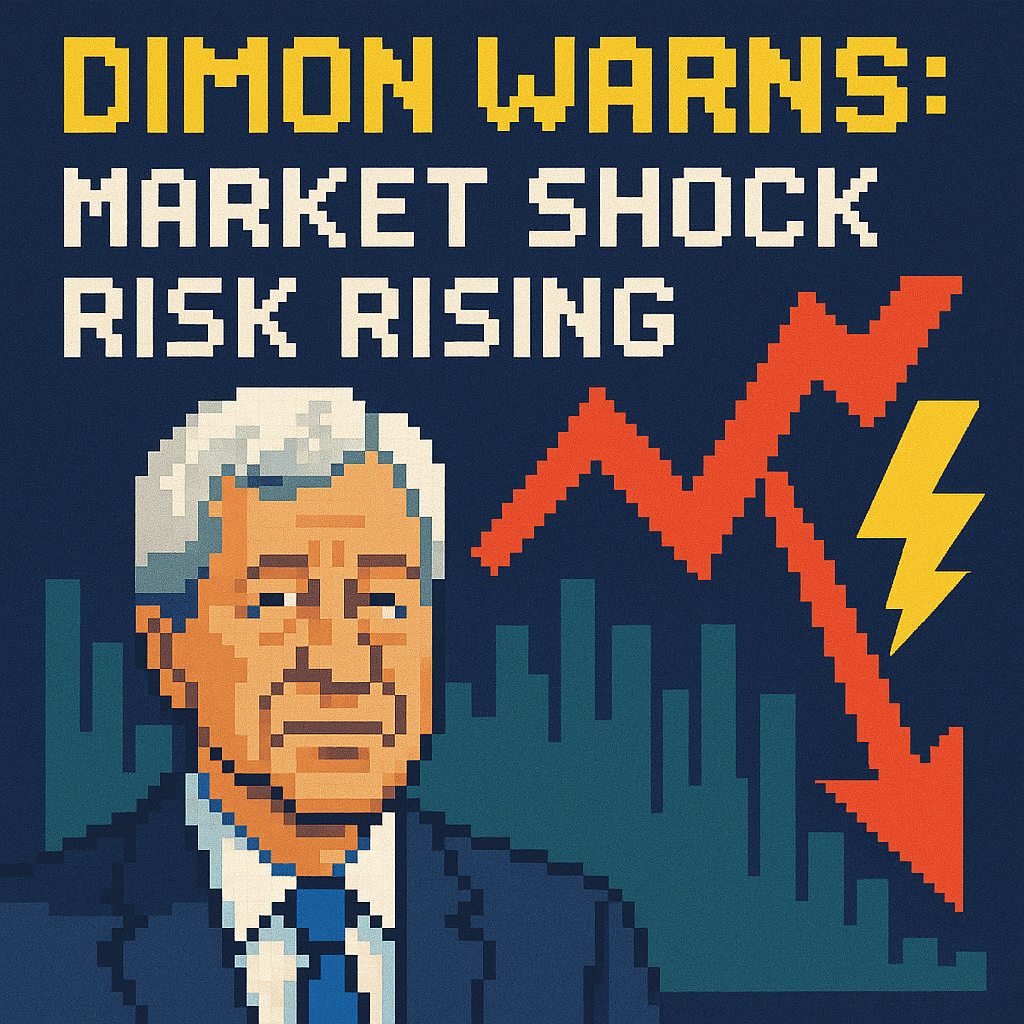
Dimon Warns: Market Shock Risk Rising | Analysis by Brian Moineau

TL;DR

  • Jamie Dimon, JPMorgan’s CEO, has warned since at least the 2023 shareholder letter that higher-for-longer rates, war risk, and fiscal deficits could hit assets; the deeper fuse is U.S. debt rollover colliding with persistent Treasury supply and finite balance sheets. [1][2]
  • Even with June CPI around 3.5% year over year, the 10-year Treasury hovered near 4.6% in mid-July 2026; that level sits well above the government’s current average interest rate on outstanding debt, implying net interest keeps trending higher as low-coupon notes reset. [3][4][5]
  • The 2022 UK gilts shock showed how a long-end spike (30-year yields jumping roughly 130–140 bps in days) can trigger forced selling; the U.S. won’t replay LDI, but heavy funding needs plus convexity and dealer limits can rhyme. [6]

What the source said

In the 2023 JPMorgan shareholder letter, Jamie Dimon flagged persistent inflation, geopolitical conflicts (notably Russia–Ukraine and Middle East hotspots), and fiscal deficits as reasons rates could stay high and markets could see a shock; he argued investors should not assume a smooth disinflation glide path like the mid-1980s. He linked these risks to potential pressure on both equities and bonds if term premia rise and cash flows get discounted at higher rates. He framed bank operating conditions as strong in 2023–2024 but warned they can change quickly if funding costs or credit losses climb. [1]

Why it matters

  • Primary dealers in New York, U.S. money market funds, and foreign reserve managers in places like Tokyo and Beijing finance the Treasury’s deficits, while retirees on Social Security and Medicare, and S&P 500 firms rolling debt, depend on the cost of that funding. If “vigilantes” demand more term premium, the 10-year at roughly 4.55%–4.60% in mid-July 2026 can lift mortgage rates, capex hurdles, and equity discount rates even after a soft CPI headline. [3][4]

  • Traditional 60/40 allocators, banks’ AFS/HTM books, and long-duration ETFs such as iShares TLT (launched 2002) face path risk that inflation prints alone won’t capture; the UK’s 2022 episode showed 30-year gilts spiking about 130–140 bps within days and forcing deleveraging, while TLT itself lost roughly 31% in calendar 2022 during the U.S. rate shock. [6][7]

Original analysis

Dimon’s “shock” setup rests on rates, geopolitics, and deficits. The common reply says: core inflation is easing, so yields drift lower; flare-ups are priced; deficits matter later. I disagree because the plumbing points to supply, rollover, and balance-sheet constraints that act now.

Contrarian read

  • Consensus: Softer CPI = lower yields = duration relief.
  • Counter: Supply and rollover are repricing duration irrespective of CPI. June CPI ran near 3.5% y/y while the 10-year sat around 4.6%, and recent Treasury refunding guidance emphasized steady coupon auction sizes over “at least the next several quarters,” a stance that can buoy term premia when dealer capacity is finite. [3][4][8]

Back-of-envelope calculation (rollover wedge)

  • Facts:
    • Debt held by the public was roughly $29.7 trillion around late 2025, per Treasury’s Debt to the Penny dataset. [9]
    • The weighted average maturity (WAM) of marketable debt was about 70.8 months (≈5.9 years) as of October 31, 2024. [8]
    • The average interest rate on outstanding Treasury marketable debt ran near 3.4% in 2025–2026 per Treasury’s dataset. [5]
    • The 10-year yield in mid-July 2026 printed around 4.55%–4.60%. [4]
  • Mechanics:
    • If WAM ≈ 70.8 months, about 12/70.8 ≈ 17% of the portfolio resets per year.
    • 17% × $29.7T ≈ $5.0T rolling in the next 12 months.
    • Rate gap vs. legacy average cost: 4.60% − 3.40% ≈ 1.20 percentage points.
    • Extra annualized interest from this year’s roll: 1.20% × $5.0T ≈ $60B.
  • Interpretation: That is just year one; as more low-coupon notes roll in 2027–2028, the wedge compounds if the 10-year hangs near 4.6%, regardless of monthly CPI noise. [4][5][9]

Historical analogue: UK gilts, September–October 2022

  • The “mini-budget” shock was not about surprise inflation; it was about sudden term-premium repricing to fund deficits and hedge leverage, with 30-year yields jumping roughly 130–140 bps in a few days, forcing LDI selling and a Bank of England liquidity backstop. The U.S. has deeper markets and no LDI ubiquity, yet persistent supply plus convexity and dealer VAR limits can still pressure the long end quickly. [6]

A simple 2x2: supply vs. risk capacity

  • High supply + thin risk capacity (e.g., big refundings during bank VAR constraints): risk of sharp yield spikes and auction tails.
  • High supply + ample risk capacity (e.g., strong dealer balance sheets and risk-on credit): gradual bear steepening.
  • Low supply + thin risk capacity: choppy range trading with occasional squeezes; term premium can still stay positive.
  • Low supply + ample risk capacity: benign decline in long-end yields; this is the cyclical “soft landing” case and requires deficits to narrow or issuance to skew short.

Named-stakeholder breakdown

  • U.S. Treasury: Recent Quarterly Refunding materials and TBAC slides signal maintaining coupon auction sizes and a stable WAM, which keeps a steady duration pipe flowing into a market where dealers must warehouse risk. [8]
  • JPMorgan, Goldman Sachs, and Bank of America: Trading desks benefit from volatility, but a violent long-end selloff stresses client collateral, increases margin calls, and can dampen primary issuance in New York and London.
  • 60/40 allocators and long-duration ETFs (e.g., TLT): If the 10-year revisits 5% without a growth scare, equity multiples compress while bond NAVs fall—hurting both legs at once; the 2022 TLT drawdown of about −31% shows the convexity bite. [4][7]

One more inconvenient anchor: deficits

  • The CBO’s long-term projections show debt held by the public reaching roughly 116% of GDP by 2034 with primary deficits persisting, implying sustained issuance and a positive term premium absent policy changes; this fiscal backdrop amplifies the rollover wedge described above. [2]

What others are missing

Most coverage centers on “inflation vs. the Fed,” but the under-covered angle is the portfolio’s effective reset speed—call it WANRR, the weighted average next repricing rate. Bills and FRNs shorten the government’s true interest-rate sensitivity; TBAC slides show bills plus FRNs comprising roughly the high-30s percent of marketable debt in 2024, far quicker to reprice than 7–10 year notes. That accelerates the pass-through from a 10-year near 4.6% to the average interest rate, which Treasury’s dataset shows climbing as legacy sub-2% coupons from 2020–2021 roll away. [8][4][5][3]

What to watch next

  1. By October 31, 2026, the 10-year Treasury yield (FRED series DGS10) records a weekly average at or above 5.00% for at least one week, indicating term premium and supply pressure overcame benign CPI prints. [4]

  2. By December 31, 2026, at least one 30-year Treasury bond auction (new issue or reopening) tails by 3.0 basis points or more versus the when-issued yield at the 1:00 p.m. ET deadline, signaling constrained balance-sheet capacity at primary issuance. [10]

  3. By March 31, 2027, iShares TLT posts a total return of −10% or worse from the July 15, 2026 close to that date (using NAV total return on the fund’s page), consistent with duration pain despite moderating CPI. [7]

Sources

[1] JPMorgan Chase 2023 Shareholder Letter (Jamie Dimon) — outlines CEO views on higher rates, geopolitics, and market risk, anchoring the “shock” narrative.

[2] Congressional Budget Office — Long-Term Budget Projections — provides deficit and debt-to-GDP trajectories that inform issuance and term-premium pressure.

[3] U.S. Bureau of Labor Statistics — Consumer Price Index — supplies CPI data used for the June year-over-year reading and inflation context.

[4] Federal Reserve Bank of St. Louis (FRED) — 10-Year Treasury Constant Maturity (DGS10) — benchmark for long-end yields and the 4.6% reference point.

[5] U.S. Treasury FiscalData — Average Interest Rates on U.S. Treasury Securities — tracks the average coupon cost on outstanding debt to compare against current yields.

[6] Bank of England — Financial Stability Report, December 2022 — documents the UK gilt crisis mechanics, LDI deleveraging, and yield spike magnitudes.

[7] iShares — TLT (20+ Year Treasury Bond ETF) — provides historical performance and duration metrics to illustrate convexity and drawdown risk.

[8] U.S. Treasury — Treasury Borrowing Advisory Committee (TBAC) Q4 2024 Presentation — shows WAM, issuance mix, and debt composition (bills/FRNs vs. coupons).

[9] U.S. Treasury FiscalData — Debt to the Penny — gives levels for debt held by the public to size the rollover base.

[10] U.S. Treasury — Auction Query (official results) — verifies auction tails and bid metrics for 30-year bond sales.

Dimon: Market Complacency Raises Risk | Analysis by Brian Moineau

Markets are Too Calm — and That’s the Problem, Says Jamie Dimon

There’s a peculiar kind of silence in markets right now — one that sounds less like confidence and more like complacency. That was the blunt message from JPMorgan CEO Jamie Dimon in recent interviews and appearances: asset prices are high, credit spreads are tight, and investors seem to be shrugging off a long list of risks. When one of Wall Street’s most prominent risk-watchers warns that “people feel pretty good,” it’s worth listening.

What happened and why it matters

  • Jamie Dimon has repeatedly warned investors that markets are underestimating risk — from rising inflation to geopolitical flashpoints and stretched credit conditions.
  • His comments have come in public forums (investor days, conferences, TV interviews) over the past year as global headlines — tariffs, geopolitical clashes, and credit concerns — made rounds. Recent press coverage highlighted his concern that markets are acting complacently even after shocks such as renewed geopolitical tensions that lifted oil prices. (marketwatch.com)

Why this matters:

  • Complacency can mask the build-up of systemic risk: elevated valuations and narrow credit spreads mean there is less cushion when a real shock hits.
  • If inflation reaccelerates or a credit cycle worsens, central banks may have less room to respond without causing deeper market dislocations. Dimon explicitly flagged higher inflation risk and a potentially “worse than normal” credit cycle as threats. (benzinga.com)

The investor dilemma: optimism vs. realism

  • Markets have rallied and volatility has fallen — and with that recovery comes a tendency to treat downside scenarios as unlikely. That’s the classic optimism bias at work.
  • Dimon’s argument is the opposite: when valuations look rich and policy levers are constrained (big deficits, limited central-bank flexibility), the probability of a sharper correction or a prolonged tougher patch rises. (cnbc.com)

Practical implications:

  • Earnings expectations may still be too sanguine. If profits disappoint, equity multiples could compress. (cnbc.com)
  • Credit markets are deceptively calm. Narrow spreads don’t reflect borrower weakness or a future tightening in liquidity conditions. (benzinga.com)

Signs that Dimon’s warning isn’t just noise

  • Historical precedent: periods of sustained policy stimulus and low rates have pushed asset prices up before sharp corrections followed (think pre-2008 dynamics). Dimon has drawn attention to how many market participants today lack firsthand experience with a real credit cycle. (benzinga.com)
  • Market reactions to geopolitical events have been muted compared with price moves in commodities (e.g., oil spikes), suggesting investors are selectively ignoring channels that can feed into inflation. Recent coverage showed oil moving while stocks barely flinched. (marketwatch.com)

How investors (and policymakers) might respond

  • Reassess risk budgets:
    • Expect lower forward returns if valuations are high — adjust position sizing accordingly.
    • Stress-test portfolios for higher inflation, wider credit spreads, and slower growth.
  • Watch liquidity and credit indicators closely:
    • Monitor funding costs, loan defaults, covenant loosening, and secondary-market liquidity as early warning signs.
  • Factor geopolitics into scenario planning:
    • Energy shocks, trade disruptions, and cyber/terror risks can transmit rapidly into inflation and supply chain stress.
  • For policymakers: communicate limits. Central banks and fiscal authorities should be candid about trade-offs and constraints to avoid fostering false reassurance.

Quick wins for individual investors

  • Trim concentrated positions and rebalance toward diversified exposures.
  • Maintain a short list of high-quality, liquid assets to lean on if markets reprice.
  • Consider inflation-protected instruments or real assets as partial hedges if inflation risk appears underpriced.
  • Avoid chasing yield in low-quality credit just because spreads are narrow.

What the coverage shows (context)

  • MarketWatch highlighted Dimon’s recent comments noting the disconnect between oil moves and muted equity reactions after a geopolitical spike. (marketwatch.com)
  • CNBC and Bloomberg have traced Dimon’s warnings back through 2025, where he flagged tariffs, deficits, and complacent central banks as sources of risk. (cnbc.com)
  • Analysts and commentators pick up the framing that many market participants haven’t lived through a deep credit downturn and may underestimate how fast conditions can change. (benzinga.com)

My read of those sources: Dimon isn’t trying to be a constant Cassandra. He’s reminding an upbeat market that risk is asymmetric right now — upside may be limited while downside remains meaningful.

A few sharper questions worth watching

  • Will inflation settle back near policymakers’ targets, or will renewed energy or supply shocks re-accelerate prices?
  • How would central banks respond if inflation and growth diverged (stagflation)?
  • Are credit standards loosening quietly in leveraged lending or other pockets that could transmit losses rapidly?
  • How do fiscal dynamics (large deficits) limit policy options in a stress scenario?

Final thoughts

Complacency is seductive: calm markets feel good and reward short-term risk-taking. But markets don’t owe investors perpetually rising prices. Jamie Dimon’s warnings are a useful reality check — not a prediction of imminent doom, but a call to re-evaluate assumptions. For investors, that means humility, active risk management, and scenario planning for outcomes that the market currently underprices.

Sources


Related update: We recently published an article that expands on this topic: read the latest post.

JPMorgan Chase employee fired after questioning CEO Jamie Dimon about return-to-office. Then… – Hindustan Times | Analysis by Brian Moineau

JPMorgan Chase employee fired after questioning CEO Jamie Dimon about return-to-office. Then… - Hindustan Times | Analysis by Brian Moineau

**Title: Navigating the Choppy Waters of Return-to-Office: Lessons from JPMorgan Chase's RTO Drama**

Ah, the office. That sacred space where the coffee is free, the gossip flows like water, and the air conditioning is perpetually set to Arctic blast. For many, the return to this hallowed ground has been met with a mix of excitement and dread. This tension was on full display in a recent saga involving JPMorgan Chase, where an employee was briefly fired after questioning CEO Jamie Dimon's stance on the bank's return-to-office (RTO) policy during a town hall meeting. Let's dive into this tale and see what it tells us about the current state of work, leadership, and corporate culture.

**The Incident: A Bold Move in a Bold World**

In an era where remote work has become not just a perk but a staple, JPMorgan Chase's decision to enforce a strict RTO policy is a bold move. The decision has not come without pushback. During a town hall meeting, one brave employee decided to directly question Jamie Dimon about the policy, highlighting the concerns that many workers have about returning to the office full-time.

Dimon, known for his confident and sometimes unyielding leadership style, has been a vocal advocate for the benefits of in-person work. He argues that it fosters collaboration, innovation, and culture—an argument that has its merits. However, in this instance, the employee's inquisitive spirit resulted in a brief termination, illustrating the precarious balance between corporate transparency and hierarchy.

**Jamie Dimon: The Man Behind the Desk**

Jamie Dimon is no stranger to controversy or making headlines. As the CEO of JPMorgan Chase, he's led the bank through numerous challenges, including the 2008 financial crisis. His leadership style is often described as direct and pragmatic, and while this has earned him respect in many circles, it occasionally clashes with the evolving expectations of the modern workforce.

Dimon's stance on RTO isn't unique among executives, but it highlights a broader conversation happening in boardrooms across the globe. As companies navigate the post-pandemic landscape, leaders are grappling with how to balance business needs with employee preferences. This incident at JPMorgan Chase serves as a microcosm of this larger debate.

**The Bigger Picture: RTO Policies in a Changing World**

The JPMorgan Chase incident isn't an isolated case. Companies worldwide are struggling to find the right formula for their RTO policies. For example, tech giants like Google and Apple have also faced pushback on their RTO mandates. Meanwhile, some companies, like Twitter, have embraced a fully remote work model, showcasing the diverse approaches to this complex issue.

As the world adjusts to a new normal, the tension between remote work and RTO policies is likely to continue. Employees have experienced the benefits of flexible work arrangements and are increasingly seeking workplaces that offer autonomy and work-life balance.

**Final Thoughts: Navigating the Future of Work**

The JPMorgan Chase RTO saga is a reminder that the future of work is still being written. It highlights the need for open dialogue and mutual understanding between employers and employees. As companies craft their RTO policies, they must listen to their workforce and consider the diverse needs and perspectives that exist within their organizations.

Ultimately, the key to navigating these choppy waters lies in flexibility and adaptability. As Jamie Dimon and other leaders steer their ships through these uncertain times, they would do well to remember that the best solutions often emerge from collaboration and compromise. After all, in this brave new world of work, it's not just about where we work, but how we work together.

Read more about AI in Business

Read more about Latest Sports Trends

Read more about Technology Innovations