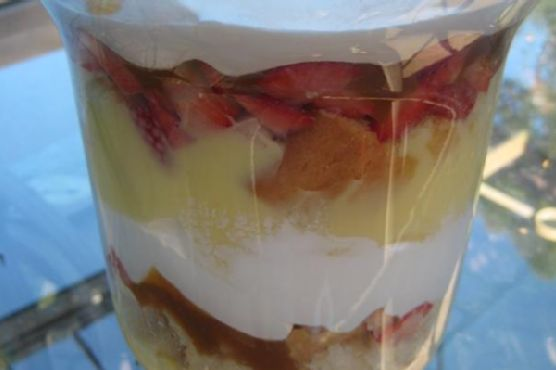
Caramel Almond Berry Trifle | Made by Meaghan Moineau

Caramel Almond Berry Trifle

Intro

There’s something truly special about desserts that combine layers of flavor and texture, and the Caramel Almond Berry Trifle is a perfect example of this magic. This dessert takes me back to warm summer afternoons at my grandmother’s house, where the aroma of fresh berries and sweet caramel wafted through the air. The kitchen was always bustling with activity, and the centerpiece was always a beautiful trifle that brought smiles to everyone’s faces. Today, I’m sharing this cherished recipe with you, hoping it brings as much joy to your table as it did to ours.

Why You’ll Love It

This Caramel Almond Berry Trifle is a showstopper for several reasons. First, it combines the richness of butterscotch caramel with the freshness of berries, creating a balance that will delight your taste buds. The almond extract adds a subtle but distinct flavor that elevates the entire dessert. It’s a perfect treat for gatherings, as it’s easy to make and assemble, yet impressive enough to wow your guests. Whether you’re hosting a summer party or just want to indulge in a sweet treat, this trifle is bound to become a favorite.

Ingredients

  • 1 large box of vanilla pudding mix
  • Milk (as directed on pudding package)
  • 1 cap full of almond extract
  • Fresh berries (such as strawberries, blueberries, and raspberries)
  • Mrs. Richardson’s Butterscotch Caramel Sauce
  • 1 container of Cool Whip
  • Pound cake, cut into cubes

Instructions

  1. Prepare the vanilla pudding by mixing the pudding mix with milk according to the package instructions.
  2. Add one cap full of almond extract to the pudding and mix well. Allow the pudding to set by chilling it in the refrigerator.
  3. Once the pudding has set, begin layering the trifle. Start with a thick layer of pudding at the bottom of your trifle dish.
  4. Add a layer of pound cake cubes over the pudding.
  5. Spread a layer of fresh berries over the pound cake.
  6. Drizzle a generous amount of butterscotch caramel sauce over the berries.
  7. Add a layer of Cool Whip on top of the caramel sauce.
  8. Repeat the layers until you reach the top of your dish, ending with Cool Whip.
  9. Top with additional fresh berries and a final drizzle of caramel sauce for a beautiful finish.

Tips

For the best results, make sure your pudding is fully set before beginning the layering process. This will help each layer maintain its shape. You can also slightly toast the pound cake cubes for added texture and flavor. Ensure your berries are fresh and washed thoroughly, and consider using a mix of different berries for a more vibrant presentation.

Variations & Substitutions

If you want to switch things up, consider using different flavors of pudding, such as chocolate or butterscotch, instead of vanilla. You can also swap the pound cake for angel food cake or even brownies for a richer dessert. For a nut-free version, simply omit the almond extract. If fresh berries are not available, frozen berries can be used, but make sure to thaw and drain them properly to avoid excess moisture in your trifle.

Storage

The Caramel Almond Berry Trifle is best enjoyed fresh, but it can be stored in the refrigerator for up to two days. Cover the dish with plastic wrap to keep the layers intact and prevent the dessert from absorbing any fridge odors. Note that the longer it sits, the more the layers will blend together, which may affect the texture.

FAQ

Can I make this trifle ahead of time?

Yes, you can prepare the individual components of the trifle, such as the pudding and cake, a day in advance. Assemble the trifle on the day you plan to serve it to ensure the freshest layers and presentation.

What can I do if I don’t have a trifle dish?

If you don’t have a trifle dish, any large, clear bowl will work. You can also create individual servings using smaller glasses or jars, which makes for a beautiful presentation at parties.

Nutrition

While this trifle is a treat best enjoyed in moderation, it’s good to be aware of its nutritional content. Each serving provides a delightful combination of carbohydrates, fats, and sugars. For a lighter option, consider using sugar-free pudding mix, low-fat Cool Whip, and a reduced-sugar caramel sauce.

Conclusion

The Caramel Almond Berry Trifle is not just a feast for the taste buds but also a feast for the eyes. It combines the best of flavors and textures into a dessert that’s perfect for any occasion. Whether you’re reminiscing about family gatherings or creating new memories, this trifle is sure to become a beloved part of your dessert repertoire. Give it a try, and watch as it becomes a staple at your family gatherings, just as it has in mine.

Related update: Caramel Almond Berry Trifle

Related update: Yoghurt Honey Madeleines

Glasses-Free AI 3D: Light-Steered Vision | Analysis by Brian Moineau

A future where 3D doesn’t come with glasses (for real this time)

Imagine sitting on your couch, a movie begins, and the characters step out of the screen—no clunky glasses, no parallax barriers, no weird double-images. That vision of true, comfortable glasses-free 3D has long been teased by prototypes and niche devices. This week a team from Shanghai AI Lab and Fudan University published a Nature paper describing EyeReal, a system that gets remarkably close to that dream by using AI to steer light exactly where your eyes are.

Why this feels like a turning point

  • Glasses-free (autostereoscopic) 3D has always faced a brutal physical constraint: the space-bandwidth product (SBP). In short, you can’t simultaneously have a very large, high-quality display and a wide viewing angle without paying an impossible information cost.
  • EyeReal doesn’t break physics. It sidesteps waste. Instead of broadcasting a complete, full-angle light field into the room, the system uses fast eye-tracking and a neural network to compute and emit the specific light needed for the viewer’s eyes in real time.
  • The result: a desktop-sized display prototype that achieves a viewing angle north of 100°, with full-parallax 3D rendering and dynamic content that adapts as you move and look around.

What EyeReal actually does (in plain language)

  • Hardware that’s surprisingly ordinary: EyeReal uses a stack of three LCD panels (not exotic holographic optics) plus a front-facing sensor for tracking.
  • Software that’s the secret sauce: a deep-learning model predicts the optimal light-field patterns to display on those panels so the correct rays reach each eye as they move.
  • Efficiency by focus: rather than trying to create every possible light ray in all directions, the system only generates what’s perceptually necessary for the viewer’s current gaze and head pose. That’s computation compensating for limited optical “bandwidth.”

Why that matters beyond neat demos

  • Practical manufacturing: because EyeReal leans on layered LCDs and computation, it’s potentially compatible with existing panel-making ecosystems—easier to scale than some entirely new optical technology.
  • Comfort and realism: prototype tests reportedly show smooth transitions, accurate depth cues as eyes change focus, and no notable motion sickness—one of the long-standing complaints about many 3D approaches.
  • Path to new applications: education, telepresence, product visualization, and gaming all benefit when realistic depth comes without extra wearables. Imagine museum exhibits or online shopping where a product truly “sits” in front of you.

What still needs work

  • Multi-viewer support: EyeReal currently targets a single viewer; scaling to multiple simultaneous viewers requires heavier sensing and more complex light routing.
  • Latency and reliability: the AI system must track and render at high speed to avoid perceptible lag. Real-world lighting, reflective environments, and unpredictable head motion will stress robustness.
  • Content pipeline and standards: filmmakers, game studios, and app creators will need accessible tools to produce light-field or depth-aware content that matches the system’s assumptions.
  • Commercial cost and power: stacked panels and continuous eye-tracking/compute come with cost, power draw, and heat considerations that affect consumer deployment.

A brief tech context

  • This effort is part of a larger trend where computation (especially deep learning) compensates for optical limits. We’ve seen similar shifts in computational photography and camera sensor design—where algorithms let modest hardware produce stunning results.
  • Autostereoscopic displays have taken many forms: lenticular lenses, parallax barriers, metagratings, time-multiplexed backlights, and holographic techniques. EyeReal’s contribution is marrying inexpensive layered displays with gaze-aware AI to maximize the effective use of available optical information.
  • Related research lines include foveated and gaze-driven light-field displays and recent industry demos of autostereoscopic handhelds and large-format displays—showing both industrial interest and technical convergence.

A few scenarios to imagine

  • A virtual product preview that you can walk around at your kitchen table, with correct depth and focus, without strapping on headgear.
  • Remote meetings where participants appear as volumetric, depth-correct images—more like being in the same room.
  • Games that use true, view-dependent parallax and depth, giving level designers a new palette for immersion.

My take

EyeReal isn’t magic glue that erases all engineering trade-offs. But it’s a smart, pragmatic pivot: use intelligence to reduce the optical “waste” that’s dogged glasses-free 3D for decades. The prototype’s reported 100°+ viewing angle on a desktop-scale display is impressive because it signals practical progress—this is the kind of advance that could migrate into real products faster than approaches that demand totally new manufacturing processes. If the team (or industry partners) can extend support to multiple viewers and make the system robust under everyday conditions, this could be the year glasses-free 3D stops being a novelty and becomes a real feature.

What to watch next

  • Progress on multi-user implementations and whether eye-tracking can be done discretely and cheaply.
  • Demonstrations of consumer-level prototypes (or licensing/partnership deals with panel makers).
  • Software toolchains for creators: depth capture, conversion to view-dependent assets, and runtime integrations for games and media players.

Sources

Final thought: the combination of modest optics plus smart computation keeps paying off. If EyeReal’s ideas scale, the next time you reach for 3D glasses, they might only be for nostalgia.


Related update: We recently published an article that expands on this topic: read the latest post.