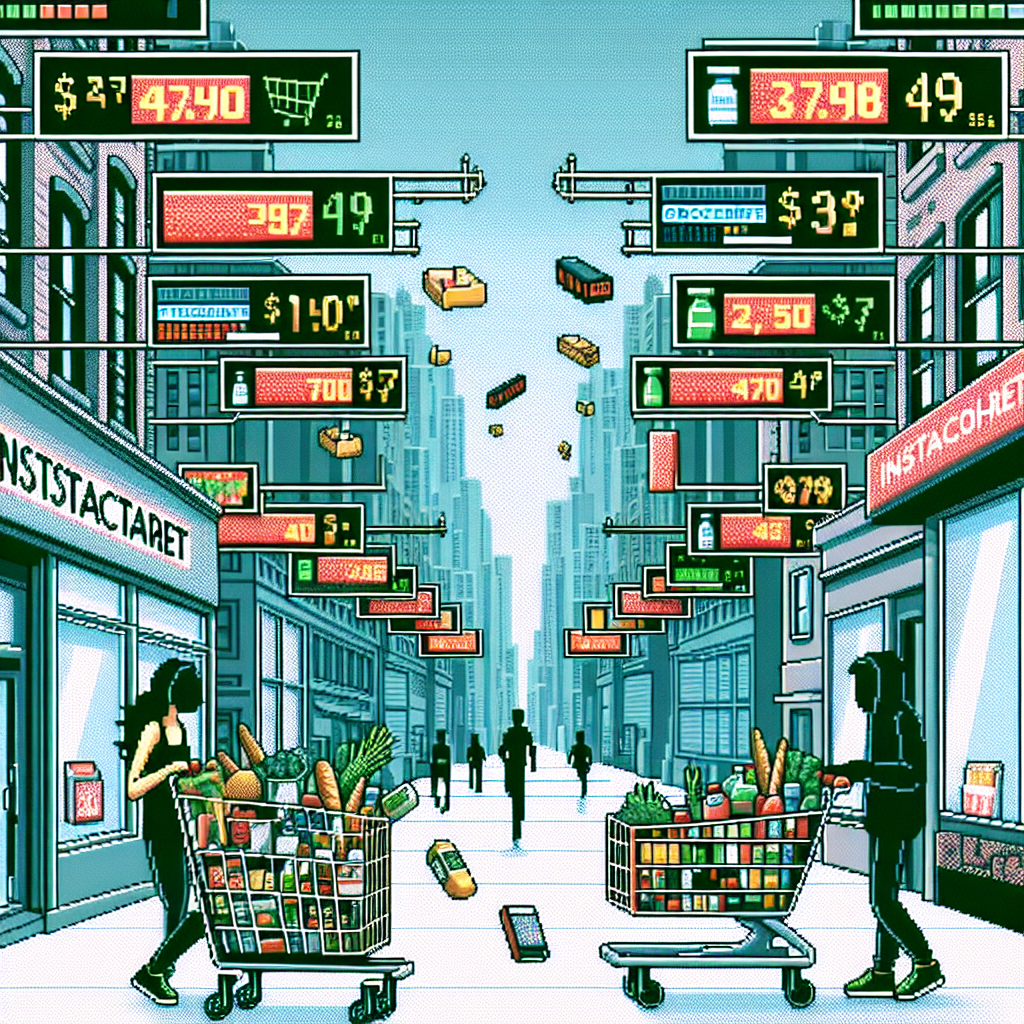
The grocery price you see might not be the grocery price someone else sees
Imagine loading your cart with the same staples you always buy — eggs, peanut butter, cereal — and watching the total quietly climb depending on who’s logged into the app. That’s the unsettling picture painted by a new investigation into Instacart’s pricing experiments. The findings suggest algorithmic pricing on grocery delivery platforms is no longer hypothetical: it’s affecting the bills people pay for essentials.
Why this matters right now
- Grocery affordability is a top concern for many households in the U.S., and small percentage differences compound quickly.
- The findings come from a coordinated investigation by Groundwork Collaborative, Consumer Reports, and labor group More Perfect Union that tested live prices across hundreds of Instacart users in multiple cities.
- The study’s headline figure — that average pricing variation could cost a four-person household roughly $1,200 a year — is what turned heads and spurred debate about transparency, fairness, and the role of algorithmic experiments in everyday commerce.
What the investigation found
- Across tests in four U.S. cities, nearly three-quarters of items showed multiple prices to different shoppers for the exact same product at the exact same store and time. (groundworkcollaborative.org)
- Price differences for individual items were often sizable — the highest price was as much as 23% above the lowest for the same SKU. Examples included peanut butter, deli turkey and eggs. (groundworkcollaborative.org)
- Average basket totals for identical carts differed by about 7% in the study’s sample. Using Instacart’s own estimates of household grocery spending, that swing could translate to roughly $1,200 extra per year for a household of four exposed to the typical price variance observed. (consumerreports.org)
How it works (the mechanics, in plain language)
- Instacart and some retailers use dynamic pricing tools and experimentation platforms (including technology Instacart acquired in 2022) to run price tests.
- These systems can show different “original” or “sale” prices and can test multiple price points simultaneously across users to see what increases purchases or revenue.
- The troubling element isn’t experimentation per se — price testing exists in physical stores too — but the lack of disclosure and the fact that shoppers trying to comparison-shop or budget are effectively excluded from seeing consistent prices. (consumerreports.org)
Responses and pushback
- Instacart has acknowledged running pricing experiments in some cases but has asserted it does not use personal or demographic data to set prices and that most retailers do not use their pricing tools. The company also said it had stopped running experiments for some retailers named in coverage. (consumerreports.org)
- Retail partners gave mixed reactions: some distanced themselves or said they were not involved, while others did not comment. Lawmakers and consumer advocates have seized on the report to call for clearer disclosures or limits on “surveillance pricing.” (consumerreports.org)
Broader implications
- Algorithmic pricing can amplify existing inequalities if certain groups are more likely to be exposed to higher-priced experiments — even if a company insists it’s not using demographic targeting. The opacity of models and the complexity of A/B tests make oversight difficult. (consumerreports.org)
- The grocery sector is already under regulatory and public scrutiny for price transparency. States and federal policymakers are beginning to consider rules about algorithmic price disclosures and “surveillance pricing” bans. Expect legislative activity and watchdog attention to grow. (wcvb.com)
- For consumers, the convenience of home delivery may now come with a hidden premium that is not obvious at checkout.
What shoppers can do now
- Compare with in-store prices when possible. If an item looks markedly higher in the app, check the store shelf price or call the store before completing a large order. (wcvb.com)
- Use price-tracking habits: keep receipts, note repeated price differences, and report discrepancies to the retailer or Instacart. Consumer complaints create records that regulators and journalists can use.
- Consider pickup (if available) or buying directly through a retailer’s own online service when price transparency matters most. Some retailers still control and publish consistent prices on their own platforms. (wcvb.com)
My take
Algorithmic testing can be a useful business tool — it can tune pricing to demand, clear inventory, or optimize promotions. But when the item is a family’s food staples, the ethical and practical bar for transparency should be higher. Consumers budgeting for essentials need predictable, comparable prices. If pricing experiments are going to be run on grocery purchases, they should be disclosed clearly, limited in scope for essentials, and subject to guardrails so that convenience doesn’t become a stealth surcharge.
Sources
-
Same Cart, Different Price: Instacart’s Price Experiments Cost Families at Checkout — Groundwork Collaborative.
https://groundworkcollaborative.org/work/instacart/ -
New Report Exposes Instacart’s Hidden Price Games — Consumer Reports (press release / report summary).
https://www.consumerreports.org/media-room/press-releases/2025/12/new-report-exposes-instacarts-hidden-price-games/ -
Instacart caught using shady algorithm to charge different prices to individual customers — New York Post.
https://nypost.com/2025/12/09/business/instacart-charging-different-prices-on-same-grocery-staples-in-same-stores-study/
Related update: We recently published an article that expands on this topic: read the latest post.