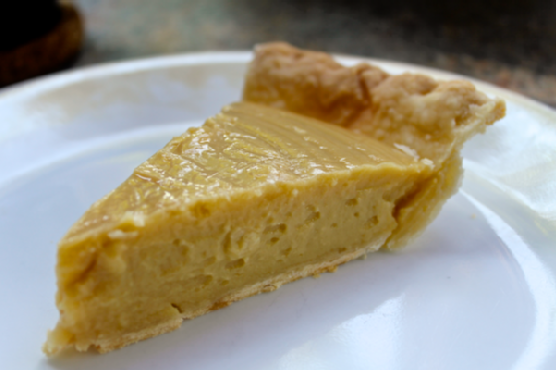
Irish Whiskey Pie | Made by Meaghan Moineau

So, picture this: I just got home after a dreary, rainy day, and all I wanted was a slice of something indulgent, something that instantly warms you up from the inside. That’s when I remembered my Irish Whiskey Pie recipe. It’s a comfort wrapped in a buttery crust, with a deliciously rich filling that makes you feel like you’re being hugged by a cozy blanket. The best part? It’s one of those pies that seems super fancy but is actually pretty easy to pull off. Trust me, once you try it, you’ll be making excuses to bake it over and over again. Oh, and if you’re in a rush to dive into the pie-making, go ahead and Jump to Recipe

What You’ll Need

Don’t worry, this list looks longer than it feels. Chances are you already have most of it chilling in your pantry—or, you know, your liquor cabinet.

  • Condensed milk
  • Cornstarch
  • Egg yolks
  • Light brown sugar
  • Homogenized milk
  • Pastry flour
  • Salt
  • Unsalted butter
  • Vodka
  • Water
  • Irish whiskey

How to Make Irish Whiskey Pie

  1. For the crust, sift the pastry flour and salt together in a large bowl. This is the backbone of your pie, so make sure it’s all airy and smooth.
  2. Using a food processor, pastry blender, or two knives—whatever floats your boat—cut the butter into the flour until you have a crumbly, pebbly texture.
  3. Add water and vodka a little at a time, mixing after each addition until the dough just comes together. Trust me, you’ll know when it happens.
  4. Form the dough into a ball, cut it in half, and flatten each half into a disc. Wrap them in wax paper and refrigerate for at least half an hour. Freeze one for later—you won’t regret having a backup!
  5. Preheat your oven to 375°F. Roll out one disc of the pastry on a well-floured surface to fit a 9-inch pie plate. Trim and crimp the edges to make it look all pretty.
  6. Prick the bottom with a fork, wrap it with tin foil, and fill it with pie weights or dried beans. Bake for 25 minutes in the oven’s center.
  7. Remove the weights and foil, and bake for another nine minutes until the crust turns golden brown and smells like heaven. Let it cool while you whip up the filling.
  8. For the filling, whisk together the condensed milk, cornstarch, and salt in a medium-sized bowl. Add egg yolks one at a time, whisking thoroughly after each addition. Set aside.
  9. Melt butter over moderate heat in a saucepan. Add brown sugar and let it bubble slightly, giving off a glorious caramel aroma.
  10. Slowly whisk in the homogenized milk, then add the egg mixture gradually, whisking constantly to avoid scrambling those yolks.
  11. Bring it all to a boil, stirring the whole time. Once boiling, let it cook for about a minute until it’s thick and luscious.
  12. Remove from heat and stir in the Irish whiskey—it’s the star of the show, after all. Pour the filling into your cooled pie shell, cover with plastic wrap, and refrigerate for at least four hours to set.

Cook’s Notes

Here’s a pro tip: if you’re making this pie ahead, leave the whipped cream off until just before serving. It helps keep everything fresh and light. Store any leftovers covered in the fridge. They’ll keep for a couple of days, assuming you don’t devour the whole thing in one sitting. Also, don’t rush the cooling process—give the pie its chill time in the fridge, or the filling might not set properly. Patience is key here!

Make It Your Own

  • Swap the Irish whiskey with a smooth bourbon for a different kind of warmth and aroma.
  • Add a tablespoon of cocoa powder to the filling for a chocolatey twist that complements the whiskey perfectly.
  • Introduce a spiced element by sprinkling a dash of nutmeg or cinnamon into the filling for a cozy, holiday vibe.
  • Try a graham cracker crust instead of traditional pastry for a sweeter, more rustic taste.

If you try this, I’d love to hear how it turns out—drop a comment or tag me on social media! Your feedback makes my day and helps me keep sharing recipes you’ll love. Enjoy your baking adventure!

Related update: Irish Whiskey Pie

Related update: Pumpkin Pecan Streusel Cake - gluten free, soy free, vegan

AMD Helios Challenges Nvidia in AI Racks | Analysis by Brian Moineau

TL;DR

  • AMD just won Microsoft as a buyer for its AMD Helios rack AI system, putting real heat on Nvidia’s rack-scale offerings and signaling that Azure wants diversity at the rack, not just the chip. [1][2][3]
  • The strategic bet isn’t raw FLOPS; it’s procurement resilience and lower “cost per token” on inference, enabled by an open ORW rack design and 72‑GPU double‑wide racks from multiple OEMs. [1][4][5]
  • If AMD sells roughly 1,900 Helios racks in 2027 at ~$5.25M each, that’s a $10B run-rate—precisely the scale AMD says it’s chasing as it courts eight of the top ten AI companies. [1][7]

What the source said

CNBC reports that AMD will ship its first rack-scale AI system, Helios, in 2H 2026, with Microsoft joining Meta, OpenAI, and Oracle as customers. Microsoft says Helios will power frontier model inference for Azure and add new EPYC “Venice” CPU instances. Futurum pegs Helios at $5–$5.5 million per rack, compared with Nvidia’s Vera Rubin at $3.5–$4 million, while Nvidia still holds ~95% data center GPU market share and analysts float a 20–25% AMD path. Shares of AMD rose more than 4% on the news in July 2026. [1]

Why it matters

This isn’t just about “AMD vs. Nvidia.” The real stakeholders are the hyperscale buyers—Microsoft, Meta, OpenAI, and Oracle—who need predictable delivery schedules, second sources, and better inference economics as model counts and context windows expand. Microsoft adding Helios means Azure can hedge against single-vendor risk while tuning for lower cost per token on inference-heavy workloads. [1][2][3]

For AMD, Helios is the vehicle to convert GPU credibility into system-scale revenue in 2026–2027. An open, standards-based rack (built on Meta’s ORW OCP design) lets ODMs like Supermicro ship at volume, which spreads manufacturing risk and accelerates field deployment across North America, Europe, and APAC. If that flywheel spins, AMD doesn’t need 50% share to win; it needs enough racks landing on time to anchor a multi‑billion‑dollar AI systems business. [4][5]

Original analysis

AMD Helios vs Nvidia rack systems: a 2x2

  • Open rack + inference-first (AMD Helios today)
    • ORW/OCP design, 72‑GPU double‑wide racks via multiple OEMs; pitched as “lowest cost per token.” Strong fit for large-scale inference and retrieval‑augmented serving under tight TCO constraints. [1][4][5]
  • Open rack + training-first (Helios roadmap)
    • As MI4xx/MI5xx mature, the same ORW chassis can host newer GPUs/NICs; training viability rises if software and interconnects keep pace with multi‑rack scale. [4]
  • Proprietary rack + training-first (Nvidia GB/“Rubin” pedigree)
    • NVLink/NVSwitch coherence and tight CPU‑GPU coupling remain the gold standard for training scale, but lock in procurement to one roadmap and supply queue. [6]
  • Proprietary rack + inference-at-scale (Nvidia Rubin/Vera Rubin)
    • Excellent perf/latency at the node, but customers carry lock‑in risk and single‑vendor supply exposure when quarterly capacity allocations drive product timelines. [6]

Back‑of‑envelope calculation

  • AMD says it plans to book “tens of billions” in data center AI revenue starting in 2027, with Helios as the majority. Assume an average Helios rack price of $5.25M (midpoint of the $5–$5.5M range cited by Futurum via CNBC). To hit $10B in 2027 AI systems revenue purely from racks: $10,000M ÷ $5.25M ≈ 1,905 racks; for $20B: ≈ 3,810 racks. This frames the task: win a few thousand rack installs across Microsoft, Meta, OpenAI, Oracle, and others. [1]

Historical analogue

  • In 2003, Opteron’s integrated memory controller upended Intel Xeon’s front‑side bus and briefly drove AMD to ~25% server CPU share before execution stumbles reversed the gains. The lesson is clear: when an incumbent optimizes for one axis (raw training scale), a challenger can wedge in on TCO and platform modularity. Helios pairs AMD’s regained CPU credibility (EPYC “Venice”) with an open rack and multiple OEMs to avoid the single‑supplier trap that hurt AMD in the late 2000s. [1][3][7]

Contrarian read

  • Consensus says Microsoft chose Helios to squeeze Nvidia on GPU price. My read: it’s mainly schedule insurance plus inference TCO for Azure’s frontier‑model services. Helios’s ORW/OCP lineage and OEM diversity (e.g., Supermicro) spread manufacturing risk when midplane or liquid‑cooling parts slip. Reports also flag shifting Nvidia rack timelines, which strengthens the appeal of a rack‑level second source. [1][2][3][5][6]

Named‑stakeholder breakdown

  • AMD: Helios is the bridge from GPU share to system revenue; openness and OEM breadth become differentiators, not just chip perf. Hitting a 2,000‑rack year in 2027 would validate the strategy. [1][4][5]
  • Microsoft: Gains bargaining power and faster time‑to‑capacity for inference workloads; adds new “Venice” CPU instances for agentic AI, EDA, and data pipelines in Azure. [1][3]
  • Nvidia: Still the training default in 2026–2027, but now faces procurement‑driven share leakage in inference and expansion phases where open racks and second sources are board‑level KPIs. [1][6]
  • Supermicro: Positioned to capture high‑margin rack integration, liquid cooling, and service revenue if Helios deployments scale through 2H 2026–2027. [5]
  • Meta/OpenAI/Oracle: More credible timelines for multi‑GW rollouts if a single vendor under‑delivers in a given quarter; ORW compatibility reduces integration friction at fleet scale. [1][4]

What others are missing

The story is less “AMD versus Nvidia silicon” and more “open ORW racks versus proprietary rack ecosystems.” ORW/OCP alignment means Helios can be built, qualified, and serviced by multiple OEMs, de‑risking freight lanes, liquid‑cooling manifolds, and midplane supply across regions like Texas, Frankfurt, and Singapore. That matters when a one‑quarter slip in rack deliveries pushes out a model launch date. Supermicro has already positioned a 72‑GPU double‑wide Helios configuration—evidence that this is a multi‑vendor program, not a single SKU—and that weakens the hold of proprietary rack interconnects by giving buyers a rack‑level second source. [4][5]

What to watch next

  1. By December 31, 2026, Azure announces general availability of at least one Helios‑backed instance family for inference or agentic AI, beyond private preview. Verification: Microsoft Azure blog or product pages. [3]

  2. By June 30, 2027, AMD reports an annualized data center AI systems revenue run‑rate of ≥$10B, with Helios cited as a majority contributor. Verification: AMD earnings materials and investor presentations. [1]

  3. By September 30, 2027, at least two OEMs (e.g., Supermicro and one other named partner) announce customer production deployments of Helios racks outside “Tier‑1” hyperscalers. Verification: OEM press releases and customer case studies. [5]

My take

Microsoft buying Helios isn’t a headline about FLOPS; it’s a procurement thesis for Azure. If you think AI will be bound by supply chains and power more than by paper specs, you buy the most open, multi‑source rack you can qualify in 2026–2027. Nvidia will remain the training yardstick, but the hyperscalers live and die by rollout calendars, not benchmarks. If AMD can ship a couple thousand racks on time and keep cost per token trending down, Helios will carve a durable inference beachhead. [1][2][3][4][5]

Sources

  1. AMD launches Helios, its first rack AI system to rival Nvidia, adding Microsoft as newest buyer — CNBC (https://www.cnbc.com/2026/07/20/amd-helios-microsoft-ai-nvidia.html) — News of Microsoft adopting Helios, pricing estimates via Futurum, market share context, and AMD’s “cost per token” positioning.

  2. Microsoft to Deploy Next-Gen AMD Instinct and AMD EPYC Processors as the Companies Expand Their Long-Term Strategic Partnership — AMD Press Release (https://www.amd.com/en/newsroom/press-releases/2026-7-20-microsoft-to-deploy-next-gen-amd-instinct-and-amd-.html) — Confirms Microsoft will deploy AMD Helios on Azure and shipping begins in 2H 2026.

  3. Microsoft expands Azure AI and HPC infrastructure with AMD — Microsoft Official Blog (https://blogs.microsoft.com/blog/2026/07/20/microsoft-expands-azure-ai-and-hpc-infrastructure-with-amd/) — Details Azure’s use of Helios for frontier model inference and new EPYC “Venice” CPU instances.

  4. AMD Helios: Advancing Openness in AI Infrastructure — AMD Product Page (https://www.amd.com/en/products/rackscale-solutions/helios.html) — Documents ORW/OCP alignment, open architecture intent, and deployment timing.

  5. Supermicro Expands Rack-Scale AI Leadership with AMD Helios Platform — Supermicro (https://www.supermicro.com/en/pressreleases/supermicro-expands-rack-scale-ai-leadership-amd-helios-platform-accelerating) — Provides 72‑GPU double‑wide rack configuration and OEM execution details.

  6. Nvidia’s Huang vows to deliver “giant amounts” of Vera Rubin — Tom’s Hardware (https://www.tomshardware.com/tech-industry/artificial-intelligence/nvidias-huang-vows-to-deliver-giant-amounts-of-vera-rubin-company-says-that-our-roadmap-is-intact) — Context on Nvidia’s rack-scale roadmap and shipment cadence discussions.

  7. 2025 Annual Report — AMD (https://ir.amd.com/financial-information/sec-filings/content/0001193125-26-129106/0001193125-26-129106.pdf) — States “eight of the world’s top ten AI companies” use AMD Instinct and outlines Helios/“Venice” roadmap context.

Cauliflower, Leek and Cheddar Cheese Soup | Made by Meaghan Moineau

It was a chilly Tuesday evening, and my fridge was looking pretty bare. You know those nights when you just stand there, door open, hoping for inspiration to strike? That was me. But then, hiding behind some leftover lettuce, I found a head of cauliflower and half a leek. It was like a culinary “Aha!” moment. I remembered a soup I improvised once that was so comforting and cheesy, it felt like a warm hug in a bowl. Cauliflower, Leek, and Cheddar Cheese Soup to the rescue! It’s so simple, you might not even need to make a grocery run, and it’s rich and satisfying without being heavy. Plus, it’s a fabulous way to sneak in those veggies.

Jump to Recipe

What You’ll Need

Surprisingly, this soup calls for ingredients you might already have lurking in your kitchen. Simple but mighty, these ingredients come together to make a creamy delight:

  • 1 head of trimmed cauliflower
  • 1 leek, sliced
  • Olive oil
  • 1 teaspoon fresh thyme
  • 2 cloves garlic, minced
  • 1 tablespoon Worcestershire sauce
  • 4 cups vegetable broth
  • 1 cup fat-free evaporated milk
  • 2 cups shredded cheddar cheese

How to Make Cauliflower, Leek and Cheddar Cheese Soup

  1. Start by heating a splash of olive oil in a large saucepan over medium heat. Toss in the sliced leeks and let them cook for about 5 minutes. You want them softened and a little caramelized, filling your kitchen with that sweet, oniony aroma.
  2. Next, add the chopped cauliflower, minced garlic, fresh thyme, Worcestershire sauce, and pour in the vegetable broth. Give it a good stir, and bring the soup to a simmer. Let it bubble away gently over medium-low heat for 30 to 40 minutes, until the cauliflower is so tender it practically falls apart.
  3. Take the pot off the heat. Now for the fun part—puree the soup until it’s silky smooth. You can do this with an immersion blender right in the pot or in batches using a regular blender. Just be careful with hot liquids!
  4. Once your soup is blended, return it to the saucepan, and stir in the evaporated milk and 2 cups of cheddar cheese. Place it back on medium heat for just 3 to 5 minutes, stirring until the cheese melts into the soup and it’s all dreamy and creamy.
  5. Pour it into bowls and finish with a sprinkle of cheddar cheese on top for a little extra indulgence. Enjoy your cozy creation!

Cook’s Notes

This soup is super forgiving. If you find it a bit too thick after blending, just add a splash more broth until you reach your desired consistency. It keeps well in the fridge for about 3 days, making it a great make-ahead meal. Reheat gently on the stove to avoid any separation. Freezing isn’t ideal because of the cheese and milk, but it can work in a pinch—just expect a slightly different texture.

Make It Your Own

  • Spice it up by adding a pinch of cayenne or smoked paprika for a little heat and depth of flavor.
  • If you’re a meat lover, throw in some crispy bacon bits on top just before serving. It adds a delightful crunch!
  • For a vegetarian twist, substitute the Worcestershire sauce with soy sauce to keep it plant-friendly.
  • Swap the cheddar for a sharp blue cheese if you’re feeling bold and want a tangy kick.

If you try this, I’d love to hear how it turns out—drop a comment or tag me in your cozy creations! Remember, cooking is all about making it suit your taste and enjoying the process. Happy cooking!

Related update: Cauliflower, Leek and Cheddar Cheese Soup

Related update: Minted Pea & Spinach Soup