TL;DR
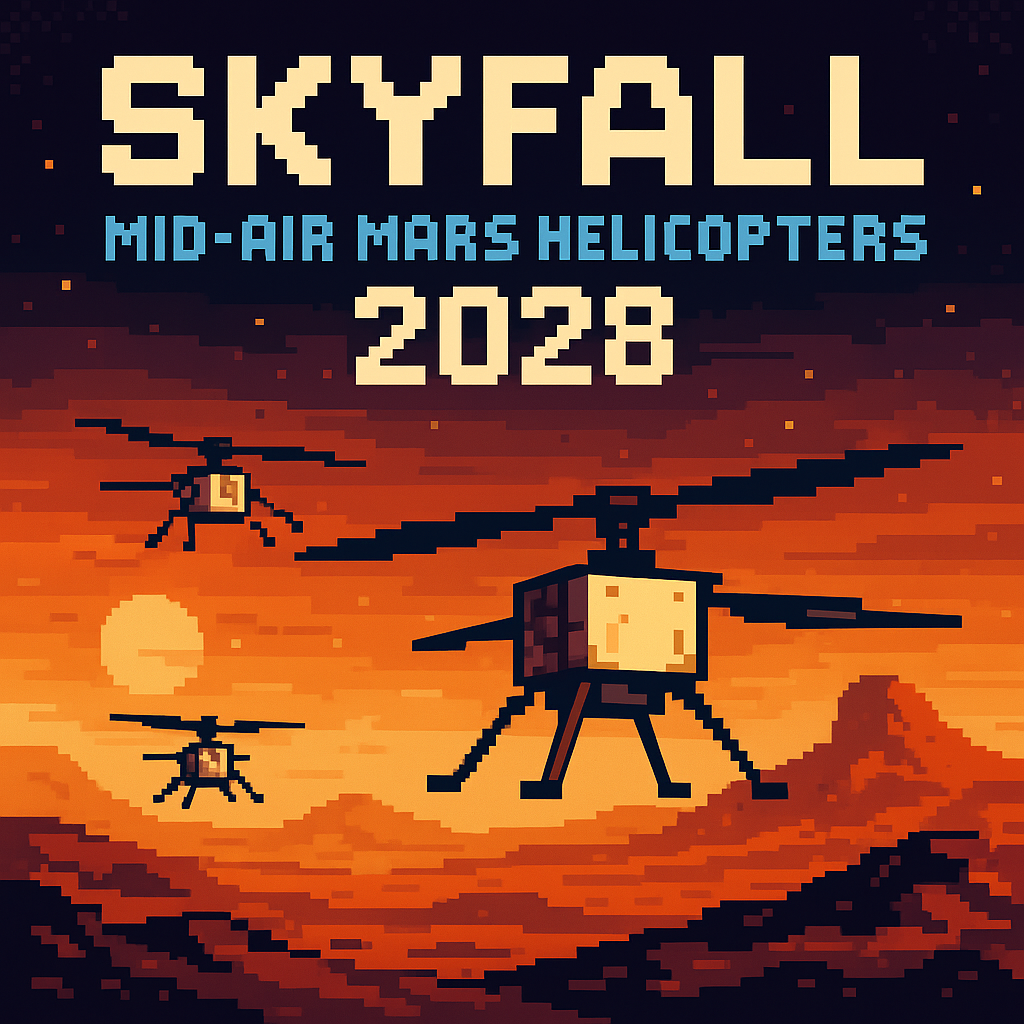
- NASA’s SkyFall Mars helicopter mission just moved from sketch to steel: JPL tapped Firefly Aerospace for a $13 million aeroshell, targeting a 2028 launch of three Ingenuity-class rotorcraft via a mid-air “SkyFall Maneuver.” [1][2][3] (https://www.space.com/space-exploration/missions/nasa-begins-funding-hardware-for-skyfall-mars-helicopter-mission)
- The consensus headline is “first nuclear-powered interplanetary spacecraft,” but that only holds if SkyFall flies a fission reactor; NASA has already fielded many RTG-powered interplanetary spacecraft since the 1970s (Voyager 1 in 1977, Cassini in 1997, New Horizons in 2006). The real breakthrough is mid-air deployment of aircraft at Mars. [4][5] (https://science.nasa.gov/planetary-science/programs/radioisotope-power-systems/missions/)
- If Firefly delivers by late 2027 with a 20-person team, the implied fully loaded cost runs near ~$520k per person-year—evidence that commercial composites and lunar-lander heritage are compressing planetary EDL costs. [5][2] (https://aviationweek.com/space/launch-vehicles-propulsion/firefly-aerospace-produce-shell-nasas-skyfall-mission)
What the source said
Space.com reports that NASA/JPL awarded Firefly Aerospace a $13 million subcontract to design and build the aeroshell—backshell plus heat shield—for SkyFall, a nuclear-powered Mars mission slated for 2028. SkyFall will carry three Ingenuity-like helicopters and release them mid-descent to start flying immediately, a technique NASA dubs the “SkyFall Maneuver.” [1][3] (https://www.space.com/space-exploration/missions/nasa-begins-funding-hardware-for-skyfall-mars-helicopter-mission)
Firefly will develop, manufacture, and test the aeroshell in Texas, including work at its Rocket Ranch site in Briggs before shipment to JPL in Pasadena, California for integration. The helicopters will prospect for near-surface water ice to inform future crewed landing sites, extending Ingenuity’s 2021–2024 legacy into resource mapping and site scouting. [2][1] (https://www.globenewswire.com/news-release/2026/07/07/3323174/0/en/firefly-aerospace-receives-13-million-nasa-jpl-subcontract-to-build-aeroshell-for-skyfall-mars-mission.html)
Why it matters
Two communities have the most to gain—or lose—here. For human spaceflight planners at NASA and its partners, a trio of airborne scouts mapping shallow subsurface ice could reset the shortlist of safe, useful landing zones before any habitat lands on Mars in the 2030s. Water ice supports in-situ propellant, life support, and radiation shielding; getting that reconnaissance without landing a full rover or lander first saves mass, money, and years. [1][5] (https://aviationweek.com/space/launch-vehicles-propulsion/firefly-aerospace-produce-shell-nasas-skyfall-mission)
For the commercial deep-space supply chain, Firefly’s aeroshell order is a signal: planetary entry, descent, and landing (EDL) hardware is opening to nontraditional primes. If the Texas-built shell performs and the mid-air release works in 2028, the template—commercial composites plus JPL avionics—could become the go-to stack for “rotorcraft-first” Mars missions this decade. [2][3] (https://www.jpl.nasa.gov/videos/nasas-skyfall-mars-helicopters/)
Original analysis
Contrarian read
- Consensus: The big story is NASA’s “first nuclear-powered interplanetary spacecraft.”
- My take: That line muddles history. NASA has flown nuclear-powered (RTG) interplanetary craft for five decades—Voyager (launched 1977), Galileo (1989), Cassini (1997), and New Horizons (2006). The novelty only stands if SkyFall uses a fission reactor rather than an RTG; what’s genuinely new—and risky—is mid-air deployment of helicopters from a 2.65‑meter heritage aeroshell and jetpack, trading a lander’s mass/complexity for the ability to fly immediately at higher-elevation, rougher sites. [4][6] (https://arxiv.org/abs/2203.03704)
Historical analogue (2012: “sky crane” for Curiosity)
- In 2012, JPL’s sky-crane lowered Curiosity on tethers—a maneuver many thought too exotic until it worked and then became standard for large rovers (Perseverance in 2021). New EDL paradigms that buy mass margins and site access tend to stick. If SkyFall’s mid-air release works, expect a generational pivot: helicopter-first Mars missions for regional surveys, then targeted landers where the copters flag resources or hazards. [9] (https://science.nasa.gov/planetary-science/programs/mars-exploration/mission-timeline/how-we-land-on-mars/)
Back-of-envelope calculation
- Firefly told Aviation Week it can deliver the aeroshell by late 2027 with a team of ~20 employees. If we approximate 1.25 years of effort, that’s 25 person‑years. $13M / 25 ≈ $520k per person‑year. That envelope must cover salaries, materials (high‑temperature composites), tooling, structural/thermal testing, QA, and program overhead—lean for planetary EDL hardware. [5][2] (https://aviationweek.com/space/launch-vehicles-propulsion/firefly-aerospace-produce-shell-nasas-skyfall-mission)
Named-stakeholder breakdown
- Firefly Aerospace: A successful, on‑schedule aeroshell vaults Firefly from lunar CLPS supplier to credible Mars EDL house, broadening revenue beyond Alpha/Eclipse launch and Blue Ghost landers. Miss the 2027 handoff, and SkyFall’s 2028 window—and Firefly’s “fast planetary” brand—take a hit. [2][5] (https://www.globenewswire.com/news-release/2026/07/07/3323174/0/en/firefly-aerospace-receives-13-million-nasa-jpl-subcontract-to-build-aeroshell-for-skyfall-mars-mission.html)
- JPL: Mid-air deployment (MAD/MAHD) is a JPL bet that trims entry mass (~275 kg modeled vs. Phoenix’s 573 kg) and buys access to highlands (+5 km MOLA) at the cost of a riskier separation sequence. A single botched release could stall rotorcraft‑first Mars architecture for years. [6] (https://arxiv.org/abs/2203.03704)
- AeroVironment: Ingenuity’s rotor supplier is already testing next‑gen Mars rotors past Mach 1 tip speeds; SkyFall is the natural platform to monetize that R&D at scale. More helicopters = more composite rotors, hubs, and control hardware flowing from Simi Valley. [3][7] (https://www.jpl.nasa.gov/news/nasa-pushes-next-gen-mars-helicopter-rotor-blades-past-mach-1/)
- NASA/DOE RPS program: If “nuclear-powered” means RTG, Pu‑238 allocations and thermal design become schedule gates; if it means a flight reactor, integration and safety reviews get heavier. Either way, the program’s optics and supply chain matter to hitting a 2028 stack. [4] (https://science.nasa.gov/planetary-science/programs/radioisotope-power-systems/missions/)
Framework: Risks vs. payoffs for the SkyFall Mars helicopter mission
- Payoffs
- Resource intelligence: Airborne scouts quickly map shallow subsurface ice to de‑risk crewed site selection in one campaign in the late 2020s. [5][1] (https://aviationweek.com/space/launch-vehicles-propulsion/firefly-aerospace-produce-shell-nasas-skyfall-mission)
- Access: MAHD/MAD enables operations at higher elevations and rougher terrain than rover‑class landings typically allow, expanding sites above +5 km MOLA. [6] (https://arxiv.org/abs/2203.03704)
- Cost/time: No lander; simpler EDL; commercial aeroshell—shorter critical path and leaner budgets if assumptions hold. [2][6] (https://www.globenewswire.com/news-release/2026/07/07/3323174/0/en/firefly-aerospace-receives-13-million-nasa-jpl-subcontract-to-build-aeroshell-for-skyfall-mars-mission.html)
- Risks
- Separation dynamics: Helicopters must stabilize aerodynamically at tens of m/s terminal conditions before first powered lift—narrow margins, and high winds can kill missions. [6] (https://arxiv.org/abs/2203.03704)
- Autonomy and comms: Without a rover relay, three aircraft must coordinate nav, radar sampling, and downlink across the DSN without human-in-the-loop piloting. [3] (https://www.jpl.nasa.gov/videos/nasas-skyfall-mars-helicopters/)
- “Nuclear-first” messaging: If “first nuclear spacecraft” is misframed, critics will point to Voyager/Cassini RTGs; clarity on power type prevents a sideshow. [4][5] (https://science.nasa.gov/planetary-science/programs/radioisotope-power-systems/missions/)
One more useful yardstick: Ingenuity cost about $80M to build and $5M to operate for the demo month, then flew 72 times before its final flight on Jan. 18, 2024. If SkyFall fields three improved helos and each manages 100 flights, that’s 300 sorties. Even if unit hardware cost stayed Ingenuity‑like (assume $80M each), you’d get ~$240M/300 ≈ $0.8M per sortie in pure air‑vehicle capex—already cheaper “per flight” than Ingenuity’s ~$1.18M (=$85M/72). It’s a crude metric, but it shows how scaling the fleet can make exploration economics look less like bespoke stunts and more like air campaigns. [8] (https://www.planetary.org/space-missions/ingenuity)
What others are missing
The hinge isn’t just the helicopters—it’s the aeroshell aperture and packing problem. The MAHD/MAD studies assume a 2.65‑meter, Mars‑heritage aeroshell (Pathfinder/MER/Phoenix/InSight). Fitting a jetpack plus a Mars Science Helicopter inside that diameter already pushes geometry; SkyFall is promising three Ingenuity‑class craft. That implies aggressive stowage, separation sequencing, and debris‑free clearance under dynamic loads during descent. If JPL and Firefly prove repeatable, low‑shock, no‑foul release of multiple flyers from a small capsule, Mars missions gain a new “multi‑drop” logistics primitive. That’s the scalable part—not the nuclear label. [6][2] (https://arxiv.org/abs/2203.03704)
What to watch next
- By Q4 2027, Firefly delivers the SkyFall aeroshell to JPL; any slip beyond December 2027 likely punts to the next Earth–Mars synodic window (~26 months later). [5][10] (https://aviationweek.com/space/launch-vehicles-propulsion/firefly-aerospace-produce-shell-nasas-skyfall-mission)
- By June 2027, JPL publishes mid‑air deployment drop‑test results (e.g., jetpack‑to‑helicopter separation stability) with video and data, consistent with the MAHD test flow outlined in 2022 and past EDL verification campaigns. [6][9] (https://arxiv.org/abs/2203.03704)
- By March 2028, NASA clarifies SkyFall’s power source in public docs—RTG vs. reactor—and aligns comms accordingly; if it’s RTG, expect explicit comparisons to Voyager/Cassini to avoid “first nuclear” backlash. [4] (https://science.nasa.gov/planetary-science/programs/radioisotope-power-systems/missions/)
My take
I’m bullish—on the maneuver, not the marketing. If SkyFall nails a mid‑air release of multiple scouts in 2028 and those aircraft come home with believable subsurface ice maps, this becomes the Curiosity sky‑crane moment for aerial Mars. The aeroshell order signals that JPL intends to build around commercial composites and iterate fast. Don’t get distracted by the nuclear headline; the lasting value is a repeatable way to insert swarms into rough, high‑elevation terrain. If that works in 2028, the next Mars decade belongs to fleets of rotorcraft, not lone mega‑rovers. [2][5][6] (https://www.globenewswire.com/news-release/2026/07/07/3323174/0/en/firefly-aerospace-receives-13-million-nasa-jpl-subcontract-to-build-aeroshell-for-skyfall-mars-mission.html)
Sources
-
NASA begins funding hardware for “SkyFall” Mars helicopter mission — Space.com (https://www.space.com/space-exploration/missions/nasa-begins-funding-hardware-for-skyfall-mars-helicopter-mission) — News on Firefly’s $13M aeroshell award, 2028 target, and the “SkyFall Maneuver.”
-
Firefly Aerospace Receives $13 Million NASA JPL Subcontract to Build Aeroshell for SkyFall Mars Mission — GlobeNewswire (https://www.globenewswire.com/news-release/2026/07/07/3323174/0/en/firefly-aerospace-receives-13-million-nasa-jpl-subcontract-to-build-aeroshell-for-skyfall-mars-mission.html) — Confirms contract value, Texas facilities, and mid-air release naming.
-
NASA’s SkyFall Mars Helicopters — JPL (https://www.jpl.nasa.gov/videos/nasas-skyfall-mars-helicopters/) — Official JPL page describing the mission concept and mid-air deployment approach.
-
Radioisotope Power Systems Missions — NASA Science (https://science.nasa.gov/planetary-science/programs/radioisotope-power-systems/missions/) — Documents NASA’s RTG-powered interplanetary spacecraft (Voyager, Cassini, New Horizons), crucial for parsing the “first nuclear” claim.
-
Firefly Aerospace To Produce Shell For NASA’s SkyFall Mission — Aviation Week (https://aviationweek.com/space/launch-vehicles-propulsion/firefly-aerospace-produce-shell-nasas-skyfall-mission) — Adds delivery-by-late-2027 detail and reiterates the three‑helicopter, water‑ice mapping goal.
-
Mid-Air Helicopter Delivery at Mars Using a Jetpack — arXiv (https://arxiv.org/abs/2203.03704) — JPL/NASA preprint on the MAHD concept, including 2.65‑m aeroshell fit, +150% payload mass, and ~275 kg entry mass modeling.
-
NASA Pushes Next-Gen Mars Helicopter Rotor Blades Past Mach 1 — JPL (https://www.jpl.nasa.gov/news/nasa-pushes-next-gen-mars-helicopter-rotor-blades-past-mach-1/) — Evidence of AeroVironment-built next-gen rotors and ongoing rotorcraft maturation at JPL.
-
Ingenuity, NASA’s Mars Helicopter — The Planetary Society (https://www.planetary.org/space-missions/ingenuity) — Establishes Ingenuity’s 72 flights (ending Jan. 18, 2024) and ~$85M development/initial ops cost, used in sortie economics.
-
How We Land on Mars — NASA Science (https://science.nasa.gov/planetary-science/programs/mars-exploration/mission-timeline/how-we-land-on-mars/) — Curiosity’s 2012 sky-crane and Perseverance’s 2021 EDL context for new paradigms.
-
Mars Fact Sheet — NASA GSFC (https://nssdc.gsfc.nasa.gov/planetary/factsheet/marsfact.html) — Provides the 779.94‑day Earth–Mars synodic period (~26 months) to frame launch-window slips.
Related update: We recently published an article that expands on this topic: read the latest post.
Related update: We recently published an article that expands on this topic: read the latest post.