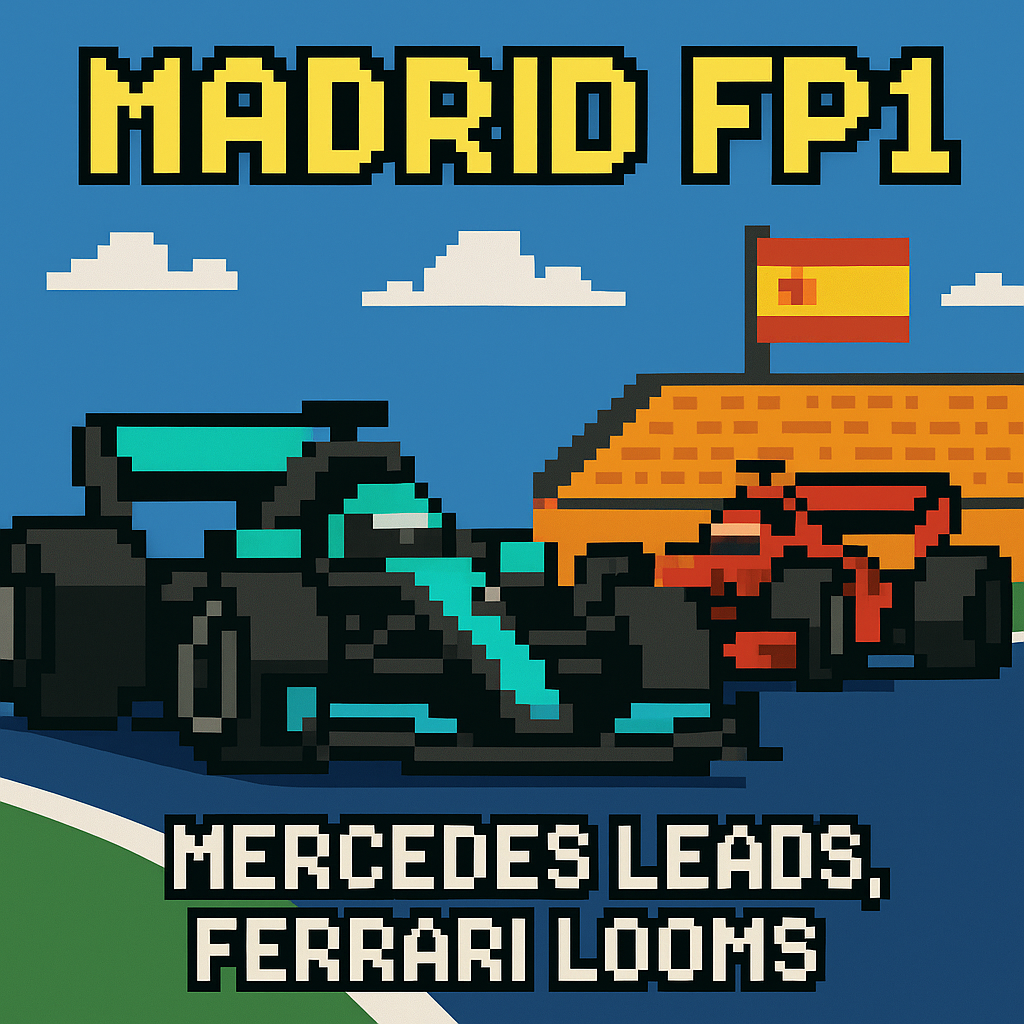
Madrid FP1: Mercedes Leads, Ferrari Looms | Analysis by Brian Moineau

TL;DR

  • Mercedes topped FP1 at the 2026 Spanish GP in Madrid’s Madring, with George Russell quickest in 1:34.077 and Kimi Antonelli second, but Ferrari’s medium‑tyre pace suggests the headline gap flatters Brackley. [1][2]
  • The new 5.414 km, 22‑turn semi‑urban circuit around IFEMA loads the left‑side tyres hard; low grip plus traffic at “La Monumental” already triggered impeding flashpoints that could spill into qualifying. [5][6][3]
  • Back‑of‑envelope fuel and tyre corrections put Ferrari within 0.1–0.3 s for qualifying and better placed for Sunday’s degradation, so the early “Mercedes domination” narrative looks premature. [1][2][7]

What the source said

Autosport reports the first‑ever Formula 1 session at Madring ended with a Mercedes FP1 one‑two: George Russell P1 in 1:34.077 and rookie Kimi Antonelli P2 in 1:34.363. Ferrari’s Lewis Hamilton set an early benchmark on the medium compound and was one of only two drivers not to set a best time on softs, while Charles Leclerc ran close behind the Mercedes pair and Max Verstappen ended P5 for Red Bull. Multiple traffic incidents flared at the fast “La Monumental” section, with Arvid Lindblad frustrated after encountering slow Mercedes and Ferrari cars, and Yuki Tsunoda retired with a power‑steering issue. [1][2][3]

Why it matters

  • Competitive order: A brand‑new venue can scramble read‑throughs from FP1, and the first hour at Madrid’s 5.414 km Madring showed how fuel loads and compound choices still mask true pace; Russell’s 1:34.077 sits as a reference, not a verdict. [1][5]
  • Event economics: Madrid’s IFEMA‑anchored, 22‑turn semi‑urban project stands in direct comparison to the long‑running Barcelona round at Montmeló, and a compelling qualifying plus race would validate the capital’s investment and FOM’s calendar bet. [5][6]

Original analysis

  • Back‑of‑envelope: correcting FP1 times with shown work

    • Given: Russell 1:34.077 (soft), Antonelli 1:34.363 (soft); Hamilton’s headline laps came on mediums. [1]
    • Fuel effect rule‑of‑thumb: 0.3–0.4 s per 10 kg → use 0.03 s/kg for a conservative 0.30 s/10 kg. [7]
    • Scenario A (Mercedes lighter by ~15 kg): Inflated advantage ≈ 15 kg × 0.03 s/kg = 0.45 s; adjust Russell’s lap to a “fuel‑equalized” 1:34.53 versus Ferrari medium. Typical soft–medium delta on C2–C4 sits ~0.3–0.5 s at medium‑energy tracks, implying Ferrari’s soft‑tyre qualifying potential within ~0.1–0.3 s of Russell’s FP1 best. [2][6][7]
    • Scenario B (similar fuel, compound delta drives the gap): If soft–medium at Madring ~0.3–0.5 s, Hamilton’s medium reference suggests Ferrari erases most of the deficit when both switch to softs in Q3. [2][6]
  • 2×2 typology: track trait × team trait (FP1 inference)

    • Horizontal: Grip state (low/evolving vs stable). Vertical: Tyre warm‑up (fast vs slow).
    • Ferrari: low/evolving + fast warm‑up (medium‑tyre pace strong on a green surface). [2]
    • Mercedes: low/evolving + medium warm‑up (soft peaks early; management in traffic becomes pivotal). [1][3]
    • Red Bull: low/evolving + uncertain warm‑up (rear‑limited strength may underpay on long aero corners here). [2][6]
  • Contrarian read

    • Consensus: Mercedes “ruled Friday” and will control qualifying at Madring.
    • Counter: Ferrari’s best work came on the medium, and Hamilton never logged a peak on softs; with Pirelli’s C2–C4 selection, low‑grip expectations, and 50°C‑plus asphalt in practice, Ferrari’s temperature window and rotation through long loaded corners point to tighter qualifying and stronger long‑run potential. [2][6][8]
  • Named‑stakeholder breakdown

    • Mercedes (Toto Wolff): Banked one‑lap clarity with Russell’s 1:34.077 and an assured Antonelli; the task is clean sequencing at La Monumental to avoid Q1/Q2 traffic traps. [1][3]
    • Ferrari (Fred Vasseur): Medium‑tyre speed is the tell; if the SF‑26 holds front grip through the 22‑turn load cycle, Ferrari can pressure Mercedes on deg over race distance. [2][6]
    • Red Bull (Christian Horner): Verstappen’s P5 gives a base, but the RB car must find rotation in long aero corners to enter the pole fight. [1][2]
    • Pirelli: C2–C4 choice, low grip, and high lateral load mean strict camber/pressure policing and likely multi‑stop viability if track temps mirror FP1. [6][8]
    • City of Madrid/IFEMA: A smooth qualifying and visible passing in support series would bolster the case for the capital’s 5.414 km semi‑urban concept versus the established Barcelona template. [5]

What others are missing

The operational bottleneck at “La Monumental” is a qualifying risk multiplier, not a curiosity, because blind entry prep laps into a high‑load sequence collided with push laps several times in FP1 and triggered radio complaints. If stewards escalate after additional reports, teams must harden pit‑release deltas and widen gaps on out‑laps, trading tyre life for track position. With DRS activation placed after Turn 22, single‑lap blockage risk rises, and one compromised push could swing a front row to a second row at Madring. [3][5]

What to watch next

  1. By qualifying on September 12, 2026, Mercedes will not secure a front‑row lockout; at least one Ferrari starts on the front row.
  2. Before the start of Q3 on September 12, 2026, race control will issue at least one formal reprimand or time penalty for impeding at or near La Monumental.
  3. On September 13, 2026, the race will feature at least one full Safety Car or two Virtual Safety Car periods due to incidents or tyre overheating in long loaded corners.

My take

FP1 at Madring flatters Mercedes because they executed soft‑tyre laps early while Ferrari banked mediums on a 5.414 km layout that stresses the left‑front across long arcs. Russell’s 1:34.077 was sharp, yet fuel‑corrected gaps and compound deltas compress the field when both sides run the C4 for Q3. Ferrari’s temperature window looks kinder for Sunday when degradation bites, so I expect a split front row and a red car dictating stint lengths as track temps hover near FP1’s 50°C‑plus benchmark; if Mercedes want the win, they must win it on Saturday. [1][2][6][8]

Sources

  1. F1 Spanish GP: Mercedes tops FP1 with Russell fastest at Madring — Autosport (https://www.autosport.com/f1/news/f1-spanish-gp-fp1-report/10854512/) — Baseline FP1 order, Russell’s 1:34.077, Antonelli P2, and incidents at La Monumental.
  2. FP1: Russell leads Antonelli and Leclerc as cars hit Madring for first time — Formula1.com (https://www.formula1.com/en/latest/article/fp1-russell-leads-antonelli-and-leclerc-as-cars-hit-madring-for-first-time.1CiLnqKjDFMohqIlyx5uAm) — Confirms Mercedes one‑two, Ferrari’s medium‑tyre strength, and Tsunoda’s power‑steering issue.
  3. F1 Spanish GP: George Russell tops FP1 as Lewis Hamilton impedes several drivers — Motorsport.com (https://www.motorsport.com/f1/news/f1-spanish-gp-fp1-report/10854498/) — Details on traffic/impeding at La Monumental and Lindblad’s radio frustration.
  4. Russell leads Antonelli as Mercedes set the pace in first Madring practice — FIA (https://www.fia.com/news/f1-russell-leads-antonelli-mercedes-set-pace-first-madring-practice) — Governing‑body confirmation of FP1 result at the all‑new Madring.
  5. Circuit guide: Everything you need to know about the Madring — Formula1.com (https://www.formula1.com/en/latest/article/circuit-guide-everything-you-need-to-know-about-the-madring.NF7Mh3iag3w9GUPlihwJA.NF7Mh3iag3w9GUPlihwJA) — Track length (5.414 km), 22 turns, DRS placement after Turn 22, and IFEMA‑anchored layout.
  6. Pirelli anticipa un Madring complicado: poco agarre y grandes cargas — Motorsport.com (ES) (https://es.motorsport.com/f1/news/pirelli-anticipa-madring-complicado-neumaticos/10853908/) — Compound selection (C2–C4), low grip, high lateral loads, and expected evolution.
  7. Why F1 cars are only at the limit 3.1% of the time — Autosport (https://www.autosport.com/f1/news/why-f1-cars-are-only-at-the-limit-31-of-the-time-5111698/5111698/) — Rule‑of‑thumb fuel‑mass effect: ~0.3–0.4 s per 10 kg, used for corrections.
  8. What we learned from Friday practice at the 2026 F1 Spanish GP — Autosport (https://www.autosport.com/f1/news/what-we-learned-from-friday-practice-at-the-2026-f1-spanish-gp/10854706/) — Adds track‑temperature context (50°C‑plus) and left‑side tyre stress through long corners.


Related update: We recently published an article that expands on this topic: read the latest post.
Related update: We recently published an article that expands on this topic: read the latest post.

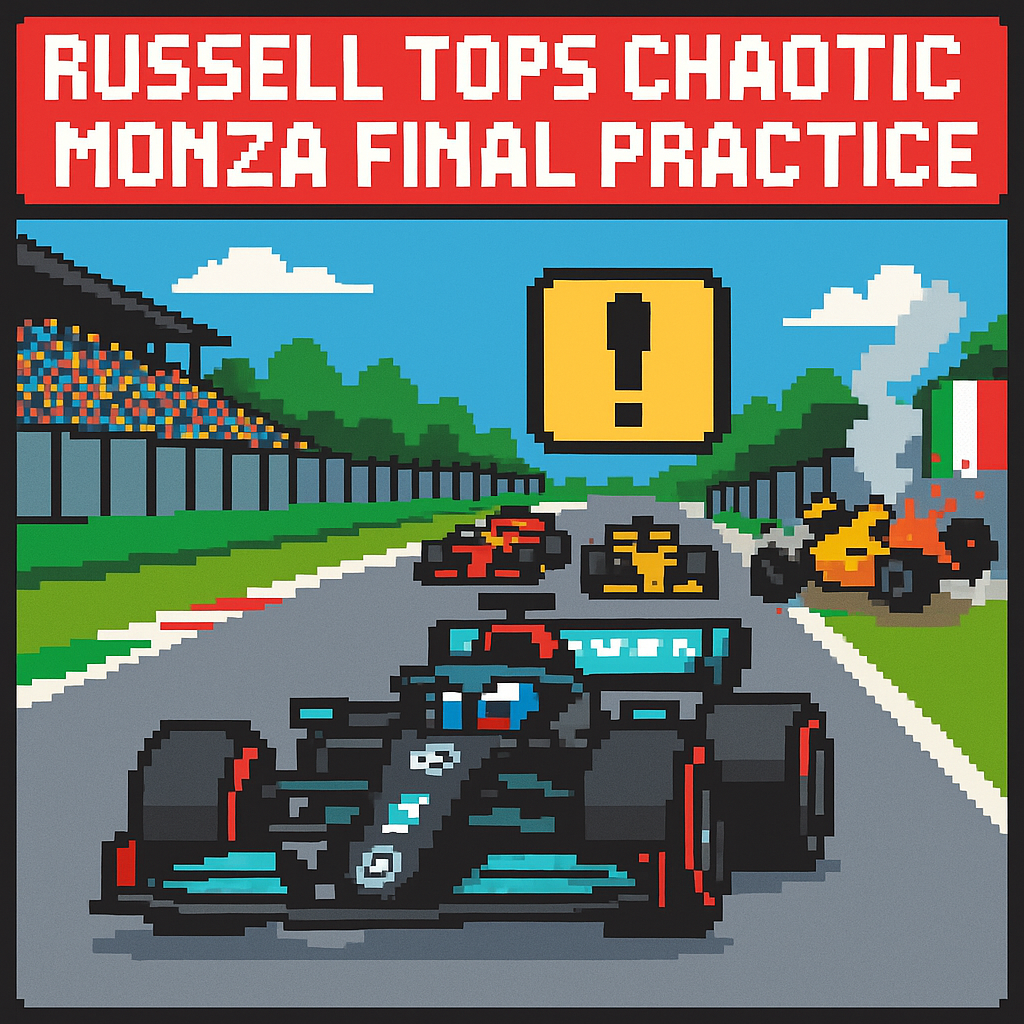
Russell Tops Chaotic Monza Final Practice | Analysis by Brian Moineau

TL;DR

  • Final practice at Monza put George Russell on top again with a 1:22.219, ahead of Ferrari’s Lewis Hamilton (+0.226) and Red Bull’s Max Verstappen (+0.350), making Mercedes the qualifying favorite on raw FP pace. [1][4]
  • The tow at Monza is historically worth roughly 0.5–0.7s per lap; with Russell’s FP3 edge only 0.226s over Hamilton, slipstream execution and traffic management will likely decide pole more than base car speed. [5][6][4]
  • Under 2026 regs, active aero and heavier electrical energy dependence add a new layer to the tow lottery, rewarding teams that script slipstreams without starving the battery down the 1.1 km main straight. [8][2]

What the source said

Formula 1’s official report states George Russell topped FP3 at the 2026 Italian Grand Prix with a 1:22.219 at Monza, ahead of Ferrari’s Lewis Hamilton and Red Bull’s Max Verstappen, after an hour marked by traffic, yellow flags, and a late switch to softs. Kimi Antonelli took P4 for Mercedes, Lando Norris was P5 for McLaren, and Charles Leclerc P6 for Ferrari. [1]

Stewards noted a Hamilton–Verstappen near‑miss on the start/finish straight but did not investigate; Williams’ Alex Albon suffered an early steering‑wheel glitch and rejoined later. Post‑session checks included potential yellow‑flag infringements for Albon and Carlos Sainz. Qualifying is set for 16:00 local time (CEST) at the Autodromo Nazionale Monza. [1][7]

Mercedes’ consistency carried from Friday to Saturday; Russell also led FP2, underscoring the W15’s low‑drag form entering Q1–Q3. The classification was confirmed by the FIA’s event bulletin. [2][4]

Why it matters

Margins at Monza are small and enforcement is sharp; stewards’ post‑session calls can flip rows when gaps sit in the two‑to‑four‑tenths band. Russell’s FP3 advantage—0.226s over Hamilton and 0.350s over Verstappen—sits inside the historical tow delta, so choreography can outweigh horsepower. Expect deliberate out‑lap pacing and strict minimum‑time deltas to shape Q3. [4][6]

For Ferrari, Hamilton’s P2 on home soil in Italy gives the Tifosi a realistic front‑row shot if a properly timed tow materializes on the Rettifilo run. For Red Bull, Verstappen’s deficit is bridgeable with one clean lap and a team‑assisted slipstream, given Monza’s 5.793 km layout and long straights. Midfielders risk queuing for tows and tripping impeding notes when gaps compress at Curva Alboreto. [4][5][6]

Original analysis

Monza magnifies execution. FP3 confirmed Mercedes as the reference, but the margin is tow‑sized rather than car‑sized. Qualifying will be won or lost on the pit wall. [4][6]

Back‑of‑envelope calculation (tow math):

  • Russell’s FP3 best: 1:22.219. Hamilton +0.226; Verstappen +0.350. [4]
  • Historic tow value at Monza: ~0.5–0.7s per lap (Mercedes cited ~0.7s in 2020; ESPN placed the benefit around ~0.5s in 2019/2020). [5][6]
  • If Hamilton lands a 0.5s tow and Russell runs clean air, Hamilton’s projected advantage becomes −0.274s (0.226 + 0.5 = 0.726s swing). If Russell nets even a modest 0.2–0.3s tow—plausible within that range—the gap compresses back near zero. This frames pole as a choreography problem first, a horsepower problem second. [5][6]

Historical analogue (2019’s “Monza farce” and the guardrails since):

  • In 2019, Q3 turned into a crawl as cars tried to avoid leading; several missed the flag. The FIA responded with guidance and minimum‑lap‑time deltas to curb near‑parking on straights. Incentives remain—the tow is still worth ~0.5s—but constraints force cleaner sequences in 2026. Expect similar gamesmanship today, minus the chaos of 2019. [6]

A 2×2: Quali DNA at Monza (2026 edition)

  • X‑axis: Tow reliance (Low → High).
  • Y‑axis: Energy‑strategy coherence under 2026 regs (Low → High).
    • Low Tow/High Energy: “Bankers”—clear air to nail deploy/harvest and active‑aero states. Risk: surrender 0.3–0.7s tow bonus. Reward: repeatable laps, fewer impeding risks. [5][8]
    • High Tow/High Energy: “Surgical Strikers”—script gaps and toggle low‑drag modes at the right spots without over‑harvesting. This is the pole quadrant if execution hits. [8]
    • High Tow/Low Energy: “Lottery Tickets”—big straights boost, but messy recharge/deploy or traffic kills sector balance. [6][8]
    • Low Tow/Low Energy: “Sitting Ducks”—neither slipstream nor smart energy use; qualify to car potential or worse.

Named‑stakeholder breakdown (what FP3 signals):

  • Mercedes (Russell/Antonelli): Two sessions on top—FP2 and FP3—indicate a strong baseline; they can even use Antonelli as a tow reference in Q3 without sacrificing both runs. [2][4]
  • Ferrari (Hamilton/Leclerc): Hamilton’s P2 is inside the tow window; at Monza, Ferrari can burn one attempt to set a two‑car chain for the main straight. [1][4]
  • Red Bull (Verstappen): The RB is in range; Verstappen’s traffic radio and the Hamilton near‑miss preview how tight gaps will be. They need Perez’s positioning—even from deeper in Q2/Q3—to punch a hole. [1][7]
  • Williams (Albon): Steering‑wheel glitches plus a yellow‑flag probe suggest a messy build‑up; prioritize creating sacrificial tows in Q1 to reach Q2. [1]
  • Stewards: FP3 already generated notes on impeding and yellow‑flags; one three‑place penalty can invert Rows 1–3 at these margins. [1][6]

Why the 2026 rules tilt the calculus

  • Active aero reduces drag on the straights for everyone, and the 2026 power units’ higher electrical proportion makes timing of deployment/harvest as critical as the slipstream. Teams must sync the tow with a battery profile that avoids “super‑clipping” before Curva Grande. A perfect tow with poor energy mapping may net less than a smaller tow with a dialed deploy map. That’s the added 2026 complexity. [8]

One more concrete point: Monza historically runs around 78% full throttle per lap, the highest on the calendar, and the track measures 5.793 km. Long straights still amplify small drag deltas into big lap‑time chunks, even with new aero states. Expect explicit team orders and pre‑baked out‑lap speeds to dominate Q3 radio. [5]

What others are missing

Most coverage spotlights the Russell–Hamilton–Verstappen order and the main‑straight flashpoint, but the hinge is the 2026 energy‑management/tow interaction. Active aero lowers drag while the MGU‑K deployment window narrows, so a mistimed map can force harvesting on the main straight and erase a 0.5s slipstream. [8][6]

The specific angle: aligning tow onset with peak battery state of charge so the car doesn’t hit the deploy limiter before the braking zone into Turn 1 (Rettifilo). The fastest package may not take pole; the best‑timed deploy map inside a tow will. [8]

What to watch next

  1. By 16:30 CEST today, Russell takes pole by less than 0.15s after a clean‑air banker plus one tow‑assisted lap; if he misses the tow window, Hamilton inherits P1.

  2. In Q3 today, at least one top‑eight lap is deleted or penalized for impeding or yellow‑flag delta breaches, reshuffling the second row between Curva Alboreto and Turn 1.

  3. On Sunday, the pole sitter’s opening‑stint average speed is ≥252.5 km/h, and the decisive overtake for the win occurs with a tow plus low‑drag mode engaged on the main straight within Lap 1–35.

My take

I lean Mercedes for pole and track position. Russell looks like the driver with both the car and headspace to survive Monza’s qualifying roulette, and his side already executed FP2 and FP3 cleanly. Ferrari can nick it with a perfectly timed two‑car train on the front stretch. [2][4][5]

Verstappen remains dangerous over one lap, but Red Bull must place a wingman precisely in Q3 traffic to engineer the gap. This weekend feels like Russell’s to stamp—if Mercedes keeps the out‑laps tidy and the battery map honest through Curva Alboreto and down the Rettifilo. [1][2][6]

Sources

  1. Russell goes fastest in busy final practice at Monza — Formula 1 (https://www.formula1.com/en/latest/article/fp3-russell-goes-fastest-from-hamilton-and-verstappen-in-final-italy-practice.6i9o4gazCqUo3UtLVRgoe8) — Official FP3 report: classification, incidents, investigations, and session context.

  2. F1 – Russell tops FP3 in Monza ahead of Hamilton and Verstappen — FIA (https://api.fia.com/news/f1-russell-tops-fp3-monza-ahead-hamilton-and-verstappen) — Governing‑body confirmation of FP3 order and Mercedes’ form across the weekend.

  3. F1 Italian GP: George Russell leads Lewis Hamilton in FP3 — Motorsport.com (https://www.motorsport.com/f1/news/f1-italin-gp-fp3-report/10852508/) — Independent report on the FP3 pace picture and team read‑throughs into qualifying.

  4. 2026 Formula 1 Italian GP — FP3 results — Autosport (https://www.autosport.com/f1/results/2026/italian-gp-661686/?st=FP3) — Detailed times, including Russell’s 1:22.219 and gaps to Hamilton (+0.226s) and Verstappen (+0.350s).

  5. 2021 Italian Grand Prix — Preview — Mercedes‑AMG F1 (https://media.mercedesamgf1.com/marsF1/en/instance/ko/2021-Italian-Grand-Prix—Preview.xhtml) — Monza context: high full‑throttle percentage, slipstream magnitude, and track characteristics.

  6. Explaining Monza’s qualifying shambles — and the tow advantage — ESPN (https://www.espn.com/f1/story/_/id/27560426/explaining-monza-qualifying-farce-why-vettel-avoided-penalty) — Background on the 2019 Q3 fiasco and the ~0.5s tow effect.

  7. George Russell sets pace as Hamilton and Verstappen clash in final Monza practice — Crash.net (https://www.crash.net/f1/news/1103660/1/george-russell-sets-pace-lewis-hamilton-and-max-verstappen-clash-final-monza-f1) — Additional detail on the Hamilton–Verstappen near‑miss and session timing.

  8. F1’s New Era: 2026 regulations overview — FIA (https://www.fia.com/news/f1s-new-era-everything-you-need-know-about-how-fia-making-formula-1-more-competitive-more) — Active‑aero and energy‑deployment changes shaping 2026 tow dynamics.


Related update: We recently published an article that expands on this topic: read the latest post.


Related update: We recently published an article that expands on this topic: read the latest post.

Norris Tops FP3, Sets Stage for Mexico GP | Analysis by Brian Moineau

Lando Norris Leads the Pack in FP3 Ahead of Mexico City GP: What to Expect

As the engines roar to life in the vibrant atmosphere of Mexico City, Formula 1 fans are buzzing with excitement. With the Mexico City Grand Prix just around the corner, the final practice session (FP3) has set the tone for what promises to be a thrilling race. In a surprising turn of events, McLaren’s Lando Norris topped the timing sheets, edging out the legendary Lewis Hamilton of Ferrari by more than three-tenths of a second. This FP3 session has raised eyebrows and heightened anticipation for the race ahead.

A Quick Look at the Mexico City GP Context

The Mexico City Grand Prix has always been a spectacle, renowned for its high-altitude challenges and passionate fans. Nestled in the heart of Mexico City, the Autódromo Hermanos Rodríguez offers a unique blend of speed and technicality, making it a favorite among drivers and spectators alike. As we gear up for the race, it’s essential to understand the implications of FP3, which not only tests the cars but also sets the stage for strategy and performance.

In recent races, we’ve seen a fierce battle among the top teams, with Ferrari and Mercedes pushing each other to the limits. However, McLaren’s resurgence this season has caught many off guard. Norris’s impressive performance in FP3 serves as a reminder that the competition is always evolving, and surprises are part of the thrill of F1 racing.

Key Takeaways

– Lando Norris’s Dominance: McLaren’s Lando Norris topped FP3, proving that he and his team are serious contenders for the Mexico City GP.

– Hamilton’s Strong Performance: Lewis Hamilton, driving for Ferrari, finished just behind Norris, highlighting the competitiveness between the two teams.

– George Russell Rounds Out the Top Three: Mercedes’ George Russell finished third, indicating that the Silver Arrows are still in the mix for a podium finish.

– High-Altitude Challenges: The unique altitude of the Mexico City circuit poses distinct challenges for teams, especially in terms of aerodynamics and engine performance.

– Excitement for Race Day: With the grid shaping up and teams fine-tuning their strategies, race day promises to deliver thrilling high-speed action.

Conclusion: A Race to Remember

As we look ahead to the Mexico City Grand Prix, Lando Norris’s performance in FP3 has set the stage for an electrifying race. With the likes of Hamilton and Russell breathing down his neck, it’s anyone’s guess who will take the top step on the podium. The unpredictable nature of Formula 1 means that anything can happen, and that’s what makes this sport so captivating. Buckle up, fans—this is going to be a race to remember!

Sources

– Formula 1 News: “Norris leads Hamilton in FP3 ahead of Mexico City GP” [Formula 1](https://www.formula1.com)


Related update: We recently published an article that expands on this topic: read the latest post.


Related update: We recently published an article that expands on this topic: read the latest post.

Ferrari reveal radical F1 changes for first Hamilton car – Racingnews365.com | Analysis by Brian Moineau

Ferrari reveal radical F1 changes for first Hamilton car - Racingnews365.com | Analysis by Brian Moineau

**Ferrari's New Frontier: A Bold Step with Hamilton in 2025**

In a move that has set the motorsport world abuzz with excitement, Ferrari has unveiled their bold new design for the 2025 Formula 1 season, which will be piloted by none other than the legendary Lewis Hamilton. This announcement, covered in detail by RacingNews365's technical analyst Paolo Filisetti, showcases Ferrari's commitment to innovation and their desire to reclaim their place at the pinnacle of Formula 1 glory.

### A Radical Redesign

Ferrari's 2025 car is not just an evolution of its predecessors but a revolutionary leap forward. The design changes are radical, aiming to optimize aerodynamics, reduce weight, and enhance overall performance. This aggressive approach highlights Ferrari's intent to break free from the constraints that have held them back in recent years. With Hamilton behind the wheel, the potential for this car is exhilarating.

One of the most striking features of the new design is the integration of advanced materials and technologies, which have been inspired by cutting-edge advancements in aerospace engineering. This aligns with the broader trend of industries, such as automotive and aviation, converging in their technological pursuits. As we see developments like the rise of electric vehicles and sustainable aviation fuel, it's exciting to witness how these innovations trickle down into sports like F1, where speed and efficiency reign supreme.

### Lewis Hamilton: The Perfect Driver for a New Era

Lewis Hamilton's move to Ferrari is a storyline that could have been scripted in Hollywood. With seven World Championships under his belt, Hamilton's career has been nothing short of extraordinary. His switch to Ferrari represents a new chapter, not only for him but for the team as well. Known for his relentless pursuit of excellence and his ability to extract every ounce of performance from a car, Hamilton is undoubtedly equipped to handle the radical changes Ferrari is implementing.

Beyond his prowess on the track, Hamilton has been an influential figure off it as well. His advocacy for diversity, sustainability, and social justice has made him a role model and a powerful voice in the sporting world. As he joins Ferrari, it will be interesting to see how he continues to leverage his platform to drive positive change, perhaps even influencing the iconic team’s culture and outreach.

### The Broader Context

Ferrari's ambitious redesign comes at a time when Formula 1 itself is undergoing significant transformations. The sport has been actively working to enhance sustainability, with initiatives like the introduction of biofuels and a push towards a net-zero carbon footprint by 2030. Ferrari’s innovative approach fits well within this framework, as they seek to balance performance with environmental responsibility.

Additionally, the world of motorsport is becoming increasingly competitive, with new teams and manufacturers entering the fray. Ferrari's bold moves are a clear indication that they are not content with resting on their laurels and are ready to face the challenges head-on.

### Final Thoughts

The unveiling of Ferrari's 2025 car is more than just a technical announcement; it's a statement of intent. With Lewis Hamilton at the helm, Ferrari is poised to embark on a new journey, one that promises to be thrilling for fans and formidable for competitors. As we look forward to the 2025 season, this partnership between Ferrari and Hamilton could very well redefine the landscape of Formula 1, blending tradition with innovation to create something truly spectacular.

In the end, whether you're a die-hard Ferrari fan, a Hamilton supporter, or just a casual observer, there's no denying that the future of Formula 1 looks incredibly exciting. Fasten your seatbelts, because 2025 is going to be a year to remember.

Read more about AI in Business

Read more about Latest Sports Trends

Read more about Technology Innovations

The top shots from F1 75 extravaganza at The O2 – Formula 1 | Analysis by Brian Moineau

The top shots from F1 75 extravaganza at The O2 - Formula 1 | Analysis by Brian Moineau

**Revving Up the Celebrations: The F1 75 Extravaganza at The O2**

Ladies and gentlemen, start your engines! The 75th season of Formula 1 has kicked off with a bang, or should we say, a roar at London's iconic The O2. In an event that was more red carpet than pit lane, all 20 drivers and their team principals gathered to unveil this year’s liveries in a dazzling display of speed and style. With thousands in attendance and even more tuning in from around the globe, this groundbreaking spectacle was nothing short of an automotive Oscars.

The glitz and glamour of the event were palpable, reminiscent of the grandeur of the Met Gala. However, instead of haute couture, this runway was all about horsepower. Each team presented their car liveries with the flair and drama that only F1 can deliver. From Mercedes' sleek silver to Ferrari's iconic red, the liveries were as much a statement of intent as they were a nod to the sport’s rich history.

As the drivers took to the stage, one couldn't help but draw parallels to another significant event happening just across the pond—the Super Bowl. Much like the NFL's biggest night, the F1 75 extravaganza was a celebration of talent, teamwork, and tenacity. Both events serve as reminders of how sport, in its various forms, has an unparalleled ability to unite us in anticipation and excitement.

Speaking of anticipation, one driver who has caught the eye of both fans and pundits alike is Lewis Hamilton. The seven-time world champion, who is no stranger to the spotlight, continues to be a central figure in F1. His influence extends beyond the track, as he uses his platform to advocate for diversity and inclusion in motorsport. Hamilton’s role in the F1 75 extravaganza was not just as a competitor, but as an ambassador for the sport’s future direction.

This celebration at The O2 also highlighted the remarkable evolution of F1 over the decades. From the cigar-shaped cars of the 1950s to today’s technological marvels, the sport has been on a constant journey of innovation. This mirrors the rapid advancements we see in other sectors, such as electric vehicles in the automotive industry. With sustainability becoming a focal point, F1 is also steering towards a greener future, aiming for net-zero carbon emissions by 2030.

In a world where innovation and tradition often find themselves at odds, the F1 75 extravaganza struck a harmonious chord. It honored the past while embracing the future, showcasing not just the cars, but the people and passion that fuel this sport. As the drivers gear up for another thrilling season, fans can look forward to more than just races; they can anticipate stories of rivalry, redemption, and remarkable feats of engineering.

In closing, the F1 75 extravaganza was more than just a celebration of a milestone; it was a testament to the enduring allure of Formula 1. As the engines roar and the lights go out on the starting grid, here’s to a season filled with speed, spectacle, and perhaps, a few surprises along the way. Buckle up, because this is going to be one exhilarating ride!

Read more about AI in Business

Read more about Latest Sports Trends

Read more about Technology Innovations