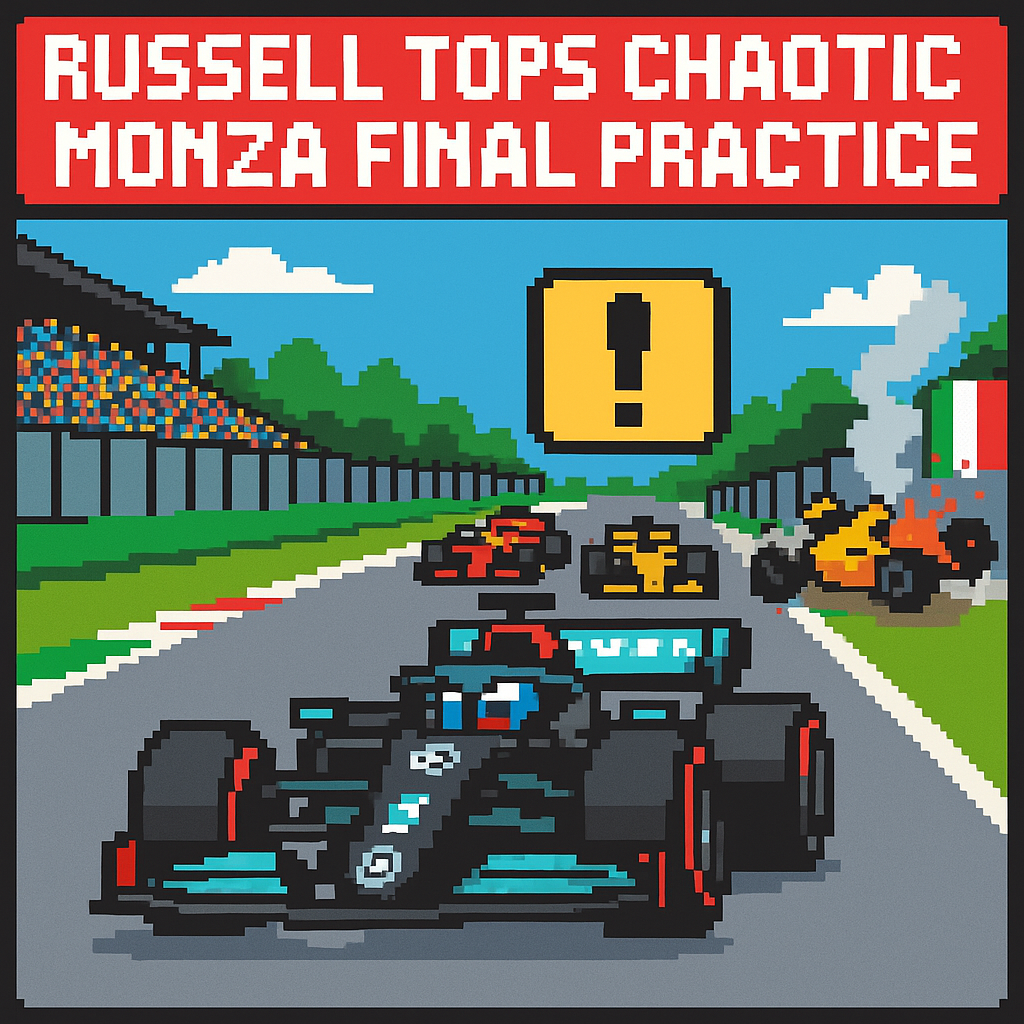
Russell Tops Chaotic Monza Final Practice | Analysis by Brian Moineau

TL;DR

  • Final practice at Monza put George Russell on top again with a 1:22.219, ahead of Ferrari’s Lewis Hamilton (+0.226) and Red Bull’s Max Verstappen (+0.350), making Mercedes the qualifying favorite on raw FP pace. [1][4]
  • The tow at Monza is historically worth roughly 0.5–0.7s per lap; with Russell’s FP3 edge only 0.226s over Hamilton, slipstream execution and traffic management will likely decide pole more than base car speed. [5][6][4]
  • Under 2026 regs, active aero and heavier electrical energy dependence add a new layer to the tow lottery, rewarding teams that script slipstreams without starving the battery down the 1.1 km main straight. [8][2]

What the source said

Formula 1’s official report states George Russell topped FP3 at the 2026 Italian Grand Prix with a 1:22.219 at Monza, ahead of Ferrari’s Lewis Hamilton and Red Bull’s Max Verstappen, after an hour marked by traffic, yellow flags, and a late switch to softs. Kimi Antonelli took P4 for Mercedes, Lando Norris was P5 for McLaren, and Charles Leclerc P6 for Ferrari. [1]

Stewards noted a Hamilton–Verstappen near‑miss on the start/finish straight but did not investigate; Williams’ Alex Albon suffered an early steering‑wheel glitch and rejoined later. Post‑session checks included potential yellow‑flag infringements for Albon and Carlos Sainz. Qualifying is set for 16:00 local time (CEST) at the Autodromo Nazionale Monza. [1][7]

Mercedes’ consistency carried from Friday to Saturday; Russell also led FP2, underscoring the W15’s low‑drag form entering Q1–Q3. The classification was confirmed by the FIA’s event bulletin. [2][4]

Why it matters

Margins at Monza are small and enforcement is sharp; stewards’ post‑session calls can flip rows when gaps sit in the two‑to‑four‑tenths band. Russell’s FP3 advantage—0.226s over Hamilton and 0.350s over Verstappen—sits inside the historical tow delta, so choreography can outweigh horsepower. Expect deliberate out‑lap pacing and strict minimum‑time deltas to shape Q3. [4][6]

For Ferrari, Hamilton’s P2 on home soil in Italy gives the Tifosi a realistic front‑row shot if a properly timed tow materializes on the Rettifilo run. For Red Bull, Verstappen’s deficit is bridgeable with one clean lap and a team‑assisted slipstream, given Monza’s 5.793 km layout and long straights. Midfielders risk queuing for tows and tripping impeding notes when gaps compress at Curva Alboreto. [4][5][6]

Original analysis

Monza magnifies execution. FP3 confirmed Mercedes as the reference, but the margin is tow‑sized rather than car‑sized. Qualifying will be won or lost on the pit wall. [4][6]

Back‑of‑envelope calculation (tow math):

  • Russell’s FP3 best: 1:22.219. Hamilton +0.226; Verstappen +0.350. [4]
  • Historic tow value at Monza: ~0.5–0.7s per lap (Mercedes cited ~0.7s in 2020; ESPN placed the benefit around ~0.5s in 2019/2020). [5][6]
  • If Hamilton lands a 0.5s tow and Russell runs clean air, Hamilton’s projected advantage becomes −0.274s (0.226 + 0.5 = 0.726s swing). If Russell nets even a modest 0.2–0.3s tow—plausible within that range—the gap compresses back near zero. This frames pole as a choreography problem first, a horsepower problem second. [5][6]

Historical analogue (2019’s “Monza farce” and the guardrails since):

  • In 2019, Q3 turned into a crawl as cars tried to avoid leading; several missed the flag. The FIA responded with guidance and minimum‑lap‑time deltas to curb near‑parking on straights. Incentives remain—the tow is still worth ~0.5s—but constraints force cleaner sequences in 2026. Expect similar gamesmanship today, minus the chaos of 2019. [6]

A 2×2: Quali DNA at Monza (2026 edition)

  • X‑axis: Tow reliance (Low → High).
  • Y‑axis: Energy‑strategy coherence under 2026 regs (Low → High).
    • Low Tow/High Energy: “Bankers”—clear air to nail deploy/harvest and active‑aero states. Risk: surrender 0.3–0.7s tow bonus. Reward: repeatable laps, fewer impeding risks. [5][8]
    • High Tow/High Energy: “Surgical Strikers”—script gaps and toggle low‑drag modes at the right spots without over‑harvesting. This is the pole quadrant if execution hits. [8]
    • High Tow/Low Energy: “Lottery Tickets”—big straights boost, but messy recharge/deploy or traffic kills sector balance. [6][8]
    • Low Tow/Low Energy: “Sitting Ducks”—neither slipstream nor smart energy use; qualify to car potential or worse.

Named‑stakeholder breakdown (what FP3 signals):

  • Mercedes (Russell/Antonelli): Two sessions on top—FP2 and FP3—indicate a strong baseline; they can even use Antonelli as a tow reference in Q3 without sacrificing both runs. [2][4]
  • Ferrari (Hamilton/Leclerc): Hamilton’s P2 is inside the tow window; at Monza, Ferrari can burn one attempt to set a two‑car chain for the main straight. [1][4]
  • Red Bull (Verstappen): The RB is in range; Verstappen’s traffic radio and the Hamilton near‑miss preview how tight gaps will be. They need Perez’s positioning—even from deeper in Q2/Q3—to punch a hole. [1][7]
  • Williams (Albon): Steering‑wheel glitches plus a yellow‑flag probe suggest a messy build‑up; prioritize creating sacrificial tows in Q1 to reach Q2. [1]
  • Stewards: FP3 already generated notes on impeding and yellow‑flags; one three‑place penalty can invert Rows 1–3 at these margins. [1][6]

Why the 2026 rules tilt the calculus

  • Active aero reduces drag on the straights for everyone, and the 2026 power units’ higher electrical proportion makes timing of deployment/harvest as critical as the slipstream. Teams must sync the tow with a battery profile that avoids “super‑clipping” before Curva Grande. A perfect tow with poor energy mapping may net less than a smaller tow with a dialed deploy map. That’s the added 2026 complexity. [8]

One more concrete point: Monza historically runs around 78% full throttle per lap, the highest on the calendar, and the track measures 5.793 km. Long straights still amplify small drag deltas into big lap‑time chunks, even with new aero states. Expect explicit team orders and pre‑baked out‑lap speeds to dominate Q3 radio. [5]

What others are missing

Most coverage spotlights the Russell–Hamilton–Verstappen order and the main‑straight flashpoint, but the hinge is the 2026 energy‑management/tow interaction. Active aero lowers drag while the MGU‑K deployment window narrows, so a mistimed map can force harvesting on the main straight and erase a 0.5s slipstream. [8][6]

The specific angle: aligning tow onset with peak battery state of charge so the car doesn’t hit the deploy limiter before the braking zone into Turn 1 (Rettifilo). The fastest package may not take pole; the best‑timed deploy map inside a tow will. [8]

What to watch next

  1. By 16:30 CEST today, Russell takes pole by less than 0.15s after a clean‑air banker plus one tow‑assisted lap; if he misses the tow window, Hamilton inherits P1.

  2. In Q3 today, at least one top‑eight lap is deleted or penalized for impeding or yellow‑flag delta breaches, reshuffling the second row between Curva Alboreto and Turn 1.

  3. On Sunday, the pole sitter’s opening‑stint average speed is ≥252.5 km/h, and the decisive overtake for the win occurs with a tow plus low‑drag mode engaged on the main straight within Lap 1–35.

My take

I lean Mercedes for pole and track position. Russell looks like the driver with both the car and headspace to survive Monza’s qualifying roulette, and his side already executed FP2 and FP3 cleanly. Ferrari can nick it with a perfectly timed two‑car train on the front stretch. [2][4][5]

Verstappen remains dangerous over one lap, but Red Bull must place a wingman precisely in Q3 traffic to engineer the gap. This weekend feels like Russell’s to stamp—if Mercedes keeps the out‑laps tidy and the battery map honest through Curva Alboreto and down the Rettifilo. [1][2][6]

Sources

  1. Russell goes fastest in busy final practice at Monza — Formula 1 (https://www.formula1.com/en/latest/article/fp3-russell-goes-fastest-from-hamilton-and-verstappen-in-final-italy-practice.6i9o4gazCqUo3UtLVRgoe8) — Official FP3 report: classification, incidents, investigations, and session context.

  2. F1 – Russell tops FP3 in Monza ahead of Hamilton and Verstappen — FIA (https://api.fia.com/news/f1-russell-tops-fp3-monza-ahead-hamilton-and-verstappen) — Governing‑body confirmation of FP3 order and Mercedes’ form across the weekend.

  3. F1 Italian GP: George Russell leads Lewis Hamilton in FP3 — Motorsport.com (https://www.motorsport.com/f1/news/f1-italin-gp-fp3-report/10852508/) — Independent report on the FP3 pace picture and team read‑throughs into qualifying.

  4. 2026 Formula 1 Italian GP — FP3 results — Autosport (https://www.autosport.com/f1/results/2026/italian-gp-661686/?st=FP3) — Detailed times, including Russell’s 1:22.219 and gaps to Hamilton (+0.226s) and Verstappen (+0.350s).

  5. 2021 Italian Grand Prix — Preview — Mercedes‑AMG F1 (https://media.mercedesamgf1.com/marsF1/en/instance/ko/2021-Italian-Grand-Prix—Preview.xhtml) — Monza context: high full‑throttle percentage, slipstream magnitude, and track characteristics.

  6. Explaining Monza’s qualifying shambles — and the tow advantage — ESPN (https://www.espn.com/f1/story/_/id/27560426/explaining-monza-qualifying-farce-why-vettel-avoided-penalty) — Background on the 2019 Q3 fiasco and the ~0.5s tow effect.

  7. George Russell sets pace as Hamilton and Verstappen clash in final Monza practice — Crash.net (https://www.crash.net/f1/news/1103660/1/george-russell-sets-pace-lewis-hamilton-and-max-verstappen-clash-final-monza-f1) — Additional detail on the Hamilton–Verstappen near‑miss and session timing.

  8. F1’s New Era: 2026 regulations overview — FIA (https://www.fia.com/news/f1s-new-era-everything-you-need-know-about-how-fia-making-formula-1-more-competitive-more) — Active‑aero and energy‑deployment changes shaping 2026 tow dynamics.


Related update: We recently published an article that expands on this topic: read the latest post.

Related update: We recently published an article that expands on this topic: read the latest post.

Leclerc Penalised After Miami GP Spin | Analysis by Brian Moineau

Why Leclerc was hit with a penalty after Miami GP — a closer look

Charles Leclerc endured a rollercoaster Miami Grand Prix on Sunday, and the headline — "Why Leclerc was hit with a penalty after Miami GP – Formula 1" — tells only part of the story. On the last lap he spun, clipped the wall, and limped across the line only to be demoted later when stewards added a post-race penalty. Fans saw the drama; the stewards saw repeated track-limit transgressions. Let’s unpack what happened, why it mattered, and what it means for Leclerc and Ferrari going forward.

Quick takeaways

  • The stewards handed Leclerc a drive-through penalty that was converted to a 20-second time addition because it was applied after the race.
  • The formal reason: repeated leaving of the track on the final lap without a justifiable reason, per FIA race regulations.
  • The penalty dropped Leclerc from sixth on the road to eighth in the official classification.
  • The decision reflects stricter enforcement of track limits and that mechanical issues do not automatically justify off-track excursions.
  • The incident underlines how a single error — compounded by post-race scrutiny — can erase a hard-fought recovery.

What exactly did Leclerc do on the last lap?

On the final lap at the Miami International Autodrome, Leclerc lost the rear end at Turn 3, spun and made light contact with the wall. He rejoined and continued to the finish, crossing the line in sixth position on track. Race control then reviewed telemetry, video and the car’s path. They concluded that on that lap Leclerc had left the track “on several occasions without a justifiable reason.” That finding triggered a drive-through penalty equivalent to 20 seconds added to his race time after the checkered flag, which demoted him in the final standings. (formula1.com)

The rule behind the decision

The stewards referenced F1 sporting regulations that penalize drivers who repeatedly go off the track to gain an advantage or avoid losing time, or who leave the track without a “justifiable reason.” Leaving the track because of an unavoidable mechanical failure or because someone else forced you off can be a valid defense. But in this case, the stewards judged Leclerc’s multiple excursions were not sufficiently justified by any mechanical issue. The wording used in the official explanations makes clear the decision centered on serial infringements on a single lap rather than one isolated mistake. (formula1.com)

Why the penalty was applied after the race

Stewards can issue certain penalties during the race (for example, drive-throughs or time penalties) but sometimes investigations extend beyond the chequered flag. When a drive-through is imposed post-race, the regulation converts it into a fixed time addition — in this case 20 seconds. That conversion is why Leclerc’s on-track sixth place became an eighth-place classification in the final results. Post-race conversions are standard procedure but feel especially brutal for drivers when the outcome was decided on the final lap. (formula1.com)

The human side: a costly mistake

Leclerc himself admitted the error was his responsibility, saying the last-lap spin was “not acceptable.” The image is stark: after fighting through the race, he loses rhythm and control right at the end, then suffers the double blow of a dramatic on-track error and an equally dramatic post-race demotion. That emotional arc — from hope to heartbreak — is part of why this story resonated with fans and pundits alike. (racer.com)

The tactical and championship implications

A single 20-second swing can be significant in both drivers’ and constructors’ standings, especially early in a season where margins are small. Beyond the points, there’s a reputational and momentum cost. For Leclerc, who has shown blistering pace but also occasional late-race errors this year, this incident reinforces a narrative teams hate: lost points are often more painful when they follow a recovery drive that could have yielded valuable reward.

For Ferrari, the stewards’ stance signals that teams must prepare drivers to accept strict policing of track limits — even when a spin or contact complicates the picture. Ferrari may need to reassess risk management in wheel-to-wheel scenarios and emphasize finishing cleanly as much as pushing for every tenth. (motorsport.com)

Why the stewards weren’t more lenient

Some fans expected sympathy — a spin and wall contact feel like extenuating circumstances. But stewards look at patterns. In Miami, the repeated nature of Leclerc’s departures from the track on that last lap made leniency harder to justify. The rule exists to preserve fairness: if drivers could routinely rejoin after going wide without consequence, track limits would lose their meaning. That said, debates always remain about proportionality: was a drive-through (20 seconds) the right conversion here? Opinions differ across pundits and former drivers. (motorsport.com)

My take

Racing is a mix of razor-edge skill and cold rules. Leclerc’s spin was human; the penalty was procedural. Both elements matter. Stewards are right to keep the sport consistent, but enforcement will always feel harsh when it erases a comeback. For Leclerc, the takeaway is practical: avoid leaving the track repeatedly, even after a mistake. For Ferrari, the task is to support that discipline while keeping Leclerc in a mindset that balances aggression with clean finishes.

Final thoughts

The Miami weekend will stick in memories not just for the on-track entertainment but because it highlights how modern F1 blends split-second driving with meticulous post-race governance. Rules are there to assure fairness; their application can change race outcomes. That tension — the human drama vs. the rulebook — is exactly what keeps debates alive after every Grand Prix.

Sources


Related update: We recently published an article that expands on this topic: read the latest post.


Related update: We recently published an article that expands on this topic: read the latest post.

Verstappen Penalized for Pit Exit Breach | Analysis by Brian Moineau

When a White Line Became the Story: Verstappen's Five-Second Penalty in Miami

A five-second time penalty has gone Max Verstappen’s way for crossing the white line at the pit exit in the Miami Grand Prix. The penalty felt small in raw seconds, but like many things in Formula 1, the detail — a single tyre over a painted line — grew into a prism that reflected rules, timing, and how tiny margins tilt championship narratives.

The incident happened during the 2026 Miami Grand Prix weekend. Verstappen rejoined the track after a pit stop and was later investigated by the stewards, who concluded his front-left tyre had crossed the outside of the solid white pit-exit line in breach of Appendix L, Chapter IV Article 6(c) of the International Sporting Code. The stewards applied the standard five-second time penalty post-race. Despite the sanction, race events (notably Charles Leclerc’s own post-race penalty) left Verstappen’s final position unchanged, but the moment still offers useful lessons about enforcement, perception, and the thin hairline between fair play and foul.

Why the white line matters

The pit-exit line isn’t a cosmetic rule. It exists to manage rejoining cars so they don’t create unsafe situations as they enter live racing lines. Crossing that line can put a driver directly into another car’s path, especially during safety-car periods or full-course yellows when cars bunch up and speeds converging are unpredictable.

Race control treats the line seriously because it’s an objective, clearly marked boundary. Video evidence and timing data make it straightforward to check whether a tyre touched the outside of the white. The regulation doesn’t make exceptions for the context — so, even if a driver says they were rejoining under a full-course yellow, that does not automatically excuse a line breach. The stewards’ published reasoning in Miami referenced exactly that text of the sporting code. (formula1.com)

What happened in Miami (short timeline)

  • Verstappen pitted and rejoined the track during a period when the race was affected by slowed conditions.
  • Race control flagged the exit; the stewards reviewed the camera footage after the race.
  • They determined the outside of Verstappen’s front-left tyre had crossed the solid white pit-exit line, constituting a breach.
  • The stewards imposed the standard five-second time penalty, applied to his race time post-event.
  • The final finishing order left Verstappen in P5, helped by other events and penalties that shuffled the order. (grandprixwire.com)

The penalty: proportional or pickier enforcement?

On the surface, a five-second penalty is the routine sanction here. But what made the Miami story interesting wasn’t the amount of time — it was how and when the stewards acted.

  • Timing: Officials chose a post-race review rather than an in-the-moment call. That invites debate: should obvious infractions be dealt with immediately to clear the air, or is it better to ensure incontrovertible evidence before penalising a championship leader?
  • Consistency: Fans and teams always compare enforcement across weekends. Some infractions get immediate penalties; others get reviewed later. That perceived inconsistency fuels chatter about “driver bias” or variable stewarding standards.
  • Outcome sensitivity: Because penalties can be converted (drive-throughs become time additions if issued after the race), the final race order can swing by seconds — and seconds matter in F1 standings and storytelling. (formula1.com)

These aren’t novel complaints. Formula 1 has long balanced on the tension between instant sporting justice and the need for airtight evidence. Miami’s choice to investigate post-race seems driven by the caution of stewards who wanted an unmistakable picture before altering results.

Broader race context matters

Verstappen’s penalty didn’t exist in a vacuum. The Miami race featured strategic gambles, on-track skirmishes, and other post-race investigations (notably Charles Leclerc receiving a larger time addition). Those developments meant the five-second penalty had less immediate consequence than it might have in a cleaner race.

Still, the optics are important: a World Champion being penalised for a pit-exit line breach feeds headlines and social media reaction. It reinforces that even the biggest names must obey the smallest lines, and it reminds teams to brief on rejoin discipline as much as they do tyre compounds. (formula1.com)

What teams and drivers will take away

  • Precision trumps bravado: A millimetre over a white line can cost time and headlines. Drivers must be drilled on pit-exit discipline.
  • Cameras win arguments: Expect continued investment in pit-exit camera angles and telemetry crosschecks to prevent late penalties.
  • Stewarding predictability should be the target: Teams want clearer, quicker signals so they can adapt strategy rather than chase post-race reversals.

From a championship perspective, the incident is a reminder that mechanical reliability, strategy, and tiny human choices combine to decide outcomes — not just raw pace.

My take

Rules are necessary and, in this case, straightforward. The stewarding panel followed the rulebook and delivered the expected sanction. What I find more notable is how a relatively small infraction can dominate headlines when it touches a star driver. That magnification is part sport, part media economics: Verstappen’s name sells attention, and the white line became a lens into how finely tuned F1 governance has to be.

That said, if the FIA wants to reduce post-race drama, a move toward faster, more transparent on-track communications — or an automated sensor-backed confirmation of pit-exit breaches — would help. Racing should feel like a contest decided by speed and strategy, not post-race paperwork.

Final thoughts

The Miami five-second penalty was a tidy enforcement of an old rule. It didn’t upend the championship, but it did what good sporting processes do: remind everyone that rules matter and that even tiny errors have consequences. In a sport where milliseconds define legacy, a tyre over a line is both a cautionary tale and a prompt to refine processes.

Sources


Related update: We recently published an article that expands on this topic: read the latest post.


Related update: We recently published an article that expands on this topic: read the latest post.