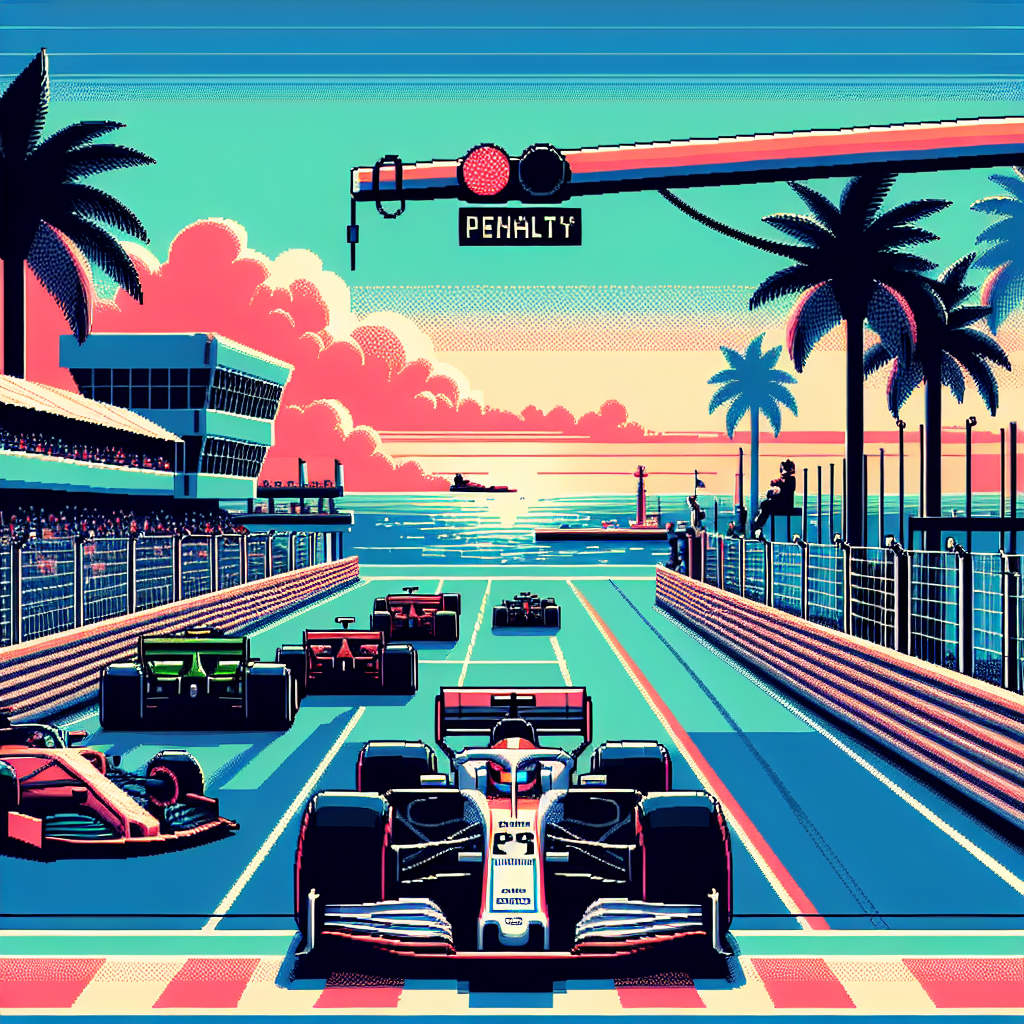
When a White Line Became the Story: Verstappen's Five-Second Penalty in Miami
A five-second time penalty has gone Max Verstappen’s way for crossing the white line at the pit exit in the Miami Grand Prix. The penalty felt small in raw seconds, but like many things in Formula 1, the detail — a single tyre over a painted line — grew into a prism that reflected rules, timing, and how tiny margins tilt championship narratives.
The incident happened during the 2026 Miami Grand Prix weekend. Verstappen rejoined the track after a pit stop and was later investigated by the stewards, who concluded his front-left tyre had crossed the outside of the solid white pit-exit line in breach of Appendix L, Chapter IV Article 6(c) of the International Sporting Code. The stewards applied the standard five-second time penalty post-race. Despite the sanction, race events (notably Charles Leclerc’s own post-race penalty) left Verstappen’s final position unchanged, but the moment still offers useful lessons about enforcement, perception, and the thin hairline between fair play and foul.
Why the white line matters
The pit-exit line isn’t a cosmetic rule. It exists to manage rejoining cars so they don’t create unsafe situations as they enter live racing lines. Crossing that line can put a driver directly into another car’s path, especially during safety-car periods or full-course yellows when cars bunch up and speeds converging are unpredictable.
Race control treats the line seriously because it’s an objective, clearly marked boundary. Video evidence and timing data make it straightforward to check whether a tyre touched the outside of the white. The regulation doesn’t make exceptions for the context — so, even if a driver says they were rejoining under a full-course yellow, that does not automatically excuse a line breach. The stewards’ published reasoning in Miami referenced exactly that text of the sporting code. (formula1.com)
What happened in Miami (short timeline)
- Verstappen pitted and rejoined the track during a period when the race was affected by slowed conditions.
- Race control flagged the exit; the stewards reviewed the camera footage after the race.
- They determined the outside of Verstappen’s front-left tyre had crossed the solid white pit-exit line, constituting a breach.
- The stewards imposed the standard five-second time penalty, applied to his race time post-event.
- The final finishing order left Verstappen in P5, helped by other events and penalties that shuffled the order. (grandprixwire.com)
The penalty: proportional or pickier enforcement?
On the surface, a five-second penalty is the routine sanction here. But what made the Miami story interesting wasn’t the amount of time — it was how and when the stewards acted.
- Timing: Officials chose a post-race review rather than an in-the-moment call. That invites debate: should obvious infractions be dealt with immediately to clear the air, or is it better to ensure incontrovertible evidence before penalising a championship leader?
- Consistency: Fans and teams always compare enforcement across weekends. Some infractions get immediate penalties; others get reviewed later. That perceived inconsistency fuels chatter about “driver bias” or variable stewarding standards.
- Outcome sensitivity: Because penalties can be converted (drive-throughs become time additions if issued after the race), the final race order can swing by seconds — and seconds matter in F1 standings and storytelling. (formula1.com)
These aren’t novel complaints. Formula 1 has long balanced on the tension between instant sporting justice and the need for airtight evidence. Miami’s choice to investigate post-race seems driven by the caution of stewards who wanted an unmistakable picture before altering results.
Broader race context matters
Verstappen’s penalty didn’t exist in a vacuum. The Miami race featured strategic gambles, on-track skirmishes, and other post-race investigations (notably Charles Leclerc receiving a larger time addition). Those developments meant the five-second penalty had less immediate consequence than it might have in a cleaner race.
Still, the optics are important: a World Champion being penalised for a pit-exit line breach feeds headlines and social media reaction. It reinforces that even the biggest names must obey the smallest lines, and it reminds teams to brief on rejoin discipline as much as they do tyre compounds. (formula1.com)
What teams and drivers will take away
- Precision trumps bravado: A millimetre over a white line can cost time and headlines. Drivers must be drilled on pit-exit discipline.
- Cameras win arguments: Expect continued investment in pit-exit camera angles and telemetry crosschecks to prevent late penalties.
- Stewarding predictability should be the target: Teams want clearer, quicker signals so they can adapt strategy rather than chase post-race reversals.
From a championship perspective, the incident is a reminder that mechanical reliability, strategy, and tiny human choices combine to decide outcomes — not just raw pace.
My take
Rules are necessary and, in this case, straightforward. The stewarding panel followed the rulebook and delivered the expected sanction. What I find more notable is how a relatively small infraction can dominate headlines when it touches a star driver. That magnification is part sport, part media economics: Verstappen’s name sells attention, and the white line became a lens into how finely tuned F1 governance has to be.
That said, if the FIA wants to reduce post-race drama, a move toward faster, more transparent on-track communications — or an automated sensor-backed confirmation of pit-exit breaches — would help. Racing should feel like a contest decided by speed and strategy, not post-race paperwork.
Final thoughts
The Miami five-second penalty was a tidy enforcement of an old rule. It didn’t upend the championship, but it did what good sporting processes do: remind everyone that rules matter and that even tiny errors have consequences. In a sport where milliseconds define legacy, a tyre over a line is both a cautionary tale and a prompt to refine processes.
Sources
-
Verstappen hit with penalty for pit exit breach during Miami Grand Prix — Formula1.com
https://www.formula1.com/en/latest/article/verstappen-hit-with-penalty-for-pit-exit-breach-during-miami-grand-prix.y0KVGAbtL5liHWc02fZMB -
Max Verstappen Under Investigation by Miami GP Stewards — Grand Prix Wire (May 3, 2026)
https://grandprixwire.com/2026/05/03/max-verstappen-under-investigation-by-miami-gp-stewards-championship-leader-faces-potential-penalty/ -
Max Verstappen feels regret over strategy call in Miami — Formula1.com
https://www.formula1.com/en/latest/article/it-was-just-too-difficult-to-keep-the-tyres-alive-verstappen-admits-regret-over-strategy-call-in-miami.h8v4jv39bH3RQPO5VRvcE
Related update: We recently published an article that expands on this topic: read the latest post.
Related update: We recently published an article that expands on this topic: read the latest post.