Cash Payers Subsidize Cardholder Perks | Analysis by Brian Moineau

TL;DR

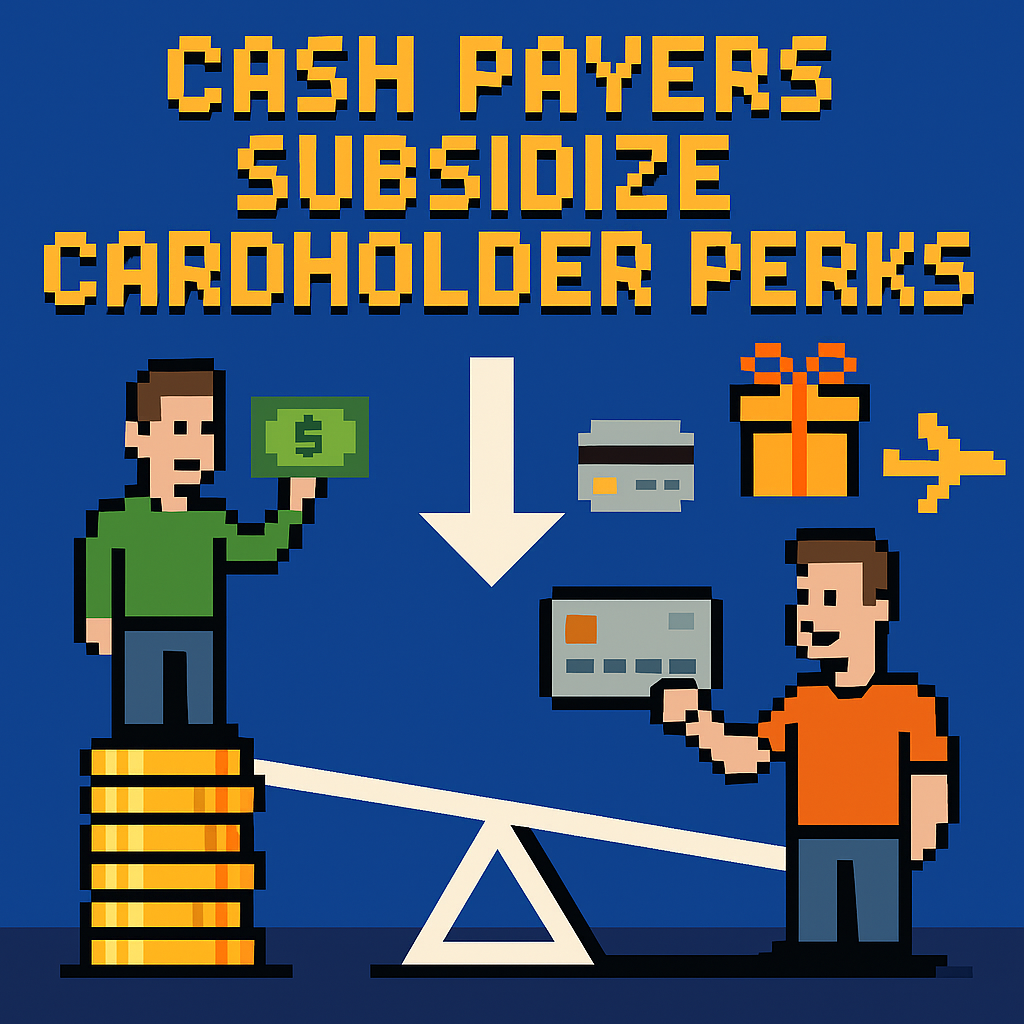
  • High-end credit card perks don’t come free: U.S. merchants baked roughly $198.25 billion of 2025 card fees into prices, shifting costs onto cash and debit users while rewarding premium cardholders [3][4]. (merchantspaymentscoalition.com)
  • A Harvard Business School working paper estimates an implicit transfer of about $30 billion a year from cash/debit users—often lower-income households—to rewards card users [2].
  • The “easy fix” of cutting interchange looks oversold: after the 2011 Durbin cap on debit, about 77% of merchants did not lower prices, hinting new reforms could enrich large retailers while shrinking consumer rewards [7].

What the source said

NBC News profiled Tiger Fuel in Ruckersville, Virginia, and other small merchants who say rising swipe fees from Visa and Mastercard networks and issuing banks now rival or exceed rent and utilities [1]. Premium rewards cards often carry fees above 2%, and total U.S. merchant card fees hit about $198 billion in 2025, per the Nilson Report and industry tallies [3][4]. The National Retail Federation claims these fees add more than $1,200 a year to the average household’s costs [5]. Harvard researchers estimate roughly $30 billion flows annually from cash/debit users to rewards cardholders, while the Electronic Payments Coalition argues that cash handling also carries costs like theft risk and labor [2][13].

Why it matters

This isn’t “points people vs. Luddites.” It’s a regressive cross-subsidy embedded in 2025 retail pricing: cash and debit users—disproportionately households under $25,000 in income—fund airport lounges, 5x dining multipliers, and companion fares via higher shelf prices, while rewards users get some of it back as points [2][6]. Harvard’s $30 billion estimate and the Federal Reserve’s Diary of Consumer Payment Choice both show who pays and who benefits when merchants recoup acceptance costs through uniform pricing [2][6].

Merchants face a blunt P&L trade-off in 2026: accept card convenience and bigger baskets but pay rising tolls, or push cash/ACH and risk lost sales and chargebacks. Networks (Visa, Mastercard), big issuers (JPMorgan Chase, Capital One, Citi), and loyalty partners (United, Delta, American) live on interchange economics that fund rewards; banks alone collected about $66 billion of interchange revenue in 2025, according to the St. Louis Fed [10]. Policy tinkering can redirect billions across these pipes, but pass-through depends on local competition and merchant power, not promises in a press release.

Original analysis

High-end credit card perks and the cash shopper subsidy

  • Back-of-envelope math, shown:

    • Total U.S. merchant card fees in 2025: $198.25 billion (credit + debit) [3][4]. Total U.S. card purchase volume in 2025: $12.498 trillion [3]. Average all-in fee load ≈ 198.25 / 12,498 ≈ 1.59% on carded spend, before acquirer markups and MCC differences [3][4]. For low-margin formats like grocery, that burden explains why fuel stations and c-stores complained first.
    • What would a 10-basis-point (0.10%) cut do at the register? On a $100 basket, it saves $0.10; on $1,000,000 in monthly credit sales, it saves $1,000. The proposed Visa/Mastercard settlement’s five-year, 10 bps reduction would be meaningful for thin-margin operators, but small in a supermarket aisle price tag context [8].
  • A contrarian read:

    • Consensus: “Rewards are a regressive tax; cap interchange and prices will fall.”
    • Pushback: After the 2011 Durbin cap on debit, Richmond Fed surveys found about 77% of merchants did not cut prices; roughly 1–2% lowered them, and others raised them—weak pass-through from lower acceptance costs to shelf prices [7]. If credit caps replay this script, consumers could lose rewards value while prices mostly stay put.
  • A 2x2 to predict pass-through from fee cuts:

    • Low ticket, high competition (e.g., QSRs like McDonald’s; MCC 5814): Highest odds of pass-through via value menus and combo pricing to defend share.
    • Low ticket, low competition (e.g., captive venues at airports; limited-choice c-stores on highways): Low pass-through; fee relief pads margins or offsets rent.
    • High ticket, high competition (e.g., electronics retailers; Home Depot vs. Lowe’s): Moderate pass-through in promos, rebates, or free financing offers.
    • High ticket, low competition (e.g., airline direct sales; Delta/American/United): Minimal pass-through; savings more likely to fund loyalty tweaks or fees.
  • A named-stakeholder breakdown:

    • Visa and Mastercard: A time-limited 10 bps haircut is manageable; the bigger risk is the Credit Card Competition Act forcing routing choice that could erode network dominance [8][9].
    • Large issuers (JPMorgan Chase, Capital One, Citi): Expect incremental rewards repricing—fewer eye-popping multipliers, more annual-fee creep, and tighter lounge/partner access if interchange compresses.
    • Small merchants (gas, c-stores, restaurants): Savings from a 10 bps cut are real but thin; dual pricing, PINless debit routing, and steering will likely drive more net benefit in 2026–2027 than headline settlements [4].
    • Low-income cash users: The Harvard-estimated $30 billion transfer exists, but history suggests caps won’t automatically flow back as lower prices; cash-acceptance mandates and transparent dual pricing are more targeted [2][11].

What others are missing

The specific angle missing is the break-even basket size and fraud-loss variance by merchant category code: compare fully loaded cash costs (till labor, shrink, armored car, bank fees) against card acceptance (interchange, assessments, chargeback loss) for MCC 5411 (grocery), 5541 (service stations), and 5814 (fast-food/QSR). Industry groups highlight one side—NRF emphasizes card tolls; EPC stresses cash’s hidden costs—yet policymakers rarely see an apples-to-apples, third-party audit by basket size and format [5][13]. A 2026 benchmark that publishes per-transaction cost curves and pass-through elasticities by format would show whether “cash isn’t free” or “cards tax every item” dominates in real stores, not just in D.C. hearing rooms.

What to watch next

  1. By Q4 2026, Judge Margo Brodie either approves the revised Visa/Mastercard settlement or remands it; my call: not approved in 2026, given retailer opposition and limited structural change [12].
  2. By June 2027, at least three additional states follow New York’s March 2026 statute and enact cash-acceptance mandates for most brick-and-mortar retailers, citing equity for unbanked consumers [11].
  3. By 2027 year-end, at least one top-5 U.S. card issuer announces a meaningful rewards devaluation (earn rates or redemption), attributing it to program costs and regulatory pressure around routing and fees [9].

My take

Yes, premium credit card perks are hurting cash shoppers; the ~$30 billion annual transfer is real and persistent in 2024–2026 data [2]. But if Congress or the courts shave interchange without enforcing shelf-level transparency, consumers will likely lose rewards while prices stay sticky. The practical fix is local and testable in 2026: universal cash acceptance, visible dual pricing, and competitive routing that merchants can actually use [11]. If Washington wants broad relief, force price clarity and rivalry—not just a smaller toll collected in the dark [4].

Sources

  1. NBC News — How shoppers who pay in cash are subsidizing Americans’ credit card reward points (https://www.nbcnews.com/business/consumer/credit-card-perks-hurt-shoppers-pay-cash-debit-rcna346905) — Reported merchant pain points, cited network/issuer roles, and surfaced household impact claims.

  2. Harvard Business School — Interchange Fees and Cross-Subsidies in Consumer Payments (Working Paper 26-069) (https://www.hbs.edu/ris/Publication%20Files/26-069_6c4ebfc5-af17-4744-b8a5-3f2ca740aea7.pdf) — Estimated ~$30B annual transfers from cash/debit users to credit users, with incidence by income.

  3. The Nilson Report — Merchant Processing Fees in the United States — 2025 (https://nilsonreport.com/articles/merchant-processing-fees-in-the-united-states-2025/) — Provided 2025 U.S. purchase volume ($12.498T) and context for fee-load calculations.

  4. Merchants Payments Coalition — Credit and Debit Card ‘Swipe’ Fees Reach Record $198.25 Billion (https://merchantspaymentscoalition.com/credit-and-debit-card-swipe-fees-reach-record-19825-billion-president-and-congress-call-action) — Cited Nilson’s 2025 fee total and summarized merchant-side advocacy.

  5. National Retail Federation — Swipe Fees (https://nrf.com/advocacy/policy-issues/swipe-fees) — Claimed swipe fees are a top cost driver and add “more than $1,200 a year” to average household costs.

  6. Federal Reserve Financial Services — 2025 Findings from the Diary of Consumer Payment Choice (https://www.frbservices.org/binaries/content/assets/crsocms/news/research/2025-diary-of-consumer-payment-choice.pdf) — Documented higher cash use among low-income households and transaction-size patterns.

  7. Federal Reserve Bank of Richmond — Did the Durbin Amendment Reduce Merchant Costs? Evidence from Survey Results (https://www.richmondfed.org/publications/research/economic_brief/2015/eb_15-12) — Found limited post-cap price reductions, informing pass-through expectations.

  8. U.S. SEC — Mastercard filing summarizing proposed settlement terms (10 bps cut; caps) (https://www.sec.gov/Archives/edgar/data/0001141391/000114139125000197/exb991-11102025.htm) — Documented details of the November 2025 revised settlement structure.

  9. Congress.gov — Credit Card Competition Act bill page (https://www.congress.gov/bill/119th-congress/senate-bill/3623/all-actions) — Tracked routing-choice legislation that could change network economics.

  10. Federal Reserve Bank of St. Louis — Credit and Debit Card Fees Collected by U.S. Banks Rose in 2025 (https://www.stlouisfed.org/on-the-economy/2026/apr/banking-analytics-credit-debit-card-fees-collected-banks-rose-2025) — Estimated banks’ 2025 interchange revenue (~$66B).

  11. New York Attorney General — Statewide Cash Acceptance Law (Press Release, March 2026) (https://ag.ny.gov/press-release/2026/attorney-general-james-notifies-new-yorkers-about-new-state-law-requiring-stores) — Confirmed a cash-acceptance mandate trend shaping “cash equity” policy.

  12. American Bar Association — In re Payment Card Interchange Fee and Merchant Discount Antitrust Litigation (newsletter) (https://www.americanbar.org/groups/antitrust_law/resources/newsletters/in-re-payment-card-interchange-fee-merchant-discount-antitrust-litigation/) — Summarized settlement posture before Judge Margo Brodie.

  13. Electronic Payments Coalition — Cash Costs More Than Credit Cards for Small Businesses (https://electronicpaymentscoalition.org/resources/cash-costs-more-than-credit-cards-for-small-businesses/) — Presented the industry view on cash-handling costs versus card acceptance.

Prime Day First-Day Sales Dive 41%, Retail Consultant Reports – PYMNTS.com | Analysis by Brian Moineau

Prime Day First-Day Sales Dive 41%, Retail Consultant Reports - PYMNTS.com | Analysis by Brian Moineau

Title: Amazon Prime Day: A Dive or a Detour in the Retail Roadmap?

Ah, Prime Day! The annual celebration that usually has shoppers frantically adding to cart, much like a modern-day supermarket sweep. However, this year, instead of a virtual stampede, it seems like consumers took a more leisurely stroll down the Amazon aisles. According to a report by a retail consultant, Amazon's first-day sales of their extended four-day Prime Day event this year took a nosedive, plummeting by 41% compared to the first day of last year's two-day event. Now, before we start penning the eulogies for e-commerce, let's unpack this retail revelation.

The Numbers Game

First, let's consider the broader retail landscape. The pandemic catalyzed a digital shopping boom, with Amazon at the forefront, delivering everything from toilet paper to treadmills. However, as the world gingerly steps out of the shadow of COVID-19, consumer habits are shifting once again. People are eager for in-person experiences, which might explain why this year's Prime Day didn't quite hit the high notes.

But is this decline truly a catastrophe for Amazon? Not necessarily. A multitude of factors could be at play. For instance, inflationary pressures are leading consumers to tighten their purse strings. According to the U.S. Bureau of Labor Statistics, inflation rates have been fluctuating, impacting disposable income and thus, discretionary spending. Additionally, the extended four-day event might have spread out purchases, evening out the spending frenzy that usually characterizes the first day.

The Wider Web of Retail

Interestingly, Amazon's dip coincides with a broader trend in retail—consumers are becoming more discerning. The surge of sustainable and ethical shopping practices is reshaping how people approach consumption. Companies like Patagonia and The RealReal are thriving by championing sustainability, and consumers are increasingly opting for brands that align with their values.

Moreover, the rise of competitors in the retail space cannot be ignored. Walmart and Target are upping their game with online sales events and exclusive deals, offering a viable alternative to Amazon's Prime Day. This diversification in consumer choice could be diluting the once-uncontested dominance of Amazon's sales event.

A Global Glance

Zooming out, let's consider how global events may be influencing this trend. The ongoing war in Ukraine and geopolitical tensions are contributing to economic uncertainty worldwide. Such instability affects global markets, with ripples felt by companies and consumers alike.

Furthermore, the world is facing supply chain challenges, a hangover from pandemic disruptions. These issues are causing delays and inventory shortages, affecting sales across various sectors, including e-commerce.

Final Thoughts: A Prime Opportunity?

So, what does this 41% drop really signify? While it might seem like a setback, it's perhaps more of a recalibration than a collapse. Amazon is a retail behemoth with a robust ecosystem of services—from AWS to Kindle—that insulate it from the impact of a single sales event.

For consumers, this could be a win. As competition heats up, companies will be vying for attention, possibly leading to better deals and more innovative shopping experiences. For Amazon, this could be a pivotal moment to reassess and refine their strategies, ensuring they stay ahead in the ever-evolving retail landscape.

In conclusion, while the numbers might suggest a downturn, remember: in the world of business, every setback is but a setup for a comeback. So, here's to the next Prime Day—may it be as thrilling as ever, whether you're shopping from your desk or your deck chair.

Read more about AI in Business

Read more about Latest Sports Trends

Read more about Technology Innovations

Dollar Tree raises red flag about unexpected customer behavior – TheStreet | Analysis by Brian Moineau

Dollar Tree raises red flag about unexpected customer behavior - TheStreet | Analysis by Brian Moineau

Unpacking the Dollar Tree Dilemma: A Lighthearted Dive into Consumer Curiosities


In the ever-evolving world of retail, where trends can shift as quickly as a TikTok dance craze, Dollar Tree has recently raised an intriguing red flag concerning unexpected customer behavior. While the original article from TheStreet might have approached this topic from a business-centric perspective, let's take a moment to explore this retail conundrum with a touch of whimsy and broader context.

The Dollar Tree Phenomenon: More Than Just a Store


Dollar Tree isn't just a discount haven; it's a cultural staple. For many, it's the place where you can find everything from party supplies to the oddly satisfying array of seasonal decorations. However, this beloved budget-friendly chain is witnessing a shift in customer behavior that's got them scratching their heads.

Whether it's customers buying in bulk or opting for items they wouldn't have considered before, these changes could be a reflection of broader economic uncertainties. With inflationary pressures still lingering in many parts of the world, consumers are more price-conscious than ever. It's interesting to see how Dollar Tree, a store that thrives on the allure of affordability, is responding to these shifts.

Retail Therapy Meets Real World Challenges


This trend isn't occurring in isolation. Across the retail landscape, companies are grappling with changing consumer habits. For instance, during the pandemic, we saw a surge in online shopping—a habit that many have retained. Similarly, the rise of "frugal living" influencers on platforms like Instagram and YouTube has encouraged shoppers to be more discerning about their purchases, seeking value in every dollar spent.

In contrast, luxury brands are also seeing shifts. While Dollar Tree customers might be focused on stretching their dollars, high-end retailers are catering to a different kind of consumer: one who is looking for quality over quantity, thereby creating a fascinating dichotomy in consumer behavior.

Connections to the Wider World


Looking beyond the retail shelves, these shifts in consumer behavior can also be linked to larger global events. Economic slowdowns in major markets, geopolitical tensions, and supply chain disruptions have all played a role in shaping how and where people spend their money. In the U.S., for example, the fluctuating job market and housing concerns have tightened budgets for many households.

Moreover, environmental consciousness is another factor influencing shopping habits. More consumers are now opting for sustainable products, which often means buying less but buying better. This could explain why some are turning to Dollar Tree for essentials while saving up for eco-friendly splurges elsewhere.

Final Thoughts: The Future of Frugality


Dollar Tree's red flag might be an indication of changing times, but it's also a testament to the resilience of consumers. In an era where adaptability is key, both retailers and shoppers are finding new ways to navigate the economic landscape. As we look to the future, it will be fascinating to see how Dollar Tree and its counterparts continue to adapt to these evolving consumer behaviors.

So, next time you find yourself wandering the aisles of a Dollar Tree, remember: each purchase is not just a transaction but a reflection of broader trends and personal priorities. Who knew a dollar store could hold such profound insights?

Read more about AI in Business

Read more about Latest Sports Trends

Read more about Technology Innovations

What’s open and what’s closed this Memorial Day – PBS | Analysis by Brian Moineau

What’s open and what’s closed this Memorial Day - PBS | Analysis by Brian Moineau

Title: Memorial Day: Navigating the Open, the Closed, and the Shopping Sprees

Ah, Memorial Day—the unofficial kickoff to summer, a long weekend filled with barbecues, parades, and a moment to honor those who have served in the military. Traditionally, this day has been a time for reflection and remembrance, but increasingly, it's also become one of the most bustling retail sales and travel weekends of the year. While some businesses stay true to the holiday’s roots by closing their doors, more and more are choosing to stay open. So, what's open and what's closed this Memorial Day?

The Retail Rush


Once upon a time, Memorial Day was a day of rest for businesses. However, in recent years, retailers have seized the opportunity to capitalize on the long weekend. Major chains like Walmart, Target, and Home Depot will swing open their doors, offering enticing sales that make it nearly impossible for the average consumer to resist. According to the National Retail Federation, retail sales during this period have surged, making it a crucial weekend for businesses nationwide. [Forbes](https://www.forbes.com) has aptly named it "the Black Friday of Spring."

A Travel Boom


Travel agencies, airlines, and hotels are also open for business, ready to welcome the throngs of people eager to escape for a mini-vacation. The American Automobile Association (AAA) predicts that millions will hit the road, with popular destinations including beach towns, national parks, and city getaways. The rise in travel during this holiday weekend is so significant that it almost mirrors the bustling Thanksgiving travel week.

What’s Closed?


While many businesses choose to keep the cash registers ringing, some places honor the solemnity of the day by closing up shop. Government offices, banks, and the stock market typically take a pause. These closures serve as a gentle reminder of the day's original intent: to honor and remember those who have served in the U.S. Armed Forces.

A Global Perspective


Interestingly, the commercialization of Memorial Day isn’t an isolated phenomenon; other countries experience similar trends with their holidays. In Australia, Anzac Day serves a similar purpose, yet retail closures on this day are enforced by law until 1:00 PM, allowing citizens time to attend commemorative services. It's a fascinating contrast that highlights how different cultures balance commerce and commemoration.

Final Thoughts


As Memorial Day continues to evolve, it’s essential to strike a balance between honoring its origins and indulging in the festivities that have grown around it. Whether you're planning to shop till you drop, travel to a new destination, or simply enjoy a backyard cookout, take a moment to remember the significance of the day. After all, Memorial Day is about more than just sales and sun—it's a time to reflect on the sacrifices made by those who served.

In a world that’s constantly moving, having a day that serves as both a commemoration and a celebration is a unique opportunity to pause, reflect, and enjoy. With both open doors and quiet moments, Memorial Day offers a little something for everyone.

Read more about AI in Business

Read more about Latest Sports Trends

Read more about Technology Innovations