Minted Pea & Spinach Soup | Made by Meaghan Moineau

I had one of those chaotic Tuesdays where nothing seemed to go as planned. My phone was buzzing with notifications, the laundry pile was threatening to overthrow the hamper, and my stomach was growling like an angry bear by 6 PM. With no time to fuss over a fancy dinner, I needed something quick yet soul-soothing. Enter Minted Pea & Spinach Soup — my mid-week savior. It’s the kind of dish that feels like a warm hug in a bowl, ready in no time, and with a freshness that makes you feel like you’re doing something good for yourself. Plus, the ingredients are mostly things you’ll likely find lurking in your pantry or freezer. It’s like a little magic trick on a hectic day.

Jump to Recipe

What You’ll Need

You won’t need anything too fancy here, just some basic kitchen staples. Chances are you already have most of this on hand, which makes this recipe a dream come true for a busy evening.

  • Chicken stock
  • Cream
  • Canned dried mint
  • Milk
  • Frozen peas
  • Diced potatoes
  • Salt & pepper
  • Fresh spinach
  • Sugar
  • Water
  • Yoghurt

How to Make Minted Pea & Spinach Soup

  1. Place the diced potatoes in a medium-sized pot. Add just a splash of water and a sprinkle of salt & pepper. Pop the lid on and let them cook on medium heat for about 20 minutes, until they’re almost soft. You’ll know they’re ready when you can easily pierce them with a fork.
  2. Add the frozen peas to the pot and let them simmer for another 5 minutes. By now, the potatoes should be fully tender and ready to melt in your mouth.
  3. Toss in the fresh spinach and cook for another 3-5 minutes, stirring occasionally, until the spinach wilts down into a lovely green tangle.
  4. Remove the pot from the heat and let it cool down for a few minutes. This gives you time to prepare for the blending magic without risking a steamy facial.
  5. Using an immersion blender, blend the mixture to a silky puree. It should be smooth, yet vibrant with that gorgeous green hue.
  6. Place the pot back on the stovetop. Pour in the cream, milk, chicken stock, and a bit more water if needed. Heat it gently until it’s piping hot but not boiling.
  7. Stir in the yoghurt, mint, and a pinch of sugar. Taste the soup and adjust the salt and pepper if necessary. Give it a good stir to combine all those lovely flavors.
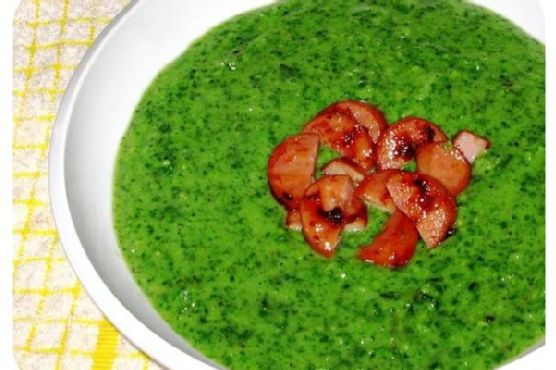
  8. Serve immediately. For extra flair, scatter some crispy croutons or bacon bits on top. If you’re like me, and have some cheesegrillers on hand, slice them thinly, fry with a touch of sweet chili sauce, and use them as a delicious topper.

Cook’s Notes

This soup is incredibly forgiving — perfect for those nights when you’re a bit forgetful or distracted. If you happen to overcook the peas or spinach, don’t worry. The immersion blender will still work its magic. For a thicker consistency, reduce the amount of water or let it simmer longer after blending. Leftovers can be stored in an airtight container in the fridge for up to 3 days. Just reheat gently on the stove and enjoy again.

Make It Your Own

  • Swap the chicken stock for vegetable stock to make it vegetarian.
  • For a vegan version, replace cream and yoghurt with coconut milk.
  • Add a squeeze of lemon juice before serving for a zesty kick.
  • If you like a bit of spice, sprinkle in some chilli flakes or cayenne pepper.

If you try this, I’d love to hear how it turns out — drop a comment or tag me! Your kitchen adventures make my day, so don’t be shy about sharing your soup tales. Enjoy your cozy bowl of green goodness!

Related update: Minted Pea & Spinach Soup

Related update: Creamy Cauliflower Chowder

Alphabet Earnings: AI Capex vs. Semis | Analysis by Brian Moineau

TL;DR

  • Alphabet earnings are the market’s Rorschach test: a higher 2026 capex guide could either reignite the Magnificent Seven trade or finally force investors to price the cash‑flow hit that AI spending is already inflicting on hyperscalers like Alphabet, Microsoft, and Amazon. [1][4]
  • The semiconductor drawdown isn’t just “profit taking”; it’s a confidence wobble triggered by policy risk from the U.S. Commerce Department and competitive shocks like Moonshot’s Kimi K3, which sharpen questions about ROI on ever‑bigger AI data centers. [2][3][7]
  • My edge: Alphabet’s capex mix and disclosure will be the tell—if the language tilts toward in‑house accelerators and infrastructure ownership in 2026–2027, merchant semis won’t get the reflexive relief rally people expect. [4][5]

What the source said

Yahoo Finance frames Alphabet’s results as a “moment of truth” for tech investors weighing a revived Magnificent Seven trade versus “buying the dip” in semiconductors, citing a widening one‑month performance gap between the SOX and the MAGS cohort. The article quotes Evercore ISI’s view that hyperscalers’ forward free cash flow could turn negative this quarter, and it argues Alphabet’s print and 2026 capex outlook could either lift both groups or deepen the split. The piece flags export rules, tariff headlines, and China‑based model releases (Kimi K3, DeepSeek) as catalysts that stoke fears U.S. firms are overspending on AI. The advice: watch Alphabet’s 2026–2027 capex signal and the stock’s reaction on the day of the report. [1]

Why it matters

Two sets of investors are exposed right now. First, anyone who chased the AI hardware trade through SOX constituents is learning how policy whiplash (export controls, tariff noise) and model‑cycle surprises can compress multiples in a week. Reuters pegs the SOX down more than 11% from its June record as of mid‑July 2026; South Korea’s KOSPI, a chip‑heavy barometer, slid more than 20% from its late‑June peak into a bear market before episodic bargain‑hunting bounces. [2][6]

Second, Alphabet, Microsoft, Amazon, and Meta shareholders own the other side of the AI buildout: the capex and the cash flow. FactSet highlights that hyperscaler spending increasingly outruns internal cash generation, with rating agencies already punishing balance sheets (S&P cut Oracle to BBB‑ in July 2026, citing surging AI capex and negative FCF). Alphabet’s guidance cadence on 2026–2027 will indicate whether the runway is smooth or a funding gap still needs bridging, which matters for credit spreads and equity risk premia. [4]

Original analysis

Back‑of‑envelope: what Alphabet’s capex implies

  • Fact pattern: On its Q4 2025 call (Feb 4, 2026 transcript), Alphabet guided 2026 capex to $175–$185 billion, primarily for AI compute, technical infrastructure, and Cloud growth; management also flagged faster 2026 depreciation from prior ramps. [5]
  • Simple math: Use the $180B midpoint and assume a 5‑year straight‑line life for a blended basket of data centers, servers, and networking. Annual depreciation ≈ $180B ÷ 5 = $36B.
  • Cash consequence: To offset $36B of incremental non‑cash expense and its downstream cash costs (power, ops), Alphabet would need incremental operating cash flow of roughly the same order. At a 30% operating margin (Alphabet reported ~30% in Q4 2025), that implies ~$36B ÷ 0.30 ≈ $120B of additional annual revenue over a steady‑state base to hold FCF flat—directional, but scale‑setting. [5]
  • Why this matters: Even if the real mix and useful lives differ, the size signals that one or more quarters of pressured or even negative free cash flow is plausible as assets ramp, a dynamic credit markets and rating agencies are already sensitized to across the hyperscaler set. [4][7]

2×2: “Capex Trajectory” × “Model Edge”

  • Axes

    • X: Capex trajectory in 2026–2027 (raising vs. pausing) as implied by Alphabet’s guide and commentary. [5]
    • Y: Model edge in 2026 (frontier differentiation rising vs. compressing) amid Kimi K3 and DeepSeek pressure on capability‑per‑dollar. [3][1]
  • Quadrants

    • Flywheel (Raising × Rising): Alphabet guides up and demonstrates widening AI product monetization in Search and Cloud, with explicit attach metrics or pricing anecdotes. This pulls MAGS higher; merchant‑semi relief is muted unless Alphabet signals more third‑party silicon procurement.
    • Cash‑burn trap (Raising × Compressing): Guidance up, but external shocks (e.g., Kimi K3 narrowing capability/cost gaps) keep monetization lagging; market punishes semis and hyperscalers, and spreads widen for issuers tapping debt to fund AI builds. [3][4]
    • Wait‑and‑see (Pausing × Rising): Capex restraint plus visible product velocity favors MAGS; SOX stabilizes but trails as investors rotate to software yield over hardware volume.
    • Value rotation (Pausing × Compressing): Both trades suffer; capital chases power, grid, cooling, and memory vendors with nearer‑term pricing power such as Vertiv, Schneider Electric, SK hynix, and Micron Technology.

My base case for the print: Alphabet’s language will keep capex elevated and emphasize infrastructure ownership across data centers, networking, and power integration. That stance is bullish for Alphabet’s moat and for select suppliers like HBM memory and advanced packaging, but it’s not a “lift all semis” catalyst—especially with BIS export‑policy noise resurfacing in Washington and investors newly alert to the cash cost of AI. [4][7]

What others are missing

Coverage obsesses over A100s vs. TPUs and the SOX chart, while the overlooked variable is competitive efficiency: open‑weight models like Moonshot’s Kimi K3 narrow capability gaps at lower API prices and push buyers toward “good‑enough” inference. If good‑enough AI improves faster than customers’ willingness to pay in 2026, ROI thresholds on hyperscaler‑owned capacity ratchet higher, and utilization needs to run hotter before expansions pencil. That dynamic hits merchant compute volumes first (customers sweat assets longer) and compresses the window for hyperscalers to translate capex into sticky revenue. Nature’s reporting that Kimi K3’s launch swamped capacity and narrowed the U.S.–China performance gap frames this as an industry‑wide pricing and payback story, not just a China headline. [3]

What to watch next

  1. By October 31, 2026, Alphabet’s FY2026 capex midpoint will remain at or above $180B, with FY2027 qualitatively guided “higher” again in prepared remarks or Q&A (transcripts/IR pages will make this falsifiable). [5]
  2. By January 15, 2027, the U.S. Commerce Department will publish at least one new tightening step or formal clarification that restricts AI‑chip shipments to Chinese firms or their overseas subsidiaries (Federal Register, BIS notices, or congressional testimony). [7]
  3. By December 31, 2026, the KOSPI will have rallied at least 10% from its July 8, 2026 close of 7,246.79 as retail “buy‑the‑dip” flows and chip export strength intermittently counter AI‑spending angst (index data checkable). [6]

My take

Alphabet earnings are the fulcrum for the AI trade, but not because a bigger 2026 capex number rescues semis. If management doubles down on owning the stack, I’d stay overweight Alphabet and be selective in semis: HBM suppliers and advanced packaging ride the build; merchant compute faces share risk where TPUs or custom silicon take wallet. The SOX can bounce on positioning, but sustained upside likely waits for either a clearer monetization arc at the hyperscalers or policy relief from Washington and Brussels. Until then, favor the cash engines that control their own destiny—and make everyone else pay to plug in. [4][5]

Sources

[1] Alphabet earnings offer a moment of truth in this tech stock battle — Yahoo Finance (https://finance.yahoo.com/technology/article/alphabet-earnings-offer-a-moment-of-truth-in-this-tech-stock-battle-121514421.html) — Frames the “moment of truth,” the MAGS vs. SOX divergence, and Evercore ISI’s FCF warning.

[2] Chip stocks hit rocky patch. What’s next? — Reuters via Investing.com (https://www.investing.com/news/economy-news/chip-stocks-hit-rocky-patch-whats-next-4787795) — Documents the July semiconductor selloff and cites the SOX down >11% from its June record.

[3] Does China’s latest AI model finally equal US rivals? What scientists think — Nature (https://www.nature.com/articles/d41586-026-02281-2) — Reports on Moonshot’s Kimi K3 launch, demand spikes, and the narrowing performance gap.

[4] Hyperscalers Tap External Financing as AI Capex Outruns Cash Flow — FactSet Insight (https://insight.factset.com/hyperscalers-tap-external-financing-as-ai-capex-outruns-cash-flow) — Explains the financing strain; notes S&P’s Oracle downgrade tied to surging capex and negative FCF.

[5] Alphabet (GOOGL) Q4 2025 Earnings Call Transcript — The Motley Fool (https://www.fool.com/earnings/call-transcripts/2026/02/04/alphabet-googl-q4-2025-earnings-call-transcript/) — Provides Alphabet’s 2026 capex guide ($175–$185B) and commentary on depreciation and AI infrastructure priorities.

[6] South Korea’s KOSPI drops 20% from June record close as chipmakers drag — Reuters via MarketScreener (https://www.marketscreener.com/news/south-korea-s-kospi-drops-20-from-june-record-close-as-chipmakers-drag-ce7f5ed8de8ef522) — Establishes the KOSPI’s bear‑market move and chip‑led volatility shaping “buy‑the‑dip” episodes.

[7] Regulatory action on chips, AI is coming, Commerce official says — Reuters via MarketScreener (https://www.marketscreener.com/news/regulatory-action-on-chips-ai-is-coming-commerce-official-says-ce7f5edddb8bf121) — Signals pending U.S. export‑control actions on AI chips, a key variable for hyperscalers and semis.


Related update: We recently published an article that expands on this topic: read the latest post.

Harvest Hash | Made by Meaghan Moineau

It was one of those chilly fall evenings when the air was crisp, and the leaves crunched underfoot like potato chips. I was rummaging through the fridge, looking for something cozy and satisfying yet simple enough not to turn dinner into a late-night affair. You know, the kind of weeknight dinner that lets you sit down with a glass of wine before you’ve completely run out of energy? Harvest Hash was my answer. This dish is everything I love about fall on a plate: sweet, savory, and just a little bit indulgent with crispy bacon and caramelized apples. It’s one of those dishes that makes you feel like you’ve done something special, even if you’re tired, and the best part is, it’s all done in about 30 minutes.

Jump to Recipe

What You’ll Need

The beauty of this recipe is in its simplicity. Chances are, you already have most of these ingredients lounging around in your kitchen, waiting for their moment to shine.

  • 2 medium sweet potatoes, peeled and cubed
  • 4 slices of bacon, cut into bite-sized pieces
  • 1 small red onion, diced
  • 2 honeycrisp apples, cored and diced
  • 2 tablespoons extra-virgin olive oil (EVOO), divided
  • Kosher salt, to taste

How to Make Harvest Hash

  1. First things first, get your oven preheating to 400°F. This helps everything cook evenly and gives those sweet potatoes a head start to become perfectly tender.
  2. In a large bowl, toss the cubed sweet potatoes with one tablespoon of EVOO and a good sprinkle of kosher salt. Make sure each piece is nicely coated, then spread them out on a baking sheet in a single layer.
  3. Roast the sweet potatoes for about 10-15 minutes until they’re tender but still hold their shape. You’ll know they’re ready when you can pierce them easily with a fork without them falling apart. Set aside when done.
  4. While the sweet potatoes are doing their thing, heat the remaining tablespoon of EVOO in a large frying pan over medium heat. Toss in the bacon pieces and let them cook until they start to get crisp and release their delicious fat.
  5. Add the diced red onion to the pan and sauté until they’re soft and tender. The onions will soak up some of that bacon goodness, making them irresistible.
  6. Next, add the diced apples and cook for another 3-4 minutes. They’ll become slightly golden and fragrant, adding a lovely sweetness to the mix.
  7. Stir in the roasted sweet potatoes and cook everything together for another 6-8 minutes. Let the edges of the sweet potatoes and apples get a little crispy — this is where the magic happens.
  8. Serve it up warm alongside a juicy ham steak, and you’ve got yourself a feast that tastes like fall on a plate.

Cook’s Notes

This dish is pretty forgiving, which is why I love it for those busier nights. Remember not to overcrowd your baking sheet with sweet potatoes; otherwise, they’ll steam rather than roast. Store leftovers in an airtight container in the fridge for up to three days. Reheat in a skillet to bring back some crispness, or pop in the microwave for convenience. If you’re planning ahead, you can roast the sweet potatoes a day before and store them until you’re ready to complete the dish.

Make It Your Own

  • Vegetarian Version: Skip the bacon and use smoked paprika to bring in that smoky flavor.
  • Pumpkin Spice Twist: Sprinkle a pinch of cinnamon and nutmeg when you add the apples for a cozy spice blend.
  • Protein Boost: Stir in cooked, shredded chicken when you add the sweet potatoes.
  • Vegan Delight: Swap out the bacon for crispy tofu cubes and use coconut oil instead of EVOO.

If you try this, I’d love to hear how it turns out — drop a comment or tag me! Cooking is all about sharing, after all. Enjoy these fall flavors!

Related update: Harvest Hash

Chimichurri Skirt Steak with Grilled Asparagus | Made by Meaghan Moineau

Picture this: It’s a Tuesday evening, and I’ve just gotten home after a day that felt like a whirlwind. The sun is setting, casting a golden hue over my kitchen, and I’m in the mood for something satisfying yet not too complicated. Enter my trusty Chimichurri Skirt Steak with Grilled Asparagus. It’s got that zingy, herby kick from the chimichurri that makes everything feel a little more special, and the whole meal comes together in a way that feels more weekend than weeknight. You’ll be surprised at how the bold flavors and the simplicity of the dish make it an absolute favorite for any night. Let’s dive in and make some magic happen. Jump to Recipe

What You’ll Need

This ingredient list is a breeze, and I bet you have most of these at home already. The stars here are definitely the fresh herbs and that gorgeous skirt steak.

  • Skirt steaks
  • Flat leaf parsley
  • Fresh mint leaves
  • Fresh oregano leaves
  • Garlic cloves (4 to 5, depending on your garlic love level)
  • Chili pepper flakes
  • Kosher salt
  • Lemon juice
  • Olive oil
  • Red wine vinegar
  • Shallot
  • Green and white asparagus
  • Black freshly cracked pepper

How to Make Chimichurri Skirt Steak with Grilled Asparagus

  1. In your food processor, throw in everything for the chimichurri sauce except the olive oil. Give it a few pulses until it’s all well chopped and mixed together.
  2. Keep that processor running and slowly drizzle in the olive oil until the mixture is a harmonious blend. You want it smooth but still a bit rustic.
  3. Reserve half of this vibrant green sauce for later; it’s going to be the hero when you serve.
  4. Season your skirt steaks generously with salt and freshly cracked pepper on both sides.
  5. Spoon the other half of the chimichurri over the steaks, getting them good and marinated. Let them hang out and soak up the flavors for at least 30 minutes, or if you can, overnight in the fridge.
  6. Preheat your grill to a comfy 350 to 400°F. Let it warm up while you prep your veggies.
  7. In a large resealable plastic bag, toss in both the green and white asparagus. Add a drizzle of olive oil, a couple of smashed garlic cloves, and a sprinkle of salt and pepper. Seal the bag and shake it like you mean it.
  8. Place the asparagus in a grill basket to keep things neat, then set both the steak and basket directly over the hot grill.
  9. Gently toss the asparagus occasionally to ensure even grilling, and baste them lovingly with the garlic olive oil mixture. They’ll be ready in about 10 minutes, with some nice char marks.
  10. Grill your skirt steak to your preferred doneness, usually 5 to 8 minutes per side. Let it rest for 10 minutes post-grilling to keep all those juices in.
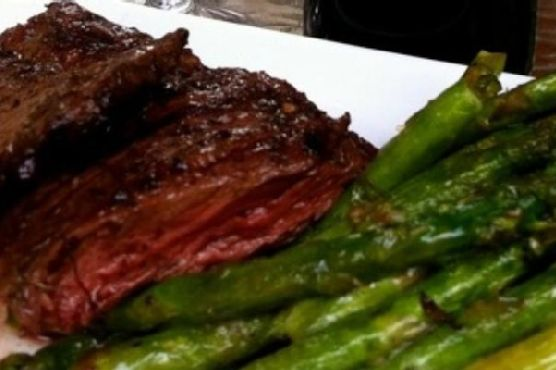
  11. Slice the steak against the grain into long strips, arrange them on a serving platter, and spoon that reserved chimichurri sauce over the top. Serve alongside the perfectly grilled asparagus.

Cook’s Notes

First off, let your steak rest after grilling. It’s tempting, but patience is key here for juicy, flavorful meat. If you’re marinating, overnight is king for maximum flavor, but 30 minutes will do if you’re in a pinch. As for leftovers, they keep well for a couple of days in the fridge. The steak is delightful cold or quickly reheated, and the chimichurri can be a flavor booster for other dishes.

Make It Your Own

  • Swap the skirt steak for a flank steak if that’s what you have on hand. Just keep in mind the cooking time might vary slightly.
  • For a vegetarian twist, use portobello mushrooms instead of steak. Marinate and grill them the same way for a hearty, satisfying meal.
  • Feeling a little wild? Add a handful of cherry tomatoes to your asparagus mix for a burst of color and extra sweetness.
  • If mint isn’t your thing, basil works beautifully here for a different but equally delicious twist.

If you try this, I’d love to hear how it turns out — drop a comment or tag me! Sharing food experiences makes them all the more enjoyable. Happy grilling!

Related update: Chimichurri Skirt Steak with Grilled Asparagus

Related update: Harvest Hash