TL;DR
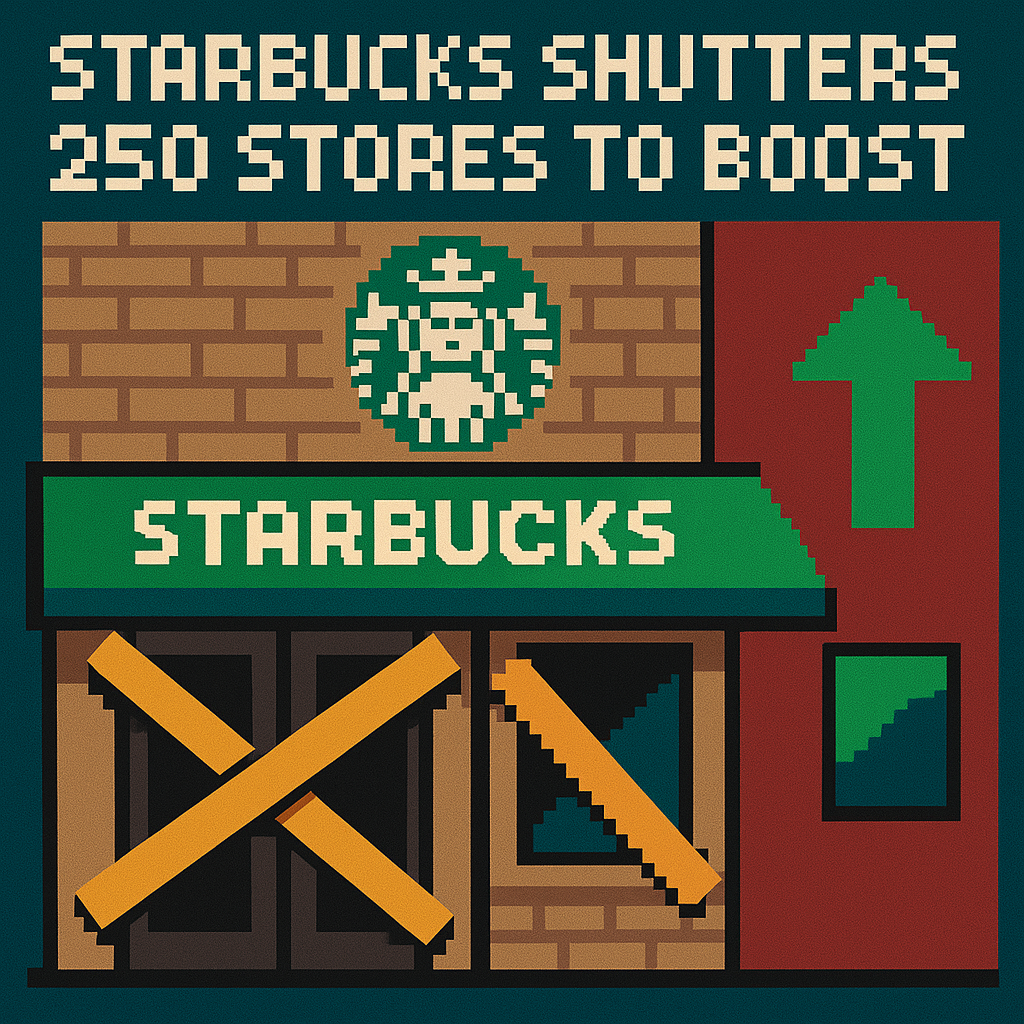
- Starbucks will close 250 North America stores this week—about 1% of its 18,371-location regional footprint—marking a second pruning in 12 months and a push to re-cut for profitability. [1], [3], [4]
- The closures come as North America Q3 FY26 revenue hit $7.4B and operating margin reached 13.6%; pruning low-yield boxes can lift system ROIC even if headline revenue dips. [3]
- The timing—days after a Sept. 17, 2026, $1M DEI settlement with Florida—adds political noise, but the operational story is clearer: cull underperformers, add 25,000 seats by fall 2026, and out-execute drive-thru rivals. [5], [6]
What the source said
Fox Business reports Starbucks will shutter about 250 coffeehouses across North America this week, a ~1% trim of its 18,000-plus regional fleet. COO Mike Grams told employees that while most units are profitable, a subset can’t deliver the desired customer/partner experience or “acceptable financial performance,” language consistent with prior portfolio resets. The article also notes Starbucks resolved a Florida DEI lawsuit with a $1 million payment and nationwide compliance commitments, citing the Florida Attorney General’s office. [1]
Why it matters
Landlords with Starbucks on their rent rolls, municipal corridors from Manhattan to Seattle trying to rebuild foot traffic, and competitors like Dunkin’ and Dutch Bros all face a localized demand shock when a green siren goes dark. AP News reported Starbucks’ share of U.S. coffee spend fell to 48% in 2025 from 52% in 2023, so nearby challengers have a real shot at inheriting transactions that don’t migrate to other Starbucks stores. [6]
Shareholders are parsing unit economics, not just headlines. Starbucks’ North America comps rose 8.1% in Q3 FY26 while segment margin reached 13.6%, yet management flagged labor investments and tariffs as ongoing pressures in Q2 FY26; trimming the bottom 1% tilts the mix toward higher-return boxes and frees capex for remodels and seat expansion. [3], [8]
Original analysis
A contrarian read
- Consensus: “Another round of closures proves Starbucks is slipping.”
- Counterpoint: This is a surgical trim to raise systemwide returns, echoing prior portfolio resets; North America comps climbed 8.1% in Q3 FY26 and operating margin reached 13.6%, so shutting money-losing units while comps are positive looks like housekeeping, not a distress flare. [3]
Back-of-the-envelope math
- 2023 North America company-operated revenue: $23.9B across 10,628 stores ≈ $2.25M per store annually. Calculation: $23,905M ÷ 10,628 ≈ $2.249M. [4]
- If 250 closures average 60–70% of AUV ($1.35M–$1.58M), that’s about $338M–$395M of low-margin revenue removed; math: 250 × $1.35M = $337.5M, 250 × $1.58M = $395M.
- Assume these stores run at a 0–3% store-level margin (post-wage, pre-G&A) versus a 15% target; cutting them can lift consolidated margin even if reported revenue dips. Baselines come from FY25 filings; comps/margin trajectory comes from FY26 results. [4], [3]
Historical analogue: 2020’s “format” reset
In 2020, Starbucks announced plans to close up to 400 U.S./Canada units to speed a shift toward Pickup and drive‑thru formats, a reset that matched digital ordering and on-the-go demand and preceded revenue growth in subsequent years. The 2026 closures rhyme with that playbook, but the emphasis has shifted: Starbucks plans to add 25,000 café seats by fall 2026 to revive the “third place” while maintaining mobile/delivery strength. [7], [6]
A simple 2×2: where cuts likely cluster
- High traffic + high margins: Suburban drive‑thrus near national anchors (e.g., Target/Walmart) with strong throughput; keep and invest in seating and ops tech to lift peak-hour capacity.
- High traffic + low margins: Dense urban cafés (e.g., Midtown Manhattan, San Francisco’s FiDi) with lease or labor drag; renovate or relocate if added seats can boost dwell and food attach.
- Low traffic + high margins: Seasonal/tourist nodes (e.g., Orlando attractions, national park gateways) with pricing power; keep and optimize scheduling and prep.
- Low traffic + low margins: Aging mall inline or office‑dependent sites in corridors with weak return‑to‑office; close or relocate nearby to smaller, cheaper formats.
This aligns with Starbucks’ notes on margin pressure from labor investments and tariffs and the need to shift mix toward stores that amplify connection and throughput. [8], [3]
Named-stakeholder breakdown
- Starbucks (SBUX): Gains cleaner unit economics, redirects capex to remodels and 25,000 added seats through 2026, and expects comps to offset revenue lost from pruning. [3], [6]
- Landlords (open‑air centers, downtown street retail): Face short‑term occupancy gaps; best‑positioned owners backfill quickly with QSR/coffee challengers like 7 Brew or Scooter’s near vacated corners. [6]
- Rivals (Dunkin’, Dutch Bros): Inheritable demand near closed sites; AP pegged Starbucks’ U.S. coffee spend share at 48% in 2025 (from 52% in 2023), signaling a live land‑grab. [6]
- Partners (employees): Disruption at affected cafés; redeployment can mitigate impacts, while FY25 restructuring and impairment charges of $892M underscore ongoing cost discipline. [4]
What others are missing
The licensed vs. company‑operated revenue‑mix effect. In North America, about 90% of 2023 segment revenue came from company‑operated stores, with ~10% from licensed operations; closing a company‑operated café directly lowers segment sales, while closing a licensed store mainly trims product/royalty flows. If this 250‑unit wave skews company‑operated (as past restructurings did), expect a modest headline revenue dip with an outsized operating‑margin lift once lease exits and impairments roll off, consistent with Q2 FY26 margin commentary and the Q3 FY26 uptick. [4], [8], [3]
What to watch next
- By Q4 FY26 (quarter ending late September 2026), North America segment operating margin expands at least 50 bps sequentially as closure drag ebbs and seat‑adding remodels start to raise throughput. [3]
- By Q1 FY27 (reported winter 2026/27), U.S. net unit growth turns positive despite the 250 closures, in line with guidance to open 575+ U.S. stores over three years. [6]
- By H1 2027, at least two drive‑thru challengers (e.g., Dutch Bros, Scooter’s, or 7 Brew) announce targeted openings within one mile of clusters of shuttered Starbucks sites, indicating competitive backfill. [6]
My take
I’d rather own a Starbucks that prunes 1% of dead wood than one that props it up; FY25 saw $892M of restructuring and 627 closures, and management kept pushing. With comps back, margins stabilizing, and 25,000 seats slated by fall 2026, this wave looks like oxygen redirected to winners, not retreat. The risk: rivals fill the gaps in 2026–2027 faster than Starbucks rebuilds the “third place.” Net‑net, the trim reads bullish for margins and brand relevance if execution on speed, seating, and service meets the FY26–FY27 plan. [4], [3], [6]
Sources
- Starbucks to close 250 stores: “Difficult decision” — Fox Business (https://www.foxbusiness.com/fox-news-food-drink/starbucks-close-250-stores-difficult-decision) — Initial report on the 250 North America closures, the ~1% figure, and rationale attributed to COO Mike Grams.
- Creating coffeehouses customers love and partners are proud of — Starbucks (https://about.starbucks.com/press/2026/creating-coffeehouses-customers-love-and-partners-are-proud-of/) — Official strategy framing and timing, including portfolio pruning within the current plan.
- Starbucks Reports Q3 Fiscal Year 2026 Results — Starbucks Investor Relations (https://investor.starbucks.com/news/financial-releases/news-details/2026/Starbucks-Reports-Q3-Fiscal-Year-2026-Results/) — North America comps (+8.1%), $7.4B segment revenue, store counts (18,371 NA), and 13.6% operating margin.
- Starbucks 2025 Annual Report (Form 10‑K) — Starbucks Investor Relations (https://s203.q4cdn.com/326826266/files/doc_financials/2025/ar/Starbucks-Corporation_2025-Annual-Report-Web-Ready.pdf) — Documents FY25 restructuring/impairment costs ($892M), closures (627), NA store mix, and a baseline for per‑store revenue.
- Starbucks, Florida AG ink deal to end lawsuit over alleged illegal DEI practices — HR Dive (https://www.hrdive.com/news/starbucks-florida-ag-ink-lawsuit-alleged-illegal-dei/830829/) — Confirms Sept. 17, 2026 settlement, $1M payment, and nationwide compliance commitments without admission of wrongdoing.
- Starbucks feeling the heat as more chains vie for US coffee drinkers — AP News (https://apnews.com/article/starbucks-coffee-menu-open-drivethru-dunkin-7f47a4e35e411a0e61c2bf2e551d1de7) — Competitive context, U.S. coffee spend share at 48% (2025) vs. 52% (2023), 25,000-seat plan by fall 2026, and guidance to open 575+ U.S. stores over three years.
- Starbucks to accelerate store portfolio transformation (Exhibit 99.1, June 2020) — SEC (https://www.sec.gov/Archives/edgar/data/829224/000082922420000057/sbux-06102020ex991.htm) — 2020 announcement to close up to 400 stores while shifting to Pickup and drive‑thru formats.
- Starbucks Reports Q2 Fiscal Year 2026 Results — Starbucks Investor Relations (https://investor.starbucks.com/news/financial-releases/news-details/2026/Starbucks-Reports-Q2-Fiscal-Year-2026-Results/default.aspx) — Notes margin compression from labor investments and tariffs, framing why pruning low‑yield stores can lift mix.
Related update: We recently published an article that expands on this topic: read the latest post.
Related update: We recently published an article that expands on this topic: read the latest post.
Related update: We recently published an article that expands on this topic: read the latest post.