TL;DR
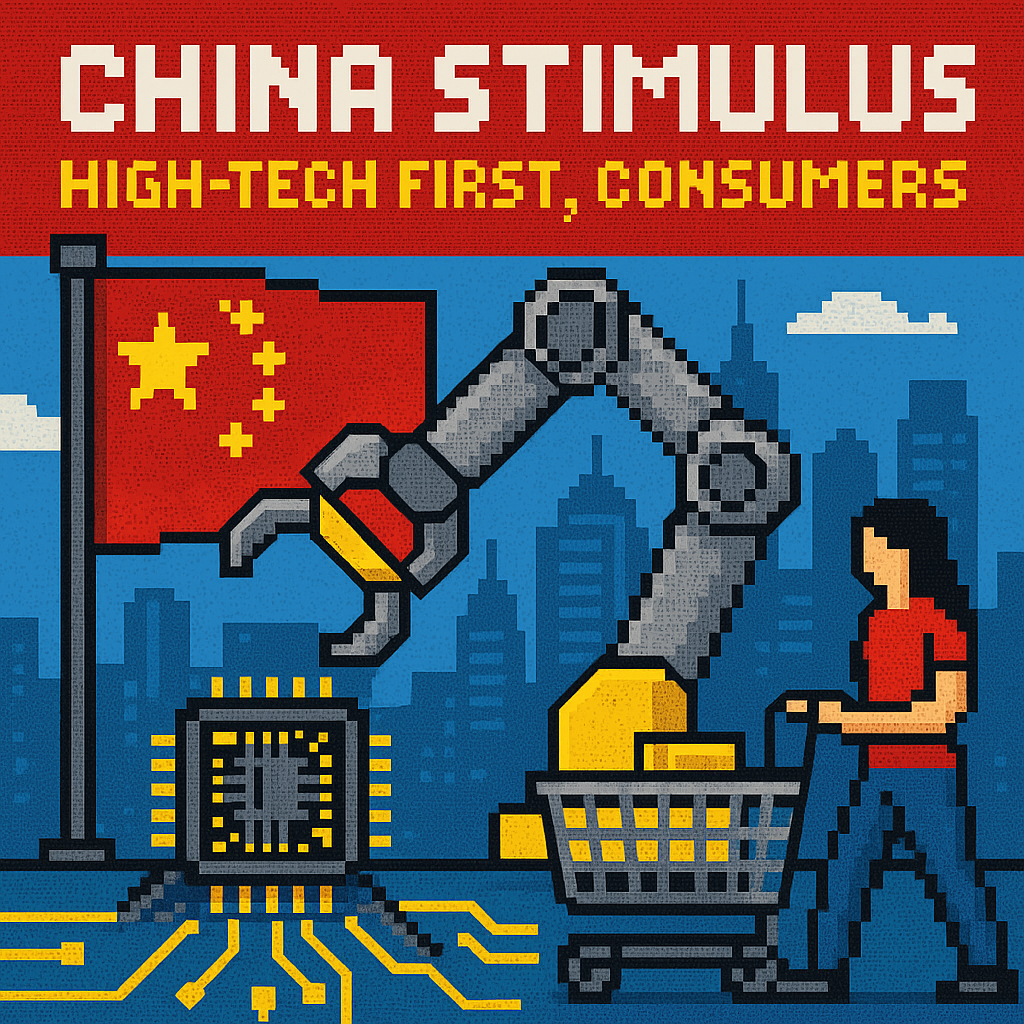
- Beijing is signaling more “China stimulus,” but the playbook still points to targeted support for high‑tech capacity and balance‑sheet repair—not a big-bang cash splash for households, as flagged by the Financial Times ahead of the late‑July 2026 Politburo readout [1].
- With Q2 2026 growth down to 4.3% and June retail sales up just 1.0% y/y, tech‑led support risks propping up factories while domestic demand stays weak, deepening imbalances that invite more foreign tariffs from the US, EU, and Mexico [2][6].
- The key number isn’t the headline pledge—it’s the composition: an 8.1% of GDP 2026 consolidated deficit with only a 0.3% fiscal impulse suggests precision-guided spending; unless more goes to households and property completion, growth hovers near 4.5% and confidence lags [4][5].
What the source said
The Financial Times reports that Chinese leaders in Beijing are preparing stimulus for H2 2026 but are prioritizing “spurring high-tech” over a sweeping consumption package, with signals expected after a late‑July 2026 Politburo meeting [1]. Analysts anticipate measures that channel capital into advanced manufacturing, AI infrastructure, and green tech rather than a 2008‑style broad transfer to households [1]. The backdrop features property stress, weak private investment, soft consumer sentiment, and rising trade frictions with the US and EU in 2026 [1][6]. Markets are therefore watching for targeted—not across‑the‑board—stimulus signals that point to execution via industrial policy rather than vouchers [1].
Why it matters
Three groups have the most at stake in 2026. First, Chinese households: wage growth has cooled, property wealth has eroded, and retail sales rose just 1.0% y/y in June 2026—so a tech‑first package risks bypassing them and prolonging caution on big‑ticket spending [2]. Second, manufacturers in EVs, batteries, and AI hardware: targeted credit and fiscal support can keep capacity humming, but it also courts foreign backlash via duties and probes already discussed in the US, EU, and Mexico this year [6]. Third, local governments: they carry implementation and financing burdens while land‑sale revenues fall, which constrains the pace and breadth of any rollout in 2026 [5].
Original analysis
Consensus view in mid‑2026: China will add stimulus, but it will be selective—aimed at high tech and industrial upgrading—rather than a “big bang” for household consumption [1][6]. I agree on direction but think markets underprice how that mix caps near‑term growth and amplifies external blowback if domestic demand stays weak.
-
Hard data first. Q2 2026 GDP slowed to 4.3% y/y, a 3‑1/2‑year low. June retail sales rose 1.0% while industrial output climbed 5.3%, a picture of strong factories and weak shoppers [2]. The PBoC’s Q2 statement promises “accommodative” conditions but confirms no policy rate or RRR cuts since May 2025, alongside an official growth band near 4.5%–5.0% for 2026—stability over urgency [3].
-
Fiscal reality check. The World Bank estimates China’s 2026 consolidated deficit at 8.1% of GDP, up from 7.2% in 2025, yet the fiscal impulse is only 0.3% of GDP because soft revenues and off‑budget constraints dilute the boost [5]. Translation: big headline deficit, modest net demand support.
-
Property is the fulcrum. Real home prices are down 23% from the July 2021 peak, and a “white‑list” has steered over RMB 7 trillion to viable projects, yet completion remains the choke point; the World Bank pegs inventory clearance at roughly 30 months at current sales rates [5]. Developer financing continued to contract year over year in May 2026, and bank lending to developers has trended lower since 2023, keeping household precautionary saving elevated [5].
-
External friction is the kicker. A tech‑first boost tilts supply toward EVs, solar, batteries, and AI hardware—sectors already under investigation or tariff pressure in Brussels, Washington, and Mexico City in 2026 [6]. Pushing capacity into a world adding barriers means the marginal unit may face a blocked market [6].
Back‑of‑envelope math: how big is “more stimulus,” really?
- China’s 2025 nominal GDP: RMB 140.19 trillion (NBS) [7].
- World Bank estimate of 2026 fiscal impulse: 0.3% of GDP [5].
- 0.3% × RMB 140.19t ≈ RMB 420.6b of net demand support.
Now compare: the property white‑list loan stock is “over RMB 7 trillion”—about 5.0% of 2025 GDP—but it’s allocation for completion, not pure demand stimulus [5][7]. Even with better execution, the near‑term multiplier is smaller than direct household transfers or broad VAT cuts, which is why a 4.5%–5.0% growth outcome is feasible but biased to the low end if consumption drags [4][5].
2×2: China stimulus choices (what Beijing is likely optimizing)
- Short‑term × Broad: Household vouchers, VAT cuts, payroll tax holidays. Fast retail boost; higher import leakage and local fiscal strain.
- Short‑term × Targeted: “White‑list” completions, SOE purchases of unsold inventory for affordable housing, AI‑compute subsidies. Quick but narrow; fixes bottlenecks without lifting mass demand [5].
- Long‑term × Broad: National social insurance upgrades, hukou reform, transfer programs. Durable consumption share gains; requires structural fiscal changes and political will [4].
- Long‑term × Targeted: Industrial policy for semis, EVs, batteries, and grids. Raises potential output; risks overcapacity and retaliation if demand rebalancing lags [6].
Beijing is operating in the lower‑right and upper‑left boxes—targeted now, reform later. That mix preserves control in 2026 and limits moral hazard, but it delays the confidence effect that gets households to spend [4][5].
Named‑stakeholder breakdown
- BYD and CATL: Probable winners from credit‑steered capex into EVs and storage; watch for more grid‑side projects and export headwinds if the EU or Mexico tighten duties in late 2026 [6].
- Huawei and SMIC: Likely beneficiaries of AI‑compute and “self‑reliance” budgets; domestic orders rise, but export channels face controls and scrutiny in 2026 [6].
- State Grid Corporation of China and data‑center operators: More capex for transmission and AI infrastructure aligns with “precision” stimulus and green goals flagged by multilaterals [5].
- Local governments and LGFVs: Higher implementation burden with thinner land‑sale cash; project approval reforms and fiscal limits curb scattershot building in 2026 [5].
- Households: Marginal beneficiaries unless completions accelerate and social spending outpaces GDP; otherwise retail stays soft and precautionary saving persists through H2 2026 [2][5].
What others are missing
Commentary focuses on “how big” the package is, not “how it flows” through China’s clogged transmission channels in 2026. Two plumbing details matter more than the headline: escrow ring‑fencing and completion finance. The World Bank traces delays to weak collateral, shrinking bank appetite, and heavy reliance on presales; despite RMB 7+ trillion in white‑list loans, developer financing remains tight and clearing inventory is a 30‑month job at current sales rates [5]. If policymakers hard‑wire escrow oversight and guarantee last‑mile funding, they deliver the biggest confidence dividend available in 2026—buyers believe keys are imminent, private developers regain cash flow, and consumer durables spending follows [5].
What to watch next
- By October 31, 2026, the PBoC trims the 1‑year MLF rate by at least 10 bps as Q3 data confirm sub‑5% growth and persistent retail weakness, aligning with official “accommodative” guidance [2][3][6].
- By December 31, 2026, cumulative “white‑list” lending tops RMB 8 trillion, and the NBS reports a year‑end backlog‑clearing time under 27 months, down from 30 months in March 2026 [5].
- By Q4 2026, China’s CPI averages 1.0%–1.5% y/y, signaling demand shortfall despite solid industrial output, in line with IMF and World Bank projections for a soft consumption recovery [4][5].
My take
A disciplined, tech‑forward package can move the needle in 2026—but only if it turns presold shells into keys and lifts social outlays from rounding error to anchor [4][5]. If Beijing keeps stimulus precision‑guided and delays household support, growth hugs 4.5%, foreign pushback intensifies, and imbalances widen into 2027 [4][6]. Pair AI kits with apartment keys and a faster safety net, and 2026 lands near 5.0% with a cleaner 2027 glide path; my base case is a Q4 tilt toward households, small in yuan but large in signal [4][5].
Sources
-
Chinese leaders zero in on need for stimulus for economy — Financial Times (https://www.ft.com/content/9cf9b393-3ac7-4cfc-9dd1-4fc23831e6a0?syn-25a6b1a6%5Cu003d1) — Reports Beijing’s stimulus focus on high tech over a broad consumption package and flags the late‑July 2026 Politburo readout.
-
China’s Q2 economic growth cools to 3‑1/2‑year low as imbalances worsen — Reuters via Investing.com (https://www.investing.com/news/economy-news/chinas-q2-gdp-growth-slows-to-43-yy-misses-market-forecast-4792122) — Provides the 4.3% Q2 GDP figure, weak June retail sales, stronger industrial output, and the political timetable.
-
China’s central bank pledges to maintain accommodative policy amid weak demand, external shocks — Reuters via Investing.com (https://m.investing.com/news/economy-news/chinas-central-bank-pledges-to-maintain-accommodativepolicy-amid-weak-demand-external-shocks-4781334?ampMode=1) — Summarizes the PBoC’s Q2 policy stance, absence of rate/RRR cuts since May 2025, and the 2026 growth band.
-
How China’s Economy Can Pivot to Consumption‑led Growth — IMF (https://www.imf.org/en/news/articles/2026/02/18/cf-how-chinas-economy-can-pivot-to-consumption-led-growth) — Shares a 2026 growth projection near 4.5% and concrete rebalancing steps to lift consumption.
-
China Economic Update — July 2026 — World Bank (https://thedocs.worldbank.org/en/doc/0cb2fc6dd88d4db3816dc0433b5cb49b-0070012026/original/CEU-July-2026-EN.pdf) — Details the 8.1% consolidated deficit plan, a 0.3% fiscal impulse, property metrics (−23% from 2021 peak, RMB 7t white‑list), and the ~30‑month clearance estimate.
-
5 takeaways from China’s Central Economic Work Conference as Beijing maps its 2026 growth path — Channel NewsAsia (https://www.channelnewsasia.com/east-asia/china-central-economic-work-conference-5-takeaways-2026-priorities-5578916) — Explains emphasis on fine‑tuning, innovation/green pillars, and the external barrier backdrop in 2026.
-
Statistical Communiqué of the People’s Republic of China on the 2025 National Economic and Social Development — National Bureau of Statistics (https://www.stats.gov.cn/english/PressRelease/202602/t20260228_1962661.html) — Confirms 2025 nominal GDP at RMB 140.19 trillion used in the calculation.
Related update: We recently published an article that expands on this topic: read the latest post.
Related update: We recently published an article that expands on this topic: read the latest post.