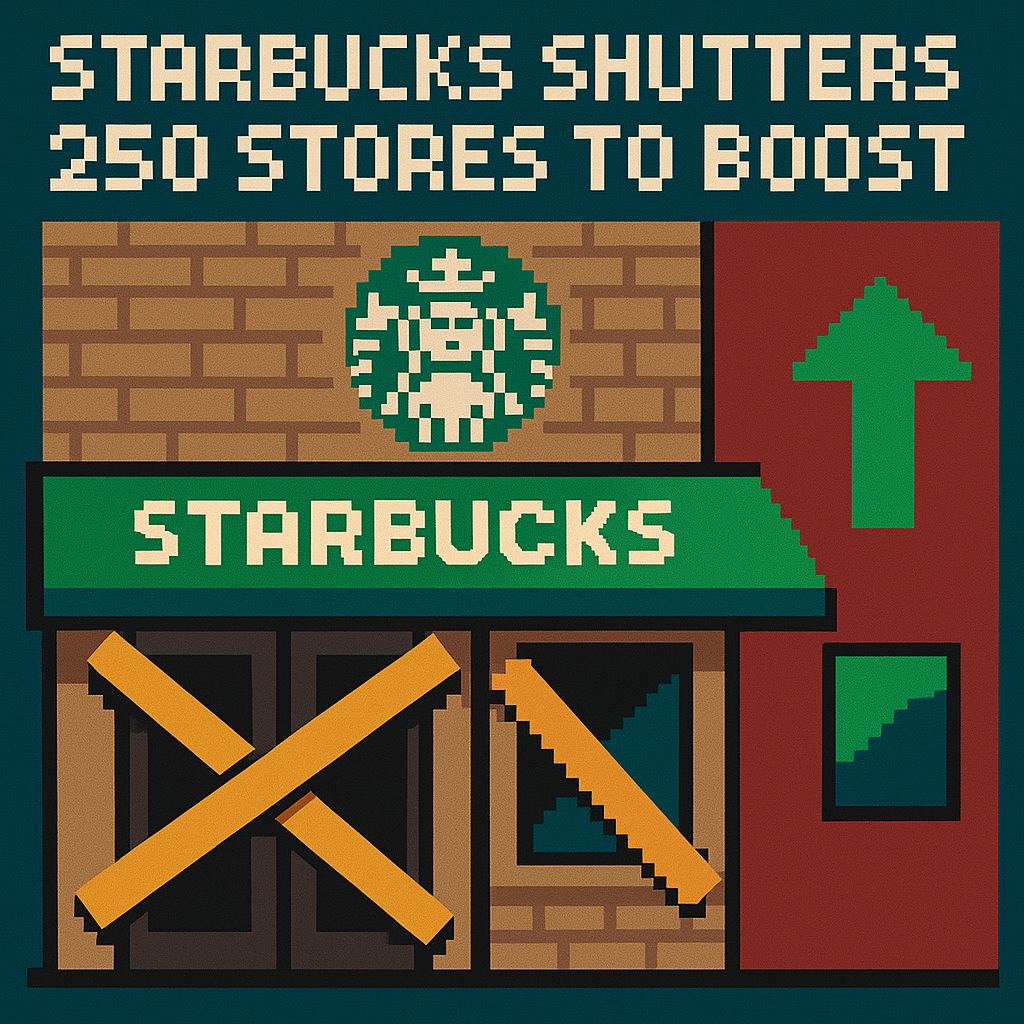
Starbucks shutters 250 stores to boost | Analysis by Brian Moineau

TL;DR

  • Starbucks will close 250 North America stores this week—about 1% of its 18,371-location regional footprint—marking a second pruning in 12 months and a push to re-cut for profitability. [1], [3], [4]
  • The closures come as North America Q3 FY26 revenue hit $7.4B and operating margin reached 13.6%; pruning low-yield boxes can lift system ROIC even if headline revenue dips. [3]
  • The timing—days after a Sept. 17, 2026, $1M DEI settlement with Florida—adds political noise, but the operational story is clearer: cull underperformers, add 25,000 seats by fall 2026, and out-execute drive-thru rivals. [5], [6]

What the source said

Fox Business reports Starbucks will shutter about 250 coffeehouses across North America this week, a ~1% trim of its 18,000-plus regional fleet. COO Mike Grams told employees that while most units are profitable, a subset can’t deliver the desired customer/partner experience or “acceptable financial performance,” language consistent with prior portfolio resets. The article also notes Starbucks resolved a Florida DEI lawsuit with a $1 million payment and nationwide compliance commitments, citing the Florida Attorney General’s office. [1]

Why it matters

Landlords with Starbucks on their rent rolls, municipal corridors from Manhattan to Seattle trying to rebuild foot traffic, and competitors like Dunkin’ and Dutch Bros all face a localized demand shock when a green siren goes dark. AP News reported Starbucks’ share of U.S. coffee spend fell to 48% in 2025 from 52% in 2023, so nearby challengers have a real shot at inheriting transactions that don’t migrate to other Starbucks stores. [6]

Shareholders are parsing unit economics, not just headlines. Starbucks’ North America comps rose 8.1% in Q3 FY26 while segment margin reached 13.6%, yet management flagged labor investments and tariffs as ongoing pressures in Q2 FY26; trimming the bottom 1% tilts the mix toward higher-return boxes and frees capex for remodels and seat expansion. [3], [8]

Original analysis

A contrarian read

  • Consensus: “Another round of closures proves Starbucks is slipping.”
  • Counterpoint: This is a surgical trim to raise systemwide returns, echoing prior portfolio resets; North America comps climbed 8.1% in Q3 FY26 and operating margin reached 13.6%, so shutting money-losing units while comps are positive looks like housekeeping, not a distress flare. [3]

Back-of-the-envelope math

  • 2023 North America company-operated revenue: $23.9B across 10,628 stores ≈ $2.25M per store annually. Calculation: $23,905M ÷ 10,628 ≈ $2.249M. [4]
  • If 250 closures average 60–70% of AUV ($1.35M–$1.58M), that’s about $338M–$395M of low-margin revenue removed; math: 250 × $1.35M = $337.5M, 250 × $1.58M = $395M.
  • Assume these stores run at a 0–3% store-level margin (post-wage, pre-G&A) versus a 15% target; cutting them can lift consolidated margin even if reported revenue dips. Baselines come from FY25 filings; comps/margin trajectory comes from FY26 results. [4], [3]

Historical analogue: 2020’s “format” reset

In 2020, Starbucks announced plans to close up to 400 U.S./Canada units to speed a shift toward Pickup and drive‑thru formats, a reset that matched digital ordering and on-the-go demand and preceded revenue growth in subsequent years. The 2026 closures rhyme with that playbook, but the emphasis has shifted: Starbucks plans to add 25,000 café seats by fall 2026 to revive the “third place” while maintaining mobile/delivery strength. [7], [6]

A simple 2×2: where cuts likely cluster

  • High traffic + high margins: Suburban drive‑thrus near national anchors (e.g., Target/Walmart) with strong throughput; keep and invest in seating and ops tech to lift peak-hour capacity.
  • High traffic + low margins: Dense urban cafés (e.g., Midtown Manhattan, San Francisco’s FiDi) with lease or labor drag; renovate or relocate if added seats can boost dwell and food attach.
  • Low traffic + high margins: Seasonal/tourist nodes (e.g., Orlando attractions, national park gateways) with pricing power; keep and optimize scheduling and prep.
  • Low traffic + low margins: Aging mall inline or office‑dependent sites in corridors with weak return‑to‑office; close or relocate nearby to smaller, cheaper formats.
    This aligns with Starbucks’ notes on margin pressure from labor investments and tariffs and the need to shift mix toward stores that amplify connection and throughput. [8], [3]

Named-stakeholder breakdown

  • Starbucks (SBUX): Gains cleaner unit economics, redirects capex to remodels and 25,000 added seats through 2026, and expects comps to offset revenue lost from pruning. [3], [6]
  • Landlords (open‑air centers, downtown street retail): Face short‑term occupancy gaps; best‑positioned owners backfill quickly with QSR/coffee challengers like 7 Brew or Scooter’s near vacated corners. [6]
  • Rivals (Dunkin’, Dutch Bros): Inheritable demand near closed sites; AP pegged Starbucks’ U.S. coffee spend share at 48% in 2025 (from 52% in 2023), signaling a live land‑grab. [6]
  • Partners (employees): Disruption at affected cafés; redeployment can mitigate impacts, while FY25 restructuring and impairment charges of $892M underscore ongoing cost discipline. [4]

What others are missing

The licensed vs. company‑operated revenue‑mix effect. In North America, about 90% of 2023 segment revenue came from company‑operated stores, with ~10% from licensed operations; closing a company‑operated café directly lowers segment sales, while closing a licensed store mainly trims product/royalty flows. If this 250‑unit wave skews company‑operated (as past restructurings did), expect a modest headline revenue dip with an outsized operating‑margin lift once lease exits and impairments roll off, consistent with Q2 FY26 margin commentary and the Q3 FY26 uptick. [4], [8], [3]

What to watch next

  1. By Q4 FY26 (quarter ending late September 2026), North America segment operating margin expands at least 50 bps sequentially as closure drag ebbs and seat‑adding remodels start to raise throughput. [3]
  2. By Q1 FY27 (reported winter 2026/27), U.S. net unit growth turns positive despite the 250 closures, in line with guidance to open 575+ U.S. stores over three years. [6]
  3. By H1 2027, at least two drive‑thru challengers (e.g., Dutch Bros, Scooter’s, or 7 Brew) announce targeted openings within one mile of clusters of shuttered Starbucks sites, indicating competitive backfill. [6]

My take

I’d rather own a Starbucks that prunes 1% of dead wood than one that props it up; FY25 saw $892M of restructuring and 627 closures, and management kept pushing. With comps back, margins stabilizing, and 25,000 seats slated by fall 2026, this wave looks like oxygen redirected to winners, not retreat. The risk: rivals fill the gaps in 2026–2027 faster than Starbucks rebuilds the “third place.” Net‑net, the trim reads bullish for margins and brand relevance if execution on speed, seating, and service meets the FY26–FY27 plan. [4], [3], [6]

Sources

  1. Starbucks to close 250 stores: “Difficult decision” — Fox Business (https://www.foxbusiness.com/fox-news-food-drink/starbucks-close-250-stores-difficult-decision) — Initial report on the 250 North America closures, the ~1% figure, and rationale attributed to COO Mike Grams.
  2. Creating coffeehouses customers love and partners are proud of — Starbucks (https://about.starbucks.com/press/2026/creating-coffeehouses-customers-love-and-partners-are-proud-of/) — Official strategy framing and timing, including portfolio pruning within the current plan.
  3. Starbucks Reports Q3 Fiscal Year 2026 Results — Starbucks Investor Relations (https://investor.starbucks.com/news/financial-releases/news-details/2026/Starbucks-Reports-Q3-Fiscal-Year-2026-Results/) — North America comps (+8.1%), $7.4B segment revenue, store counts (18,371 NA), and 13.6% operating margin.
  4. Starbucks 2025 Annual Report (Form 10‑K) — Starbucks Investor Relations (https://s203.q4cdn.com/326826266/files/doc_financials/2025/ar/Starbucks-Corporation_2025-Annual-Report-Web-Ready.pdf) — Documents FY25 restructuring/impairment costs ($892M), closures (627), NA store mix, and a baseline for per‑store revenue.
  5. Starbucks, Florida AG ink deal to end lawsuit over alleged illegal DEI practices — HR Dive (https://www.hrdive.com/news/starbucks-florida-ag-ink-lawsuit-alleged-illegal-dei/830829/) — Confirms Sept. 17, 2026 settlement, $1M payment, and nationwide compliance commitments without admission of wrongdoing.
  6. Starbucks feeling the heat as more chains vie for US coffee drinkers — AP News (https://apnews.com/article/starbucks-coffee-menu-open-drivethru-dunkin-7f47a4e35e411a0e61c2bf2e551d1de7) — Competitive context, U.S. coffee spend share at 48% (2025) vs. 52% (2023), 25,000-seat plan by fall 2026, and guidance to open 575+ U.S. stores over three years.
  7. Starbucks to accelerate store portfolio transformation (Exhibit 99.1, June 2020) — SEC (https://www.sec.gov/Archives/edgar/data/829224/000082922420000057/sbux-06102020ex991.htm) — 2020 announcement to close up to 400 stores while shifting to Pickup and drive‑thru formats.
  8. Starbucks Reports Q2 Fiscal Year 2026 Results — Starbucks Investor Relations (https://investor.starbucks.com/news/financial-releases/news-details/2026/Starbucks-Reports-Q2-Fiscal-Year-2026-Results/default.aspx) — Notes margin compression from labor investments and tariffs, framing why pruning low‑yield stores can lift mix.


Related update: We recently published an article that expands on this topic: read the latest post.


Related update: We recently published an article that expands on this topic: read the latest post.


Related update: We recently published an article that expands on this topic: read the latest post.

Xbox Grandfathers Some Cloud Gamers | Analysis by Brian Moineau

TL;DR

  • Xbox cloud gaming time limits start worldwide in November 2026, but Microsoft is “grandfathering” some auto‑recurring Game Pass members in Australia, Germany, Brazil, and Poland with no cap for now; players in the US, UK, and Canada report no such emails. [1][2][3]
  • At 1080p/60, a plausible cost stack is close to $1–$1.50 per hour: around $0.78/hour for egress plus $0.45–$0.73/hour for Azure GPU time, which breaks the margin on a $22.99/month Ultimate plan for heavy streamers. [5][6][8]
  • Expect Xbox to sell prepaid cloud hours broadly and push TV app and “stream games you own” access; the cap contains costs while shifting the model toward pay‑as‑you‑go. [2][4]

What the source said

Pure Xbox reported in September 2026 that after Microsoft announced November caps on Xbox Cloud Gaming hours (15/10/5 by tier), some existing subscribers in Australia, Germany, Brazil, and Poland received emails saying the limits won’t apply as long as their Game Pass stays on auto‑renew. US, UK, and Canada subscribers did not see the same exemption notices, based on reader reports collected by Pure Xbox and VGC. The outlets suggest regional consumer‑contract rules could explain the carve‑outs, and advise subscribers to check inboxes for localized messaging. The bottom line is that most users will see the new caps in November 2026, while a minority in select markets may be exempt. [1][2][3]

Why it matters

Two groups feel this most in 2026. Heavy cloud‑only players—the Xbox One S (2016) owner streaming Series titles, the Samsung TV app user skipping consoles, and the handheld PC crowd on ROG Ally (2023)—now hit a hard ceiling unless they buy extra hours, while Microsoft says only 4% of Game Pass users will reach the limit. That 4% are the exact users driving outsized Azure GPU minutes and outbound bandwidth bills that Microsoft cited when it announced the change on Xbox Wire. [2]

The carve‑outs fracture the product by country in September–November 2026. “Unlimited” in São Paulo and Stuttgart but not in Seattle invites confusion, churn, and gray‑market account swaps, while hinting that Brazil, Germany, and Poland have stricter consumer‑law bite on mid‑contract downgrades than the US or UK. The pattern itself is a signal about which regulators matter in subscription policy without Microsoft publishing a list. Expect forum screenshots from Brisbane, Berlin, and Warsaw to keep this visible. [1][3]

Original analysis

Xbox cloud gaming time limits: follow the unit economics

Microsoft didn’t cap cloud hours because “nobody uses it”; it capped them because a small cohort uses a lot—and streaming at scale burns two paid meters: GPU time and internet egress. Microsoft’s own post states that “the cost of providing cloud gaming grows as more people use it and play for longer,” and it pegs affected users at ~4% across Game Pass tiers. [2]

Back‑of‑envelope calculation (US/EU list prices)

  • Bandwidth: Services like GeForce NOW recommend 25 Mbps for 1080p gaming; assume a conservative 20 Mbps for Xbox Cloud Gaming on TV/PC. 20 Mbps ≈ 2.5 MB/s ≈ 9.0 GB/hour; Azure Zone 1 egress first‑tier is ~$0.087/GB, so hourly egress ≈ 9.0 × $0.087 ≈ $0.78. [7][5]
  • GPU: Xbox Cloud Gaming workloads map to Azure NV families; a representative NV6ads A10 v5 VM lists around $0.454/hour on Linux (about $0.73/hour on Windows). Call compute $0.45–$0.73/hour. [6]
  • Per‑hour ballpark: $0.78 egress + $0.45–$0.73 GPU ≈ $1.23–$1.51/hour before encoding, orchestration, and support overhead. [5][6]

Now compare to April 21, 2026 US pricing of $22.99/month for Game Pass Ultimate. A 20‑hour cloud‑only user costs roughly $24–$30/month at list infra rates—underwater on gross margin before content royalties—so the break‑even near 15–19 hours lines up with the new 15‑hour Ultimate cap by design. That makes the cap a margin governor, not a usage nudge. [2][8]

Contrarian read

  • Consensus: “Microsoft is backing away from cloud in 2026.”
  • Counter: Caps are the prerequisite to scale cloud profitably; Xbox will sell hours à la carte to subscribers (overages) and to non‑subscribers who stream games they own, similar to Nvidia’s 100‑hour policy on GeForce NOW paid tiers. That broadens the funnel, reins in worst‑case costs from the heaviest 4%, and makes COGS predictable instead of buffet‑style. Expect visible hour meters and “buy more time” flows rather than a retreat from streaming. [2][4][7]

Named‑stakeholder breakdown

  • Microsoft/Xbox: Gains cost predictability and aligns infra burn with revenue; risks the narrative that Game Pass (2017) keeps shrinking perks after the April 2026 price move. Expect hour‑pack SKUs on Xbox Store, time‑remaining UI, and TV‑first bundles in 2026–2027. [2][4][8]
  • Nvidia GeForce NOW: Opens with simple compare ads—“100 hours vs 15 hours”—and leans on 1440p/4K tiers, latency, and session length as differentiators in Q4 2026 marketing. [7]
  • Sony PlayStation Plus Premium: No explicit monthly cap today; Sony can pitch PS5‑to‑Portal (2023) and catalog streaming without a monthly hour number, even if sessions time out. Watch how Sony frames this in the US and Germany. [9]
  • Handheld PC/TV OEMs (Lenovo Legion Go, ASUS ROG Ally, TCL 2024 TVs): Messaging pivots from “unlimited cloud” to “remote play + hour top‑ups,” pushing OEMs to optimize Wi‑Fi 6E and local streaming while keeping cloud as a paid add‑on. [4]
  • Regulators in Brazil, Germany, Poland, Australia: The exemption emails imply these jurisdictions constrain mid‑contract downgrades for auto‑renewing digital services, shaping Microsoft’s policy map more than in the US or UK in late 2026. [1][3]

Another quick calc: scale of impact

  • Microsoft disclosed 34 million Game Pass subscriptions in January 2024; 4% affected implies ~1.36 million people under the cap if the base is similar in 2026. If 30% of this cohort buys an average $2 in overages, that’s ~408,000 buyers × $2 ≈ $0.816 million/month in revenue, plus avoided infra losses on the heaviest hours. This is cash‑flow stabilization more than topline growth theater. [2][11]

A quick 2×2: who’s helped vs. hurt

  • High hours + No console (Samsung/TCL TV app, hotel/travel gamers): Hurt by 15/10/5 caps; likely to buy hour packs; price sensitivity high in markets like Brazil. [2][4]
  • High hours + Console PC (Series X, ROG Ally): Mixed; can fall back to local play, but cloud convenience now metered. [2]
  • Low hours + No console (casual FIFA/EA FC in cafés): Helped; can buy 5–10 prepaid hours in 2026 holiday promos without a subscription. [2][4]
  • Low hours + Console PC: Largely unaffected; caps won’t bite, and remote play remains free over LAN. [2]

Historical analogue

  • Between 2010 and 2012, US carriers like AT&T and Verizon moved from “unlimited” smartphone data to buckets with overages as mobile video surged, and the market kept growing; Xbox’s 2026 cap rhymes with that shift by pushing heavy users into a variable‑cost lane while preserving flat‑rate value for the median user. Expect family‑style “hour packs” and seasonal coupons to soften optics in Q4 2026–Q1 2027. [2][4]

What others are missing

The hinge isn’t the cap; it’s Microsoft’s “cloud without Game Pass” SKU that Xbox Wire teased on September 3, 2026. That reframes cloud from a perk into a metered product with margins, especially when tied to TV apps from OEMs like TCL and Samsung where console penetration lags. Picture a $10 “10‑hour weekend” code sold at JB Hi‑Fi in Sydney or B&H in New York for people who already own Starfield—no subscription required. In regions like Brazil and Poland with strong internet but lower console ARPU, prepaid hours mirror mobile data top‑ups and give retailers a physical item to sell. [2][4]

What to watch next

  1. By December 15, 2026, Microsoft will publish US pricing for add‑on cloud hours at no more than $1.50 per hour (Xbox Wire or Xbox Store listing).
  2. By March 31, 2027, the Xbox app on at least two platforms (e.g., Xbox console and Windows PC) will prominently display a time‑remaining meter for cloud hours.
  3. By June 30, 2027, Xbox will end “no‑cap” grandfathering in at least two currently exempt countries (e.g., Brazil, Germany), aligning them with the global policy.

My take

The cap is the financially disciplined call Xbox should have made by mid‑2025, because unlimited cloud inside a flat subscription let a tiny cohort run six‑hour Saturday sessions that torched Azure egress and GPU budgets. Locking in 15/10/5 hours per tier and selling overages resets unit economics and, crucially, enables pay‑as‑you‑go cloud for people who already own games but don’t want a subscription. If Microsoft prices hour packs near unit cost (about $1–$1.50/hour at list) and nails the 2026 TV experience with TCL and Samsung apps, cloud can stand on its own without bleeding green. This is Xbox choosing predictable gross margin over vibes, and it likely sticks through FY2027. [2][4][5][6][8]

Sources

[1] Xbox Is Telling Some People They Don't Need To Worry About Cloud Gaming Time Limits — Pure Xbox (https://www.purexbox.com/news/2026/09/xbox-is-telling-some-people-they-dont-need-to-worry-about-cloud-gaming-time-limits) — Reports Microsoft’s exemption emails for existing auto‑recurring Game Pass members in select countries, and absence in the US/UK/Canada.

[2] Upcoming Changes to Xbox Cloud Gaming — Xbox Wire (https://news.xbox.com/en-us/2026/09/03/xbox-cloud-gaming-changes/) — Official details: 15/10/5 hours by tier, November 2026 start, impacts ~4% of users, rationale (costs), add‑on hours, and non‑subscriber hour purchases.

[3] Xbox tells existing Game Pass members its new cloud gaming cap doesn’t apply to them, but only in certain countries — Video Games Chronicle (https://www.videogameschronicle.com/news/xbox-tells-existing-game-pass-members-its-new-cloud-gaming-cap-doesnt-apply-to-them-but-only-in-certain-countries/) — Corroborates the email carve‑out and cites markets (Australia, Brazil, Poland, Germany).

[4] Microsoft is introducing hourly limits on Xbox Cloud Gaming starting in November — Windows Central (https://www.windowscentral.com/gaming/xbox/microsoft-is-introducing-hourly-limits-on-xbox-cloud-gaming) — Explains the policy shift, 4% figure, and the plan to sell cloud hours and allow cloud without Game Pass.

[5] Pricing – Bandwidth — Microsoft Azure (https://azure.microsoft.com/en-us/pricing/details/bandwidth/) — Official egress pricing used to estimate per‑hour streaming bandwidth cost.

[6] NVIDIA A10 cloud pricing (Azure NV6ads_A10_v5) — Instance Pricing (https://www.instance-pricing.com/gpu/model%3Dnvidia-a10/) — Lists ~$0.454/hour (Linux) for a representative Azure GPU VM suited to game streaming.

[7] GeForce NOW FAQ — NVIDIA (https://www.nvidia.com/en-gb/geforce-now/faq/) — Confirms Nvidia’s monthly playtime policies and 1080p bandwidth guidance, the nearest industry analogue.

[8] Microsoft announces surprise Xbox Game Pass price cuts, ends day‑one Call of Duty inclusion — Tom’s Hardware (https://www.tomshardware.com/video-games/xbox/microsoft-announces-surprise-xbox-game-pass-price-cuts-ends-day-one-call-of-duty-inclusion-ultimate-down-to-usd22-99-while-pc-game-pass-drops-to-usd13-99) — Documents April 21, 2026 price drop of Ultimate to $22.99/month, key to the margin math.

[9] Cloud streaming on PS5 — PlayStation.com (https://www.playstation.com/en-us/ps5-game-cloud-streaming/) — Describes Sony’s Premium‑tier cloud streaming approach for contrast on caps and positioning.

[10] Xbox Cloud Gaming | Brasil não seria afetado pelos ajustes recentes; entenda — Omelete (https://www.omelete.com.br/games/xbox-cloud-gaming-brasil-nao-seria-afetado-por-ajustes-recentes) — Local reporting that Brazil’s auto‑recurring subscribers received Microsoft’s “no cap” message, reinforcing the market‑by‑market carve‑out.

[11] Xbox Game Pass hits 34 million subscribers — The Verge (https://www.theverge.com/2024/1/30/23929824/microsoft-xbox-game-pass-34-million-subscribers) — Establishes a concrete subscription base (January 2024) used for affected‑user scale math.


Related update: We recently published an article that expands on this topic: read the latest post.


Related update: We recently published an article that expands on this topic: read the latest post.


Related update: We recently published an article that expands on this topic: read the latest post.

Tech Pullback: Palantir Bucks the Trend | Analysis by Brian Moineau

When a Rally Meets Reality: Tech Rotation Sends Dow Lower — but Palantir Shines

The market hit that familiar tug-of-war this week: broad indexes slipping while one high-profile tech name sprinted ahead. The Dow fell roughly 400 points and the S&P 500 lost about 1% as investors rotated out of richly valued software and cloud names — even as Palantir’s strong fourth-quarter results and upbeat guidance gave the tech complex a momentary lift.

Here’s a readable take on what happened, why it matters, and what to watch next.

Why the selloff felt different this time

  • Markets were already on edge from stretched valuations in AI and software stocks. That “priced-for-perfection” setup made the sector unusually sensitive to any signal that future growth might be harder to monetize.
  • A wave of fresh product launches and model advances in AI (and attendant discussions about disruption and pricing power) amplified investor anxiety about which companies will actually keep margins and customers.
  • The result: investors rotated away from high-flying software names toward either defensive sectors or names with clearer near-term fundamentals — a rotation that pulled the Dow and S&P lower even though pockets of tech reported strong results.

A bright spot: Palantir’s Q4 pushed a rally — briefly

  • Palantir reported stronger-than-expected fourth-quarter results and gave upbeat guidance, which initially sent its shares higher and provided a lift to the tech sector.
  • The company’s numbers reinforced the narrative that certain data- and AI-centric firms are converting demand into revenue and improved profitability — which is exactly what investors want to see when they question long-term business resilience.
  • Still, the broader software and cloud indexes were under pressure, suggesting Palantir was the exception rather than the rule in this pullback.

Market dynamics in plain language

  • When a handful of sectors (here: software and cloud) dominate gains over a long stretch, even modest doubts about future growth can produce outsized moves down.
  • Earnings surprises, guidance, and product launches now serve double duty: they can validate a growth story or create fresh skepticism about sustainability (and sometimes both, across different names).
  • In other words, a single company’s great quarter (Palantir) can’t single-handedly reverse a sector-wide reassessment — but it points to the winners investors will watch most closely.

What this means for investors and observers

  • Volatility is a feature, not a bug, in an era where AI expectations are stretched. Expect sharper moves as new models and product rollouts reshape perceived winners and losers.
  • Look beyond headlines: strong revenue growth or a beat matters, but so do guidance, customer metrics, and unit economics. Those are the signals that tend to outlast one-day price moves.
  • Diversification and a clear view of time horizon matter more than ever: short-term rotations can punish momentum-heavy portfolios, while longer-term investors may find opportunities in temporary selloffs.

Quick takeaways

  • Palantir’s solid Q4 and bullish guidance offered a pro-tech datapoint, but the broader software selloff overwhelmed those gains. (Markets can be unforgiving when an entire bucket of stocks is being re-priced.)
  • The price action reflects two competing narratives: genuine structural opportunity from AI versus near-term worries about disruption, pricing power, and stretched valuations.
  • Expect more headline-driven volatility as upcoming earnings and AI product launches hit the tape.

My take

This episode feels like a market-level reality check. Enthusiasm for AI remains powerful — but so does the discipline of investors who now demand clearer proof that AI-driven revenue growth translates into durable profits and defensible markets. Companies that can show both grit (unit economics, cash flow) and growth will outperform in the messy stretches between hype cycles.

Sources

(Article titles and coverage used to shape this post; links above point to the corresponding news outlets’ market coverage pages.)


Related update: We recently published an article that expands on this topic: read the latest post.


Related update: We recently published an article that expands on this topic: read the latest post.