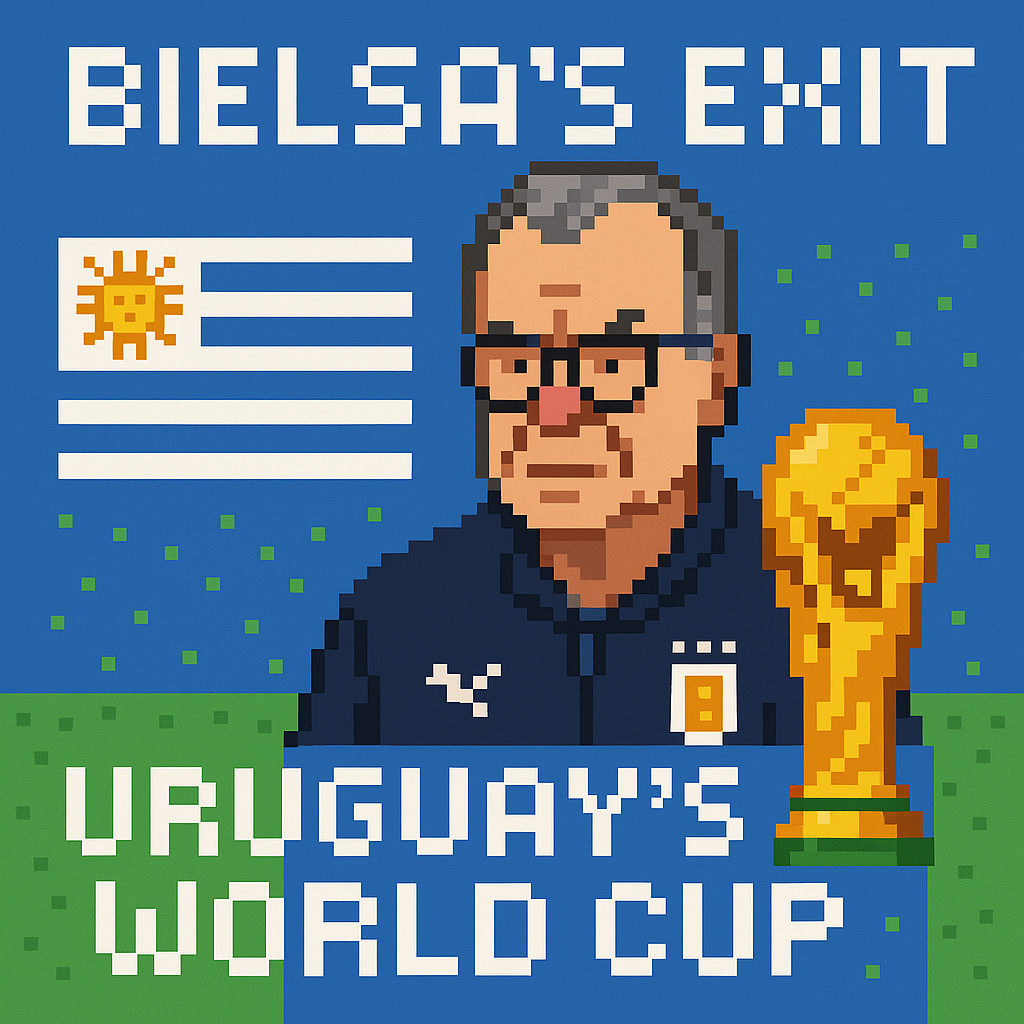
TL;DR
- Uruguay’s World Cup ended with a 1-0 loss to Spain and two draws (1-1 vs Saudi Arabia; 2-2 vs Cape Verde); Marcelo Bielsa said he “left nothing” to Uruguayan football after the exit. [1][2][3][4][5]
- The shock exit isn’t just about a “toxic” coach; it’s about a rigid system that mismatched the squad, a high-stakes goalkeeper call that backfired, and a 48‑team format where two points condemn you. [3][6]
- Cape Verde’s debutants advanced from Group H while 19th‑ranked Uruguay went home, underscoring how margins and squad politics—not mystique—decide modern World Cups. [5][6][8]
What the source said
Al Jazeera reported that Uruguay crashed out of the 2026 World Cup with zero wins after a 1-0 defeat to Spain, following draws against Saudi Arabia and Cape Verde. Marcelo Bielsa accepted full responsibility, repeated a self‑description as a “toxic perfectionist,” and said he had “left nothing” of value to Uruguayan football. The piece noted Uruguay were the highest‑ranked side eliminated at that point (FIFA No. 19 in June 2026) and recalled Bielsa’s prior World Cups: a group exit with Argentina in 2002 and a Round of 16 run with Chile in 2010. [1][8][9]
Why it matters
- For the AUF and a proud fan base in Montevideo, a second straight group‑stage exit (2022 and now 2026) dents a century‑long big‑tournament identity and forces a style‑versus‑fit debate for the next cycle. The next coach inherits a split squad—icons and a newer core—and a public argument about how Uruguay should play. [2][4][6]
- For FIFA 2026—48 teams in 12 groups with eight third‑placed teams advancing—the Uruguay case shows a heavyweight can still be out with two points and a negative goal difference. Cape Verde demonstrated a smaller federation can survive 270 minutes with structure and game management. [5][6]
Original analysis
Frame the debate: Bielsa’s ideology vs squad fit (a 2×2)
| Squad fit high (roles, profiles lined up) | Squad fit low (roles clash with demands) | |
|---|---|---|
| Ideologue manager (non‑negotiable game model) | Guardiola’s Barça/Spain core circa 2011: ideas + profiles aligned | Bielsa 2026 Uruguay: pressing/transition asks vs veterans with different rhythms [2][3][4] |
| Pragmatist manager (model flexes to players) | Del Bosque’s 2010 Spain: built around Xavi/Iniesta tempo | Tournament firefighters: compact 4‑4‑2s riding goalkeeper form |
Bielsa landed in the top‑right box once the roster didn’t match his asks. Group H told that story in three beats: 1‑1 vs Saudi Arabia, 2‑2 vs Cape Verde, then 0‑1 vs Spain after a goalkeeping error. The pressing principles showed in spurts; under stress, execution and decision‑making fell apart. [2][4][5]
Back‑of‑envelope: the unforgiving math of two points
- Format math: 12 groups x 4 teams = 48; top two per group (24) + eight best third‑placed (8) = 32 qualifiers; two‑thirds of third‑placed teams advance. Points rule: win = 3, draw = 1, loss = 0. [6]
- Uruguay’s totals: 0W‑2D‑1L = 2 points; goals for 3 (1+2), goals against 4 (1+2+1), goal difference −1. With two points and a negative GD, you lose to any third‑placed side on 3+ points and most two‑point peers on tiebreaks, so you’re effectively out. Converting one draw to a win lifts you to 4 points and a neutral or positive GD, which typically clears the best‑third cut. [2][4][5][6]
The historical analogue that actually fits: Argentina 2002, not Leeds 2020
The consensus blames Bielsa’s “toxicity.” My contrarian read: the decisive failure was systemic misfit under tournament constraints, an old Bielsa problem that echoes 2002 Argentina more than any club spell. In 2002, a talented team fell in the group because selection and in‑game adjustments didn’t bend fast enough; in 2010 with Chile, a role‑aligned, younger core reached the Round of 16. World Cups reward risk compression; Bielsa inflates risk when profiles don’t align. [1][7][9]
The goalkeeper decision as a hinge moment
Fernando Muslera, 40, started against Spain and committed the mistake that decided 1‑0; he was substituted at half‑time after staff and media reported he asked to come off. That single high‑leverage error, in a three‑game tournament sample, can swing an entire arc when your model depends on perfect execution. Uruguay paid full price. [2][3][10][11]
Inside the camp: revolt or routine tension?
Outlets in Spain and the UK reported senior‑player pushback on physical workload and tactical mirroring before the Spain match, while other reporting rejected the idea of a full mutiny. Under results pressure, routine friction turned every meeting into a referendum on leadership style. Bielsa’s own post‑match words—“I haven’t left anything to Uruguayan football”—put the accountability squarely on him. [1][12][13]
Named‑stakeholder readout
- Marcelo Bielsa: A third World Cup without a deep run hardens the view of him as a club‑cycle alchemist more than a tournament operator. [1][7]
- AUF (Uruguayan FA): Decision point for 2026–2027—double down on the philosophy and recruit profiles to match it, or pivot to a pragmatist for the 2027 Copa América qualifying rhythm.
- Cape Verde FA: Validation on debut—compact block, timely saves, and game‑state control delivered second place in Group H at the first attempt. [5]
What others are missing
The goalkeeper selection politics—and how they created avoidable variance. Bielsa re‑installed a 40‑year‑old Muslera who hadn’t anchored most of the cycle, then watched a single error decide Uruguay‑Spain and trigger a halftime switch. That wasn’t just randomness; it flowed from a pre‑tournament choice compounded by documented tension over training load and tactical mirroring, which left almost no cushion for human error across 270 minutes. [3][10][11][12][13]
What to watch next
- By July 10, 2026, AUF will confirm Bielsa’s departure and name an interim for the September FIFA window.
- By September 2026, Uruguay will start a goalkeeper other than Fernando Muslera in every match of that window.
- By December 31, 2026, at least one of Uruguay’s June 2026 group‑stage starters will announce international retirement.
My take
Bielsa didn’t poison Uruguay; he misread the tournament. In a 48‑team World Cup where many third‑placed teams survive, you manage variance first and ideology second. Uruguay did the opposite: a high‑risk model, a volatile goalkeeper bet, and a public stance that made tactical U‑turns politically costly. The Celeste didn’t need fireworks—they needed three points and quiet. They got neither. [3][5][6]
Sources
- Toxic Bielsa leaves ‘nothing good’ behind as Uruguay suffer World Cup shock — Al Jazeera (https://www.aljazeera.com/sports/2026/6/27/toxic-bielsa-leaves-nothing-good-behind-in-uruguay-shock-world-cup-exit) — Core report with Bielsa’s “left nothing” admission and Uruguay’s winless exit.
- Uruguay 0-1 Spain — FIFA.com (https://www.fifa.com/en/articles/uruguay-spain-match-report-highlights) — Official match report and highlight context for the decisive defeat.
- World Cup 2026: Uruguay 0-1 Spain — Sky Sports (https://www.skysports.com/football/news/12098/13556686/world-cup-2026-uruguay-0-1-spain-alex-baena-goal-after-fernando-muslera-error-sends-marcelo-bielsas-team-out) — Independent match report noting Muslera’s error and elimination stakes.
- Saudi Arabia 1-1 Uruguay — FIFA.com (Arabic highlights/report) (https://www.fifa.com/ar/articles/saudi-arabia-uruguay-highlights-match-report-ar) — Confirms Uruguay’s opening draw in Group H.
- Uruguay 2-2 Cape Verde — FIFA Training Centre (official post‑match summary PDF) (https://www.fifatrainingcentre.com/media/native/tournaments/fifa-world-cup/2026/PMSR-M37-URU-V-CPV.pdf) — Confirms Uruguay’s second draw and match context against Cape Verde.
- Groups, qualification rules and third‑place advancement — FIFA explainer (https://www.fifa.com/en/articles/groups-how-teams-qualify-tie-breakers) — Format math for the 48‑team tournament and best third‑placed criteria.
- “I haven’t left anything to Uruguayan football” — The Guardian (https://www.theguardian.com/football/2026/jun/27/marcelo-bielsa-exits-world-cup-stage-with-uruguay-admission) — Bielsa’s post‑exit admission; includes substitution detail.
- FIFA/Coca‑Cola Men’s Rankings (June 2026): Uruguay 19th — The FA compiled rankings PDF (https://www.thefa.com/-/media/files/thefaportal/governance-docs/registrations/mens-fifa-rankings-june-2026-12-months.ashx) — Verifies Uruguay’s No. 19 rank at the time of elimination.
- Argentina 2002 group‑stage exit under Bielsa — World Soccer archive (https://www.worldsoccer.com/world-soccer-latest/bielsablames-bad-luck-for-departure-51864) — Historical analogue for Bielsa’s prior World Cup group‑stage failure.
- Muslera substitution explanation — Globo Esporte (https://ge.globo.com/google/amp/futebol/copa-do-mundo/noticia/2026/06/27/bielsa-explica-por-que-muslera-foi-substituido-no-intervalo-na-eliminacao-do-uruguai.ghtml) — Post‑match detail on the halftime goalkeeper change.
- “Muslera asked to come off” angle — Cadena SER (https://cadenaser.com/nacional/2026/06/27/error-garrafal-de-muslera-en-el-primer-gol-de-espana-cadena-ser/) — Reporting on the goalkeeper’s role in the substitution.
- Reports of player pushback on training/workload — The Guardian (https://www.theguardian.com/football/2026/jun/27/marcelo-bielsa-uruguay-depart-storm-spite-ill-discipline-world-cup) — Accounts of senior players’ concerns pre‑Spain.
- “No mutiny” counter‑report — Cadena SER (https://cadenaser.com/nacional/2026/06/27/la-version-de-uruguay-descarta-un-motin-en-ciernes-en-el-mundial-contra-marcelo-bielsa-hay-mucha-tension-pero-no-ha-habido-motin-cadena-ser/) — Balances the narrative on alleged revolt in the camp.
Related update: We recently published an article that expands on this topic: read the latest post.
Related update: We recently published an article that expands on this topic: read the latest post.