Crimson Desert Outpaces Elden Ring | Analysis by Brian Moineau

Why Crimson Desert player retention is turning heads

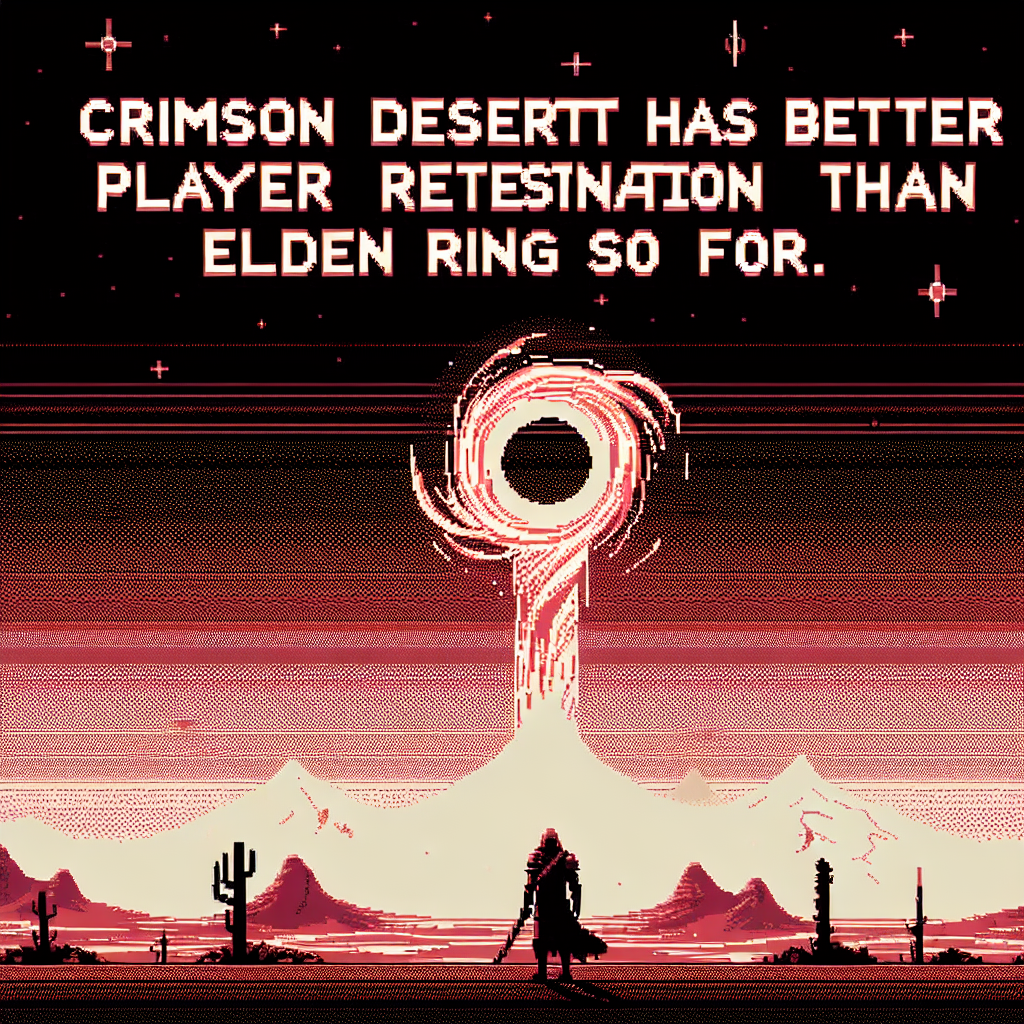
The video-game world loves big launches, but “big” doesn’t always mean “lasting.” That’s why the conversation around Crimson Desert player retention matters: despite launching later and into a crowded market, Pearl Abyss’s open-world epic has kept a surprising number of players engaged weeks after release. That kind of staying power changes how we should think about single-player games and what “success” looks like in 2026. (forbes.com)

First impressions: the numbers you’ll see in headlines

Crimson Desert exploded on release day with six-figure concurrent user peaks on Steam and later hit new highs during its second weekend. SteamDB shows daily and peak-concurrent figures in the hundreds of thousands, and multiple outlets report sustained six-figure activity more than a month after launch. Those raw numbers are impressive, but the story Forbes highlighted is retention — the percentage of launch players who are still active after the initial hype — where Crimson Desert has outpaced even an established phenomenon like Elden Ring. (steamdb.info)

Why does that matter? A huge opening-day crowd can be largely curiosity-driven. Retention suggests players found reasons to stay: systems that reward long play, content that intrigues, or a loop that fits different playstyles. For Crimson Desert, the combination of a sprawling open world, varied combat, and ongoing patches appears to have extended the window of engagement. (techradar.com)

What “player retention” really measures here

Let’s be clear: when journalists compare retention between single-player experiences, they’re often using proxy metrics such as Steam peak concurrency over time. That isn’t the same as session frequency or daily-active-user metrics used by live-service games, but it’s a useful lens. In plain terms: how many of the people who showed up at launch are still in-game a month later? Crimson Desert’s percentage drop from launch peak to month-one peak was considerably smaller than Elden Ring’s at a similar point after its release. (forbes.com)

Context matters. Elden Ring launched in 2022 with a different market environment, different player expectations, and a design that encourages completion rather than long-term wandering. Crimson Desert launched with platforms, marketing, and a community primed for streaming and discovery — factors that can extend a game’s lifespan after launch. (techradar.com)

Why Crimson Desert might be retaining players better

  • Rapid iteration and fixes: Developers responded quickly to early feedback and patched notable pain points, which can stop a first-week drop from becoming a long-term decline. This fix-first cadence matters more than ever for converting curious players into long-term fans. (sweepleague.com)

  • Breadth of content and playstyles: The game mixes long-form exploration, sandbox systems, and optional difficulty accessibility. That lets both completionists and casual explorers find a place to stay. Players who might finish a tightly-focused RPG in weeks can keep playing Crimson Desert as a sandbox or sidequests destination. (en.wikipedia.org)

  • Social and streaming momentum: High viewership and streaming attention (Twitch peaks were massive at launch) create social proof and discovery loops that keep new players arriving even after the first week — and some of those newcomers stick around. (reddit.com)

  • Patching and reputation management: Beyond bug fixes, removing controversial elements (for example, disputed AI-generated assets) and transparent communication can stabilize community sentiment and restore trust — which in turn helps retention. (gamesradar.com)

A fair comparison to Elden Ring

It’s tempting to talk about "beating" Elden Ring at retention and declare a shift in industry power dynamics. Resist that temptation. Elden Ring’s strengths are different: it’s a tightly tuned, high-difficulty RPG that many players finish and move on from because they completed its challenge. Crimson Desert’s longer tail so far is a signal that its design and post-launch handling are keeping players engaged — not necessarily that one game is objectively “better.” (forbes.com)

Comparisons are useful for framing trends, though. They underscore that single-player games can both launch big and retain players — a mix once thought to belong mainly to live-service titles. That’s a meaningful market signal for developers and publishers thinking about investment in large-scale solo experiences.

What this means for developers and players

  • For developers: polished launch content is no longer enough. Speedy post-launch updates, community listening, and systems that support varied playstyles extend a game’s lifecycle. The industry is learning that coupling bold launches with strong live support can create hybrid success models even for single-player titles.

  • For players: retention means more reasons to return. Whether you want a sprawling world to lose yourself in or a sequence of incremental improvements and events, games that keep a community around tend to develop content, fixes, and social spaces that reward continued play.

What to watch next

  • Sales versus retention: Crimson Desert crossed multi-million sales thresholds early, but whether that sales momentum converts into a stable, multi-year community will depend on continued updates and player satisfaction. (gamesradar.com)

  • Long-term engagement metrics: Watch for how concurrent peaks evolve across months and whether the player base diversifies across platforms beyond Steam. The first 60–90 days will be particularly telling.

  • Community sentiment: Review trends and forum chatter often predict whether a game’s retention will flatten or keep growing. The early review turnaround for Crimson Desert suggests a robust recovery pattern, but lasting goodwill needs consistent care. (windowscentral.com)

My take

Crimson Desert’s retention story is one part design, one part timing, and one part reaction speed. It doesn’t dethrone Elden Ring from any throne of design excellence, but it does nudge the industry’s assumptions: single-player games can have legs, and retention isn’t exclusively a live-service metric. For players, that’s great news — it means more single-player titles will get the post-launch attention needed to become lasting experiences.

Sources

Ghost of Yotei: The New Gaming Benchmark | Analysis by Brian Moineau

Ghost of Yotei: A New Era in Gaming that Surpasses Tsushima

If you thought the gaming world couldn’t get any more breathtaking after the stunning landscapes of *Ghost of Tsushima*, think again. The latest release, *Ghost of Yotei*, has hit the PS5, and the reviews are rolling in—each one seemingly more enthusiastic than the last. But how does it stack up against its predecessor? Spoiler alert: it appears to be a game-changer. Let’s dive into what makes *Ghost of Yotei* a standout title.

The Rise of Ghost of Yotei: Context and Background

*Ghost of Tsushima* was a critical darling upon its release in 2020, lauded for its stunning open-world design, compelling storytelling, and intricate samurai combat mechanics. Developed by Sucker Punch Productions, the game captured players’ hearts and minds, taking them on a journey through feudal Japan during the Mongol invasion.

Now, with *Ghost of Yotei*, the developers have taken the beloved formula and enhanced it further. Set in the breathtaking backdrop of Hokkaido, Japan, this sequel not only maintains the stunning visuals but also introduces new gameplay mechanics and a narrative that delves deeper into the lore and culture of the region. As the reviews suggest, Sucker Punch has managed to elevate the experience to a whole new level.

What Critics Are Saying

The early reviews have been overwhelmingly positive, with many critics praising the game for its rich storytelling, character development, and visual fidelity. The combat system has seen significant improvements, offering players new ways to engage with enemies and the environment.

The emotional depth of the story also seems to have taken center stage, with players reporting a more immersive experience that resonates on a personal level. In essence, *Ghost of Yotei* appears to capture the essence of its predecessor while pushing the boundaries of what players can expect from a narrative-driven action-adventure game.

Key Takeaways

Improved Graphics and Performance: The PS5 capabilities have allowed for stunning visuals and smoother gameplay, creating an immersive experience that surpasses *Ghost of Tsushima*.

Enhanced Combat Mechanics: Players can expect more fluid combat with new techniques and abilities, making battles more dynamic and engaging.

Deeper Storytelling: The narrative in *Ghost of Yotei* has received high praise for its emotional depth and character arcs, offering a more poignant experience for players.

Cultural Richness: The game delves deeper into Japanese culture, with Hokkaido’s unique flora and fauna playing a significant role in both the story and gameplay.

Critical Acclaim: Many reviews suggest that *Ghost of Yotei* has set a new benchmark in the gaming industry, with some critics believing it could redefine open-world action games.

Conclusion: A New Benchmark in Gaming

As we explore the evolving landscape of video games, *Ghost of Yotei* stands out not just as a sequel but as a massive leap forward for the genre. With its breathtaking visuals, improved gameplay mechanics, and richer storytelling, it’s poised to captivate both fans of *Ghost of Tsushima* and newcomers alike. If the reviews are any indication, this game may just redefine what we expect from open-world adventures and storytelling in gaming.

So, whether you’re a seasoned gamer or just dipping your toes into the world of action-adventure, *Ghost of Yotei* deserves a spot on your must-play list. Get ready to embark on a journey that not only challenges your skills but also tugs at your heartstrings.

Sources

– “Ghost Of Yotei Reviews Are In, And Better Than ‘Tsushima’ – Forbes” (https://www.forbes.com)
– “Ghost of Tsushima Review” (https://www.ign.com/articles/2020/07/17/ghost-of-tsushima-review)
– “Ghost of Yotei: Everything We Know” (https://www.gamesradar.com/ghost-of-yotei-everything-we-know)

Remember to keep your eyes peeled for more updates on this exciting new title! Happy gaming!


Related update: We recently published an article that expands on this topic: read the latest post.


Related update: We recently published an article that expands on this topic: read the latest post.


Related update: We recently published an article that expands on this topic: read the latest post.

“This Might Be A Very Controversial Take”: Oblivion Remastered Players Don’t Miss A Key Mechanic From Skyrim And Want It Changed For The Elder Scrolls 6 – TheGamer | Analysis by Brian Moineau

"This Might Be A Very Controversial Take": Oblivion Remastered Players Don't Miss A Key Mechanic From Skyrim And Want It Changed For The Elder Scrolls 6 - TheGamer | Analysis by Brian Moineau

The Great Elder Scrolls Debate: Is Oblivion Really Better Than Skyrim?


Ah, the age-old debate that keeps Elder Scrolls fans up at night: "Oblivion is better than Skyrim." It's a bold claim that sparks heated discussions across forums, social media, and gaming circles. But before we dive into the nitty-gritty, let's take a step back and appreciate the beauty of this debate. It's not just about which game is better; it's a celebration of what makes each game unique and beloved by its fans.

The Mechanics of Nostalgia


Recently, TheGamer published an article highlighting a controversial take among players of Oblivion Remastered. Some fans don't miss a key mechanic from Skyrim and are advocating for changes in the upcoming Elder Scrolls 6. This sentiment underscores a broader discussion: how nostalgia and evolving gameplay mechanics shape our preferences.

Oblivion, released in 2006, was a marvel of its time, offering an open-world experience that was both groundbreaking and immersive. Its mechanics, while dated by today's standards, are fondly remembered by fans who appreciate the depth and complexity they brought to the game. On the other hand, Skyrim, released in 2011, streamlined many of these mechanics, making the game more accessible to a broader audience.

Evolution of Gameplay


The evolution of gameplay mechanics is not unique to the Elder Scrolls series. Consider how the Legend of Zelda series has evolved. "Breath of the Wild" revolutionized the franchise by introducing a vast, open world with a non-linear approach to gameplay. This shift was both praised for its innovation and critiqued by purists who missed the structured dungeon-crawling of earlier titles.

Similarly, the debate between Oblivion and Skyrim often boils down to a matter of personal preference. Do you prefer the rich, text-heavy quests and intricate skill systems of Oblivion, or do you enjoy the streamlined, visually stunning, and mod-friendly world of Skyrim?

A Reflection of Broader Trends


This debate also mirrors broader trends in the world. Take, for example, the ongoing discussions in the film industry about practical effects versus CGI. Just as some cinephiles long for the tangible effects of classic films, some gamers yearn for the complex mechanics of older games. It's a testament to how technology and art continuously evolve, sparking debates that reflect our diverse tastes and values.

The Future of Elder Scrolls


As we look forward to Elder Scrolls 6, the question remains: which mechanics will Bethesda choose to incorporate? Will they honor the complexity of Oblivion or continue the streamlined approach of Skyrim? Perhaps they'll strike a balance, offering something that pleases both camps.

In the end, the debate between Oblivion and Skyrim is less about finding a definitive answer and more about celebrating the diversity of gaming experiences. It's a reminder that our preferences are as varied as the worlds we explore in these games.

Final Thoughts


As technology continues to push the boundaries of what's possible, it's exciting to think about where the Elder Scrolls series will go next. Whether you're team Oblivion or team Skyrim, one thing is certain: the journey is what truly matters. So, let's keep the discussion going, celebrate the games we love, and look forward to the adventures that await us in Elder Scrolls 6.

Happy gaming!

Read more about AI in Business

Read more about Latest Sports Trends

Read more about Technology Innovations