
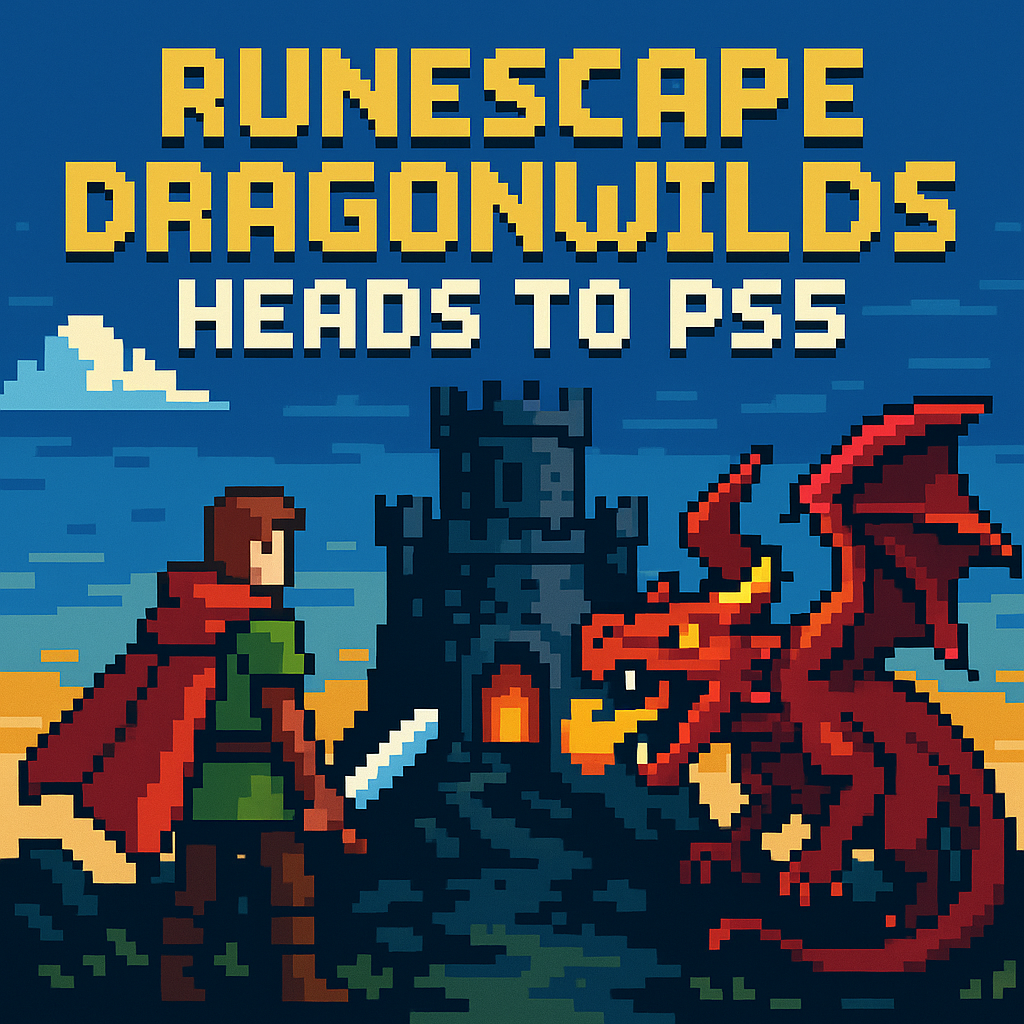
RuneScape: Dragonwilds Heads to PS5 | Analysis by Brian Moineau

TL;DR

  • RuneScape: Dragonwilds is coming to PlayStation 5 in late 2026 as a day-one PlayStation Plus Extra/Premium catalog title, the RuneScape IP’s first proper console landing in 25 years. [1][2]
  • Jagex isn’t porting the click-heavy MMO; it’s leading with a survival-crafting spinoff that already cleared 1 million PC sales and holds a “Very Positive” Steam rating—both strong signals for controller-first play and PS Plus discovery. [1][3][5]
  • The upside is outsized: PlayStation Network counted 132 million monthly active users in 2024, and 38% of PS Plus members pay for Extra or Premium, so even modest catalog sampling could rival Dragonwilds’ 1 million–player PC start. [7][8][1]

What the source said

IGN reported that RuneScape: Dragonwilds will launch on PlayStation 5 “later in 2026” and join PlayStation Plus Extra and Premium on day one, marking the franchise’s first console appearance since RuneScape began on PC in 2001. The spinoff swaps MMO interfaces for 1–4 player survival crafting on Ashenfall, where parties build skills and hunt the Dragon Queen. IGN and the official site add that Dragonwilds has sold over 1 million copies on PC and holds a “Very Positive” Steam user rating. The main RuneScape and Old School RuneScape clients remain on PC and mobile with no console versions announced. [1][3][5]

Why it matters

Two stakeholder groups stand to gain—or stumble—here. For Jagex, this is a controlled expansion that avoids reworking a two-decade-old MMO UI for gamepads while extending 25 years of Gielinor lore into a controller-native loop. Survival crafting suits pick-up-and-play on PS5, pairs well with subscription sampling, and can onboard lapsed players into the wider RuneScape universe if events and progression land cleanly. [3][4]

For Sony, Dragonwilds is a 2026 proof point that third‑party day-one PS Plus Game Catalog drops can boost engagement. Tchia hit 1 million players in six weeks via PS Plus in 2023, and a co-op survival title with RuneScape’s brand gravity gives Extra/Premium a sticky fall window anchor on PlayStation 5. [2][9]

Original analysis

RuneScape: Dragonwilds on PS5 — why a survival-crafter is the beachhead

The consensus take is “RuneScape finally comes to console.” The contrarian read: Jagex is sidestepping a costly, risky MMO port by building a console-native pillar in the same universe. Survival crafting directly tackles the three console MMO blockers—fiddly UI, marathon sessions, and upfront price hesitance—by leaning into controller-friendly loops (gather, craft, base-build, boss runs) and launching straight into PS Plus Extra/Premium to kill purchase friction. [2][3]

Back-of-envelope reach math (scenario, not a forecast):

  • PC baseline: 1.0 million Early Access players on Steam and PC storefronts. [1][3]
  • PS Plus gating: 38% of PS Plus members are on Extra or Premium. Let N = total PS Plus subscribers; Extra+Premium members ≈ 0.38N. [8]
  • Solve for “match PC in month one”: 0.06 × 0.38N ≈ 1.0m → N ≈ 43.9m. So, if PS Plus sits near 44m subscribers at launch, a 6% try rate among Extra/Premium would yield ≈1.0m players (0.06 × 0.38 × 43.9m ≈ 1.0m). This is sensitivity analysis, not a prediction. [8][1]
    This mirrors prior day-one catalog outcomes: Tchia crossed 1 million players in six weeks, showing how visibility and low-friction access can bend the player curve for smaller teams. Dragonwilds adds co-op stickiness that single‑player catalog darlings often lack. [9][2]

Named-stakeholder breakdown:

  • Jagex: Gains a console beachhead without rewriting RuneScape’s legacy client and can test cross-progression, live events, and monetization on a cleaner surface. If Dragonwilds retention holds, Jagex proves the IP travels and can route players between PC and console ecosystems. [3][4]
  • Sony (SIE): Banks a late‑2026 co-op time sink that reinforces PS Plus Extra/Premium’s value without first‑party day-one spending, and can showcase third‑party partnerships in State of Play beats. [2]
  • Steam/PC survival incumbents (Valheim‑likes, Enshrouded, Palworld‑adjacent): Face a brand-backed entrant with 25 years of lore and a studio trained on live ops cadence, which could accelerate updates if console traction feeds PC content. [4][5]
  • RuneScape MMO loyalists: Don’t get a console client yet, but do get a lore-forward on‑ramp for friends and lapsed players, with potential cross-event hooks if RS25 beats sync across titles in 2026. [4]

A visible strategy shift shows up in 2025–2026 comms: Jagex’s RS25 program emphasizes “player‑first design” and integrity roadmaps, while Dragonwilds’ updates highlight dedicated servers and steady content drops. That rhythm matters on console, where shorter sessions and party churn punish slow weekly cadence. [4][3]

2×2: IP carryover vs. porting friction

  • High IP carryover / High friction: Port RuneScape MMO to console (heavy UI/UX/controls lift across 20+ years of content).
  • High IP carryover / Low friction: A guided console client with cross‑save and slimmed interfaces (rare without a multi‑year rebuild).
  • Medium IP carryover / Low friction: Dragonwilds spinoff—shared lore, controller‑first design, subscription distribution.
  • Low IP carryover / Low friction: New IP survival‑crafter—cleanest controls, zero heritage draw.

Dragonwilds sits in the third box. It captures brand equity while optimizing for console ergonomics and subscription incentives, and it can ladder into deeper crossovers—or even a modernized MMO console client—if retention and party formation metrics clear 2026 targets. [2][3]

What others are missing

The critical angle isn’t just “reach,” it’s the co-op slope: time from a PS5 dashboard ping to a four‑stack in Ashenfall, and back again the next night. That slope depends on frictionless parties, clear cross‑play/cross‑progression messaging on the PS Store page, and resilient servers at PS Plus scale; Jagex has name‑checked dedicated servers and regular updates, but console retention hinges on how base building, enemy AI, and late‑game bosses recycle the social loop week after week. If Dragonwilds maps RuneScape‑style skilling and boss rotations onto PS5 parties—and says so clearly in pre‑launch beats—it can avoid the one‑and‑done catalog trap. [3][5]

What to watch next

  1. By September 30, 2026, Jagex announces cross‑play and cross‑progression specifics between PS5 and PC for Dragonwilds—or explicitly confirms “not at launch”—which will materially cap or expand first‑month co-op growth. [3]

  2. By November 30, 2026, Dragonwilds surpasses 2.5 million cumulative players on PlayStation, verified via a Jagex blog, PS Wrap‑Up stats, or press statements; this requires a 10–15% try rate among active Extra/Premium members at launch. [2][3]

  3. By Q1 2027 earnings, Sony cites Dragonwilds (or “survival‑crafting titles”) as a top PS Plus engagement driver for fall 2026 in a blog or investor post, echoing how prior catalog performers were spotlighted. [2]

My take

Launching Dragonwilds into PS Plus Extra/Premium in late 2026 gives Jagex immediate reach on PlayStation 5 while avoiding a risky RuneScape MMO port, and it hands Sony a co-op tentpole when subscription momentum matters. The bet works if parties form fast, progression climbs weekly, and server reliability holds at PSN scale. If those basics click, Dragonwilds becomes the franchise’s second pillar in 2026–2027, not a side story. Jagex and Sony both get measurable wins without overextending on a two‑year port of a 2001‑era client. [2][3]

Sources

  1. RuneScape IP Makes the Jump to Console for the First Time in Its 25-Year History With RuneScape: Dragonwilds Later in 2026 — IGN (https://www.ign.com/articles/runescape-dragonwilds-launches-on-consoles-later-in-2026-sony-picks-up-spinoff-for-ps-plus) — Original report: PS5 timing, PS Plus day‑one, 1M PC copies, Steam sentiment.

  2. State of Play June 2026: all announcements, trailers — PlayStation Blog (https://blog.playstation.com/2026/06/02/state-of-play-june-2026-all-announcements-trailers/) — Official confirmation of Dragonwilds’ PS5 reveal and day‑one Game Catalog positioning.

  3. Dragonwilds comes to PlayStation 5! — Dragonwilds official site (https://dragonwilds.runescape.com/news/dragonwilds-ps5) — Jagex’s PS5 announcement: “later this year,” PS Plus Extra/Premium, update cadence mentions and Early Access milestone.

  4. Jagex Marks RuneScape’s 25th Year with RS25… — Jagex press release (https://www.jagex.com/news/jagex-marks-runescape%E2%80%99s-25th-year-with-rs25-delivering-record-investment-a-dedicated-game-integrity-roadmap-new-game-modes-player-first-design-and-franchise-expansion) — Confirms 2026 franchise roadmap, integrity focus, and franchise expansion framing.

  5. RuneScape: Dragonwilds — Steam store page (https://store.steampowered.com/app/1374490?l=english) — Live user review status: “Very Positive,” review count context, Early Access positioning.

  6. RuneScape: Dragonwilds is coming to PlayStation Plus on day one — VGC (https://www.videogameschronicle.com/news/runescape-dragonwilds-gitaroo-man-ps-plus/) — Independent recap of PS Plus day‑one and late‑2026 window.

  7. PlayStation Network sets a new monthly active users record — Shacknews (https://www.shacknews.com/article/147748/playstation-network-monthly-active-user-record?amphtml=1) — PSN at 132 million MAUs and context for platform‑level reach.

  8. 38% of PS Plus Members Are Paying More for Extra, Premium — Push Square (https://www.pushsquare.com/news/2025/06/38percent-of-ps-plus-members-are-paying-more-for-extra-premium) — Tier mix data (22% Premium, 16% Extra) informing sampling scenarios.

  9. Tchia tops one million players in six weeks — Gematsu (https://www.gematsu.com/2023/05/tchia-tops-one-million-players-in-six-weeks-physical-edition-launches-july-18) — Evidence that day‑one PS Plus catalog launches can rapidly amass players.


Related update: We recently published an article that expands on this topic: read the latest post.
Failed FPS Lives On as Preservation Win | Analysis by Brian Moineau

When a Failed Shooter Refuses to Die: Blindfire Lives On Because Games Are Art

Blindfire is now free to play and will stick around for "years" so players can see what the studio created — and that simple choice tells us more about games, preservation, and the economics of live-service design than a typical shutdown story does.

The news landed quietly on May 7, 2026: Double Eleven rebranded the struggling FPS as Blindfire: Lights Out, pushed a final major update, and flipped the price to free. Crucially, the studio said it will keep the servers running for years because, as the team put it on the Steam page, they’re “proud of it” and want to preserve the work. That line — “games are art and deserve to be preserved” — is the headline-grabbing quote, but the decision behind it sits at the crossroads of creative pride, player goodwill, and the messy realities of maintaining online games.

Why this matters beyond a niche shooter

Most players have seen this pattern: an online game launches, fails to attract the numbers the publisher hoped for, and then quietly powers down. It’s jarring because, unlike single-player titles you can keep on a shelf, live multiplayer games often disappear entirely when servers go offline or licensing expires. Blindfire’s pivot — going free and remaining online despite its commercial struggles — feels like an act of preservation that acknowledges games as cultural artifacts, not just revenue streams.

That matters because digital ephemerality is real. When a server goes dark, so do the unique systems, player histories, and social experiences that made the game what it was. For some studios that inability to “archive” a multiplayer experience is an ethical sore point: games embody design choices, music, code, and community interactions that future devs, historians, and curious players will never see if everything is erased.

Blindfire: the short story

  • Released in October 2024 as an experimental online FPS built around darkness and detection.
  • Never carved out a big audience amid fierce competition and discoverability issues.
  • After a year without major patches, Double Eleven released a final update on May 7, 2026, renamed the game Blindfire: Lights Out, and made it free to download.
  • The studio committed to keeping servers running for “years” so people can play and researchers or fans can study the design. (kotaku.com)

Blindfire is now free to play and will stick around for 'years' so players can see what the studio created

That phrase — the official framing of the update — works as both marketing and manifesto. On one hand, free-to-play removes a price barrier that was likely limiting discovery. On the other, the “we’ll keep it online” pledge signals respect for the project’s lifespan beyond pure profit.

This approach isn’t unprecedented, but it’s rare. Some studios release server tools, set up private-server support, or open-source parts of a game so communities can continue running them. Double Eleven’s choice to keep the official servers live is different: it preserves the canonical experience under the developer’s own care.

The tension: stewardship versus sustainability

Keeping a game online is not free. Servers, matchmaking infrastructure, anti-cheat systems, and staff time all cost money. When a title is losing players and revenue, companies typically cut those costs. So why would a studio choose preservation over immediate bottom-line savings?

  • Reputation and goodwill. A public gesture to preserve a game can build trust and respect across the community and the wider industry.
  • Ethical and historical considerations. For teams proud of their work, shutting it down feels like erasing a creative statement.
  • Low-cost middle ground. Some server bills and maintenance can be scaled back; keeping simple, low-overhead servers running might be feasible for years with modest investment.
  • Future upside. A preserved title can become a historical curiosity, a case study, or even a source of renewed interest later on.

That last point is practical: the way communities rediscover old games — through streamers, nostalgia, or unexpected cultural moments — means that “dead” titles can sometimes be revived. A standing server makes any revival simpler.

Where this sits in the bigger preservation debate

Game preservation activists and archivists have long warned that more games are being lost every year, especially online-only experiences. The Blindfire case adds nuance: publishers can act as stewards, not just gatekeepers. It also highlights the need for industry standards around preservation: documentation, tooling for private servers, and clearer licensing for assets and code.

At the same time, the move raises questions. Will Double Eleven truly fund servers “for years,” or is this a temporary grace period? How will anti-cheat, matchmaking, and live services be maintained long-term? The answers matter for players who invest time and identity in these worlds.

Players and preservation: what this means for you

  • If you’re curious, now’s the perfect time to try Blindfire: Lights Out while the official servers remain active. Free access makes it easy to experiment without commitment. (kotaku.com)
  • If you value digital preservation, support initiatives that document live-service games: archival projects, fan wikis, and recordings of gameplay are all critical.
  • For developers, this is a reminder that the choices you make at the end of a project define its legacy — whether it’s open-sourcing tools, providing server-running instructions, or simply announcing a preservation plan.

My take

I’m glad Double Eleven chose to keep Blindfire alive. It’s a humane move in an industry that often treats projects like disposable experiments. Preserving a game acknowledges the labor and creativity behind it, and it keeps an honest record of what developers tried — successes and failures both.

That said, this can’t be the only pattern. Preservation needs systemic solutions: clearer laws around game archiving, industry norms for handing off server code, and funding for noncommercial archival efforts. Developer goodwill helps, but it’s fragile when balanced against quarterly budgets.

Sources


Related update: We recently published an article that expands on this topic: read the latest post.


Related update: We recently published an article that expands on this topic: read the latest post.

Crimson Desert Outpaces Elden Ring | Analysis by Brian Moineau

Why Crimson Desert player retention is turning heads

The video-game world loves big launches, but “big” doesn’t always mean “lasting.” That’s why the conversation around Crimson Desert player retention matters: despite launching later and into a crowded market, Pearl Abyss’s open-world epic has kept a surprising number of players engaged weeks after release. That kind of staying power changes how we should think about single-player games and what “success” looks like in 2026. (forbes.com)

First impressions: the numbers you’ll see in headlines

Crimson Desert exploded on release day with six-figure concurrent user peaks on Steam and later hit new highs during its second weekend. SteamDB shows daily and peak-concurrent figures in the hundreds of thousands, and multiple outlets report sustained six-figure activity more than a month after launch. Those raw numbers are impressive, but the story Forbes highlighted is retention — the percentage of launch players who are still active after the initial hype — where Crimson Desert has outpaced even an established phenomenon like Elden Ring. (steamdb.info)

Why does that matter? A huge opening-day crowd can be largely curiosity-driven. Retention suggests players found reasons to stay: systems that reward long play, content that intrigues, or a loop that fits different playstyles. For Crimson Desert, the combination of a sprawling open world, varied combat, and ongoing patches appears to have extended the window of engagement. (techradar.com)

What “player retention” really measures here

Let’s be clear: when journalists compare retention between single-player experiences, they’re often using proxy metrics such as Steam peak concurrency over time. That isn’t the same as session frequency or daily-active-user metrics used by live-service games, but it’s a useful lens. In plain terms: how many of the people who showed up at launch are still in-game a month later? Crimson Desert’s percentage drop from launch peak to month-one peak was considerably smaller than Elden Ring’s at a similar point after its release. (forbes.com)

Context matters. Elden Ring launched in 2022 with a different market environment, different player expectations, and a design that encourages completion rather than long-term wandering. Crimson Desert launched with platforms, marketing, and a community primed for streaming and discovery — factors that can extend a game’s lifespan after launch. (techradar.com)

Why Crimson Desert might be retaining players better

  • Rapid iteration and fixes: Developers responded quickly to early feedback and patched notable pain points, which can stop a first-week drop from becoming a long-term decline. This fix-first cadence matters more than ever for converting curious players into long-term fans. (sweepleague.com)

  • Breadth of content and playstyles: The game mixes long-form exploration, sandbox systems, and optional difficulty accessibility. That lets both completionists and casual explorers find a place to stay. Players who might finish a tightly-focused RPG in weeks can keep playing Crimson Desert as a sandbox or sidequests destination. (en.wikipedia.org)

  • Social and streaming momentum: High viewership and streaming attention (Twitch peaks were massive at launch) create social proof and discovery loops that keep new players arriving even after the first week — and some of those newcomers stick around. (reddit.com)

  • Patching and reputation management: Beyond bug fixes, removing controversial elements (for example, disputed AI-generated assets) and transparent communication can stabilize community sentiment and restore trust — which in turn helps retention. (gamesradar.com)

A fair comparison to Elden Ring

It’s tempting to talk about "beating" Elden Ring at retention and declare a shift in industry power dynamics. Resist that temptation. Elden Ring’s strengths are different: it’s a tightly tuned, high-difficulty RPG that many players finish and move on from because they completed its challenge. Crimson Desert’s longer tail so far is a signal that its design and post-launch handling are keeping players engaged — not necessarily that one game is objectively “better.” (forbes.com)

Comparisons are useful for framing trends, though. They underscore that single-player games can both launch big and retain players — a mix once thought to belong mainly to live-service titles. That’s a meaningful market signal for developers and publishers thinking about investment in large-scale solo experiences.

What this means for developers and players

  • For developers: polished launch content is no longer enough. Speedy post-launch updates, community listening, and systems that support varied playstyles extend a game’s lifecycle. The industry is learning that coupling bold launches with strong live support can create hybrid success models even for single-player titles.

  • For players: retention means more reasons to return. Whether you want a sprawling world to lose yourself in or a sequence of incremental improvements and events, games that keep a community around tend to develop content, fixes, and social spaces that reward continued play.

What to watch next

  • Sales versus retention: Crimson Desert crossed multi-million sales thresholds early, but whether that sales momentum converts into a stable, multi-year community will depend on continued updates and player satisfaction. (gamesradar.com)

  • Long-term engagement metrics: Watch for how concurrent peaks evolve across months and whether the player base diversifies across platforms beyond Steam. The first 60–90 days will be particularly telling.

  • Community sentiment: Review trends and forum chatter often predict whether a game’s retention will flatten or keep growing. The early review turnaround for Crimson Desert suggests a robust recovery pattern, but lasting goodwill needs consistent care. (windowscentral.com)

My take

Crimson Desert’s retention story is one part design, one part timing, and one part reaction speed. It doesn’t dethrone Elden Ring from any throne of design excellence, but it does nudge the industry’s assumptions: single-player games can have legs, and retention isn’t exclusively a live-service metric. For players, that’s great news — it means more single-player titles will get the post-launch attention needed to become lasting experiences.

Sources

Professor Layton Finally Arrives on PS5 | Analysis by Brian Moineau

Tip of the hat to you, sir

Introduction

Professor Layton Makes His Long-Awaited PS5 Debut Later This Year, Almost 20 Years After the Series Started — those words land like a polite but excited bow. For anyone who grew up coaxing riddles and clockwork secrets out of a stylized Victorian London on a handheld, the news that Level‑5’s puzzle maestro is finally stepping onto PlayStation 5 and PC alongside Nintendo platforms feels both inevitable and wildly overdue.

This post walks through what changed, why it matters for the franchise and the games industry, and what Layton’s migration from Nintendo exclusivity to a true multiplatform launch could mean for fans new and old.

Why this moment feels so big

  • The Professor Layton series began in 2007 on the Nintendo DS and carved its reputation around clever puzzles, cozy storytelling, and an art‑book visual voice. For nearly two decades the franchise was mostly a Nintendo territory.
  • Level‑5’s new entry, Professor Layton and the New World of Steam, was teased in prior showcases and delayed into 2026. The April Level‑5 Vision 2026 update confirmed a worldwide launch “toward the end of 2026” and — crucially — added PlayStation 5 and Windows (Steam) to the platform list.
  • That expansion makes this the first mainline Layton game to officially arrive on non‑Nintendo home consoles and PC, widening the audience for a series often associated with portable, touch‑based puzzling.

A fresh heading for an old favorite

Professor Layton Makes His Long-Awaited PS5 Debut Later This Year, Almost 20 Years After the Series Started

Putting the core topic front and center: Level‑5’s press updates and the new trailer confirm that Professor Layton and the New World of Steam will reach PS5 and PC in the same release window as Switch and Switch 2, with a global simultaneous launch penciled in for the end of 2026. For players who associate Layton with small screens and stylus clicks, the move suggests a deliberate reimagining — not a reboot, but an evolution.

What’s new in the game itself

  • Setting and tone: The game is set in Steam Bison, a steam‑driven American city that leans into the series’ affinity for charming, slightly off‑kilter locales. The narrative reportedly picks up about a year after events from earlier titles, promising both continuity and a fresh stage for mystery.
  • Presentation and mechanics: Early trailers and developer notes show fully 3D environments and expanded movement across towns — a departure from the mostly static maps of past DS/3DS entries. Mouse and PC controls were mentioned for non‑Switch versions, hinting at puzzle UIs rethought for controllers and keyboards alike.
  • Puzzles: Level‑5 promises “the most puzzles in series history” for this chapter. That’s an enticing line, but it also raises questions about puzzle quality and balance — can quantity coexist with the elegant designs that defined the originals?

Why multiplatform matters — beyond sales

  • Accessibility: New platforms mean Layton reaches players who never owned a DS or 3DS and don’t plan to invest in a Switch. PC and PS5 users get a chance to discover the series without hunting down legacy hardware or ports.
  • Preservation and legacy: Porting a beloved series to modern consoles can prevent it from becoming a dusty footnote. When distributed on major platforms, classic franchises have better odds of being preserved, patched, and rediscovered by future generations.
  • Creative possibility: Working for consoles and PC encourages developers to rethink interface, pacing, and visual storytelling. That can be a double‑edged sword: it may elevate the series’ cinematic and exploratory aspects, but it also risks losing the compact charm that made Layton a handheld staple.

Concerns for longtime fans

  • Puzzle fidelity: The original games benefited from contributors like Akira Tago and a design philosophy tuned to handheld play. With new platforms and a new era of designers, some longtime fans worry puzzles could skew toward spectacle or ambiguous solutions.
  • Localization timing: Historically, Layton games reached the West long after Japanese releases. Level‑5’s talk of a simultaneous worldwide launch is promising, but skeptical fans remember long waits and staggered rollouts.
  • Platform omissions: The announcement notably did not include Xbox, which may disappoint some players and leaves questions about Level‑5’s longer‑term platform strategy.

How this fits into larger industry trends

  • Franchises expanding beyond their original exclusivity is now normal. Bringing a property from a single‑platform identity to multiplatform release can rejuvenate creative interest and commercial prospects.
  • The move also reflects how studios need broader audiences to justify larger budgets. A global simultaneous launch across Switch, Switch 2, PS5, and PC gives Level‑5 the breathing room to invest in more ambitious visuals, voice work, and localization efforts.
  • Finally, Layton’s PS5/PC debut may nudge other “cult handheld” franchises to consider broader releases — especially ones with strong narratives and character work that translate well to living room audiences.

Transitions and expectations

We should temper excitement with realistic expectations. Level‑5 delayed the game into 2026 to “deliver the game in the best possible form,” and the new announcements frame the title as “nearing completion” rather than ready to ship tomorrow. That’s healthy. A well‑polished Layton game on modern hardware will reward patience far more than a rushed release.

My take

There’s a certain theatrical flourish to this story: a dignified professor, nearly two decades after his first case, tipping his hat and stepping onto a larger stage. Level‑5 is taking a chance — and the safest bet is to let them take their time and get the details right. If they do, Professor Layton and the New World of Steam could be the best possible bridge between the series’ comforting past and a wider, more diverse future audience.

Sources

Final thoughts

Tip of the hat to you, sir — and to the team keeping Professor Layton’s fires burning. This PS5 and PC arrival is more than a platform announcement; it’s a vote of confidence in the series’ ability to charm a new generation and to remind older players why they once fell for a puzzle‑solving gentleman in a top hat. Here’s hoping the puzzles remain fair, the characters warm, and the mystery as satisfying as ever.