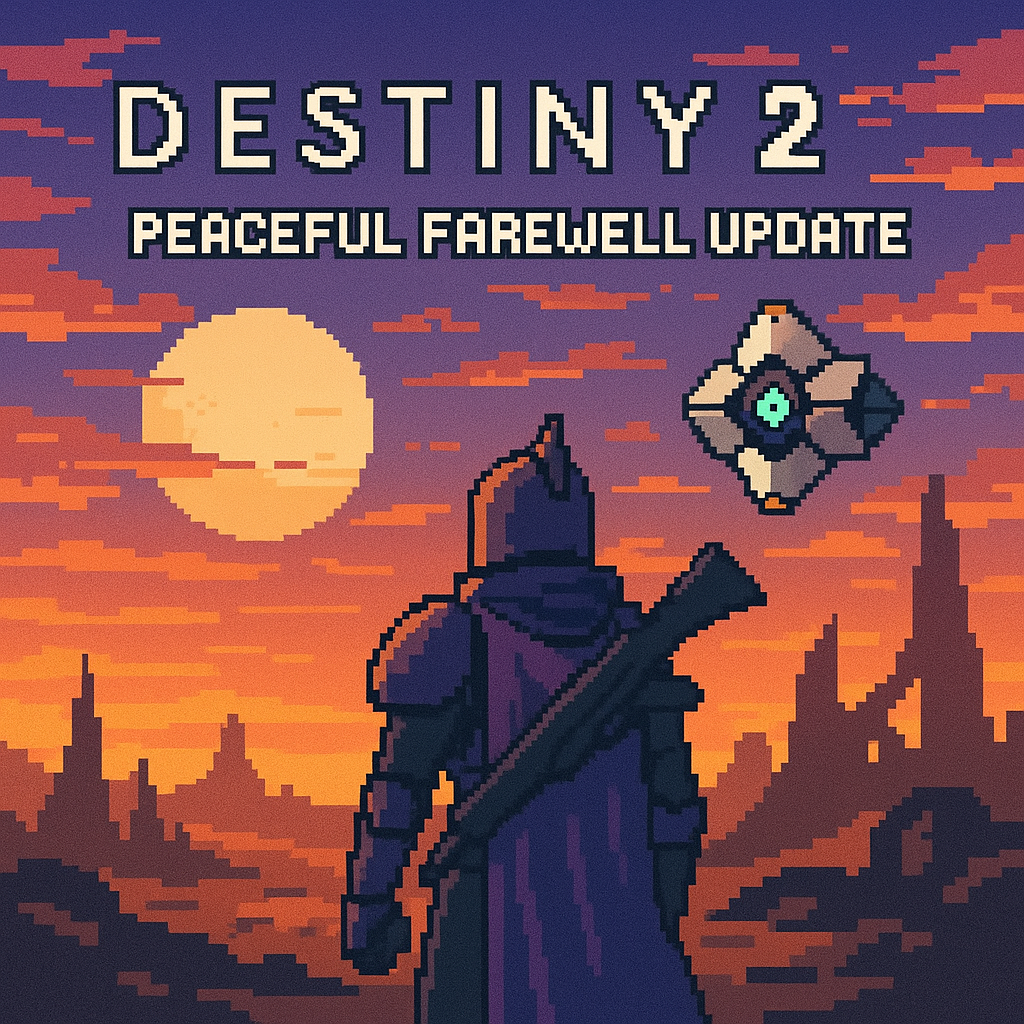
Destiny 2’s Peaceful Farewell Update | Analysis by Brian Moineau

TL;DR

  • Destiny 2’s last trailer tees up Monument of Triumph on June 9, 2026, with Ikora Rey’s “rest now, Guardian” sendoff as Bungie ends active development while keeping servers online for the Last City faithful. [1][2]
  • This is a freeze, not a funeral: Sony booked roughly $765–766 million of Bungie impairments for FY2025 (ended March 31, 2026), so halting Destiny 2’s update treadmill caps burn and preserves goodwill for a long‑tail “collection” product. [4][5]
  • The patch rewires the economy and access model—daily Bright Dust rotations, a single Destiny 2: The Collection SKU, and Sparrow Racing League’s return—signaling a playable museum that’s stable, light‑touch, and still monetizable. [2]

What the source said

Forbes reported on June 5, 2026 that Bungie released what is likely Destiny 2’s final trailer, pairing the June 9 Monument of Triumph update with imagery of the healed Traveler over the Last City and narration from Ikora Rey. The article lists reprised weapons and new armor sets, emphasizes Sparrow Racing League’s return as the “last new mode,” and notes lingering lore threads like “bind the Nine” left unresolved. It captures a tone of elegy and finality while acknowledging players’ hope for a hypothetical Destiny 3 that isn’t greenlit in 2026. [1]

Why it matters

  • Bungie is shifting from “forever updates” to preservation: on May 21, 2026, the studio said Monument of Triumph on June 9, 2026 marks the end of active development for Destiny 2, with servers staying online—echoing Destiny 1’s museum state after Age of Triumph in 2017. That reframes Destiny 2 as an evergreen product, not a growth treadmill. [2][1]
  • The portfolio math is visible in Sony’s filings: across FY2025, Sony recorded about $765–766 million in impairment losses tied to Bungie, including a $204 million hit disclosed in Q2 FY2025. In that light, ending Destiny 2’s live ops looks like risk containment while Bungie incubates new games such as Marathon. [4][5]

Original analysis

Consensus says: “Ending updates for Destiny 2 is a tragedy driven by corporate missteps.” Contrarian read: freezing Destiny 2 now is the least‑bad option that preserves the IP’s cultural equity and stops a cost spiral as engagement slid on PC; in March 2026, Steam concurrency hit all‑time lows per third‑party trackers, a trend that contextualizes Sony’s impairments and Bungie’s pivot. [7][5]

Named‑stakeholder breakdown

  • Bungie: Converts Destiny 2 into a curated museum with a lean maintenance team while staking the studio’s future on “next games.” The blog’s concrete changes—daily Bright Dust rotations, Destiny 2: The Collection, and permanent markdowns—optimize for a low‑friction, long‑tail economy. [2]
  • Sony Interactive Entertainment: Halting live updates caps opex and narrows reputational damage while SIE absorbs ~$765 million of write‑downs, testing whether Marathon or other bets can justify the $3.6 billion Bungie acquisition announced in 2022. [5][4]
  • Competitors (Warframe/Digital Extremes; Ubisoft’s The Division 2): They can court disaffected Guardians, but they also receive a warning about expensive content treadmills; Warframe’s creative director publicly called Destiny 2’s end “unthinkable,” underscoring the shock inside the live‑service cohort. [3]

2x2 framework: How live‑services “end”

  • High trust, Low burn: Curate and freeze (Destiny 2: Monument of Triumph in 2026).
  • High trust, High burn: Reinvent live (FFXIV: A Realm Reborn–style reboot; rare and risky).
  • Low trust, Low burn: Silent maintenance (servers on, minimal comms; reputational rot).
  • Low trust, High burn: Grind on with weak cadence (players churn; money vanishes).

Historical analogue (2017): Destiny 1’s Age of Triumph

  • In March 2017, Bungie closed Destiny 1’s update era with Age of Triumph—a celebration patch with revived raids and a pledge to keep servers on—then shifted momentum to Destiny 2’s September 2017 launch. Monument of Triumph echoes that playbook in 2026, but without a sequel waiting; Bungie frames this as the studio’s “new beginning,” not Destiny’s. Expect the museum to retain a core while attention migrates to whatever Bungie ships next. [1][2]

Back‑of‑envelope calculation (illustrative, not a forecast)

  • Assume a live‑ops Destiny 2 team of 300 developers at a loaded cost of $180,000/year each (salary, benefits, tools) = ~$54,000,000/year.
  • If the freeze reduces to a 60‑person maintenance crew at the same loaded rate = ~$10,800,000/year.
  • Implied opex relief ≈ $43,200,000/year, before savings on contractor art pipelines, external QA, and seasonal marketing; even at ±25%, the order of magnitude explains a freeze after ~$765–766 million in impairments. [5]
  • On revenue, a maintenance‑state Eververse plus a “Collection” bundle can still generate mid‑single‑digit millions annually; the new daily Bright Dust rotations and broader ornament access point to slow‑drip, goodwill‑first monetization. [2]

Why this isn’t just a content funeral

  • The Bungie post reads like product management, not an epitaph: a refreshed Director, Pantheon 2.0, set bonuses across raids/dungeons, Distortions on destinations, and Sparrow Racing League as a permanent pillar, all free for every platform on June 9, 2026. That ships years of asks at once so the final “frozen” state feels generous. [2]
  • PC and console press also confirm an explicit in‑game goodbye rather than a fade‑out—“yes, there’s story; yes, we get to say goodbye”—which gives The Final Shape era emotional closure and tempers petitions for a last‑minute Destiny 3. [6][1]

What others are missing

The endgame is economic design, not lore closure: Bungie reworked the reward economy and access model to minimize weekly FOMO and support tickets—daily Bright Dust rotations, Bright Engram focusing, tiered armor/weapon parity across legacy raids/dungeons, and a single Destiny 2: The Collection SKU with permanent markdowns across Steam, PlayStation, and Xbox. That cocktail compresses balance work into clear tiers, broadens cosmetic access without constant store overhauls, and yields a preservation‑first monetization scheme that can run for years with low staffing and low controversy. [2]

What to watch next

  1. By September 30, 2026, after the “Immortal” title deadline, Destiny 2’s Steam 7‑day average concurrency will be ≥20% below its June 9–16, 2026 7‑day average, and October 2026’s day‑to‑day standard deviation will be lower than any Episode month in 2024–2025 (per SteamCharts or similar trackers). [2]
  2. By December 31, 2026, Sony IR materials will report no new Bungie‑specific impairment charge ≥$50 million beyond the ~$765–766 million recorded for FY2025; any additional write‑down above that threshold would falsify this. [4][5]
  3. By March 31, 2027, Destiny 2: The Collection will either be priced at $29.99 USD MSRP or less on at least two storefronts (Steam, PSN, Xbox), or will include all remaining expansion SKUs at no extra charge inside the bundle. [2]

My take

If you love Destiny, log in on June 9, 2026 and savor Monument of Triumph, because Bungie is closing a 2017–2026 era with uncommon grace. The studio is making the only defensible move after a brutal FY2025: lock an iconic game in a generous, fan‑friendly state and move on from an opex‑heavy treadmill that no longer cleared the bar. Sony’s ~$765 million impairments forced a sober reset; the museum model protects Destiny’s cultural equity while Bungie builds something that actually merits a fresh runway. [2][5]

Sources

  1. Destiny 2’s Last Trailer Ever Is Heartbreaking — Forbes (https://www.forbes.com/sites/paultassi/2026/06/05/destiny-2s-last-trailer-ever-is-heartbreaking/) — Frames the June 9, 2026 trailer, Ikora’s narration, and Sparrow Racing’s return.
  2. Destiny 2: Every End is a New Beginning — Bungie.net (https://www.bungie.net/7/en/News/Article/d2_may_21_2026) — Confirms June 9, 2026 end of active development and details economy changes and The Collection.
  3. Destiny 2 Ending New Content Is “Unthinkable,” Warframe Dev Says — GameSpot (https://www.gamespot.com/articles/destiny-2-ending-new-content-is-unthinkable-warframe-dev-says/) — Provides a peer studio’s on‑record reaction.
  4. FY2025 Q2 Earnings Announcement Q&A — Sony IR (https://www.sony.com/en/SonyInfo/IR/library/presen/er/pdf/25q2_qa.pdf) — Discloses a $204 million impairment tied to Bungie in Q2 FY2025 and related commentary.
  5. Sony records a $766 million impairment loss against Bungie for the 2025 financial year — PC Gamer (https://www.pcgamer.com/gaming-industry/sony-records-a-usd766-million-impairment-loss-against-bungie-for-the-2025-financial-year-a-1-2-punch-of-destiny-2-and-marathon-failing-to-meet-its-expectations/) — Aggregates the ~$765–766 million FY2025 impairment total and Marathon context.
  6. Destiny 2 lead says the final update won’t just fade out — GamesRadar (https://www.gamesradar.com/games/destiny/destiny-2-lead-says-the-final-update-wont-just-fade-out-yes-theres-story-yes-we-get-to-say-goodbye/) — Confirms the “say goodbye” narrative inside Monument of Triumph.
  7. Destiny 2 player counts drop to lowest point ever on Steam — TweakTown (https://www.tweaktown.com/news/110476/destiny-2-player-counts-drop-to-lowest-point-ever-on-steam/index.html) — Documents March 2026 Steam lows to illustrate engagement decline.

Failed FPS Lives On as Preservation Win | Analysis by Brian Moineau

When a Failed Shooter Refuses to Die: Blindfire Lives On Because Games Are Art

Blindfire is now free to play and will stick around for "years" so players can see what the studio created — and that simple choice tells us more about games, preservation, and the economics of live-service design than a typical shutdown story does.

The news landed quietly on May 7, 2026: Double Eleven rebranded the struggling FPS as Blindfire: Lights Out, pushed a final major update, and flipped the price to free. Crucially, the studio said it will keep the servers running for years because, as the team put it on the Steam page, they’re “proud of it” and want to preserve the work. That line — “games are art and deserve to be preserved” — is the headline-grabbing quote, but the decision behind it sits at the crossroads of creative pride, player goodwill, and the messy realities of maintaining online games.

Why this matters beyond a niche shooter

Most players have seen this pattern: an online game launches, fails to attract the numbers the publisher hoped for, and then quietly powers down. It’s jarring because, unlike single-player titles you can keep on a shelf, live multiplayer games often disappear entirely when servers go offline or licensing expires. Blindfire’s pivot — going free and remaining online despite its commercial struggles — feels like an act of preservation that acknowledges games as cultural artifacts, not just revenue streams.

That matters because digital ephemerality is real. When a server goes dark, so do the unique systems, player histories, and social experiences that made the game what it was. For some studios that inability to “archive” a multiplayer experience is an ethical sore point: games embody design choices, music, code, and community interactions that future devs, historians, and curious players will never see if everything is erased.

Blindfire: the short story

  • Released in October 2024 as an experimental online FPS built around darkness and detection.
  • Never carved out a big audience amid fierce competition and discoverability issues.
  • After a year without major patches, Double Eleven released a final update on May 7, 2026, renamed the game Blindfire: Lights Out, and made it free to download.
  • The studio committed to keeping servers running for “years” so people can play and researchers or fans can study the design. (kotaku.com)

Blindfire is now free to play and will stick around for 'years' so players can see what the studio created

That phrase — the official framing of the update — works as both marketing and manifesto. On one hand, free-to-play removes a price barrier that was likely limiting discovery. On the other, the “we’ll keep it online” pledge signals respect for the project’s lifespan beyond pure profit.

This approach isn’t unprecedented, but it’s rare. Some studios release server tools, set up private-server support, or open-source parts of a game so communities can continue running them. Double Eleven’s choice to keep the official servers live is different: it preserves the canonical experience under the developer’s own care.

The tension: stewardship versus sustainability

Keeping a game online is not free. Servers, matchmaking infrastructure, anti-cheat systems, and staff time all cost money. When a title is losing players and revenue, companies typically cut those costs. So why would a studio choose preservation over immediate bottom-line savings?

  • Reputation and goodwill. A public gesture to preserve a game can build trust and respect across the community and the wider industry.
  • Ethical and historical considerations. For teams proud of their work, shutting it down feels like erasing a creative statement.
  • Low-cost middle ground. Some server bills and maintenance can be scaled back; keeping simple, low-overhead servers running might be feasible for years with modest investment.
  • Future upside. A preserved title can become a historical curiosity, a case study, or even a source of renewed interest later on.

That last point is practical: the way communities rediscover old games — through streamers, nostalgia, or unexpected cultural moments — means that “dead” titles can sometimes be revived. A standing server makes any revival simpler.

Where this sits in the bigger preservation debate

Game preservation activists and archivists have long warned that more games are being lost every year, especially online-only experiences. The Blindfire case adds nuance: publishers can act as stewards, not just gatekeepers. It also highlights the need for industry standards around preservation: documentation, tooling for private servers, and clearer licensing for assets and code.

At the same time, the move raises questions. Will Double Eleven truly fund servers “for years,” or is this a temporary grace period? How will anti-cheat, matchmaking, and live services be maintained long-term? The answers matter for players who invest time and identity in these worlds.

Players and preservation: what this means for you

  • If you’re curious, now’s the perfect time to try Blindfire: Lights Out while the official servers remain active. Free access makes it easy to experiment without commitment. (kotaku.com)
  • If you value digital preservation, support initiatives that document live-service games: archival projects, fan wikis, and recordings of gameplay are all critical.
  • For developers, this is a reminder that the choices you make at the end of a project define its legacy — whether it’s open-sourcing tools, providing server-running instructions, or simply announcing a preservation plan.

My take

I’m glad Double Eleven chose to keep Blindfire alive. It’s a humane move in an industry that often treats projects like disposable experiments. Preserving a game acknowledges the labor and creativity behind it, and it keeps an honest record of what developers tried — successes and failures both.

That said, this can’t be the only pattern. Preservation needs systemic solutions: clearer laws around game archiving, industry norms for handing off server code, and funding for noncommercial archival efforts. Developer goodwill helps, but it’s fragile when balanced against quarterly budgets.

Sources


Related update: We recently published an article that expands on this topic: read the latest post.
Related update: We recently published an article that expands on this topic: read the latest post.
Mid‑Tier Studio Spiders Shuts Amid Nacon | Analysis by Brian Moineau

When a Publisher’s Fall Takes an RPG Studio With It

Spiders’ confirmation that it “no longer exists” landed like a cold splash of reality for fans and developers alike. Nacon’s collapse claims first closure as RPG studio confirms it ‘no longer exists’ — a headline that captures the bluntness of what’s happened: a mid-tier French developer, known for Greedfall and Steelrising, has been liquidated amid its parent company’s insolvency. The message was short, stark, and final — Spiders’ Discord announcement makes clear this isn’t a restructuring or pause, but an end.

This post walks through what happened, why it matters beyond one studio, and what the closure reveals about the fragile middle of the games industry today.

What happened

  • In February 2026, publisher Nacon filed for insolvency after a default tied to its majority shareholder, Bigben Interactive.
  • Attempts to sell subsidiaries, including Spiders, reportedly failed.
  • On April 29, 2026, Spiders confirmed it is being liquidated and “the company as a whole no longer exists.” The studio said its planned DLC for Greedfall: The Dying World will be released via Nacon, but that Spiders itself will cease functions immediately. (videogameschronicle.com)

Together, these events turned a corporate liquidity problem into the most visible casualty so far: an independent studio with nearly two decades of output shuttered because its parent couldn’t find a buyer or otherwise solve the insolvency.

Why this stings more than a single studio closing

First, there’s the obvious human cost. Teams that poured years into code, design, writing, and art now face unemployment and uncertain futures. For many staffers, the skills they’ve honed are transferable; for others, particularly those who have specialized in a studio’s engine, tools, or niche design approach, the path forward may be more complicated.

Second, the creative cost matters. Spiders built a distinct identity in the “AA” RPG space — ambitious, occasionally rough-around-the-edges, and increasingly polished over time. Their closure removes a particular voice and a pipeline that produced riskier, mid-budget RPGs that larger publishers often won’t fund. As PC Gamer observed, Spiders improved with each release and even produced an unexpected GOTY pick for some critics. (pcgamer.com)

Third, it exposes how upstream financial failures cascade. When a publisher’s balance sheet collapses, the knock-on effects hit studios, middleware groups, and service providers. The market’s appetite for acquiring distressed studios appears reduced right now; buyers who once snapped up troubled teams aren’t stepping in as readily — a function of general market caution, investor scrutiny around returns, and shifting priorities toward either massive AAA investments or low-cost mobile/casual portfolios.

Nacon’s collapse claims first closure as RPG studio confirms it ‘no longer exists’ — what that headline reveals

Putting the core phrase into a subheading isn’t just SEO formality: it points to a structural truth. The problem isn’t only bad games or one studio’s bad quarter — it’s financial fragility in publishing that directly threatens creators. When a publisher fails to service debt or secure liquidity, the traditional scaffolding for studio survival (royalty advances, marketing, contractual support) can evaporate overnight.

Moreover, this is a cautionary tale about concentration of risk. If a publisher owns several internal studios and encounters a solvency crisis, each studio becomes an economic hostage. That concentration was a major reason Spiders — despite a loyal fanbase and recent release — could not be preserved.

Broader industry context

  • The mid-tier or “double-A” developer has been under pressure for years. Rising development costs, the scaling demands of modern engines, and investor preference for fewer, larger bets have squeezed studios that previously occupied a comfortable middle ground.
  • Market consolidation and the rise of platform-focused funding (console-first deals, subscription exclusives) have changed acquisition calculus. Acquirers now look for clear synergies and predictable returns; distressed studios without ongoing profitable IP or massive talent pools are less attractive.
  • Technological shifts (e.g., rapid AI tooling adoption, engine licensing changes) can lower some barriers but also raise expectations for output and speed — and that can increase short-term burn without guaranteeing higher revenues.

Taken together, these trends create an environment where why a solid studio like Spiders could be liquidated becomes clearer: corporate finance problems upstream can be fatal downstream.

The ripple effects developers and players should expect

  • Short-term: DLC, patches, and support may be handled unevenly. Spiders said its DLC will still release via Nacon, but future patches and player support could become more fragmented. (videogameschronicle.com)
  • Mid-term: Talent migration. Staff will likely scatter to other studios, indie teams, or different industries. That talent redistribution changes the creative map but can also seed fresh projects.
  • Long-term: A tightening of the middle market. If more mid-sized studios disappear, the industry polarizes further into AAA and indie extremes, reducing diversity in game types and experiment scale.

Lessons for publishers, creators, and players

  • Publishers must balance growth and debt prudently. Aggressive leverage to fund quick expansion leaves studios exposed when market conditions turn.
  • Studios benefit from diversified revenue streams and strong legal agreements that anticipate parent-company distress; however, these protections are limited when insolvency proceedings accelerate.
  • Players and preservationists should treat digital access and ongoing support as fragile. The closure underscores a larger conversation about game preservation and contractual obligations in insolvency scenarios.

A few hopeful notes

Despite the pain, history shows that closures can seed new beginnings. Developers from shuttered studios often form new teams, join other projects, or spin up micro-studios that carry forward creative DNA. In the long arc, the industry can absorb losses and reconfigure, but the timing and human cost are what makes each closure tragic.

Final thoughts

Nacon’s collapse claims first closure as RPG studio confirms it ‘no longer exists’ is more than a headline: it’s a snapshot of an industry in structural flux. The loss of Spiders is both a concrete casualty and a warning sign. As publishers juggle debt and ambition, the creative work we value is at risk of being collateral. We should care — not only because terrific games vanish, but because the ecosystem that lets diverse voices build them is weaker for it.

Sources


Related update: We recently published an article that expands on this topic: read the latest post.

Professor Layton Finally Arrives on PS5 | Analysis by Brian Moineau

Tip of the hat to you, sir

Introduction

Professor Layton Makes His Long-Awaited PS5 Debut Later This Year, Almost 20 Years After the Series Started — those words land like a polite but excited bow. For anyone who grew up coaxing riddles and clockwork secrets out of a stylized Victorian London on a handheld, the news that Level‑5’s puzzle maestro is finally stepping onto PlayStation 5 and PC alongside Nintendo platforms feels both inevitable and wildly overdue.

This post walks through what changed, why it matters for the franchise and the games industry, and what Layton’s migration from Nintendo exclusivity to a true multiplatform launch could mean for fans new and old.

Why this moment feels so big

  • The Professor Layton series began in 2007 on the Nintendo DS and carved its reputation around clever puzzles, cozy storytelling, and an art‑book visual voice. For nearly two decades the franchise was mostly a Nintendo territory.
  • Level‑5’s new entry, Professor Layton and the New World of Steam, was teased in prior showcases and delayed into 2026. The April Level‑5 Vision 2026 update confirmed a worldwide launch “toward the end of 2026” and — crucially — added PlayStation 5 and Windows (Steam) to the platform list.
  • That expansion makes this the first mainline Layton game to officially arrive on non‑Nintendo home consoles and PC, widening the audience for a series often associated with portable, touch‑based puzzling.

A fresh heading for an old favorite

Professor Layton Makes His Long-Awaited PS5 Debut Later This Year, Almost 20 Years After the Series Started

Putting the core topic front and center: Level‑5’s press updates and the new trailer confirm that Professor Layton and the New World of Steam will reach PS5 and PC in the same release window as Switch and Switch 2, with a global simultaneous launch penciled in for the end of 2026. For players who associate Layton with small screens and stylus clicks, the move suggests a deliberate reimagining — not a reboot, but an evolution.

What’s new in the game itself

  • Setting and tone: The game is set in Steam Bison, a steam‑driven American city that leans into the series’ affinity for charming, slightly off‑kilter locales. The narrative reportedly picks up about a year after events from earlier titles, promising both continuity and a fresh stage for mystery.
  • Presentation and mechanics: Early trailers and developer notes show fully 3D environments and expanded movement across towns — a departure from the mostly static maps of past DS/3DS entries. Mouse and PC controls were mentioned for non‑Switch versions, hinting at puzzle UIs rethought for controllers and keyboards alike.
  • Puzzles: Level‑5 promises “the most puzzles in series history” for this chapter. That’s an enticing line, but it also raises questions about puzzle quality and balance — can quantity coexist with the elegant designs that defined the originals?

Why multiplatform matters — beyond sales

  • Accessibility: New platforms mean Layton reaches players who never owned a DS or 3DS and don’t plan to invest in a Switch. PC and PS5 users get a chance to discover the series without hunting down legacy hardware or ports.
  • Preservation and legacy: Porting a beloved series to modern consoles can prevent it from becoming a dusty footnote. When distributed on major platforms, classic franchises have better odds of being preserved, patched, and rediscovered by future generations.
  • Creative possibility: Working for consoles and PC encourages developers to rethink interface, pacing, and visual storytelling. That can be a double‑edged sword: it may elevate the series’ cinematic and exploratory aspects, but it also risks losing the compact charm that made Layton a handheld staple.

Concerns for longtime fans

  • Puzzle fidelity: The original games benefited from contributors like Akira Tago and a design philosophy tuned to handheld play. With new platforms and a new era of designers, some longtime fans worry puzzles could skew toward spectacle or ambiguous solutions.
  • Localization timing: Historically, Layton games reached the West long after Japanese releases. Level‑5’s talk of a simultaneous worldwide launch is promising, but skeptical fans remember long waits and staggered rollouts.
  • Platform omissions: The announcement notably did not include Xbox, which may disappoint some players and leaves questions about Level‑5’s longer‑term platform strategy.

How this fits into larger industry trends

  • Franchises expanding beyond their original exclusivity is now normal. Bringing a property from a single‑platform identity to multiplatform release can rejuvenate creative interest and commercial prospects.
  • The move also reflects how studios need broader audiences to justify larger budgets. A global simultaneous launch across Switch, Switch 2, PS5, and PC gives Level‑5 the breathing room to invest in more ambitious visuals, voice work, and localization efforts.
  • Finally, Layton’s PS5/PC debut may nudge other “cult handheld” franchises to consider broader releases — especially ones with strong narratives and character work that translate well to living room audiences.

Transitions and expectations

We should temper excitement with realistic expectations. Level‑5 delayed the game into 2026 to “deliver the game in the best possible form,” and the new announcements frame the title as “nearing completion” rather than ready to ship tomorrow. That’s healthy. A well‑polished Layton game on modern hardware will reward patience far more than a rushed release.

My take

There’s a certain theatrical flourish to this story: a dignified professor, nearly two decades after his first case, tipping his hat and stepping onto a larger stage. Level‑5 is taking a chance — and the safest bet is to let them take their time and get the details right. If they do, Professor Layton and the New World of Steam could be the best possible bridge between the series’ comforting past and a wider, more diverse future audience.

Sources

Final thoughts

Tip of the hat to you, sir — and to the team keeping Professor Layton’s fires burning. This PS5 and PC arrival is more than a platform announcement; it’s a vote of confidence in the series’ ability to charm a new generation and to remind older players why they once fell for a puzzle‑solving gentleman in a top hat. Here’s hoping the puzzles remain fair, the characters warm, and the mystery as satisfying as ever.

Tales of Berseria Remaster: Dark Revival | Analysis by Brian Moineau

Go with the FLOW: Why Tales of Berseria Remastered Is the Remaster We Didn’t Know We Needed

The announcement landed like a surprise spell: Bandai Namco has revealed Tales of Berseria Remastered for modern platforms, with a worldwide release set for February 27, 2026. If you were hoping the next remaster would be Xillia 2, well—so were a lot of fans—but Berseria’s turn feels both bold and smart. Let’s talk about why this darker, more emotionally raw entry is the perfect candidate to ride the current wave of Tales remasters.

Why this matters right now

  • Tales remasters have been rolling out as part of Bandai Namco’s effort to preserve and reintroduce classic entries to new hardware and audiences.
  • Series producer comments earlier in 2025 explain the remaster order isn’t strictly chronological — some titles are easier to bring back because source assets are available, while others require digging for missing code. That context explains why Berseria, originally released in 2016 (Western release 2017), makes sense as the next pick. (gamesradar.com)

A hook worth stealing from Velvet

Berseria stands apart in the Tales franchise for leaning into a darker tone and a protagonist driven by grief and vengeance: Velvet Crowe. That contrast—emotionally raw storytelling paired with the series’ signature fast-paced Liberation-LMBS combat—gives the remaster a strong narrative and mechanical hook. It’s not just nostalgia; it’s a chance to revisit a game that still holds up narratively and to experience its systems with modern conveniences.

What’s actually new in the remaster

  • Release date: February 27, 2026 (February 26 in Japan). Platforms: PS5, Xbox Series X|S, Nintendo Switch, and PC (Steam). Price: around $39.99 / £34.99 depending on region. (bandainamcoent.com)
  • Quality-of-life (QoL) additions confirmed:
    • Early access to the Grade Shop.
    • Destination/map icons to reduce aimless wandering.
    • Toggle encounters to skip random battles.
    • Inclusion of DLC from the original release (costumes, items, extras). (bandainamcoent.com)
  • Platform-specific expectations: Switch will likely be capped at 30 fps like other recent Switch ports, while PS5 and current-gen platforms may offer higher fidelity or performance options. Push Square’s coverage hints at 4K/60fps on PS5, though experience may vary by platform. (pushsquare.com)

What this decision signals about Bandai Namco’s remaster strategy

  • Pragmatism over chronology: The remaster project is driven by what’s technically feasible. Older titles with fragmented source data (especially entries originally on PS3 or earlier) are harder to restore. That’s why the release cadence can feel unpredictable. Expect more surprises rather than a straight chronological march. (gamesradar.com)
  • A mix of fan service and accessibility: Berseria is already available on PS4 and PC, but remastering it for current-gen consoles and Switch broadens the audience (and cleans up QoL for modern expectations). Bandai Namco is packaging nostalgia with convenience. (bandainamcoent.com)

Who wins (and who waits)

  • Winners:
    • Newcomers who’ve heard Berseria’s reputation but never played it on a modern platform.
    • Returning fans who want a cleaner, more convenient experience with DLC and QoL baked in.
  • Still waiting:
    • Fans hungry specifically for Xillia 2 or other PS3-era titles that have been teased but remain “in progress.” The remaster project’s technical realities mean those entries may take longer. (gamesradar.com)

Notes on performance and expectations

  • Don’t expect identical experiences across platforms. The Switch port historically trends toward conservative performance targets (30 fps) while PS5/Xbox may offer higher resolutions and smoother frame rates.
  • The remaster promises the usual QoL updates players now expect from modern JRPG releases—small changes that often have outsized impact on playability (maps, toggles, early access shops).

What this means for the Tales series’ future

Berseria’s remaster reinforces a twofold thesis: first, there’s still appetite for well-crafted JRPGs from the 2010s; second, the technical messiness behind older projects will shape which games get love first. Expect Bandai Namco to keep balancing fan demand, technical feasibility, and commercial sense. For fans, that means celebrating the wins (Berseria) while exercising patience for the trickier restorations (certain PS3-era gems).

A few quick takeaways

  • Tales of Berseria Remastered launches February 27, 2026 for PS5, Xbox Series X|S, Nintendo Switch, and PC. Price around $39.99 in North America. (bandainamcoent.com)
  • The remaster includes QoL improvements (map icons, encounter toggles), DLC, and early Grade Shop access. (bandainamcoent.com)
  • Bandai Namco’s remaster roadmap is influenced by source-code availability and technical feasibility, which explains the non-linear release order. (gamesradar.com)

Final thoughts

If you’re a Tales fan, Berseria’s remaster is a nice bridge between the old and the new: fidelity upgrades, modern conveniences, and a story that still bites. If you were holding out for Xillia 2, keep your faith—Bandai Namco has said it’s “still in progress” elsewhere—but don’t let that keep you from enjoying what’s next. Velvet’s path is one of vengeance and catharsis; playing Berseria Remastered might just remind us why the series’ emotional swings and combat FLOW are worth preserving.

Sources


Related update: We recently published an article that expands on this topic: read the latest post.


Related update: We recently published an article that expands on this topic: read the latest post.

Last Of Us Complete Bundle Announced As Sony Figures Out New Way To Sell These Games Again – Kotaku | Analysis by Brian Moineau

Last Of Us Complete Bundle Announced As Sony Figures Out New Way To Sell These Games Again - Kotaku | Analysis by Brian Moineau

The Last of Us Complete Bundle: A Nostalgic Journey or a Tactical Move?

In a world where gaming is as much about nostalgia as it is about innovation, Sony's latest announcement of "The Last of Us Complete Bundle" stirs both excitement and a touch of déjà vu. Priced at $100, this bundle includes remastered versions of The Last of Us Part 1 and Part 2, offering fans a chance to relive the epic saga in enhanced glory. But what does this move say about Sony's strategy and the broader gaming landscape?

A Trip Down Memory Lane

The Last of Us series, originally developed by Naughty Dog, has been nothing short of a phenomenon since its debut in 2013. Its compelling storyline, complex characters, and immersive gameplay have garnered a loyal fanbase and critical acclaim. The franchise has become a benchmark for storytelling in video games, evidenced by its multiple awards and a successful HBO adaptation that brought Joel and Ellie's story to a wider audience.

Re-releasing these iconic games in a complete bundle could be seen as a nod to fans who have been with the series since its inception. It’s an invitation to experience the emotional journey once more, this time with improved graphics and smoother gameplay. For newcomers, it's a perfect entry point to understand the hype and perhaps see why the series has often been compared to cinematic masterpieces.

The Business of Nostalgia

Beyond fan service, this move by Sony can also be interpreted as a shrewd business tactic. In an era where remakes and remasters are increasingly common, companies are learning that nostalgia sells. Consider the success of Nintendo’s re-releases of classic games on the Switch or the recent remastered editions of Resident Evil by Capcom. These ventures remind us that while the gaming industry constantly pushes for innovation, there’s a lucrative market in the past.

Moreover, this bundle can be seen as a strategic maneuver to maintain interest in the franchise ahead of any potential future installments. By keeping the series fresh in the minds of gamers, Sony ensures a receptive audience for whatever Naughty Dog might have up its sleeve next.

Gaming in the Broader Context

This release also comes at a time when the world is increasingly recognizing video games as a legitimate form of art and storytelling. In 2023, The Last of Us TV series was nominated for several Emmy Awards, further blurring the lines between gaming and traditional media. This kind of cross-platform success is emblematic of a larger trend where video games are not just for playing, but are integral to cultural conversations.

Furthermore, the bundle's release coincides with a growing push for preservation in gaming. As digital sales overtake physical ones, questions about the longevity and accessibility of games become more pressing. Remastered editions ensure that classic games remain playable on modern systems, preserving them for future generations.

Final Thoughts

Whether you're a die-hard fan or a curious newcomer, The Last of Us Complete Bundle offers something for everyone. It’s a chance to revisit—or discover for the first time—a landmark series that has shaped gaming as we know it.

In the end, Sony’s decision to release this bundle is more than just a commercial venture; it's a celebration of gaming history. As we look to the future, it’s moves like these that remind us of the power of story and the timeless appeal of a well-crafted game. So, whether you're braving the post-apocalyptic world with Joel and Ellie for the first time or the fiftieth, this bundle promises an unforgettable journey. After all, in the world of The Last of Us, it's not just about survival—it's about the stories we tell along the way.

Read more about AI in Business

Read more about Latest Sports Trends

Read more about Technology Innovations