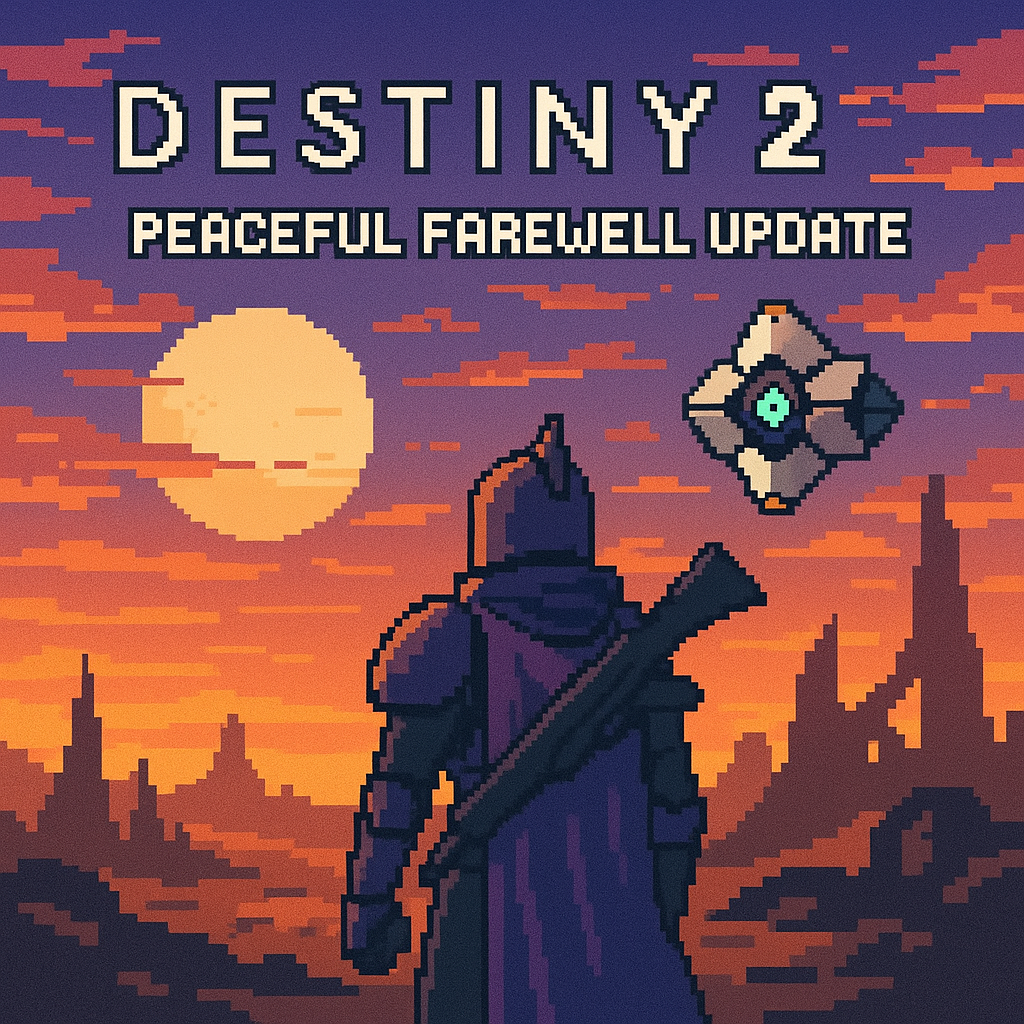
TL;DR
- Destiny 2’s last trailer tees up Monument of Triumph on June 9, 2026, with Ikora Rey’s “rest now, Guardian” sendoff as Bungie ends active development while keeping servers online for the Last City faithful. [1][2]
- This is a freeze, not a funeral: Sony booked roughly $765–766 million of Bungie impairments for FY2025 (ended March 31, 2026), so halting Destiny 2’s update treadmill caps burn and preserves goodwill for a long‑tail “collection” product. [4][5]
- The patch rewires the economy and access model—daily Bright Dust rotations, a single Destiny 2: The Collection SKU, and Sparrow Racing League’s return—signaling a playable museum that’s stable, light‑touch, and still monetizable. [2]
What the source said
Forbes reported on June 5, 2026 that Bungie released what is likely Destiny 2’s final trailer, pairing the June 9 Monument of Triumph update with imagery of the healed Traveler over the Last City and narration from Ikora Rey. The article lists reprised weapons and new armor sets, emphasizes Sparrow Racing League’s return as the “last new mode,” and notes lingering lore threads like “bind the Nine” left unresolved. It captures a tone of elegy and finality while acknowledging players’ hope for a hypothetical Destiny 3 that isn’t greenlit in 2026. [1]
Why it matters
- Bungie is shifting from “forever updates” to preservation: on May 21, 2026, the studio said Monument of Triumph on June 9, 2026 marks the end of active development for Destiny 2, with servers staying online—echoing Destiny 1’s museum state after Age of Triumph in 2017. That reframes Destiny 2 as an evergreen product, not a growth treadmill. [2][1]
- The portfolio math is visible in Sony’s filings: across FY2025, Sony recorded about $765–766 million in impairment losses tied to Bungie, including a $204 million hit disclosed in Q2 FY2025. In that light, ending Destiny 2’s live ops looks like risk containment while Bungie incubates new games such as Marathon. [4][5]
Original analysis
Consensus says: “Ending updates for Destiny 2 is a tragedy driven by corporate missteps.” Contrarian read: freezing Destiny 2 now is the least‑bad option that preserves the IP’s cultural equity and stops a cost spiral as engagement slid on PC; in March 2026, Steam concurrency hit all‑time lows per third‑party trackers, a trend that contextualizes Sony’s impairments and Bungie’s pivot. [7][5]
Named‑stakeholder breakdown
- Bungie: Converts Destiny 2 into a curated museum with a lean maintenance team while staking the studio’s future on “next games.” The blog’s concrete changes—daily Bright Dust rotations, Destiny 2: The Collection, and permanent markdowns—optimize for a low‑friction, long‑tail economy. [2]
- Sony Interactive Entertainment: Halting live updates caps opex and narrows reputational damage while SIE absorbs ~$765 million of write‑downs, testing whether Marathon or other bets can justify the $3.6 billion Bungie acquisition announced in 2022. [5][4]
- Competitors (Warframe/Digital Extremes; Ubisoft’s The Division 2): They can court disaffected Guardians, but they also receive a warning about expensive content treadmills; Warframe’s creative director publicly called Destiny 2’s end “unthinkable,” underscoring the shock inside the live‑service cohort. [3]
2×2 framework: How live‑services “end”
- High trust, Low burn: Curate and freeze (Destiny 2: Monument of Triumph in 2026).
- High trust, High burn: Reinvent live (FFXIV: A Realm Reborn–style reboot; rare and risky).
- Low trust, Low burn: Silent maintenance (servers on, minimal comms; reputational rot).
- Low trust, High burn: Grind on with weak cadence (players churn; money vanishes).
Historical analogue (2017): Destiny 1’s Age of Triumph
- In March 2017, Bungie closed Destiny 1’s update era with Age of Triumph—a celebration patch with revived raids and a pledge to keep servers on—then shifted momentum to Destiny 2’s September 2017 launch. Monument of Triumph echoes that playbook in 2026, but without a sequel waiting; Bungie frames this as the studio’s “new beginning,” not Destiny’s. Expect the museum to retain a core while attention migrates to whatever Bungie ships next. [1][2]
Back‑of‑envelope calculation (illustrative, not a forecast)
- Assume a live‑ops Destiny 2 team of 300 developers at a loaded cost of $180,000/year each (salary, benefits, tools) = ~$54,000,000/year.
- If the freeze reduces to a 60‑person maintenance crew at the same loaded rate = ~$10,800,000/year.
- Implied opex relief ≈ $43,200,000/year, before savings on contractor art pipelines, external QA, and seasonal marketing; even at ±25%, the order of magnitude explains a freeze after ~$765–766 million in impairments. [5]
- On revenue, a maintenance‑state Eververse plus a “Collection” bundle can still generate mid‑single‑digit millions annually; the new daily Bright Dust rotations and broader ornament access point to slow‑drip, goodwill‑first monetization. [2]
Why this isn’t just a content funeral
- The Bungie post reads like product management, not an epitaph: a refreshed Director, Pantheon 2.0, set bonuses across raids/dungeons, Distortions on destinations, and Sparrow Racing League as a permanent pillar, all free for every platform on June 9, 2026. That ships years of asks at once so the final “frozen” state feels generous. [2]
- PC and console press also confirm an explicit in‑game goodbye rather than a fade‑out—“yes, there’s story; yes, we get to say goodbye”—which gives The Final Shape era emotional closure and tempers petitions for a last‑minute Destiny 3. [6][1]
What others are missing
The endgame is economic design, not lore closure: Bungie reworked the reward economy and access model to minimize weekly FOMO and support tickets—daily Bright Dust rotations, Bright Engram focusing, tiered armor/weapon parity across legacy raids/dungeons, and a single Destiny 2: The Collection SKU with permanent markdowns across Steam, PlayStation, and Xbox. That cocktail compresses balance work into clear tiers, broadens cosmetic access without constant store overhauls, and yields a preservation‑first monetization scheme that can run for years with low staffing and low controversy. [2]
What to watch next
- By September 30, 2026, after the “Immortal” title deadline, Destiny 2’s Steam 7‑day average concurrency will be ≥20% below its June 9–16, 2026 7‑day average, and October 2026’s day‑to‑day standard deviation will be lower than any Episode month in 2024–2025 (per SteamCharts or similar trackers). [2]
- By December 31, 2026, Sony IR materials will report no new Bungie‑specific impairment charge ≥$50 million beyond the ~$765–766 million recorded for FY2025; any additional write‑down above that threshold would falsify this. [4][5]
- By March 31, 2027, Destiny 2: The Collection will either be priced at $29.99 USD MSRP or less on at least two storefronts (Steam, PSN, Xbox), or will include all remaining expansion SKUs at no extra charge inside the bundle. [2]
My take
If you love Destiny, log in on June 9, 2026 and savor Monument of Triumph, because Bungie is closing a 2017–2026 era with uncommon grace. The studio is making the only defensible move after a brutal FY2025: lock an iconic game in a generous, fan‑friendly state and move on from an opex‑heavy treadmill that no longer cleared the bar. Sony’s ~$765 million impairments forced a sober reset; the museum model protects Destiny’s cultural equity while Bungie builds something that actually merits a fresh runway. [2][5]
Sources
- Destiny 2’s Last Trailer Ever Is Heartbreaking — Forbes (https://www.forbes.com/sites/paultassi/2026/06/05/destiny-2s-last-trailer-ever-is-heartbreaking/) — Frames the June 9, 2026 trailer, Ikora’s narration, and Sparrow Racing’s return.
- Destiny 2: Every End is a New Beginning — Bungie.net (https://www.bungie.net/7/en/News/Article/d2_may_21_2026) — Confirms June 9, 2026 end of active development and details economy changes and The Collection.
- Destiny 2 Ending New Content Is “Unthinkable,” Warframe Dev Says — GameSpot (https://www.gamespot.com/articles/destiny-2-ending-new-content-is-unthinkable-warframe-dev-says/) — Provides a peer studio’s on‑record reaction.
- FY2025 Q2 Earnings Announcement Q&A — Sony IR (https://www.sony.com/en/SonyInfo/IR/library/presen/er/pdf/25q2_qa.pdf) — Discloses a $204 million impairment tied to Bungie in Q2 FY2025 and related commentary.
- Sony records a $766 million impairment loss against Bungie for the 2025 financial year — PC Gamer (https://www.pcgamer.com/gaming-industry/sony-records-a-usd766-million-impairment-loss-against-bungie-for-the-2025-financial-year-a-1-2-punch-of-destiny-2-and-marathon-failing-to-meet-its-expectations/) — Aggregates the ~$765–766 million FY2025 impairment total and Marathon context.
- Destiny 2 lead says the final update won’t just fade out — GamesRadar (https://www.gamesradar.com/games/destiny/destiny-2-lead-says-the-final-update-wont-just-fade-out-yes-theres-story-yes-we-get-to-say-goodbye/) — Confirms the “say goodbye” narrative inside Monument of Triumph.
- Destiny 2 player counts drop to lowest point ever on Steam — TweakTown (https://www.tweaktown.com/news/110476/destiny-2-player-counts-drop-to-lowest-point-ever-on-steam/index.html) — Documents March 2026 Steam lows to illustrate engagement decline.
Related update: We recently published an article that expands on this topic: read the latest post.