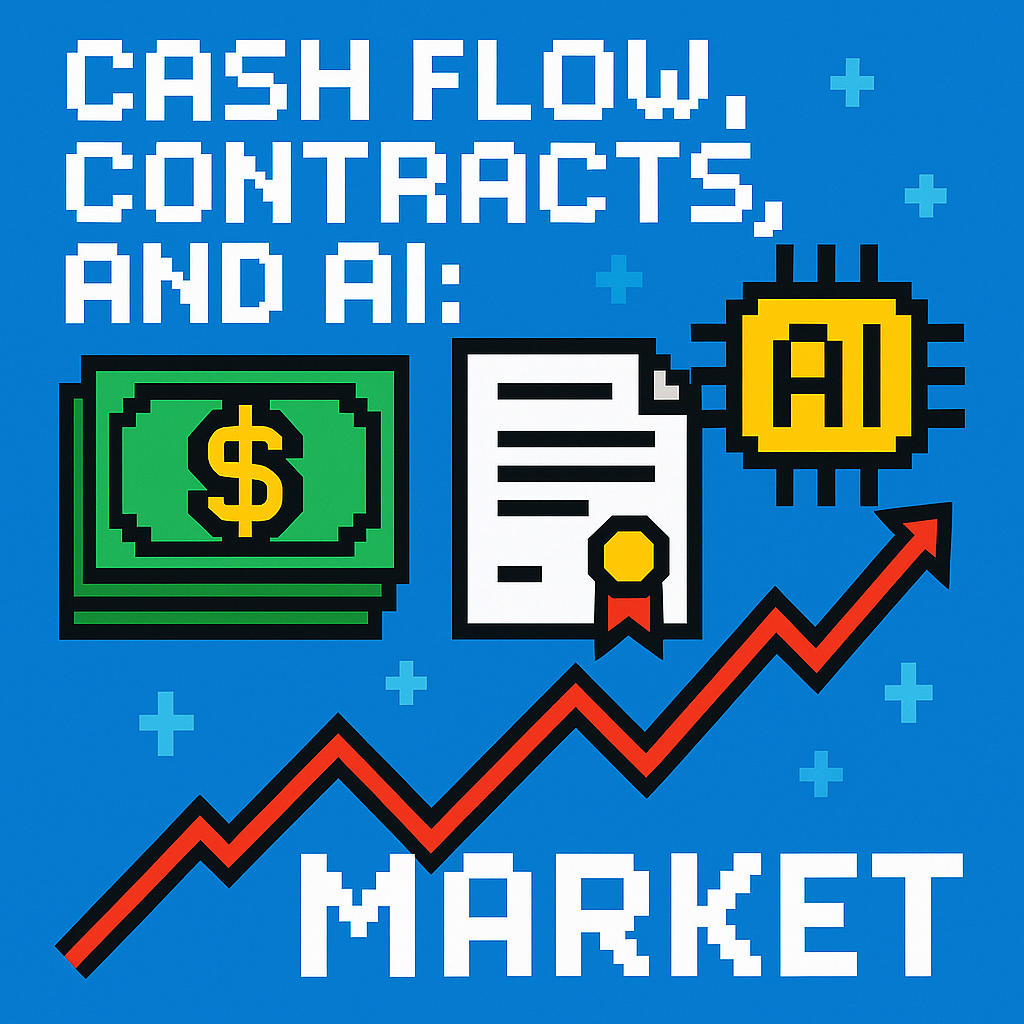
Cash Flow, Contracts, and AI: Market | Analysis by Brian Moineau

TL;DR

  • Apple, Amazon, Reddit, Micron, SK Hynix, and Roblox were the stocks that explained today’s market tape: AWS-driven optimism battled iPhone-margin angst, while AI memory suppliers traded like utilities-in-the-making and ad/social names paid a “Google tax.” [1][3][4][5]
  • The real tell: cash flow and contracts. Amazon’s AI push juiced AWS 37% YoY but flipped free cash flow negative; Micron locked in $22B of multi‑year take‑or‑pay deals, shifting memory from cyclical to contracted. [3][6]
  • Consumer platforms are now distribution‑fragile. Reddit’s post‑print wobble on search‑referral fears and Roblox’s spring guidance cut show what happens when Google changes the hose. Expect valuation dispersion to widen. [9][10]

What the source said

Barron’s grouped the day’s action around a handful of bellwethers—Apple, Amazon, Reddit, Micron, SK Hynix, and Roblox—to explain why U.S. stocks ended a bruising July on a mixed but improving note. It highlighted a tech rebound that still had to swim against Apple’s drop, while AI‑infrastructure names steadied sentiment. The framing was less about a single earnings print and more about how these companies’ moves mapped onto the market’s push‑pull between AI capex optimism and consumer tech skepticism. In short: Amazon and chips lifted; Apple weighed; social/ad names chopped. [1]

Why it matters

  • Stakeholders with the most to win or lose aren’t just the obvious shareholders. Hyperscalers (Amazon and peers), memory suppliers (Micron, SK Hynix), and their debt and equity financiers are tied together by multi‑year AI buildouts. A pause or re‑acceleration cascades instantly through contracts, capex plans, and margins. [3][6][7][8]
  • On the other side sit ad‑dependent consumer platforms (Reddit, Roblox) and even Apple’s hardware complex, whose fortunes hinge on distribution and unit economics. One algorithm tweak or one quarter of component inflation can erase a year’s worth of product work—or a quarter’s beat. [4][9][10]

Original analysis

The bifurcated tape behind “stocks that explain today’s market”

The tape split cleanly into two economies: AI infrastructure sellers (Amazon’s AWS and chip supply chain) and consumer‑facing platforms (Apple devices, Reddit/Roblox engagement). Infrastructure got validation; consumer names got questions.

  • AWS’s 37% YoY growth and Amazon’s disclosure that AI+chips are already a $25B annualized business tell you demand is real—but the bill is too. Amazon’s 12‑month free cash flow swung to a $7.6B outflow as it front‑loads capacity, which is why the stock can surge and still raise financing eyebrows. [3]
  • Memory suppliers have quietly derisked. Micron says customers have committed $22B via five‑year take‑or‑pay deals—language this industry simply didn’t use in past cycles. That’s a structural pivot from “price taker” to “capacity allocator.” [6]
  • Apple’s quarter was strong on the surface—$109.4B revenue, EPS $2.02, records across iPhone, Mac, and Services—but management also flagged rising memory costs into September. That pushes investors to ask: how much AI‑era component inflation can Services’ margin cushion offset? [4]
  • Social/UGC businesses are distribution‑fragile. Reddit’s results beat, but sentiment turned on search‑referral risk; publishers across the web are considering restricting Google access as AI Overviews cannibalize clicks. That’s not a one‑day story; it’s a potential structural CAC hike for the whole open‑web ad economy. [10]

Back‑of‑envelope calculations (two quick cuts)

  1. AWS AI+chips scale: If Amazon’s “AI+chips” sub‑business is running at a $25B annualized rate today and grows a conservative 35% in the next 12 months, that’s ~$33.8B by Q2 2027. At a 25% segment‑level operating margin, that implies >$8B of operating income from this sub‑line alone, enough to mask volatility elsewhere—but only if capex intensity tapers. [3]

Calculation: $25B × 1.35 ≈ $33.8B; $33.8B × 0.25 ≈ $8.45B.

  1. Memory contracts as earnings floor: Micron’s $22B of five‑year, take‑or‑pay commitments average ~$4.4B/yr of revenue visibility. At a 45% memory-cycle gross margin (illustrative), you’ve got ~$2.0B gross profit “pre‑sold” annually—even before spot upside. This is why memory beta has started to compress. [6]

Calculation: $22B ÷ 5 ≈ $4.4B; $4.4B × 0.45 ≈ $2.0B.

A 2×2 that actually predicts behavior

Axes: Demand visibility (high ↔ low) vs. Distribution risk (low ↔ high).

  • High visibility / Low distribution risk: Micron, SK Hynix (multi‑year supply deals; ADR broadened ownership). Playbook: raise capex methodically, pre‑sell capacity, manage price discipline. [6][7][8]
  • High visibility / High distribution risk: Amazon (visibility on AI demand via backlog; but customers can optimize consumption). Playbook: sprint now, prove ROI later; expect cash flow volatility. [3]
  • Low visibility / Low distribution risk: Apple (giant installed base; unit demand tied to macro and BOM inflation). Playbook: squeeze Services and ASPs to buffer input‑cost cycles; watch memory pricing. [4]
  • Low visibility / High distribution risk: Reddit, Roblox (ad or bookings funnels exposed to search and policy shifts). Playbook: reduce Google reliance via native search and direct acquisition; reprice ads toward logged‑in, high‑intent inventory. [9][10]

Contrarian read

Consensus: “The AI infrastructure trade is back—own hyperscalers and HBM suppliers; avoid ad‑driven platforms.” My pushback: the market is underpricing the permanence of memory supply contracts and overpricing the linearity of hyperscaler free cash flow. Take‑or‑pay deals make Micron/SK Hynix earnings more utility‑like than the market credits; in contrast, AWS’s stellar growth is already showing up as cash burn. That inversion—contracted suppliers vs. capex‑heavy buyers—means the traditionally “riskier” memory names could deliver steadier EPS beats than the buyers funding them over the next 12 months, even if AI demand stays hot. [3][6][7][8]

What others are missing

The step‑function change isn’t “AI demand up.” It’s contract structure and distribution power. On supply, five‑year take‑or‑pay agreements shift memory from a spot‑exposed commodity to booked capacity—de‑risking earnings through 2027 for Micron and, indirectly, for SK Hynix now that it can tap U.S. capital at scale via ADRs. On demand, open‑web distribution is being rewritten by AI Overviews. Reddit’s wobble is the forward case for any platform leaning on Google for new users: acquisition costs rise, and growth quality tilts to logged‑in, high‑intent cohorts. Coverage that stops at “big movers” misses how these two mechanics—contracts upstream, distribution downstream—will drive multiple expansion for suppliers and a valuation headwind for ad‑dependent platforms. [6][7][8][10]

What to watch next

  1. By Q4 2026, Micron lifts disclosed take‑or‑pay/backlog commitments to $30B+ across HBM/DRAM/NAND, confirming a structural derisking of memory earnings. [6]

  2. By Q2 2027, Amazon states AI+chips (within AWS and adjacent) at a >$35B annualized revenue run‑rate, even as TTM free cash flow remains below its 2025 level due to continued data‑center buildout. [3]

  3. By Q4 2026, Reddit reports flat to negative U.S. DAU YoY but >15% ex‑U.S. DAU growth and rising ad ARPU, reflecting a pivot toward logged‑in, high‑intent traffic as Google referrals dilute. [10]

My take

I’d rather underwrite contracted bandwidth than open‑web eyeballs in this tape. Memory just crossed a one‑way door: multi‑year commitments, ADR access for SK Hynix, and hyperscalers effectively pre‑paying for supply. That is not how the last memory super‑cycle ended. Meanwhile, every consumer platform that can be “answered” by AI will relearn the cost of rented distribution. I’m buying the derisked supplier earnings (Micron/SK Hynix on pullbacks) and treating AWS‑led rallies as proof of demand, not proof of cash discipline. For consumer internet, the burden of proof is now distribution resilience—not last quarter’s beat.

Sources

[1] Apple, Amazon, Reddit, Micron, SK Hynix, Roblox, and More Stocks That Explain Today’s Market — Barron’s (https://www.barrons.com/articles/stock-movers-e7d1ed18) — Sets the day’s framing: tech rebound vs. Apple drag;


Related update: We recently published an article that expands on this topic: read the latest post.
Related update: We recently published an article that expands on this topic: read the latest post.


Related update: We recently published an article that expands on this topic: read the latest post.

Markets Rally as Oil Eases, Earnings Shine | Analysis by Brian Moineau

Market breathes easier as oil eases and earnings shine

Buoyed by solid earnings and lower oil prices, the S&P 500 and Nasdaq Composite both reached new intraday and closing highs on Tuesday. That neat sentence captures a lot: a thaw in geopolitical risk, a rally in tech and chip names, and an earnings season that keeps delivering upside surprises. The result was a broad, confident bid for risk assets—one that felt less like a short-lived snapback and more like a market that’s recalibrating to better-than-feared economic and corporate data.

Why this mattered today

  • Oil prices slid after reports of progress toward a limited U.S.–Iran understanding that could ease shipping risks through the Strait of Hormuz. Lower energy costs removed a major headwind for equities.
  • Tech and semiconductor earnings — led by a strong report from Advanced Micro Devices (AMD) — gave investors fresh reasons to buy into growth stocks.
  • With bond yields falling alongside oil, investors rotated into equities, pushing major indexes to fresh highs and expanding the breadth of the rally.

Together, those forces nudged the Dow up sharply, while the S&P 500 and Nasdaq notched both intraday and closing records. The market’s tone turned from defensive to curious and constructive almost overnight.

The big movers: oil and AMD (and why they matter)

First, oil. The market’s risk-off price spike in crude had been a core worry: higher energy costs feed inflation, squeeze margins, and raise recession risk. When news surfaced that the U.S. and Iran might be closer to a temporary agreement, crude futures retraced a chunk of their prior gains. That mattered because it removed an immediate macro tailwind for bond yields and inflation expectations, allowing equity investors to refocus on corporate fundamentals.

Second, AMD. The chipmaker’s quarter beat expectations and its commentary reinforced the narrative that AI-driven data-center demand remains robust. AMD shares jumped after hours and that lift rippled through chip suppliers and broader tech names, helping the Nasdaq punch through resistance. When a high-profile growth company posts strong results, it not only raises that firm’s valuation but also signals healthier demand across an ecosystem — which in turn attracts flows into ETFs and indices.

A closer look at market dynamics

  • Lower oil → lower inflationary pressure (short-term) → easier path for profit margins and lower bond yields.
  • Better-than-expected earnings → improved forward guidance → higher investor confidence in growth expectations.
  • Tech leadership plus expanding market breadth reduced the “narrow rally” criticism that’s dogged recent moves.

In short, the rally wasn’t solely a single-day squeeze. It was the confluence of easing geopolitical premium in commodities and the continued evidence that companies are navigating the macro backdrop well enough to grow earnings.

Market cautions to keep in mind

  • Geopolitics remains fragile. Optimism about an Iran-related deal can fade quickly if negotiations stall or incidents recur. Markets tend to price in hope fast and disappointment slower.
  • Valuations, especially in AI and semiconductor plays, are elevated. Good earnings can justify premium multiples — but they also raise the bar for future beats.
  • Macro data and Fed policy remain key. If inflation re-accelerates, or if labor markets show renewed tightness, bond yields could climb and stress equity multiples.

So while Tuesday’s action felt celebratory, prudent investors will remain mindful of the pivot points that could reverse the tone.

Market implications for investors

  • For long-term equity investors, this kind of environment rewards selective conviction: favor companies with durable competitive advantages, strong balance sheets, and exposure to secular trends (AI, cloud, digital infrastructure).
  • For traders and shorter-term allocators, volatility will likely persist around geopolitical headlines and earnings beats/misses. Use position sizing and clear entry/exit rules.
  • For diversified portfolios, a downshift in energy prices is broadly positive — it acts like a small, immediate profit margin boost for many sectors and can ease inflation psychology.

The investor dilemma

Investors face a classic trade-off: chase momentum in an advancing market or lock in gains and protect against a geopolitical re-escalation. Both choices make sense depending on horizon and risk tolerance. The smart middle path is to tilt, not leap: incrementally increase exposure where conviction is high and keep liquidity to take advantage of pullbacks.

What to watch next week

  • Follow-up on U.S.–Iran talks or any related incidents that could re-price oil.
  • Continued earnings from major tech and enterprise vendors — these reports will test whether the optimism is idiosyncratic or broad-based.
  • Weekly economic indicators and Fed commentary for signs of a sustained shift in the inflationary picture.

Key takeaways

  • Market rally was driven by easing oil prices and upbeat corporate earnings, notably from AMD.
  • Lower crude removed a near-term inflation worry, helping push S&P 500 and Nasdaq to new highs.
  • Tech and semiconductor strength fueled breadth, but geopolitical risk remains the overriding wildcard.
  • Investors should balance participation with risk management — don’t let optimism blind you to potential reversals.

My take

This was one of those sessions that proves markets are not purely mechanical. Sentiment swings on geopolitics, earnings, and macro signals can catalyze outsized moves. Tuesday’s advance felt healthy: it was backed by earnings and lessened commodity fears, not just a speculative throw at a single sector. Still, elevated valuations and fragile geopolitics argue for disciplined exposure. Ride the wave, but keep the lifeboat handy.

Sources

Sources were chosen for timely market coverage and company-level detail.


Related update: We recently published an article that expands on this topic: read the latest post.

What To Expect in Markets This Week: Fed Meeting, Tariffs Deadline, July Jobs Report – Investopedia | Analysis by Brian Moineau

What To Expect in Markets This Week: Fed Meeting, Tariffs Deadline, July Jobs Report - Investopedia | Analysis by Brian Moineau

Navigating the Week: Tariffs, the Fed, and Tech Titans Take Center Stage

As we sip our morning coffee and brace ourselves for the economic rollercoaster of the week, several pivotal events are poised to shape the financial landscape. From tariffs and interest rates to the July jobs report, the business world is buzzing with anticipation. Let's embark on this journey together, shall we?

Tariffs Deadline: The Global Game of Chess

First up on our agenda is the key tariffs deadline. Tariffs have long been the economic equivalent of a chess game, with countries maneuvering to protect their industries while negotiating for better trade deals. This week’s deadline is particularly significant, as it could impact sectors ranging from agriculture to technology. While the details of these tariffs might feel like a distant concern to some, they ripple through the global supply chain, potentially affecting everything from the price of your morning avocado toast to the latest smartphone you can’t wait to upgrade to.

A nod to the broader geopolitical stage, the ongoing trade negotiations echo the tensions and collaborations seen in recent international summits. As nations strive for balance in a rapidly changing world, we are reminded that economic decisions are rarely isolated and often reflect larger themes of diplomacy and strategy.

The Fed's Interest-Rate Decision: A Dance of Numbers

Next, all eyes turn to the Federal Reserve as it prepares to announce its latest interest-rate decision. This is the moment when economists and investors lean in, analyzing every word and nuance for hints about the Fed's future trajectory. With inflation data also being released, the stakes are high. Will the Fed choose to hold steady, or will it pivot in response to the economic conditions? The answer could influence everything from mortgage rates to the stock market's mood.

In a world increasingly driven by data, the Fed's decision is akin to a dance with numbers, where rhythm and timing are crucial. It's a reminder of how interconnected our financial systems are and how a decision in Washington can reverberate around the globe.

July Jobs Report: The Pulse of the Workforce

The July jobs report will offer a snapshot of the labor market’s health and momentum. Employment figures are not just numbers on a page; they represent real people and their livelihoods. In an era where remote work and AI are reshaping the employment landscape, these reports are more telling than ever.

Moreover, as companies grapple with the challenges of attracting and retaining talent, the jobs report also reflects broader societal shifts. From the rise of the gig economy to debates over work-life balance, the data can provide insights into the evolving nature of work itself.

Tech Titans' Earnings: The Battle of the Giants

Lastly, we have the tech giants—Microsoft, Meta, Apple, and Amazon—reporting their earnings. These companies are more than just market leaders; they are cultural behemoths shaping the way we live, communicate, and consume. Their performance will not only influence stock indices but also provide a window into consumer behavior and technological trends.

As these titans of industry reveal their financials, it's worth considering their role in addressing global challenges, such as privacy concerns, digital addiction, and misinformation. They are at the forefront of innovation, yet they also face scrutiny over their impact on society and the economy.

Final Thoughts: A Week of Reflection and Anticipation

This week promises to be a whirlwind of economic indicators and corporate revelations. As we navigate through tariffs, interest rates, jobs data, and tech earnings, it's crucial to remain informed and engaged. After all, these developments affect not only investors and policymakers but also everyday citizens.

In the grand tapestry of global events, this week serves as a reminder of the interconnectedness of markets, nations, and individuals. So, as we keep an eye on the headlines, let's also take a moment to reflect on the broader implications and the shared journey we are all a part of. Here's to a week of discovery and insight!

Read more about AI in Business

Read more about Latest Sports Trends

Read more about Technology Innovations