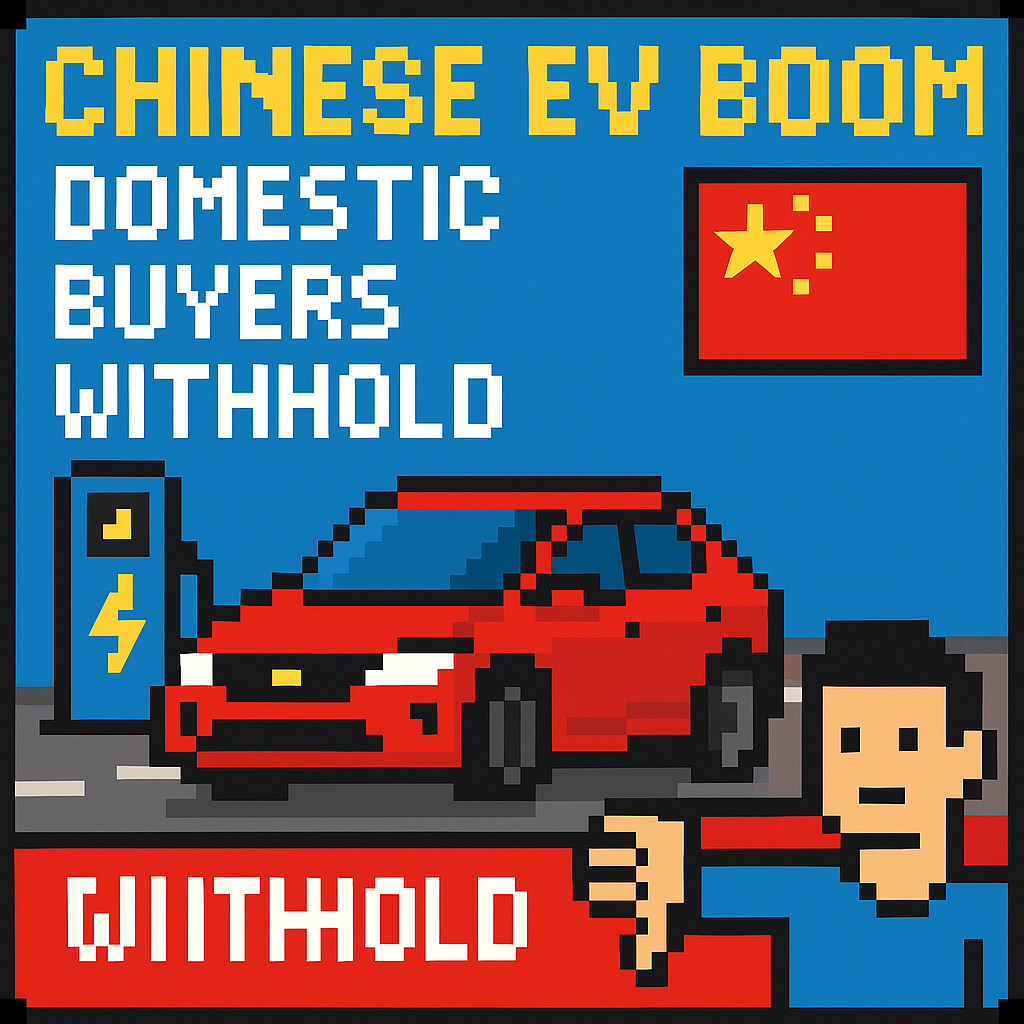
Chinese EV Boom, Domestic Buyers Withhold | Analysis by Brian Moineau

TL;DR

  • Chinese automakers are climbing global sales rankings, yet China’s own buyers delayed purchases through early 2026 amid a bruising price war and falling resale values, flipping the old “home‑market first” playbook [1][2][4][5].
  • Exports cushion P&Ls for now, but European Commission duties of 17.4%–37.6% on China‑made BEVs force double‑digit retail hikes or margin absorption in the EU’s 27 member states [3].
  • Over the next 12 months (mid‑2026 to mid‑2027), low‑cost exporters like BYD and Chery can ride volume abroad, while domestically exposed players face a grind of margin pressure, inventory risk, and model fatigue inside China [2][4][6].

What the source said

The Wall Street Journal’s “Everyone Loves Chinese Cars, Except the Chinese” (via Google News RSS) argues that Chinese automakers are winning abroad while domestic demand sags, a paradox visible in 2025–2026 sales patterns [1]. The piece ties booming exports to price competitiveness and fast model cycles, noting that those same dynamics—relentless refreshes and discounting—have trained home buyers to wait. It sets Europe and several emerging markets as bright spots, contrasted with a promotion‑heavy Chinese retail market weighed down by weak residuals and buyer hesitation; exports exceeded 7 million vehicles in 2025, while the home market cooled [2]. It also sits against a policy backdrop: January 2026 passenger‑car sales fell 19.5% year on year, and Brussels added BEV duties of up to 37.6% [3][4].

Why it matters

  • Stakeholder #1: Chinese automakers (BYD, SAIC, Chery, Geely). They gain share overseas as exports surpassed 7 million in 2025 (+21% year over year), but they face a soft home market and tightening rules against aggressive discounting in 2026 [2][4][5]. Every incremental export lifts factory utilization, yet domestic pressure tests cash flow, dealer solvency, and software update cadence.

  • Stakeholder #2: Policymakers in Brussels and Beijing. The European Commission imposed provisional countervailing duties on China‑made BEVs—BYD 17.4%, Geely 19.9%, SAIC 37.6%—re‑pricing value segments from Portugal to Poland and forcing localization decisions in 2026–2027 [3]. Beijing moved to curb the price war after January 2026’s 19.5% sales drop, signaling tolerance for discipline over chaotic promotions [4].

Original analysis

Consensus says, “Exports will save China’s carmakers while home demand chills.” Contrarian read: exports are a pressure valve, not a moat. EU duties and politics can turn a 10% cost edge into a wash, while China—still the world’s largest auto market by units—decides who survives by 2027 [2][3][4].

Back‑of‑envelope math:

  • Scale today: China exported “over 7 million” vehicles in 2025; domestic passenger‑car sales were about 24 million [2]. Exports ≈ 7 ÷ (24 + 7) ≈ 23% of unit volume. If 2026 exports grow only low single digits per CPCA commentary and domestic sales stagnate, export share inches toward ~24%—helpful, but not enough to offset multi‑point margin hits from tariffs and incentives [5].
  • Tariff impact in the EU: Assume a €15,000 ex‑factory BYD BEV. A 17.4% duty lifts border cost by €2,610; if pre‑tariff retail was €25,000, holding margin implies roughly a 10% retail hike or painful absorption by the OEM/importer. For SAIC at 37.6%, the duty is €5,640—nearly a full gross margin on an entry BEV, before distribution and financing [3].

Named‑stakeholder breakdown:

  • BYD: Cost leader with DM‑i hybrids and BEVs. A 17.4% EU duty narrows the price gap but doesn’t erase it; expect CKD/SKD or final assembly pilots inside the EU Customs Union to blunt tariffs, while hybrids keep flowing into duty‑light markets [2][3].
  • SAIC (MG): Heavy EU/UK exposure makes the 37.6% duty acute; localization or price/mix shifts can’t wait. Watch pushes into Brazil, Mexico, and the Middle East, where regulatory barriers and duties are lower in 2026 [3].
  • Chery: China’s top vehicle exporter in 2024; strong in emerging markets with ICE and PHEV lines. Less EU‑centric near‑term, but brand equity must rise to avoid “race‑to‑bottom” traps as volumes expand [6].
  • Volkswagen (China JVs): China’s slowdown squeezes legacy ICE cash cows while an EV revamp rolls out; if share erosion persists through 2026, VW’s China profit pool shrinks as Euro 7 and CO2 rules bite in Europe [5].
  • Policymakers (EU/China): Brussels raises drawbridges with countervailing duties; Beijing polices the price war after a steep January 2026 fall. Policy swings compress planning horizons and elevate inventory risk for 2026 model years [3][4].

2x2 typology (Cost position × Domestic dependency):

  • Low cost × Low domestic dependency: Chery (export‑heavy, flexible on ICE/PHEV) and SAIC‑MG if it localizes in the EU quickly.
  • Low cost × High domestic dependency: BYD (still sells the bulk in China; exports rising from a small 2023–2024 base).
  • High cost × Low domestic dependency: Geely’s premium trims in select export markets; needs localization/alliances to hold price after duties.
  • High cost × High domestic dependency: NIO and XPeng (software‑heavy, brand‑building phase), most exposed to residual‑value shocks in 2026.

Historical analogue:

  • Late‑1970s to mid‑1980s Japan hit U.S./EU barriers and pivoted to localization (e.g., NUMMI and Kentucky assembly). China’s champions will copy that template faster because they control batteries, inverters, and E/E stacks end‑to‑end; expect “build‑where‑you‑sell” by 2027 in tariff‑exposed regions.

What others are missing

The resale‑value loop is dictating Chinese consumer behavior more than ad spend. Rapid fire refreshes and publicized cuts trained buyers to wait, crushing used‑car prices and blowing up monthly‑payment math. That shows up as NEV penetration topping 40% in early 2026 without delivering steady throughput for every brand, a mismatch CPCA data flagged alongside soft retail prints into May 2026 [5]. When January 2026 sales fell 19.5% and regulators cracked down on pricing games, Beijing aimed to rebuild residual‑value credibility so buyers would stop freezing purchases [4]. If OEMs stabilize depreciation—with certified pre‑owned floors, longer battery warranties, and 90‑day price‑protection guarantees—domestic demand can rebound faster than export growth alone.

What to watch next

  1. By Q4 2026, at least one top‑five Chinese exporter announces EU final assembly or CKD capacity sized for 100,000+ units per year to blunt provisional duties; announcement specifies plant location inside the EU Customs Union [3].
  2. By Q1 2027, China’s passenger‑car retail posts year‑on‑year growth for two straight quarters as price‑war rules and stabilized residuals take hold; CPCA reports positive comps in at least two of three months each quarter [4][5].
  3. By mid‑2027, at least one major European incumbent discloses a China JV EBIT margin below 2% in an annual or interim filing, citing local EV competition and discounting pressure in 2026–2027 [5].

My take

Exports bought time, not safety. The profit engine still lives—or dies—inside China. If brands can’t steady depreciation and end the discount addiction, they’ll bleed capital while Brussels taxes away foreign margin. Expect a shake‑out down to a half‑dozen scale players that localize in tariffed markets and enforce price discipline at home; BYD and Chery make the cut, while SAIC must localize or rethink its EU stance.

Sources

  1. Everyone Loves Chinese Cars, Except the Chinese — The Wall Street Journal via Google News RSS (https://news.google.com/rss/articles/CBMilAFBVV95cUxNc2hUR0tKTU5zUUFuN3N1VzBXUjRnN3FyZHlQd09MZGhqbjZBbEI3S0JkVEhDUWd1U2R3X3A4Rm10d3JSMVlKRW9BSUhWU1hock1qcDZ0MlZ5Sm5VeFJ5NGhxazdMemhseE5GNlhFeVdnOUkyQUlmQ3dyc0F5OFFsZ2dYMmZaWWdXT281SUJVb2RXQmxx?oc=5) — Frames the paradox of strong exports vs. hesitant Chinese buyers and highlights price‑cut dynamics.
  2. China’s car exports surged in 2025, but domestic demand slowed — AP News (https://apnews.com/article/871137ad17b9e491e14da0e6de1e1cc6) — Confirms 2025 exports “over 7 million” (+21% YoY) and slower home‑market momentum.
  3. Commission imposes provisional countervailing duties on imports of battery electric vehicles from China — European Commission (press release, IP_24_3630) (https://ec.europa.eu/commission/presscorner/api/files/document/print/en/ip_24_3630/IP_24_3630_EN.pdf) — Lists provisional duty rates (BYD 17.4%, Geely 19.9%, SAIC 37.6%) and EU scope.
  4. China issues new rules to curb auto price war after January passenger car sales drop 20% — AP News (https://apnews.com/article/c5c32f6982cc163764e8941e1df3d9a2) — Details the 19.5% YoY drop in January 2026 and Beijing’s response to discounting.
  5. China car sales downturn extends into May as VW tests EV revamp — Reuters via Investing.com (https://www.investing.com/news/economic-indicators/china-car-sales-downturn-extends-into-may-as-vw-tests-ev-revamp-4730983) — Shows domestic softness into May 2026 and summarizes CPCA expectations and VW’s China pivot.
  6. 中汽协公布2024年整车出口TOP10:奇瑞、上汽、长安前三,比亚迪同比增长71.8% — Sina Finance (https://finance.sina.com.cn/tech/digi/2025-01-13/doc-ineevenx2156132.shtml) — Ranks 2024 export leaders (Chery, SAIC, Changan) and quantifies exporter mix.

(Inline citations: [1]–[6].)
BYD Overtakes Tesla as EV Leader | Analysis by Brian Moineau

When the Crown Slips: BYD Tops Tesla in the Global EV Race

A short, sharp image comes to mind: the electric vehicle throne — long assumed to be Elon Musk’s exclusive domain — quietly shifting eastward. In 2025, China’s BYD sold more fully electric cars than Tesla, marking the first time Tesla has been definitively overtaken on annual BEV (battery-electric vehicle) deliveries. That moment deserves a second look: it’s not just a change in ledger lines, it’s a sign of how fast the EV playing field is changing.

What happened

  • Tesla’s full-year deliveries fell in 2025 to roughly the mid-to-high 1.6 million range, down from about 1.79 million in 2024. Reuters and other outlets reported an annual decline driven by softer demand and the end of a key U.S. federal EV tax credit. (reuters.com)
  • BYD’s fully electric (BEV) sales jumped about 28% year-on-year, reaching a figure above 2.2 million BEVs in 2025 — while the company’s total passenger-vehicle deliveries (including plug-in hybrids) were much larger still. That helped BYD claim the top spot for BEV deliveries worldwide. (nasdaq.com)

Why this matters

  • Market leadership signals matter beyond ego: they shape investor narratives, supplier leverage, dealer and service footprints, and the direction of R&D budgets.
  • BYD’s win highlights a structural reality: scale in China + aggressive product mix (including lower-priced models) + rapid export growth = a powerful engine for volume.
  • Tesla’s setback suggests the company faces cyclical and structural headwinds: tougher competition in China and Europe, pricing pressures, and policy shifts (notably U.S. tax credit changes) that can swing consumer demand.

Quick takeaways for busy readers

  • BYD surpassed Tesla on annual BEV deliveries in 2025, driven by strong growth at home and surging exports. (forbes.com)
  • Tesla’s deliveries fell versus 2024; a key factor was the expiration of a U.S. federal tax credit that had boosted EV purchases. (reuters.com)
  • The gap reflects two different strategies: BYD’s high-volume, vertically integrated approach across price segments vs. Tesla’s higher ASP (average selling price) and continued focus on premiuming technology and margins. (statista.com)

The broader context

  • China is both the world’s largest EV market and a global manufacturing powerhouse. Domestic scale allows Chinese OEMs to iterate quickly on cost, battery chemistry, and model range — then export those efficiencies abroad.
  • BYD’s mix includes a significant volume of plug-in hybrids (PHEVs) alongside BEVs; while the global “BEV crown” is the headline, BYD’s overall passenger-vehicle scale (BEVs + PHEVs) gives it production flexibility and revenue diversification. (nasdaq.com)
  • Tesla still holds advantages: brand cachet, software and energy-integration narratives, an established Supercharger network in many markets, and high-margin software/Autopilot services. But those advantages are being contested on price, product breadth, and local partnerships in key markets.

What this could mean going forward

  • Competition will intensify on price and features. Expect more affordable models from legacy and new EV players, plus broader rollouts of mid-market tech (e.g., fast charging at lower cost). (autoini.com)
  • Global market share could fragment. Tesla may focus on differentiation (software, autonomy, energy) while BYD leverages scale and cost to win mainstream buyers and expand exports.
  • Regulation and incentives will remain swing factors. Policy changes (subsidies, tax credits, import rules) can rapidly change demand dynamics across regions.

My take

This shift is important, but not catastrophic for Tesla. It’s a signal that the EV market is maturing: leadership is contestable, and product, price and distribution matter as much as hype. BYD’s ascent is a reminder that manufacturing scale, vertical integration (including battery production) and a broad product ladder can win volume — especially when a domestic market as large as China’s acts as a testing ground and springboard.

For Tesla, the choice is tactical and strategic: defend volume with pricing and localized models where needed, and double down on the unique strengths that keep margins and future optionality intact (software, energy, and autonomy). For BYD, the opportunity is to convert volume into durable share in markets outside China while protecting profitability as it scales globally.

Final thoughts

The EV crown’s relocation tells us less about a single company’s destiny and more about an industry in transition. Expect more headline moments like this: the winners of the next decade will be those who combine scale, speed, and adaptability — and who can turn manufacturing muscle into global, trusted customer experiences.

Sources


Related update: We recently published an article that expands on this topic: read the latest post.


Related update: We recently published an article that expands on this topic: read the latest post.


Related update: We recently published an article that expands on this topic: read the latest post.


Related update: We recently published an article that expands on this topic: read the latest post.

Porsche says EV intransigence will lose it $6B. Its solutio…

Porsche says EV intransigence will lose it $6B. Its solutio…

Porsche’s Slow Move into the EV Market: A $6 Billion Gamble As the world races toward electrification, it’s hard to imagine a storied automaker like Porsche ch…

Porsche’s Slow Move into the EV Market: A $6 Billion Gamble

As the world races toward electrification, it’s hard to imagine a storied automaker like Porsche choosing to hit the brakes. Yet, in a recent announcement, Porsche hinted at a strategy that might just do that—potentially costing the company a staggering $6 billion. In a time when competitors, particularly from China, are speeding ahead in the electric vehicle (EV) space, one has to wonder: is Porsche’s decision to take its time a strategic masterstroke or a major misstep?

Understanding the Landscape of the EV Market

To grasp the implications of Porsche’s recent announcement, we need to look at the broader context of the automotive industry. The global shift towards electric vehicles is not just a trend; it’s a revolution. Governments worldwide are setting ambitious targets for phasing out internal combustion engines, and consumers are showing an increasing preference for sustainable options.

As Tesla continues to lead the charge in EV innovation and Chinese manufacturers like BYD and NIO accelerate their market presence, traditional automakers face mounting pressure to adapt or risk obsolescence. Instead of embracing the urgency of this moment, Porsche seems to be opting for a more gradual approach, citing concerns about profitability and market readiness.

The $6 Billion Question: Why Move Slower?

Porsche has publicly stated that its cautious stance could lead to a loss of $6 billion. This figure is not just a number; it represents the potential market share and innovation opportunities that could slip through its fingers as it lags behind quicker competitors. The rationale behind this slower rollout seems to be rooted in an effort to maintain the brand’s luxury status and ensure the quality of its vehicles.

However, this strategy raises eyebrows. With the rapid advancements in battery technology and the increasing availability of charging infrastructure, the argument for taking a slower approach becomes less convincing. As competitors continue to innovate and capture consumer interest with their cutting-edge EV offerings, Porsche risks becoming irrelevant in a market that is evolving faster than ever.

Key Takeaways

Porsche’s Slow Strategy: The automaker is choosing a gradual approach to EV development, potentially sacrificing $6 billion in market opportunities. – Competitors on the Fast Track: Rivals, especially from China, are rapidly innovating and capturing market share, putting Porsche at risk of falling behind. – Luxury vs. Innovation: Porsche is trying to balance its luxury brand image with the need for technological advancement, a challenging tightrope to walk in this fast-paced market. – Market Readiness Concerns: The company cites concerns about profitability and market readiness for EVs, but these fears may not hold water as consumer demand grows. – The Stakes are High: With the automotive industry in a state of flux, slow decisions could have long-term consequences for brand relevance and market position.

Concluding Reflection

In a world where agility often trumps tradition, Porsche’s strategy of moving slowly into the EV market could be seen as a gamble that might not pay off. While there’s something to be said for maintaining quality and brand integrity, the question remains: can a luxury automaker afford to be slow in an industry that’s shifting beneath its feet? Only time will tell if Porsche’s cautious approach will secure its legacy or if it will find itself left in the dust by more nimble competitors.

Sources

– “Porsche says EV intransigence will lose it $6B. Its solution? Move even slower – Electrek” [Electrek](https://electrek.co/2023/10/20/porsche-ev-intransigence-6-billion-solution-move-slower/)

By keeping tabs on the evolving landscape, we can better understand how legacy brands like Porsche adapt—or fail to adapt—to a new world that demands speed, innovation, and sustainability.


Related update: We recently published an article that expands on this topic: read the latest post.


Related update: We recently published an article that expands on this topic: read the latest post.


Related update: We recently published an article that expands on this topic: read the latest post.