TL;DR
- An ice cream brand bankruptcy isn’t about melted margins—it’s about a $23.8 million trade‑dress loss that turned packaging into a balance‑sheet liability overnight. [2][3]
- Rebel Creamery, a keto/low‑sugar label sold in Target, Kroger, and Walmart, filed after a July 16, 2026 ruling ordered it to disgorge profits and redesign its pints. [1][2]
- The real ripple: grocers will reshuffle freezer facings, and CPG founders will treat “look‑alike minimalism” as legal risk, not design trend. [2][3]
What the source said
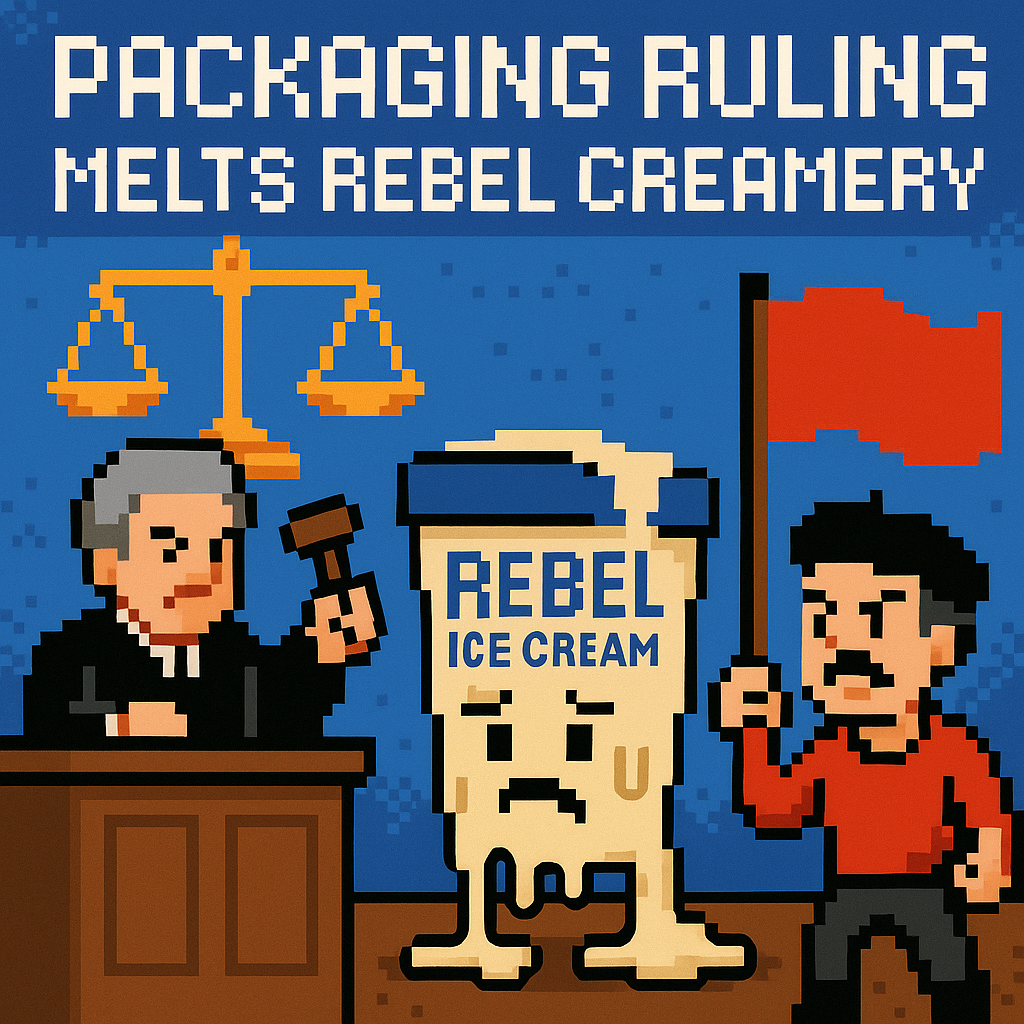
AL.com reported that Rebel Creamery, a nationally distributed keto ice cream sold in Target, Kroger, and Walmart, filed for bankruptcy following a packaging‑infringement ruling. The Eastern District of New York decision, signed by Judge Eric Komitee on July 16, 2026, awarded $23.785 million and imposed a permanent injunction on Rebel’s prior packaging. The piece frames the filing as a direct response to the judgment and flags potential shelf gaps for shoppers in those banners. [1][2]
Why it matters
This isn’t just a boutique dessert spat; it hits the high‑turn “better‑for‑you” freezer set where brands like Halo Top, Yasso, and Van Leeuwen fight for facings at Walmart, Target, and Kroger. When a ruling from E.D.N.Y. forces a redesign, retailers must rebalance planograms to avoid confusion and protect category dollars. The mix shift can move to private label or to the winning plaintiff, Van Leeuwen, within the next reset window. [2][3][5]
There’s also a precedent signal. Van Leeuwen’s win—an injunction plus $23.785 million in disgorged profits—shows that minimalist, pastel, script‑forward packaging can be protectable trade dress when shoppers are likely to be confused. That will change how founders, co‑packers, and design firms cost, document, and govern packaging decisions across CPG in 2026–2027. [2][3]
Original analysis
-
Back‑of‑envelope math
- The court awarded $23.785 million in Rebel’s profits and permanently enjoined the infringing packaging as of July 16, 2026. [2]
- If a typical manufacturer’s net revenue per pint after trade and freight sits around $3.00–$3.75 (assumption), the judgment equals roughly 6.3–7.9 million pints ($23.785M ÷ $3.75 ≈ 6.3M; $23.785M ÷ $3.00 ≈ 7.9M). The scale matches multiple months of throughput for a national better‑for‑you brand.
- Add redesign costs: new dielines, prepress, plate changes, inventory write‑offs, and retailer reset fees can land in mid‑six to low‑seven figures depending on SKU count and co‑packer MOQs (assumption). The cash burn while off‑shelf compounds the hit.
-
A 2×2 on CPG packaging risk (Design distinctiveness vs. Legal/process rigor)
- High distinctiveness + High legal/process rigor: “Safe originals.” Example: Van Leeuwen’s Pentagram‑styled system that the court deemed distinctive and enforceable. [2][3]
- High distinctiveness + Low rigor: “Artists without alibis.” Great aesthetics, weak clearance—vulnerable when challenged.
- Low distinctiveness + High rigor: “Generic fortresses.” Boring by intent, backed by searches and memos.
- Low distinctiveness + Low rigor: “Copycat hazard zone.” The court found Rebel intentionally copied Van Leeuwen’s overall look; that’s this quadrant. [2][4]
-
Historical analogue (1992)
- Two Pesos, Inc. v. Taco Cabana, Inc. held that inherently distinctive trade dress is protectable without secondary meaning, long before DTC brands embraced minimalism. That Supreme Court ruling in 1992 establishes a foundation for 2026 decisions that guard the “overall look and feel,” not just a logo or a pantone chip. [6]
-
Named‑stakeholder breakdown
- Walmart, Target, Kroger: Fewer Rebel facings mean immediate reallocation to private label, Halo Top, Yasso, or Van Leeuwen, with quarterly reset windows dictating speed. AL.com and Rebel’s site confirm national distribution across these banners, so the hole is material. [1][5]
- Van Leeuwen: A brand‑safety win—cash award, an injunction that prunes a confusing shelf neighbor, and legal validation for its national expansion system. [2][3]
- Rebel’s founders and creditors: DIP financing will price in litigation overhang, packaging write‑offs, and the risk of appeal. A fast compliant redesign could preserve some enterprise value; a slow one hands share to rivals. [2]
- Design agencies and in‑house marketers: Documentation becomes a first‑class asset. The court’s findings of intentional infringement raise the cost of “vibes‑only” development without research files and clearance trails. [2][4]
-
Contrarian read
- Consensus: “This was about owning pastel colors and cursive—design trends everyone uses.”
- Counter: The order hinges on the full “look and feel” and evidence of likely confusion, not any single element, which is why it pairs a permanent injunction with disgorgement. That combination signals misappropriation of a coherent brand system rather than a fight over colors. [2][3]
-
What the money signals
- Disgorgement (not Van Leeuwen’s lost profits) strips Rebel’s gains tied to the infringing get‑up and sets a sharper deterrent than a running royalty. For founder‑led CPGs, the message in 2026 is blunt: a design decision can carry eight‑figure downside plus months of lost shelf momentum. [2][3]
What others are missing
Coverage is fixated on “pastels vs. pastels.” The under‑reported angle is planogram and inventory physics: retailers buy packaging months ahead, co‑packers set MOQs for printed pints and lids, and resets follow fixed calendars. A permanent injunction in July freezes shipments in peak summer, forces a rapid re‑plate or an outage, and converts legal loss into a shelf‑share transfer during the most valuable selling weeks. That timing, not just the judgment dollars, is what shifts repeat purchases to rivals like Van Leeuwen in 2026. [2][3]
What to watch next
- By Q4 2026, at least one national grocer will expand Van Leeuwen facings or add a low‑sugar line in Rebel’s vacated slots across 250+ stores. [2][3]
- By Q1 2027, Rebel will either secure DIP financing tied to a packaging relaunch or pursue a 363 sale of IP/SKUs to a strategic that can shoulder redesign and retailer reintros. [2]
- By mid‑2027, two or more CPG trade‑dress suits citing Van Leeuwen v. Rebel will surface in food/beverage, as brands test enforcement of minimalist systems post‑judgment. [2][3]
My take
Rebel survives only if it treats design like food safety: a governed, audited process with dated paper trails in 2026 and 2027. The July 16 ruling turned “vibes‑based branding” into a liability with cash costs and lost facings. If I’m a grocery buyer at a chain like Kroger, I’d rather hand slots to Van Leeuwen or private label than wait on a Chapter 11 relaunch under injunction. If I’m a founder, I’d fund original systems and clearance before influencers, because packaging is collateral that courts and planograms will price. [2][3][5]
Sources
- Ice cream brand sold at Target, Kroger and Walmart files for bankruptcy after judge’s ruling — AL.com (https://www.al.com/news/2026/08/ice-cream-brand-sold-at-target-kroger-and-walmart-files-for-bankruptcy-after-judges-ruling.html) — Breaks the bankruptcy news and ties it to the court ruling.
- MEMORANDUM & ORDER (July 16, 2026) — Justia Dockets (https://docs.justia.com/cases/federal/district-courts/new-york/nyedce/1%3A2021cv02356/463399/125) — Confirms the $23.785M profits award, injunction, judge (Eric Komitee), and findings of intentional infringement; notes Rebel’s national retail footprint.
- Court Awards $23.8 Million Over Trade Dress Infringement Claims — Loeb & Loeb (https://www.loeb.com/en/insights/passle/2026/07/court-awards-238-million-over-trade-dress-infringement-claims) — Explains why the packaging “look and feel” was protectable and the scope of the injunction.
- Van Leeuwen Just Won $24 Million in a Trademark Copying Case — Inc. (https://www.inc.com/georgia-fearn/van-leeuwen-million-ice-cream-trademark-case-copying-rebel-lawsuit/91376767) — Adds context on founders, timeline, and the court’s reasoning on copying and disgorgement.
- Where to Buy — Rebel Creamery (https://rebelcreamery.com/pages/where) — Shows distribution into Walmart, Target, and Kroger banners, underscoring the mainstream shelf exposure at issue.
- Two Pesos, Inc. v. Taco Cabana, Inc. (1992) — Oyez (https://www.oyez.org/cases/1991/91-971) — Establishes that inherently distinctive trade dress is protectable without secondary meaning, a key legal backdrop for modern packaging disputes.
Related update: We recently published an article that expands on this topic: read the latest post.
Related update: We recently published an article that expands on this topic: read the latest post.
Related update: We recently published an article that expands on this topic: read the latest post.
