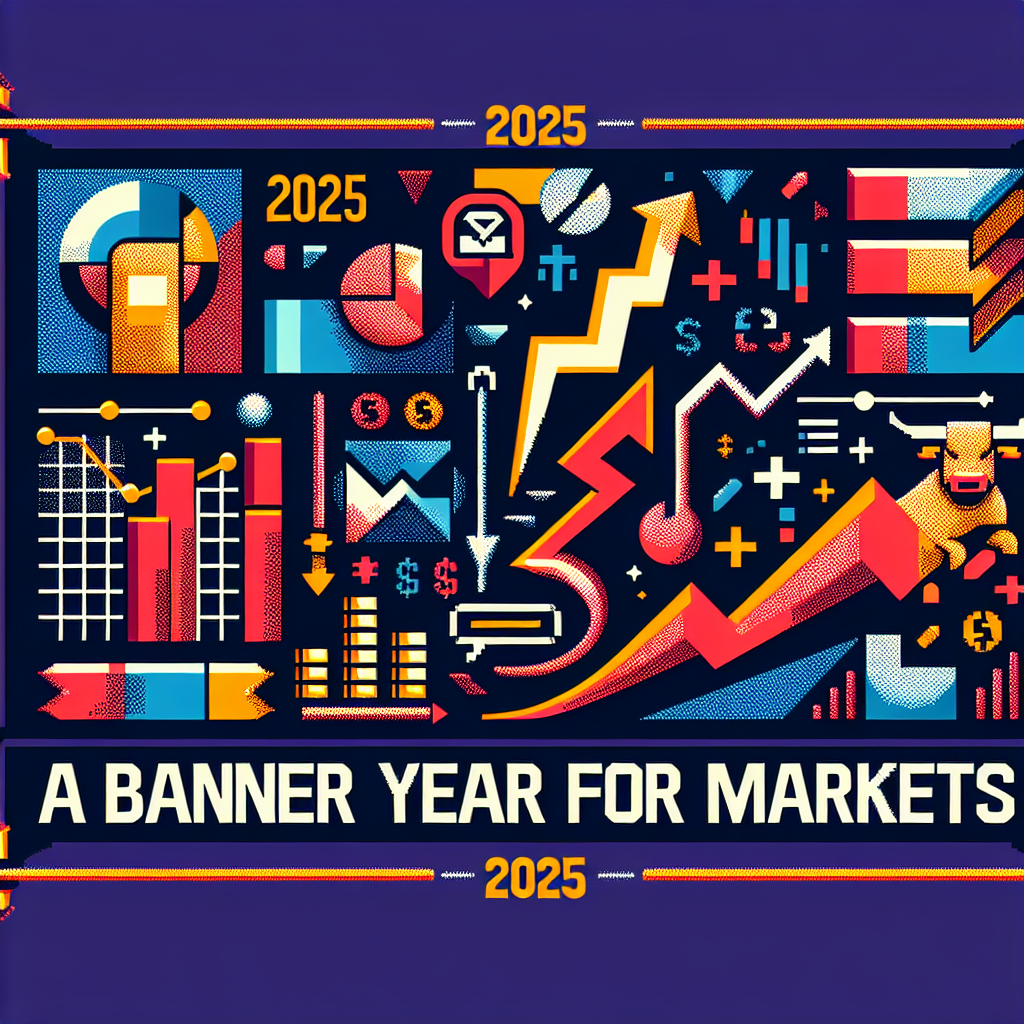
A banner year — and a cautionary tail: how AI powered the S&P’s 2025 jump
Hook: 2025 ended with markets celebrating a banner year — the S&P 500 rose roughly 16.4% — but the party had a clear DJ: artificial intelligence. That enthusiasm pushed big tech higher, buoyed indices, and created intense concentration in a handful of winners. By year-end, some corners of the market had begun to fray, reminding investors that rallies driven by a single theme can be both powerful and fragile. (apnews.com)
What happened this year — the headlines in plain language
- The S&P 500 finished 2025 up about 16.4% as markets digested faster-than-expected AI adoption, a friendlier interest-rate backdrop and renewed risk appetite. (apnews.com)
- AI enthusiasm — from chipmakers to cloud providers and software firms — was the dominant narrative, driving outperformance in tech-heavy areas and across the Nasdaq. (cnbc.com)
- Late in the year some pockets cooled: not every AI-linked stock delivered on lofty expectations, and overall breadth narrowed as gains concentrated in a smaller group of large-cap names. (cnbc.com)
A little context: why 2025 felt different
-
Three key forces aligned. First, companies accelerated spending on AI infrastructure and services; second, markets grew more comfortable with an easing in monetary policy expectations; third, investor FOMO around AI narratives stayed intense. Those forces compounded to lift valuations, especially in firms tied to semiconductors, data centers and generative-AI software. (cnbc.com)
-
But rally composition matters. When a handful of megacaps or a single theme is responsible for a large slice of index gains, headline numbers can mask vulnerability. That dynamic showed up later in the year as some AI-exposed pockets underperformed or stalled — a reminder that concentrated rallies can reverse quickly if growth or profit expectations slip. (cnbc.com)
Why AI became the market’s engine
- Real demand, not just hype: companies across industries rushed to integrate AI for cost savings, automation and new products. That created genuine revenue and margin opportunities for the vendors supplying chips, cloud capacity and software tooling. (cnbc.com)
- Scarcity of supply for key inputs: specialized chips and data-center capacity tightened, lifting the financials of firms positioned to supply AI workloads. Where supply constraints met exploding demand, prices and profits followed. (cnbc.com)
- The reflexive nature of markets: investor sentiment amplified fundamentals. Early winners saw outsized flows, which pushed valuations higher and attracted still more attention — a classic feedback loop. (cnbc.com)
The risks that crept in as the year closed
- Narrow leadership increases systemic sensitivity. When a smaller group of stocks drives the bulk of gains, an earnings miss or regulatory worry can have outsized market impact. (cnbc.com)
- Valuation compression risk. High expectations bake future growth into prices; if execution falters, multiples can re-rate quickly. Analysts flagged restrictive valuations for some AI winners. (cnbc.com)
- Macro and geopolitical overhangs. Tariff talk, geopolitical tensions, and any unexpected shift in Fed policy can flip sentiment — especially when market positioning is crowded. (cnbc.com)
How different investors experienced 2025
- Index owners: enjoyed a strong calendar return, but the headline gain hid concentration risk. Passive investors benefited when the big winners rose, but they also absorbed the downside when those names wobbled. (apnews.com)
- Active managers: some delivered standout returns by being long the right AI plays or adjacent beneficiaries (semiconductors, cloud infra). Others underperformed if they were overweight cyclicals or value stocks that lagged the AI trade. (cnbc.com)
- Long-term allocators: faced choices about whether to rebalance away from hot winners or to add exposure in anticipation of durable structural gains from AI adoption. That debate dominated portfolio meetings. (cnbc.com)
Practical lessons from the 2025 rally
- Look past the headline. A healthy rally ideally shows broad participation; concentration warrants scrutiny. (apnews.com)
- Distinguish durable winners from momentum. Ask whether revenue and profits support lofty valuations, not just whether a story is exciting. (cnbc.com)
- Mind risk sizing. In thematic rallies, position sizing and diversification are practical defenses against sharp reversals. (cnbc.com)
Market signals to watch in 2026
- Earnings delivery from AI-exposed companies — can revenue growth translate into margin expansion? (cnbc.com)
- Fed guidance and real rates — further rate cuts or a surprise tightening would change the calculus on valuation multiples. (reuters.com)
- Signs of broader participation — rotation into cyclicals, value, or international markets would indicate healthier breadth. (apnews.com)
My take
2025 was a clear example of how a powerful structural theme can reshape markets quickly. AI isn’t a fad — the technology has broad, real-world applications — but the market’s tendency to overshoot expectations is alive and well. For investors, the smart posture is curiosity plus caution: follow the business economics underneath the hype, size positions thoughtfully, and don’t confuse headline index gains with uniform, across-the-board strength. (cnbc.com)
Sources
-
CNBC Daily Open: AI still key to markets despite tariff overhang
https://www.cnbc.com/2025/05/21/cnbc-daily-open-ai-still-key-to-markets-despite-tariff-overhang.html -
CNBC Daily Open: The AI peak hasn't crested yet
https://www.cnbc.com/2025/01/07/cnbc-daily-open-back-in-black.html -
Associated Press: Wall Street falls in light trading on the final day of 2025, another banner year for markets
https://apnews.com/article/fccc61b72ed242f62000add1575707d0 -
Reuters: AI boom is in early bubble phase, Bridgewater founder Ray Dalio says
https://www.reuters.com/business/ai-boom-is-early-bubble-phase-bridgewater-founder-ray-dalio-says-2026-01-05/
Related update: We recently published an article that expands on this topic: read the latest post.
Related update: We recently published an article that expands on this topic: read the latest post.