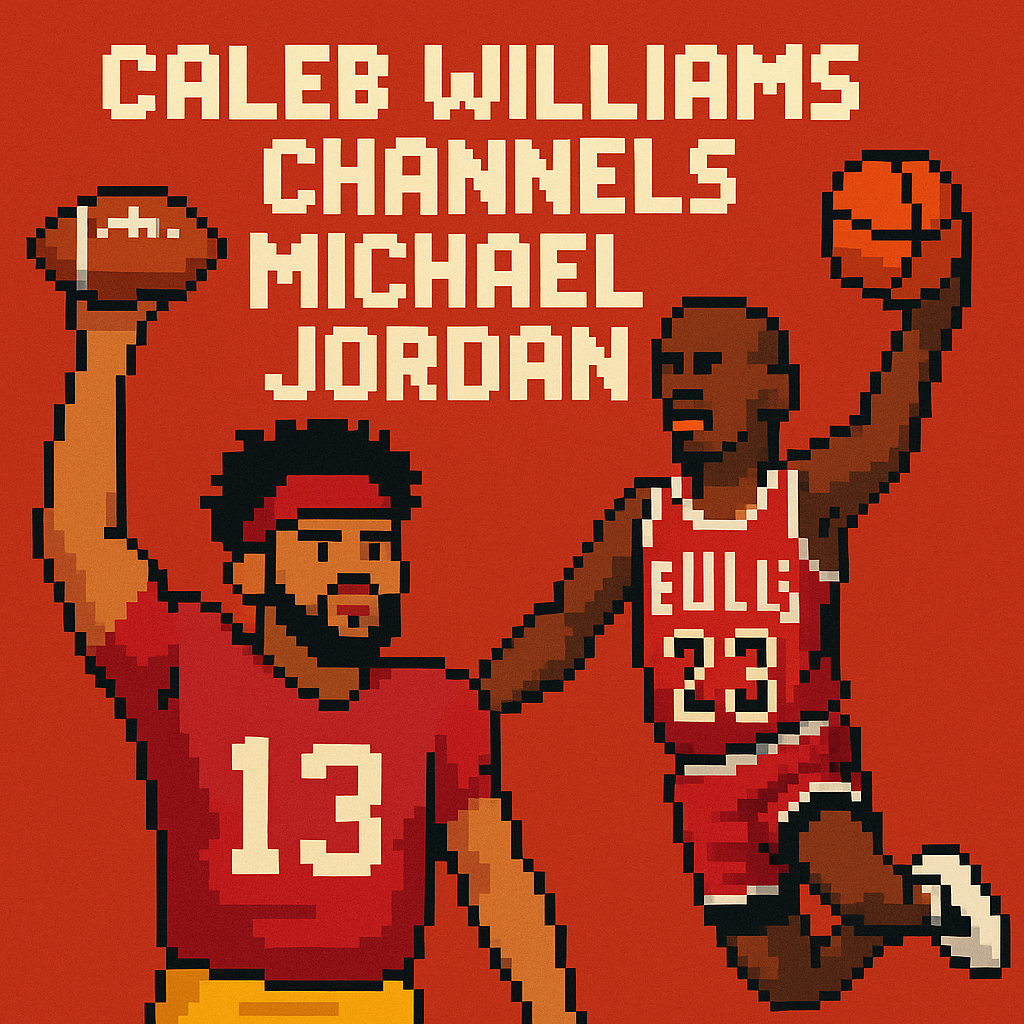
Caleb Williams Channels Michael Jordan | Analysis by Brian Moineau

TL;DR

  • Caleb Williams’s Madden NFL 27 cover mirrors Michael Jordan’s Chicago-skyline iconography, dropping a Bears QB into the city’s MJ canon on day one [1], [2].
  • This is a multi-brand swing: EA Sports gets a fresh Chicago narrative, the Bears get first-ever cover validation, and Williams pushes bold IP amid an “Iceman” trademark dispute with George Gervin [1], [4], [6].
  • The headline worry is a “Madden Curse,” but the real risk is brand overreach; if on-field results dip or the Gervin clash escalates, the Jordan homage flips from accelerant to flashpoint [1], [4].

What the source said

NBC Sports and the Associated Press report that the standard Madden NFL 27 cover places the Chicago skyline behind Caleb Williams as he recreates his jump pass against Green Bay, with Williams saying he wanted to “pay respect to MJ” and that a meeting with Jordan is “in the works” [1], [2]. He shrugged off the “Madden Curse” by pointing to Patrick Mahomes’s win after his own cover appearance, a precedent that aired on NFL.com in past discussions of the trope [1], [5]. EA’s deluxe edition leans into Williams’s “Iceman” nickname with a white-jersey, snow-flake motif, even as he acknowledged George Gervin’s prior claim to the moniker in NBA lore [1], [3], [4]. Williams joins the short list of recent NFL cover stars, a club that includes league-MVP caliber names since 2019 [1], [5].

Why it matters

The core stakeholders are EA Sports, the Chicago Bears, and Williams’s camp, and each has a different scoreboard. EA gains a cover star tied to Chicago’s Jordan mythology, perfect for launch trailers and Madden Ultimate Team beats that can visually echo the skyline across the 2026 cycle [1], [3]. The Bears, based at Halas Hall in Lake Forest, Illinois, finally place a player on the main cover, a first that signals national relevance beyond the NFC North and sells well to sponsors who buy reach through 17 regular-season weeks [6].

For Williams, the upside is cultural shorthand from day zero and a clear merchandising lane around the “Iceman” persona—if he can secure clean rights. The catch is legal: George Gervin’s filings and public statements raise a USPTO fight that could surface as an opposition or coexistence deal in 2026, with headlines that might shadow every Soldier Field home game [4]. When the cover is a thesis statement, every Sunday in Chicago becomes a brand audit.

Original analysis

Historical analogue: the “Mahomes exception,” 2019 → 2020

The “Madden Curse” narrative bent in 2019 when Patrick Mahomes fronted Madden NFL 20 and then won the Super Bowl that season, reframing the cover as a heat check for rising QBs rather than a hex [5]. That sequence proved the cover can add lift if the on-field arc holds—image plus wins equals lore, not noise [5]. Williams’s Chicago skyline play borrows that template: fuse a city’s myth with a present-tense ascent so the art becomes inseparable from the player’s 2026 story [1]. The bet is simple: performance converts homage into history.

Contrarian read

Consensus says the risk is a curse or too-soon pressure for a rookie in 2026. The sharper risk sits in IP and iconography management: Williams’s “Iceman” nickname faces conflict with George Gervin’s prior use and filings, which can trigger an opposition window or co-branding carve-out during the game’s promo cadence [4]. If the USPTO file goes loud in Q3 2026, EA loses a clean deluxe-edition motif and Williams forfeits a tidy merchandising spine just as national broadcasts spike attention [3], [4]. Superstition doesn’t crater a brand; courtroom paper and muddled rights can.

Named-stakeholder breakdown

  • EA Sports (EA Tiburon + publishing): Gains a Chicago-led storyworld that can echo across Ultimate Team, loading screens, and promos from August to January 2026 [1], [3].
  • Chicago Bears (front office, marketing): Land their first main-cover athlete, a recruiting and sponsor talking point that travels beyond Illinois and Wisconsin [6].
  • Caleb Williams’s camp: Gets a national platform and a Jordan-adjacent silhouette; risks a forced retreat from “Iceman” if a 2026 office action or opposition lands [1], [4].
  • George Gervin (and counsel): Holds leverage through prior “Iceman” fame and filings, making coexistence talks or a narrow license a rational 2026 outcome [4].
  • Nike/Jordan Brand (indirect): No formal tie-in announced, but the skyline homage speaks their Chicago dialect and keeps the MJ aura in circulation without new product [1].
  • NFL + NFLPA (licensing): A Chicago-centric cover can broaden casual reach and support player-licensing narratives through the 2026 season window [3], [6].

A typology for cover bets

  • Myth Tappers: Anchor to city canon for instant resonance (Williams → MJ skyline → Chicago) [1].
  • Skill Showcases: Pose equals archetype (Lamar Jackson’s speed; Josh Allen’s arm) [5].
  • Dynasty Signals: Coronate multi-year dominance (Tom Brady; Patrick Mahomes) [5].
  • Redemption Pitches: Recast after injury or slump (rarer, higher variance).

Williams is a Myth Tapper by design, which is potent but binary. If he’s playoff-good in 2026, the image cements into lore; if he’s scattershot in two Bears–Packers tilts, it reads as cosplay [1], [2].

What others are missing

EA and the Bears pinned the main cover to a single rivalry snapshot—a fourth-down jump pass against the Green Bay Packers—thereby staking claim to the most charged street in Illinois–Wisconsin sports, not just Chicago’s skyline [1], [2]. That decision forces every 2026 Bears–Packers meeting to re-litigate the cover in real time on FOX, CBS, or NBC, which amplifies either triumph or trolling. The creative is efficient mythology that can print on Wabash Avenue billboards and Lambeau Field signs, but it’s brittle because the frame ties Williams to one opponent with receipts. If Green Bay sweeps the 2026 series, the art becomes a meme accelerator, not a banner [2].

What to watch next

  1. By September 30, 2026, EA deploys at least one in-game presentation package or Ultimate Team cosmetic that reproduces the Chicago-skyline/MJ silhouette motif across Madden NFL 27 menus or cards [3].
  2. By Week 12 of the 2026 NFL season, a national broadcast (FOX, CBS, NBC, or ESPN/ABC) runs a split-screen of the Williams cover next to a current-season Bears–Packers highlight, explicitly calling out the homage on-air [1], [2].
  3. By December 31, 2026, the “Iceman” trademark dispute triggers a visible USPTO step—an office action, opposition, or coexistence filing—followed by a public comment from Williams’s or Gervin’s representatives [4].

My take

I like the audacity because Chicago in 2026 needs a singular QB image as much as it needs third-down conversions on the Lakefront. Williams stapled the city’s Jordan star to a global title from EA Sports and dared the NFC North to measure him against it [1], [3]. That courage carries brand debt; every Soldier Field prime-time throw becomes a ledger entry. If Williams stacks wins, the cover turns into wallpaper across Illinois and beyond; if the season wobbles or “Iceman” stalls at the USPTO, the art ages in dog years [4].

Sources

  1. Caleb Williams pays homage to Michael Jordan on Madden 27 cover — NBC Sports (https://www.nbcsports.com/nfl/profootballtalk/rumor-mill/news/caleb-williams-pays-homage-to-michael-jordan-on-madden-27-cover) — Core report with Williams’s quotes, skyline concept, “Iceman” nod, and curse context.
  2. Caleb Williams strikes jump-throw pose for Madden NFL 27 cover — Associated Press (https://apnews.com/article/51bcc01f6b4a60b75aa91e0d34386a8c) — Independent confirmation of the cover, pose, and Green Bay framing.
  3. Caleb Williams Named EA SPORTS Madden NFL 27 Cover Athlete — EA (press release) (https://news.ea.com/press-releases/press-releases-details/2026/Caleb-Williams-Named-EA-SPORTS-Madden-NFL-27-Cover-Athlete/default.aspx) — Publisher strategy backdrop and feature set cues for live-service tie-ins.
  4. The Budding ‘Iceman’ Trademark Dispute Between Caleb Williams and George Gervin, Explained — Sports Illustrated (https://www.si.com/nfl/bears/budding-iceman-trademark-dispute-caleb-williams-george-gervin-explained) — Details on competing filings, potential oppositions, and legal timelines.
  5. Bears QB Caleb Williams channels Michael Jordan on ‘Madden NFL 27’ cover — NFL.com (https://www.nfl.com/_amp/madden-nfl-27-cover-caleb-williams-bears-qb) — League context on the MJ homage and the Mahomes precedent for post-cover success.
  6. Bears QB Caleb Williams’ ‘Madden 27’ cover revealed — Chicago Sun-Times (https://chicago.suntimes.com/bears/2026/06/03/bears-caleb-williams-madden-27-cover-revealed-quarterback-video-game-nfl-ea-sports) — Local verification that Williams is the first Bears player to front the main Madden cover.

Rodgers, Steelers: The Awkward New Normal | Analysis by Brian Moineau

For the Steelers and Rodgers, the new normal is abnormal

The headline — Report: No meeting scheduled or expected between Steelers, Aaron Rodgers – NBC Sports — landed like a splash of cold water for a fanbase that has been living in limbo for months. If you were hoping for a tidy, cinematic “welcome back” moment in Pittsburgh this weekend, reality served something messier: stop-start negotiations, mixed signals from reporters and insiders, and a veteran quarterback who seems intent on keeping his calendar and his options open.

The Rodgers-Steelers story has never been normal. But the awkward, publicly visible pauses and reverse-scoops we’re seeing now feel like the new normal — and that abnormality matters for how the team prepares, how fans cope, and how the roster will be built between now and the start of mandatory OTAs on May 18, 2026.

The context you need

Last season Aaron Rodgers arrived in Pittsburgh as a late free-agent addition and helped the Steelers reach the playoffs. Expectations were immediately elevated, and the idea of a short-term reunion in 2026 made sense on paper: veteran QB, experienced coach in Mike McCarthy, and a roster that still had youth waiting behind a potential bridge starter.

But Rodgers’ offseason behavior has been consistent with his past pattern: public ambiguity, selective availability, and an emphasis on keeping freedom of movement. NBC Sports’ ProFootballTalk reported Rodgers himself saying there have been no “progressive conversations” with Pittsburgh — and now, according to Steelers reporter Mark Kaboly, “there is no meeting scheduled or expected between Aaron Rodgers and the Steelers” this weekend. Those two facts feed one another: public comment creates speculation, speculation pressures teams to respond, teams get cautious, and the cycle repeats. (nbcsports.com)

Meanwhile, Pittsburgh’s internal calendar is real. OTAs start May 18 and the draft and roster planning process moves quickly after that. The Steelers can wait — they did last year — but waiting carries risk. It compresses decision windows, complicates quarterback coaching plans, and limits the front office’s ability to shop or pivot if Rodgers declines to sign.

Report: No meeting scheduled or expected between Steelers, Aaron Rodgers

That exact phrase has become the latest drumbeat for two competing narratives.

  • Narrative A: Rodgers is playing hard-to-get for leverage and personal comfort. He wants to avoid being tethered to mandatory offseason work, or he’s weighing other suitors. Rodgers has a history of pacing his decisions and wanting terms that protect playing-time freedom and personal flexibility. (nbcsports.com)

  • Narrative B: The Steelers are learning the cost of patience. Waiting for a marquee veteran can disrupt roster development (think young quarterbacks like Will Howard or Mason Rudolph) and create holes elsewhere if resources are tied up or contingency plans aren’t enacted early. Recent public statements from team insiders show growing organizational friction about timetables. (nfl.com)

Neither narrative is strictly wrong. The line between prudent flexibility and organizational paralysis is fine — and this moment exposes how tightrope-like the relationship has become.

Why this limbo matters beyond headlines

Short-term drama fuels clicks, but the operational effects matter more. Here’s what’s at stake:

  • Quarterback room chemistry: Young QBs need clarity. If Rodgers signs late (or not at all), the Steelers might enter training camp with a rotating plan that complicates development and depth management.

  • Roster construction: Waiting on a veteran can prevent the team from making early decisions in free agency or the draft, particularly if there’s a belief Rodgers will be in town. That affects offensive line upgrades, receiver contracts, and defensive adjustments.

  • Coaching narrative: Mike McCarthy’s reunion storyline with Rodgers is tempting, but coaching staffs prefer predictable workloads. Uncertainty about the starter’s availability changes practice planning and playbook installation.

  • Fan and cultural perceptions: Fans crave certainty. Repeated false starts or ambiguous reporting erode trust in front-office communication and leave supporters oscillating between optimism and frustration.

All of that is amplified by Rodgers’ celebrity status — his decisions resonate in ways that a typical roster move might not. When the quarterback of your team is also a cultural lightning rod, every delay becomes a story.

What the Steelers can do next

There are three pragmatic routes Pittsburgh can choose, each with trade-offs:

  1. Continue to wait and keep the door open for Rodgers, while quietly building contingency plans (sign a short-term veteran or draft/develop a QB). This is a balanced approach but requires disciplined resource allocation.

  2. Pivot decisively — sign a different veteran or commit to a young QB — and move forward publicly. This reduces drama but risks regret if Rodgers later opts to stay.

  3. Use the leverage: publicly set firm internal deadlines and let Rodgers decide. That’s high-risk from a PR perspective, but it forces clarity.

None are ideal. The team’s decision will reveal how much weight it places on short-term playoff dreams versus long-term roster health.

What to watch next

  • Any new travel or meeting reports involving Rodgers and Steelers executives. Even small scheduling shifts will reshape the narrative.

  • Official roster moves around the OTA start date (May 18, 2026). If Pittsburgh signs another veteran QB or makes a trade, that’s a clear sign they’re preparing to move on.

  • Rodgers’ public comments. He has historically used media appearances to signal intentions in a controlled way.

These markers will give the clearest signal that the “new normal” is shifting back toward something less chaotic.

A few takeaways from the saga

  • The Rodgers-Steelers situation proves top-tier free agents can create structural uncertainty for teams.
  • Patience is a strategy, but it isn’t free — it costs decision windows and can hurt development.
  • Media cross-talk (different reporters offering conflicting timelines) amplifies chaos; the truth often lands somewhere between hype and deflation.

My take

This is less about Aaron Rodgers or the Steelers individually and more about how modern roster-building and celebrity intersect. Teams once operated in quieter channels; now, every possible conversation can be amplified and misread. The “new normal” — open-ended timelines, conditional visits, and public hedging — is uncomfortable, but it’s the reality of a league where talent, brand, and bargaining power collide.

If I had to bet, Pittsburgh will preserve the option to reunite with Rodgers while quietly hedging. That’s pragmatic, if emotionally unsatisfying. Fans won’t get neat closure overnight — but the best outcome would be a clear, documented decision that lets the team move forward one way or the other before OTAs begin on May 18, 2026.

Sources


Related update: We recently published an article that expands on this topic: read the latest post.

Related update: We recently published an article that expands on this topic: read the latest post.
Paul Skenes: Proudly Wearing USA Colors | Analysis by Brian Moineau

When Paul Skenes Says “I’m Never Saying No,” It’s Not Just Baseball — It’s a Statement

If you thought Team USA’s hockey gold stirred the pot, wait until the World Baseball Classic arrives and Paul Skenes takes the hill. The Pirates’ young ace didn’t offer a tepid, neutral soundbite when asked about representing the United States — he gave the kind of full-throated yes that turns a sports story into something bigger: identity, pride, and the culture wars that keep showing up in sports coverage.

Skenes’ line — effectively, “If I ever get the chance to do this, I’m never saying no” — is simple, direct, and unglamorous. But in 2026, when the World Baseball Classic puts country jerseys back under the spotlight, simple things can become cultural Rorschach tests. OutKick’s take (loud, partisan, and gleefully provocative) frames that answer as fuel for the right’s narrative that “lefty sports media” will be outraged. Other outlets treat it as what it most likely is: a top player eager to compete for his country.

Below I run through the context, why the reaction matters beyond headlines, and what this moment says about sport, fans, and media.

The set-up: Skenes, Team USA, and the WBC stage

  • Paul Skenes is among the game’s brightest young pitchers — a former Air Force Academy cadet turned LSU national champion, No. 1 overall pick, and immediate frontline starter in MLB.
  • Team USA for the 2026 World Baseball Classic has been building star power: Aaron Judge as captain, high-profile pitchers (including Skenes), and a roster meant to fix the pitching shortfalls that dogged the 2023 squad.
  • The WBC is different than the regular season: short tournaments, national jerseys, and emotions that bring out patriotism and critique in equal measure. Players say it feels like playoff baseball; fans and media often treat it like geopolitics in cleats.

(Sources: MLB, CBS, Fox Sports.) (mlb.com)

Why a straightforward “I’ll always say yes” matters right now

  • It underscores a rare thing in modern pro sports: player enthusiasm for international competition. That alone helps legitimize the WBC’s prestige.
  • It invites interpretation. In today’s polarized media ecosystem, a short quote becomes raw material. Outlets on the right will frame it as patriotic defiance; critics will scrutinize the broader symbolism (which players wear the star, what national representation means, etc.).
  • Skenes’ background — Air Force Academy, collegiate national team experience — makes his answer resonate differently than if it came from a player without military ties or prior Team USA history. That personal history amplifies the authenticity people read into his words. (mlb.com)

What we’re likely to see in coverage — and why it matters

  • Polarized headlines: Expect the extremes. Some pieces will paint Skenes as emblematic of unapologetic national pride; others will analyze how the WBC interacts with social and political narratives. OutKick’s headline is an example of the first approach — combative and performative. (outkick.com)
  • Sports-as-culture coverage: The WBC will be less about batting averages for many readers and more about what the event means culturally — unity, protest, representation, or division. That’s not new, but tournaments focused on national teams concentrate those conversations.
  • Player reactions will matter more than ever: If Skenes and other high-profile athletes lean into patriotism-themed messaging, the storylines will feed themselves; if they avoid politics and focus on competition, the coverage may pivot back to tactics and rosters.

What this says about fans and the media ecosystem

  • Fans want narratives. A player who pledges to “never say no” gives them a clean, emotional story to latch onto. National-team competition sells easily because it taps into identity.
  • Media incentives push toward extremes. Outlets that traffic in outrage or confirmation bias will squeeze a soundbite for clicks. Balanced outlets will contextualize Skenes’ quote with his history and the WBC’s competitive stakes. Both approaches coexist — and both shape public perception.
  • The athlete’s control is limited. Skenes can make a heartfelt statement; how it’s amplified is up to dozens of editors, columnists, podcasters, and social-media users. That’s the modern cost (and reach) of five words on a microphone.

Notes on the bigger baseball picture

  • Team USA’s pitching concerns from 2023 were real; adding Skenes addresses that on-paper weakness and raises expectations that the U.S. can contend for gold again. (cbssports.com)
  • The WBC’s March schedule and host cities (including pool play sites) mean the spotlight will be intense and geographically diverse — big markets, international stages, and the chance for narrative-heavy games (e.g., the U.S. versus Japan rematch potential). (mlb.com)

Notes for readers skimming headlines

  • OutKick’s piece uses partisan framing and rhetorical provocation to stoke reaction; other outlets (MLB.com, CBS, Fox Sports) focus more on Skenes’ enthusiasm and the team-building aspect. Read both types of coverage to separate spin from context. (outkick.com)

A few takeaways worth bookmarking

  • The simplest athlete quotes can become cultural flashpoints in today’s media climate.
  • Paul Skenes’ commitment to Team USA is both a purely sporting plus (better rotation) and a flashpoint for national narratives.
  • Expect WBC coverage to mix game analysis with broader cultural framing — sometimes in the same headline.
  • If you prefer calmer coverage, prioritize direct interviews and league reporting over partisan commentary.

My take

I think Skenes’ answer is exactly what most athletes mean when they talk about representing their country: pride, competitiveness, and a rare chance to wear a different uniform. The rest — outrage, triumphalism, hot takes — is a noisy overlay that tells us as much about the media and fans as it does about the player.

If you want hard baseball reasons to care, Skenes’ presence materially strengthens Team USA’s rotation. If you want cultural reasons, his background and the current media moment guarantee the conversation will be louder than the quote. Both are true, and both are interesting.

Sources


Related update: We recently published an article that expands on this topic: read the latest post.

Related update: We recently published an article that expands on this topic: read the latest post.
Belichick’s Petty T-Shirt Mic Drop | Analysis by Brian Moineau

Nobody does petty better than Bill Belichick (and apparently his entourage)

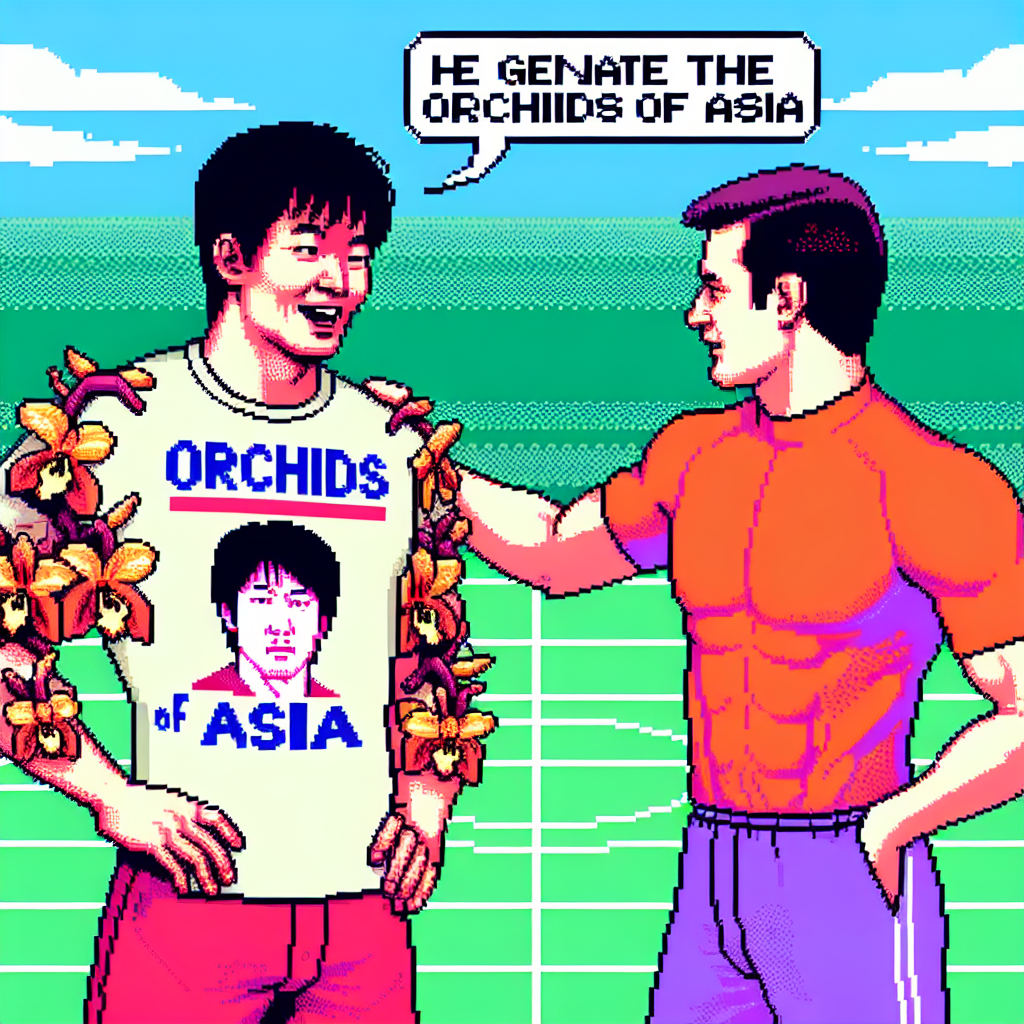
There are athletic rivalries and then there is full-on petty theater — the kind that plays out with perfect timing, pointed symbolism, and a wink that says, “You know exactly what I mean.” On February 8, 2026, Jordon Hudson, longtime girlfriend of Bill Belichick, showed up at the UNC–Duke game wearing an “Orchids of Asia Day Spa” T‑shirt. For anyone who remembers the 2019 Jupiter, Florida, scandal that briefly ensnared Patriots owner Robert Kraft, the shirt was less fashion choice and more mic drop.

This wasn’t subtle. It was theatrical. It was the kind of move that turns a sideline photo into the latest episode of an ongoing narrative: the Belichick–Kraft rift, the Hall of Fame snubs, and a dynasty’s backstage drama playing out on the public stage.

What happened and why it landed

  • Jordon Hudson appeared at the UNC–Duke basketball game wearing an Orchids of Asia Day Spa T‑shirt — a brand name associated with the 2019 legal sting that led to charges against Robert Kraft (charges were later dropped). (NBC Sports, Boston.com).
  • The timing was striking: the shirt showed up on the eve of Super Bowl LX and shortly after both Belichick and Kraft were passed over for the 2026 Pro Football Hall of Fame class — a moment that has already fueled tension between the two men. (NBC Sports, Boston.com).
  • The visual provoked a strong reaction online and in local coverage: some called it hilarious and perfectly petty; others found it in poor taste and unnecessarily provocative (Boston Globe, CBS Sports).

Why this is classic Belichick-level pettiness (even if he didn’t wear the shirt)

  • Symbolic payback beats direct confrontation. Belichick’s brand has always been about psychological edge — and this kind of off-field signaling keeps that culture alive without an on-the-record statement.
  • It extends a narrative. The Belichick–Kraft story isn’t just about two men — it’s about power, legacy, and how the Patriots dynasty is remembered. A shirt like this is a cheap, viral way of steering public perception.
  • Timing is everything. Wearing it around the Super Bowl and after the Hall of Fame snub turns a personal jab into a national talking point.

Context and recent history you should know

  • Orchids of Asia Day Spa was at the center of a 2019 investigation in Jupiter, Florida, that led to misdemeanor solicitation charges against several men, including Robert Kraft; those charges were later dropped after legal rulings about the surveillance used in the investigation. (Boston.com, The Boston Globe).
  • Bill Belichick coached the Patriots for 24 seasons and built a run of sustained success; tensions with Kraft deepened after Belichick’s 2024 departure from New England and have included public barbs and media narratives that portray each man differently. (NBC Sports coverage).
  • Jordon Hudson has previously made headlines for attention-grabbing moments — most notably a T‑shirt referencing Super Bowl LI and a tendency to insert herself into public moments around Belichick — so this move fits an established pattern. (NBC Sports, Boston Globe).

The broader meaning beyond the meme

This isn’t only about an awkward photo op. It’s emblematic of how modern sports drama is performed across platforms, where symbolism and image often carry as much currency as on-field accomplishments.

  • Legacy vs. narrative: The two men are now part of how the Patriots dynasty is told. Public spats and visual jabs influence which version of that story gets airtime.
  • Media and optics: In the social age, sideline snapshots travel wider and faster than any press release. A single shirt can define stories for days.
  • The human element: Personal slights — real or perceived — matter. Whether you see this as justified payback or unnecessary provocation depends on which side of the story you’re on, but the gesture reminds us that sports leadership is personal as well as professional.

A few notable reactions

  • Some reporters and fans hailed it as a perfectly timed, witty bit of petty drama — the kind of pop-culture zinger that keeps the Belichick mystique alive.
  • Others criticized the move as crude or mean-spirited, arguing it dredged up a painful subject for little more than a viral moment.
  • The exchange underlines how public figures weaponize imagery and memory in ways that traditional rivalry never did.

Final thoughts

Whether you laugh at the audacity or wince at the tone, the Orchids T‑shirt is a reminder: petty is a performance art, and Bill Belichick — by personality and proximity — is now a masterclass. In an era when off-field gestures can alter the conversation around legacy, one T‑shirt is enough to keep the feud alive and the headlines rolling.

Would it change anything meaningful about either man’s place in football history? Almost certainly not. But for a fleeting, perfectly petty moment, it gave the public the kind of theater that sports media runs on — a visual one-liner that sums up a much larger, complicated relationship.

Things to remember

  • This was a symbolic, public gesture tied to a real 2019 investigation in Florida; the criminal charges referenced were later dismissed.
  • The incident feeds into a larger narrative about Belichick’s split from the Patriots and the fraught public relationship between him and Robert Kraft.
  • In modern sports, image and timing can be as influential as wins and losses in shaping legacy.

Sources


Related update: We recently published an article that expands on this topic: read the latest post.


Related update: We recently published an article that expands on this topic: read the latest post.

Bevacqua vs. Yormark: Notre Dame Fallout | Analysis by Brian Moineau

Notre Dame’s Public Meltdown and the Cost of Burning Bridges

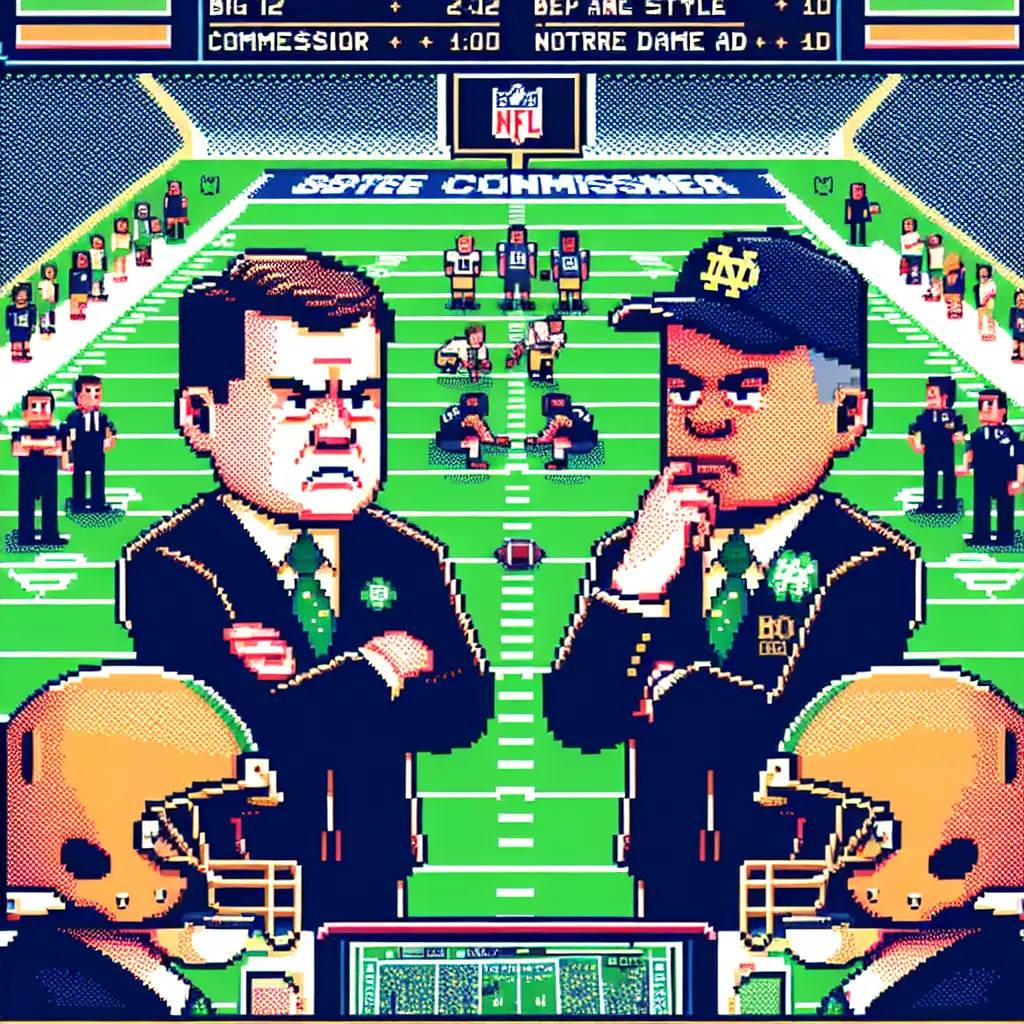
The college-football offseason rarely delivers on drama like a rivalry game — yet here we are: Notre Dame’s athletic director, Pete Bevacqua, publicly calling out the ACC after the Fighting Irish were left out of the 2025 College Football Playoff, and Big 12 commissioner Brett Yormark answering back by calling Bevacqua’s actions “egregious.” The exchange is more than headline fodder. It’s a study in modern power dynamics in college sports: brand protection, conference alliances, and the long memory of favors.

Why this row matters more than just pride

  • Notre Dame is unique: football independent in practice but tied to the ACC in most sports and scheduling agreements. Its network of relationships matters more than ever in an expanded 12-team playoff world.
  • Public finger-pointing isn’t just awkward — it can cost future scheduling, revenue, and political capital when the sport’s power players make decisions about expansion, access, and TV money.
  • Brett Yormark’s rebuke highlights an important theme: institutions that benefit from alliances don’t always get to publicly scold their partners without consequences.

What happened (plain and simple)

  • After the CFP selection favored Miami over Notre Dame (Miami had the head-to-head win), Pete Bevacqua publicly criticized the ACC, accusing it of undermining Notre Dame’s case by pushing Miami in league messaging and social media.
  • Notre Dame officials also signaled the relationship with the ACC had been “strained,” and Bevacqua suggested the league’s actions did “permanent damage.”
  • At the Sports Business Journal Intercollegiate Athletics Forum, Big 12 commissioner Brett Yormark called Bevacqua’s conduct “egregious” and “totally out of bounds,” noting the ACC had “saved” Notre Dame during the COVID-19 season in 2020 by giving them a full conference schedule and access to the conference championship.
  • The episode opened talk of potential reprisals from other athletic directors (scheduling aversion), and renewed speculation about where Notre Dame fits in the evolving conference landscape. (bleacherreport.com)

A closer look at the players and incentives

  • Pete Bevacqua (Notre Dame AD)

    • Incentives: Protect Notre Dame’s brand, fight for access to the playoff and its financial upside, and signal to fans and donors that the program will push back.
    • Risk: Alienating conference allies, compromising behind-the-scenes relationships that matter for scheduling and future political support.
  • Jim Phillips (ACC commissioner)

    • Incentives: Advocate for all ACC members and preserve the league’s credibility when promoting its teams.
    • Risk: Accusations of favoritism, even if the league was acting within normal advocacy duties.
  • Brett Yormark (Big 12 commissioner)

    • Incentives: Defend conference solidarity and discourage public feuds that could destabilize the broader system.
    • Risk: Appearing partisan or discouraging legitimate transparency about selection processes.

Bigger context: governance, memory, and leverage

  • College sports is a relationship economy. Conferences and independents trade scheduling, revenue sharing, and access. Publicly criticizing a partner is not just emotional — it’s strategic malpractice if you need that partner again.
  • Yormark’s point about the 2020 season is a reminder: favors are remembered. The ACC allowed Notre Dame a 10-game conference slate in COVID-impacted 2020; that accommodation had long-term competitive consequences and built goodwill.
  • The CFP’s expanded format and the myriad memorandums and understandings that govern access mean that political capital and perceived fairness matter almost as much as wins and losses.

Key takeaways

  • Publicly calling out a partner rarely wins loyalty; it often costs leverage.
  • Short-term PR satisfaction (rallying the fanbase) can come with long-term strategic losses (fewer high-quality opponents, strained negotiations).
  • Transparency in selection criteria is crucial — but the way institutions air grievances matters just as much as the grievance itself.
  • The Notre Dame–ACC–CFP spat is a microcosm of college sports’ transition: bigger stakes, more politics, and less room for emotional outbursts without consequences.

My take

Bevacqua’s frustration is understandable — missing the CFP stings, and athletic directors are tasked with fiercely protecting institutional interests. But stewardship in college athletics requires a balance between defending your program and preserving the relationships that make future success possible. Publicly accusing a conference partner of undermining you burns trust. Yormark’s rebuke isn’t just rhetorical theater; it’s a reminder that in the post-expansion era, relationships are currency. Notre Dame’s leadership needed a different channel: a private, strategic response that preserved options rather than narrowed them.

Sources


Related update: We recently published an article that expands on this topic: read the latest post.


Related update: We recently published an article that expands on this topic: read the latest post.

Ngannou Shrugs Off Dana White Drama | Analysis by Brian Moineau

Francis Ngannou and the Dana White Dust-Up: Why the Predator Isn’t Biting

There’s a certain rhythm to combat-sports drama: a fiery headline, a torrent of takes, clips that loop until everyone has an opinion. But when Francis Ngannou was asked about Dana White’s recent allegations that he physically accosted White and Hunter Campbell at UFC headquarters, the former heavyweight champion did something unexpected — he shrugged, pointed to cameras, and said he’s done with the noise.

In a calm exchange with Ariel Helwani, Ngannou didn’t leap to deny or escalate. Instead he sounded weary, almost philosophical, about the continued back-and-forth with the man who once helped make his career. That response matters — and not just for headlines.

What happened (quick context)

  • Dana White publicly claimed that, after being denied a post-fight bonus, Francis Ngannou pushed him in his office and grabbed Hunter Campbell by the collar. White’s comments painted a picture of a heated confrontation at UFC headquarters. (mmafighting.com)
  • Ngannou, now signed with the PFL and a recent crossover boxer, addressed the allegation on the Ariel Helwani Show. He didn’t explicitly confirm or deny the specifics. Instead he expressed fatigue with endless controversy, noted that White “must have a lot of cameras” in his office, and said he wants peace rather than drama. (mmafighting.com)
  • The exchange is the latest chapter in a fractured relationship that stretches back to Ngannou’s UFC days and his eventual departure to pursue other opportunities. (mmafighting.com)

Why Ngannou’s response is telling

  • He’s opted out of the spectacle. Fighters and promoters thrive on attention, but Ngannou’s posture — tired, measured, uninterested — signals a conscious choice to step away from whatever narrative White wants to spin. That’s a rare public display of discipline in a sport that feeds on heat.
  • The camera comment is strategic. Mentioning security footage does two things: it subtly invites verification without demanding it, and it reframes the claim from he-said-she-said gossip into something potentially objective.
  • There’s image management on both sides. White’s recounting of the episode reinforces a version of events that justifies his criticism of Ngannou; Ngannou’s refusal to engage denies the story the oxygen it needs to keep burning. Both are managing reputation — one with volume, the other with silence. (mmafighting.com)

A few practical takeaways for fans and the media

  • Don’t let drama drown out sport: Ngannou’s career choices (UFC → boxing → PFL) and performance matter more for his legacy than gossip. Focus on results and contracts, not rumors. (mmafighting.com)
  • Evidence > assertions: If there’s an actual incident at a corporate office, security footage would be decisive. Until then, treat secondhand recollections as just that — recollections. (mmafighting.com)
  • Read posture as a statement: Choosing not to escalate is itself a public position. Ngannou’s coolness communicates weariness and a desire to move on — a signal that’s harder to spin than a hot rebuttal. (mmafighting.com)

My take

This feels less like a punch than a punctuation mark in a long story. Ngannou’s trajectory — from underdog to UFC champion to international boxing star and PFL competitor — has always included moments of friction with the UFC establishment. Dana White’s latest comments are consistent with that pattern: loud, definitive, and engineered to land. Ngannou’s gentle refusal to play the erupt-or-defend game is smarter than it looks. Public feuds can lift short-term attention, but they also tether a fighter to a narrative that’s rarely beneficial in the long run.

If Ngannou wants options — bigger fights, crossover paydays, a path back to the biggest platforms — staying above the noise and letting outcomes speak will serve him better than getting dragged into another public war. And by dropping a neutral remark about cameras, he left the door open for facts to do the talking without inviting more headlines.

Final thoughts

In combat sports, heat sells. But there’s also power in restraint. Francis Ngannou’s answer — tired, clipped, and pointed toward objective proof — is a reminder that sometimes the strongest response is the quietest one. Whether you root for him or for the spectacle, this exchange underscores a larger question for the sport: how much of what we call “news” is really about athletes and how much is theater produced by promoters, networks, and personalities?

Sources


Related update: We recently published an article that expands on this topic: read the latest post.


Related update: We recently published an article that expands on this topic: read the latest post.

Warriors most valuable at $9.4 billion, average NBA franchise worth $4.66 billion in CNBC valuations – NBC Sports | Analysis by Brian Moineau

Warriors most valuable at $9.4 billion, average NBA franchise worth $4.66 billion in CNBC valuations - NBC Sports | Analysis by Brian Moineau

**Title: The Golden Warriors: How the NBA's Franchise Valuations Illuminate the Game's Bright Future**

The Golden State Warriors are sitting pretty, not just on the hardwood but also in the financial world. According to CNBC valuations reported by NBC Sports, the Warriors are now the most valuable NBA franchise, boasting a staggering worth of $9.4 billion. Meanwhile, the average NBA franchise clocks in at an impressive $4.66 billion. At the heart of this financial leap? A massive new domestic television rights deal that has executives buzzing and owners grinning ear to ear.

While it might seem surprising to some that a team once known for its decades-long playoff drought is now at the pinnacle of franchise valuations, those who have followed the team's recent history know this ascent has been years in the making. The Warriors have transformed from underdogs to dynasty builders, thanks to a combination of savvy front-office moves, a star-studded roster, and a loyal fanbase that fills the Chase Center night after night.

**Beyond the Court: The Broader Implications of Rising Valuations**

The Warriors' valuation surge is not just a testament to their on-court success but also reflects a broader trend in sports where media rights have become a goldmine. The NBA's new television deal is a game-changer, and it mirrors the lucrative contracts seen in other sports leagues like the NFL and English Premier League. These deals ensure that fans can catch every shot, dunk, and buzzer-beater from the comfort of their living rooms, and in turn, inject billions into the league's coffers.

This isn't just a win for the league and its franchises; it's a win for players too. As the league's revenue grows, so does the salary cap, allowing players to negotiate more lucrative contracts. This symbiotic relationship between media deals and player compensation ensures that the league attracts top talent, maintaining its status as a global sports powerhouse.

**A Global Perspective: Sports as a Cultural Phenomenon**

In many ways, the rising valuations of NBA franchises reflect a larger cultural shift. Sports have become a universal language, breaking barriers and bringing people together across continents. Just look at the global reach of basketball icons like Stephen Curry and LeBron James, whose influence extends far beyond the court. In a world often divided by politics and ideologies, sports offer a rare platform for unity and shared passion.

The Warriors' valuation story is not just about money; it's about the evolution of a team that has captured the hearts of millions. It's about the power of sports to inspire and the endless possibilities that arise when talent, strategy, and opportunity align.

**Final Thoughts: The Future of the Game**

As we look ahead, the sky is the limit for the NBA. With technology rapidly changing how fans engage with the game—from virtual reality experiences to interactive broadcasts—the potential for growth is immense. The Warriors' $9.4 billion valuation is just the tip of the iceberg, a sign of the robust health of a league that's continually innovating and expanding its reach.

In the end, the rise in franchise values is a reminder that in sports, as in life, there's always room to dream bigger, aim higher, and strive for greatness. Whether you're a Warriors fan, a basketball enthusiast, or just someone who loves a good success story, there's no denying that the future of the NBA looks as bright as a championship trophy under the spotlight.

So, here's to the Golden State Warriors, the NBA's golden goose, and the exciting journey that lies ahead for basketball fans around the world. Keep your eyes on the court, because the best is yet to come.

Read more about AI in Business

Read more about Latest Sports Trends

Read more about Technology Innovations