
It was one of those December weekends when the chill in the air nudges you to do something cozy and delicious. I found myself in the kitchen, rummaging for ideas to fill the house with the quintessential aroma of the holidays. That’s when I remembered the Christmas Fruit Cake — a recipe that’s not only indulgent and rich but also incredibly forgiving. This cake becomes the centerpiece of any celebration, and the best part? You can make it ahead, giving you more time to sip on that mulled wine while the cake matures into something truly spectacular.
Jump to Recipe
What You’ll Need
Before we dive into the holiday spirit, let’s gather the goods. What I adore about this recipe is that it often feels like a treasure hunt in your pantry. You might already have most of these ingredients, waiting to transform into something magical.
- Butter – for that undeniable richness
- Sugar – sweetens and balances the spices
- Eggs – to give the cake structure
- Plain flour – sifted with baking powder for a light crumb
- Baking powder – keeps things lofty
- Mixed spice – the heart of any Christmas bake
- Dried mixed fruit – the star of the show
- Pitted prunes – cut into pieces for extra moisture
- Walnuts – chopped, adding a delightful crunch
- Rum – because holiday cheer is essential
- Orange juice – for a zesty kick
- Orange zest – from one orange, to enhance the citrus notes
- Vanilla extract – a warm, sweet background
- Two layers of parchment paper – to line an 8″ square cake tin
How to Make Christmas Fruit Cake
Here’s where the magic happens. Each step is designed not just to guide you but to make you feel confident and capable.
- Start by lining your 8″ square cake tin with two layers of parchment paper. This ensures your cake doesn’t stick and makes for a smooth release.
- In a large bowl, mix the dried mixed fruit and pitted prunes with about 8 tablespoons of rum. Cover this mixture with cling wrap and let it sit overnight. This soak is where the fruits absorb all that boozy goodness.
- The following day, beat the butter and sugar together until light and fluffy. This should take on a pale yellow hue as air is incorporated.
- Slowly add in the rum, orange juice, orange zest, and vanilla extract. Mix until everything is well combined, and a sweet, citrusy aroma fills the air.
- Add the eggs one at a time, ensuring they are well incorporated before adding the next. Scrape down the sides of the bowl as you go.
- Take 1/4 of the flour and coat the soaked fruit mixture. This helps the fruit stay suspended while baking.
- Gradually add the remaining flour and mixed spice to the butter mixture. Mix until the batter comes together; it should be thick and fragrant.
- Fold in the fruit mixture and chopped walnuts using a rubber spatula. Pour the batter into the prepared cake tin and bang it on the table once to settle the contents evenly.
- Bake in a preheated oven at 160°C for about 1 1/2 hours. When the cake starts to turn brown after 30-40 minutes, cover it loosely with foil to prevent over-browning, and continue baking.
- As soon as you take the cake out of the oven, pour 3-4 tablespoons of rum over it. Let it cool, then turn it out from the tin. Wrap it in cling wrap and store in the fridge.
- For the next few days, pour 2-3 tablespoons of rum over the cake every three days until it’s time to serve or gift it. This keeps the cake moist and enhances the flavor.
Cook’s Notes
This cake is your holiday secret weapon. It’s forgiving if you need to make substitutions or if you forget to soak the fruit overnight. If you’re short on time, you can microwave the fruit and rum for a few seconds to help the process along. This cake stores beautifully in the fridge, wrapped tightly in cling wrap or foil. It actually tastes better as it sits, so don’t worry about making it a week or so ahead. Freezing is also an option; just make sure you bring it to room temperature and add a fresh splash of rum before serving.
Make It Your Own
While this cake is fantastic as is, sometimes a little twist is just what you need:
- Swap the rum for brandy if you prefer a different kind of warmth.
- Replace walnuts with pecans for a softer crunch.
- Add in some shredded coconut with the fruit for a tropical flair.
- Use dried cherries or cranberries instead of some of the mixed fruit for a tangy zip.
If you try this, I’d love to hear how it turns out — drop a comment or tag me on social media! Your holiday table just got a whole lot more festive. Happy baking!
Related update: Christmas Fruit Cake
Related update: Applesauce Cake

TL;DR
- Bessent’s Treasury is borrowing at a clip that makes net interest the fastest-growing federal bill, now bigger than year‑to‑date defense outlays—and taxpayers are already footing it [2].
- The real squeeze isn’t “debt apocalypse”; it’s financing mechanics: coupon sizes are frozen into 2026, pushing a refinancing wave into 2027 when rates may still be sticky [3][4].
- Back‑of‑envelope: if 9‑month net interest is $857B, FY2026 likely tops ~$1.14T—about $8.5K per U.S. household—before any new programs, tax cuts, or wars enter the chat [2][10].
What the source said
TheStreet’s piece argues the “troubling news for every taxpayer” is the interest bill itself and points to the CBO’s June 2026 Monthly Budget Review showing a $1.4 trillion deficit for the first nine months of the fiscal year and $857 billion in net interest, roughly $23.8 billion a week and up 13% year over year [1][2]. It notes that total federal debt is near $39.4 trillion and that year‑to‑date net interest has surpassed defense spending in the same period [1][2]. The article references CRFB’s warning that full‑year borrowing could exceed $2 trillion and cites longer‑term CBO projections showing interest costs roughly doubling by 2036, with Social Security’s OASI trust fund projected to hit insolvency in 2032 if laws remain unchanged [1][7][8].
Why it matters
Stakeholders aren’t abstract “taxpayers”; they’re workers whose FICA payroll taxes fund Medicare and Social Security, retirees whose checks depend on the OASI and DI trust funds, and households facing higher “interest taxes” in the form of rising federal carry costs each year [2][8]. The CBO ledger for FY2026 to date shows interest already outruns discretionary fights over EPA, Education, or Commerce; those culture‑war skirmishes won’t reclaim real money if the interest line keeps compounding at a double‑digit clip [2].
Markets, too, have agency. Primary dealers and bond funds absorb the supply that Bessent’s team ships each week via bills, notes, and bonds, and TBAC minutes indicate dealers expect larger coupon auctions in early 2027 [3]. That means price risk today and term‑premia tomorrow, with the bill landing in the public’s lap via higher interest outlays that crowd out choices elsewhere, including discretionary spending in FY2027–2028 [3][6].
Original analysis
Treasury’s current stance—hold coupons steady and lean on bills—prioritizes auction smoothness over long‑run carry, which assumes demand for U.S. duration remains adequate and disinflation continues through 2026 [3][4][6]. If that assumption fails and 10‑year yields hover near recent highs into 2027, taxpayers inherit a bigger, stickier interest bill for years [3][8].
What others are missing
Coverage fixates on the deficit topline. The subtler story is the composition shift underneath: CBO category tables show corporate income tax receipts down about 24% year‑to‑date versus last year due to 2025 law changes that boosted deductions, while individual/payroll taxes carried more weight until a February 2026 court ruling triggered roughly $70 billion in customs refunds that hit net tariff revenue [2]. That cocktail tilts financing toward bills and away from locking in term even as net interest outlays climb 13% year over year through June 2026, raising rollover risk into the 2027 refunding window [2][3].
What to watch next
- By September 30, 2026, net interest outlays reported in the Monthly Treasury Statement will exceed $1.12 trillion for FY2026 [2].
- By the February 2027 Quarterly Refunding, Treasury will announce increases to nominal coupon auction sizes (at least the 2‑year and 5‑year tenors), reversing 2026’s “steady for several quarters” guidance [3][4].
- By June 2027, CBO’s Monthly Budget Review will show corporate income tax receipts at least 15% below the same period two years earlier (June 2025), keeping pressure on bill issuance and net interest [2].
My take
If I ran Bessent’s Treasury, I’d front‑load some pain in 2026—nudge up coupons and lengthen maturities while market depth is intact—rather than gamble on a perfect 2027 [3][4]. The CBO scoreboard says interest is already outrunning defense, and the TBAC roadmap says the real refinance hit is coming within four quarters; trim the bill share, accept a few ugly auctions now, and buy rate insurance before the economy proves sticky [2][3][8]. Pair that with a modest, bipartisan PAYGO rule so new tax cuts or credits don’t feed the interest line. Otherwise households are staring at an $8K‑plus annual “interest tax” with nothing to show for it in FY2026–2027 [2][10].
Sources
- Bessent’s Treasury has troubling news for every taxpayer — TheStreet (https://www.thestreet.com/taxes/bessents-treasury-has-troubling-news-for-every-taxpayer) — Frames net interest as the taxpayer’s real bill and cites up‑to‑date deficit and debt figures.
- Monthly Budget Review: June 2026 — Congressional Budget Office (https://www.cbo.gov/system/files/2026-07/61982-MBR.pdf) — Confirms $1.4T nine‑month deficit, $857B net interest (up 13% YoY), and interest outlays surpassing defense year‑to‑date.
- Minutes of the Meeting of the Treasury Borrowing Advisory Committee, May 5, 2026 — U.S. Treasury (https://home.treasury.gov/news/press-releases/sb0491) — Details dealer expectations for 2027 coupon size increases and a ~$1.3T funding gap under current sizes.
- U.S. Treasury keeps auction sizes steady; dealers expect change in early 2027 — Kitco News (https://www.kitco.com/news/off-the-wire/2026-05-06/us-treasury-keeps-auction-sizes-steady-dealers-expect-change-early) — Reports on Treasury’s “several more quarters” guidance and market positioning.
- Bessent wants Americans to avoid easy‑money traps and invest in financial literacy — Washington Post (https://www.washingtonpost.com/business/2026/05/01/bessent-treasury-secretary-profile/) — Profiles Scott Bessent’s agenda and public messaging constraints.
- Bessent Has Limited Options to Halt Climb in Treasury Yields — Bloomberg News (https://news.bloomberglaw.com/capital-markets/bessent-has-limited-options-to-halt-climb-in-treasury-yields) — Explains rising yields and the narrow toolkit Treasury has to influence them.
- CBO Estimates FY 2026 Deficit Overtakes 2025, Totals $1.4 Trillion — CRFB (https://www.crfb.org/press-releases/cbo-estimates-fy-2026-deficit-overtakes-2025-totals-14-trillion) — Provides outside analysis warning FY2026 borrowing may exceed $2T.
- Director’s Statement on the Budget and Economic Outlook: 2026–2036 — CBO (https://www.cbo.gov/publication/62050) — Projects net interest rising from ≈$1.0T in 2026 to ≈$2.1T by 2036, from 3.3% to 4.6% of GDP.
- An Update on the Federal Budget Outlook (March 2026) — Brookings/TPC (https://www.brookings.edu/wp-content/uploads/2026/03/20260311_TPC_GaleAuerbach_FiscalOutlook_FINAL1.pdf) — Notes the prior historical peak of net interest at ≈3.2% of GDP in the early 1990s.
- Total Households (TTLHH) — FRED, St. Louis Fed (https://fred.stlouisfed.org/series/TTLHH/) — Supplies the ≈134.79 million household count used for per‑household cost estimates.
Related update: We recently published an article that expands on this topic: read the latest post.
Related update: We recently published an article that expands on this topic: read the latest post.
Related update: We recently published an article that expands on this topic: read the latest post.

It was one of those chilly evenings when nothing but a steaming bowl of comfort would do. My kitchen counter was a mess of ingredients that promised warmth and nostalgia: ramen packets, a handful of mussels I had ambitively picked up at the market, and that last lonely scallion in the crisper. This, I decided, was the night for Neoguri (Spicy Seafood Ramen). Quick enough for a weeknight yet impressive with its depth of flavor, this dish is all about minimal effort with maximum impact. And honestly, who doesn’t love a meal that comes together in under 15 minutes but feels like a hug in a bowl?
Jump to Recipe
What You’ll Need
You probably have most of these already lurking in your kitchen. Just a quick note, make sure to use fresh mussels for the best experience.
- Neoguri ramen (spicy seafood flavor)
- 1 egg
- Mussels (fresh, ideally)
- 1 green scallion
- Seaweed (gim sheets are perfect)
How to Make Neoguri (Spicy Seafood Ramen)
- Start by bringing a pot of water to a rolling boil. This is the moment for a deep breath because things are about to get exciting.
- Add the mussels and the sauce packets from the Neoguri ramen. Let them party in the pot for about 5 minutes. If you’re using fresh mussels, watch them closely: they should open up. Any stubborn, closed mussels deserve to be tossed.
- Time to add the ramen noodles. Give them 2 to 3 minutes to soften and soak up all that spicy goodness.
- For the egg, you have options: beat it and drizzle while swirling the noodles for those lovely egg ribbons or slide it in gently to poach. Both ways are dreamy.
- While everything mingles and cooks, grab your scallion and seaweed. Slice the scallion thinly and tear or cut up your seaweed into munchable pieces.
- Transfer your ramen to a serving bowl, putting the mussels on display like the treasures they are, and sprinkle generously with scallion and seaweed.
Cook’s Notes
The wonderful thing about this ramen is how forgiving it is. If you’re using dried seaweed snacks instead of gim, it works just as well. For those planning ahead, fresh mussels can be stored in the fridge for a day or two if they’re kept cool and moist. Once cooked, the ramen doesn’t fare well as leftovers (it tends to become a soggy sea of sadness), so plan to savor it in one sitting. If you find yourself with extra scallions or seaweed, these make great additions to salads or other soups you’ll whip up during the week.
Make It Your Own
- Swap out the mussels for shrimp or clams if that’s what you have on hand.
- Use crispy tofu instead of mussels for a delightful vegetarian spin that’s still packed with protein.
- If you’re not a fan of spicy, try mixing in a little coconut milk or cream to mellow out the heat.
- Want more greens? Toss in some spinach or bok choy just before the noodles finish cooking for extra nutrients.
If you try this, I’d love to hear how it turns out — drop a comment or tag me on social media! Whether you’re a ramen novice or a seasoned pro, this dish is bound to hit the spot. Enjoy your bowl of cozy goodness!
Related update: Neoguri (Spicy Seafood Ramen)
Related update: Braised Pork: Filipino Humba
Related update: Cauliflower, Leek and Cheddar Cheese Soup
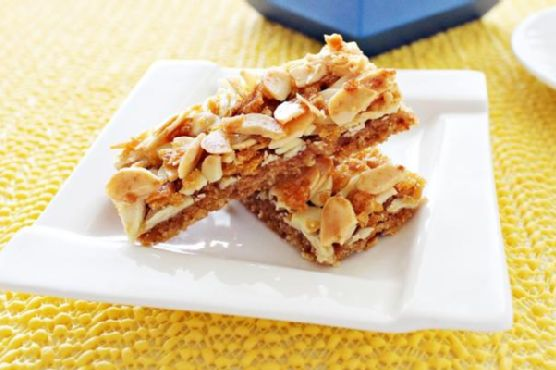
I remember one of those whirlwind Wednesday evenings, you know the type — when you get home, realize you need something sweet to take to the office the next day, and have approximately no time to do it. Enter these Almond Cookie Bars. They’re like the lovely offspring of a tempting cookie and a sophisticated tart, but they’re actually super simple to make. Just the right amount of nutty crunch meets a hint of sweet apricot. Plus, they look kind of fancy for something that doesn’t require any complicated steps. Seriously, if I can pull these off during a midweek scramble, you can too!
Jump to Recipe
What You’ll Need
Chances are you already have most of this at home, except maybe the almond flakes. The rest? Probably hanging out in your pantry or fridge.
- 100g butter, softened
- 50g brown sugar
- 70g plain flour
- 70g wholemeal flour
- 2 tbsp fresh milk
- 100g oatmeal cornflakes
- 50g almond flakes
- 100g apricot gel/jam
- 400g cookie base
How to Make Almond Cookie Bar
- Start by beating the butter and brown sugar together until the mixture is light and fluffy. This should take about 2 minutes with an electric mixer — it’s all about that creamy texture.
- In a separate bowl, combine the plain flour and wholemeal flour. Then, gently fold this dry mixture into the butter-sugar mixture using a rubber spatula. Knead it gently until you have a soft dough.
- Turn the dough out onto a floured surface or sandwich it between two plastic sheets (trust me, it’s less messy!). Roll it into a square shape and chill it for at least an hour. This helps the dough firm up for easier handling.
- Once chilled, place the dough on non-stick paper and roll it out to about 3mm thick. Prick all over with a fork—this keeps it from puffing up in weird places.
- Bake in a preheated oven at 180°C for about 15-18 minutes, or until the edges are just turning brown and the kitchen smells like buttery heaven. Set aside to cool.
- Once the biscuit base is cool, spread the apricot gel/jam over the top, ensuring an even layer.
- Mix the oatmeal cornflakes and almond flakes. Spread this topping evenly over the apricot layer using a palette knife, pressing down gently.
- Return the whole thing to the oven and bake for another 15 minutes until the topping is golden and fragrant. Let it cool completely before cutting into bars — patience is key here for neat slices!
Cook’s Notes
These bars are pretty forgiving, but here’s what I’ve learned along the way:
- Make sure your butter is truly softened, not melted. This affects the dough texture and baking consistency.
- Chilling the dough isn’t optional — it helps prevent spreading and keeps your bars nice and thick.
- You can store these in an airtight container for up to a week, but let’s be real, they probably won’t last that long. They also freeze well for longer storage.
- For a quick fix, you can even make the dough a day ahead and leave it in the fridge overnight.
Make It Your Own
Want to switch things up? Here are a few variations to keep things interesting:
- Berry Swap: Substitute the apricot gel with raspberry or blackberry jam for a different fruity twist.
- Nutty Overload: Add a handful of chopped pecans or walnuts to the almond-oat topping for extra crunch.
- Spice It Up: Stir a teaspoon of cinnamon or cardamom into the flour mixture for a warm spice note.
- Chocolate Drizzle: Once cooled, drizzle with melted dark chocolate for a fancy finish.
If you try this, I’d love to hear how it turns out — drop a comment or tag me! These bars have become a staple in my sweet treat rotation, and I hope they bring a little almond-y joy to your day too.
Related update: Almond Cookie Bar
Related update: Christmas Fruit Cake