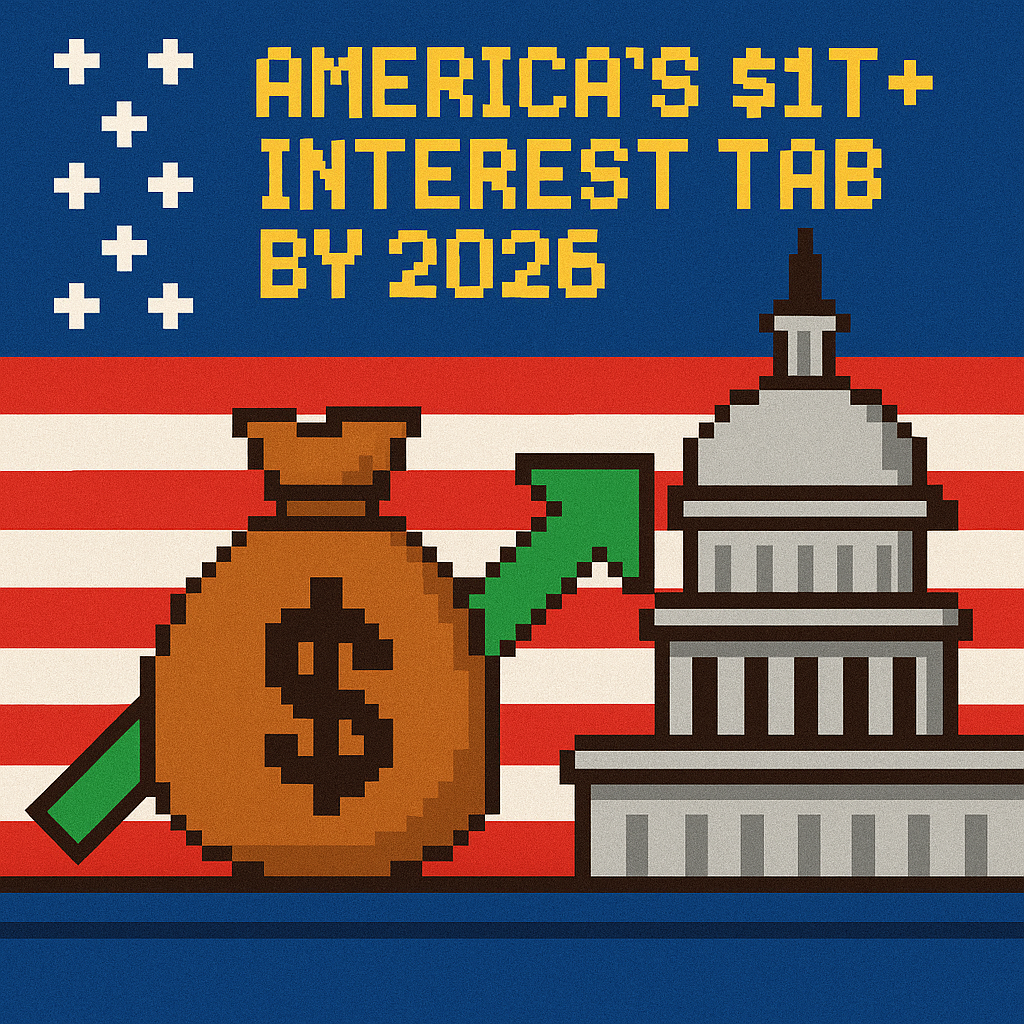
America’s $1T+ Interest Tab by 2026 | Analysis by Brian Moineau

TL;DR

  • Bessent’s Treasury is borrowing at a clip that makes net interest the fastest-growing federal bill, now bigger than year‑to‑date defense outlays—and taxpayers are already footing it [2].
  • The real squeeze isn’t “debt apocalypse”; it’s financing mechanics: coupon sizes are frozen into 2026, pushing a refinancing wave into 2027 when rates may still be sticky [3][4].
  • Back‑of‑envelope: if 9‑month net interest is $857B, FY2026 likely tops ~$1.14T—about $8.5K per U.S. household—before any new programs, tax cuts, or wars enter the chat [2][10].

What the source said

TheStreet’s piece argues the “troubling news for every taxpayer” is the interest bill itself and points to the CBO’s June 2026 Monthly Budget Review showing a $1.4 trillion deficit for the first nine months of the fiscal year and $857 billion in net interest, roughly $23.8 billion a week and up 13% year over year [1][2]. It notes that total federal debt is near $39.4 trillion and that year‑to‑date net interest has surpassed defense spending in the same period [1][2]. The article references CRFB’s warning that full‑year borrowing could exceed $2 trillion and cites longer‑term CBO projections showing interest costs roughly doubling by 2036, with Social Security’s OASI trust fund projected to hit insolvency in 2032 if laws remain unchanged [1][7][8].

Why it matters

Stakeholders aren’t abstract “taxpayers”; they’re workers whose FICA payroll taxes fund Medicare and Social Security, retirees whose checks depend on the OASI and DI trust funds, and households facing higher “interest taxes” in the form of rising federal carry costs each year [2][8]. The CBO ledger for FY2026 to date shows interest already outruns discretionary fights over EPA, Education, or Commerce; those culture‑war skirmishes won’t reclaim real money if the interest line keeps compounding at a double‑digit clip [2].

Markets, too, have agency. Primary dealers and bond funds absorb the supply that Bessent’s team ships each week via bills, notes, and bonds, and TBAC minutes indicate dealers expect larger coupon auctions in early 2027 [3]. That means price risk today and term‑premia tomorrow, with the bill landing in the public’s lap via higher interest outlays that crowd out choices elsewhere, including discretionary spending in FY2027–2028 [3][6].

Original analysis

  • Back‑of‑envelope math

    • Nine months into FY2026, net interest totals $857B. Annualizing: $857B ÷ 9 × 12 ≈ $1.142T for the full year (directionally conservative if rates or issuance tick up) [2].
    • Households: FRED shows ~134.79 million U.S. households in 2025. $1.142T ÷ 134.79M ≈ $8,470 per household in FY2026—pure carry cost, not new services [10].
  • Contrarian read

    • Consensus: “Debt is unsustainable; immediate austerity or crisis is inevitable.”
    • Counter: Over the next 12 months, the binding constraint is issuance plumbing, not instant insolvency. Treasury said it will keep note/bond auction sizes steady for “several more quarters,” even as TBAC’s discussion flags a ~$1.3 trillion funding shortfall over FY2027–2028 if current sizes persist [3][4]. Translation: the tough part got kicked into 2027, when terming out becomes unavoidable—and if 10‑year yields stay elevated, coupons will reset higher right as more supply arrives [3][4].
  • A named‑stakeholder breakdown

    • Scott Bessent, Treasury Secretary: He is selling into a rising‑rate, deficit‑heavy backdrop with limited levers beyond maturity mix, buybacks timing, and messaging that calms dealers; his “financial literacy” push won’t bend the interest curve, but execution on issuance strategy will [5][6].
    • TBAC (Treasury Borrowing Advisory Committee): Its May 2026 minutes telegraphed that dealers expect larger coupon sizes early 2027; if realized, that locks in more high‑coupon debt and lifts interest costs structurally into the 2030s [3].
    • CBO: It just printed the scoreboard—$1.4T nine‑month deficit, $857B net interest, and interest > defense year‑to‑date; its 10‑year baseline has net interest jumping from roughly $1.0T in 2026 to about $2.1T by 2036 at 4.6% of GDP, surpassing prior peaks [2][8].
    • CRFB (Maya MacGuineas): The outside push to keep borrowing under roughly $2T in FY2026 sharpens the political choice—trim now or accept higher carry costs in 2027–2028 [7].
  • Historical analogue

    • In the early 1990s, net interest peaked near about 3.2% of GDP and then ebbed as growth and falling yields did the heavy lifting from 1992 through 2000; CBO now projects roughly 3.3% in 2026 rising toward 4.6% by 2036 [8][9]. The 1990s playbook—grow out and refinance down—rode a secular disinflation tailwind; today’s baseline bakes in higher average rates, so the “grow and roll” cushion is thinner [8][9].
  • A simple 2×2: rates path vs. issuance mix

    • High rates + bill‑heavy: Best near‑term auctions, worst pass‑through to interest costs; FY2027 refi pain rises.
    • High rates + term‑out now: Higher coupons today, but reduced refi risk if the Fed eases late.
    • Lower rates + bill‑heavy: Wins everywhere; but you must be lucky on timing.
    • Lower rates + term‑out: Overpays briefly, but stabilizes carry; the conservative CFO’s choice.

Treasury’s current stance—hold coupons steady and lean on bills—prioritizes auction smoothness over long‑run carry, which assumes demand for U.S. duration remains adequate and disinflation continues through 2026 [3][4][6]. If that assumption fails and 10‑year yields hover near recent highs into 2027, taxpayers inherit a bigger, stickier interest bill for years [3][8].

What others are missing

Coverage fixates on the deficit topline. The subtler story is the composition shift underneath: CBO category tables show corporate income tax receipts down about 24% year‑to‑date versus last year due to 2025 law changes that boosted deductions, while individual/payroll taxes carried more weight until a February 2026 court ruling triggered roughly $70 billion in customs refunds that hit net tariff revenue [2]. That cocktail tilts financing toward bills and away from locking in term even as net interest outlays climb 13% year over year through June 2026, raising rollover risk into the 2027 refunding window [2][3].

What to watch next

  1. By September 30, 2026, net interest outlays reported in the Monthly Treasury Statement will exceed $1.12 trillion for FY2026 [2].
  2. By the February 2027 Quarterly Refunding, Treasury will announce increases to nominal coupon auction sizes (at least the 2‑year and 5‑year tenors), reversing 2026’s “steady for several quarters” guidance [3][4].
  3. By June 2027, CBO’s Monthly Budget Review will show corporate income tax receipts at least 15% below the same period two years earlier (June 2025), keeping pressure on bill issuance and net interest [2].

My take

If I ran Bessent’s Treasury, I’d front‑load some pain in 2026—nudge up coupons and lengthen maturities while market depth is intact—rather than gamble on a perfect 2027 [3][4]. The CBO scoreboard says interest is already outrunning defense, and the TBAC roadmap says the real refinance hit is coming within four quarters; trim the bill share, accept a few ugly auctions now, and buy rate insurance before the economy proves sticky [2][3][8]. Pair that with a modest, bipartisan PAYGO rule so new tax cuts or credits don’t feed the interest line. Otherwise households are staring at an $8K‑plus annual “interest tax” with nothing to show for it in FY2026–2027 [2][10].

Sources

  1. Bessent’s Treasury has troubling news for every taxpayer — TheStreet (https://www.thestreet.com/taxes/bessents-treasury-has-troubling-news-for-every-taxpayer) — Frames net interest as the taxpayer’s real bill and cites up‑to‑date deficit and debt figures.
  2. Monthly Budget Review: June 2026 — Congressional Budget Office (https://www.cbo.gov/system/files/2026-07/61982-MBR.pdf) — Confirms $1.4T nine‑month deficit, $857B net interest (up 13% YoY), and interest outlays surpassing defense year‑to‑date.
  3. Minutes of the Meeting of the Treasury Borrowing Advisory Committee, May 5, 2026 — U.S. Treasury (https://home.treasury.gov/news/press-releases/sb0491) — Details dealer expectations for 2027 coupon size increases and a ~$1.3T funding gap under current sizes.
  4. U.S. Treasury keeps auction sizes steady; dealers expect change in early 2027 — Kitco News (https://www.kitco.com/news/off-the-wire/2026-05-06/us-treasury-keeps-auction-sizes-steady-dealers-expect-change-early) — Reports on Treasury’s “several more quarters” guidance and market positioning.
  5. Bessent wants Americans to avoid easy‑money traps and invest in financial literacy — Washington Post (https://www.washingtonpost.com/business/2026/05/01/bessent-treasury-secretary-profile/) — Profiles Scott Bessent’s agenda and public messaging constraints.
  6. Bessent Has Limited Options to Halt Climb in Treasury Yields — Bloomberg News (https://news.bloomberglaw.com/capital-markets/bessent-has-limited-options-to-halt-climb-in-treasury-yields) — Explains rising yields and the narrow toolkit Treasury has to influence them.
  7. CBO Estimates FY 2026 Deficit Overtakes 2025, Totals $1.4 Trillion — CRFB (https://www.crfb.org/press-releases/cbo-estimates-fy-2026-deficit-overtakes-2025-totals-14-trillion) — Provides outside analysis warning FY2026 borrowing may exceed $2T.
  8. Director’s Statement on the Budget and Economic Outlook: 2026–2036 — CBO (https://www.cbo.gov/publication/62050) — Projects net interest rising from ≈$1.0T in 2026 to ≈$2.1T by 2036, from 3.3% to 4.6% of GDP.
  9. An Update on the Federal Budget Outlook (March 2026) — Brookings/TPC (https://www.brookings.edu/wp-content/uploads/2026/03/20260311_TPC_GaleAuerbach_FiscalOutlook_FINAL1.pdf) — Notes the prior historical peak of net interest at ≈3.2% of GDP in the early 1990s.
  10. Total Households (TTLHH) — FRED, St. Louis Fed (https://fred.stlouisfed.org/series/TTLHH/) — Supplies the ≈134.79 million household count used for per‑household cost estimates.


Related update: We recently published an article that expands on this topic: read the latest post.

Related update: We recently published an article that expands on this topic: read the latest post.

Bessent Reaffirms Strong Dollar, Markets | Analysis by Brian Moineau

When the dollar steadied: why Scott Bessent’s “strong dollar” line mattered more than you might think

The dollar had been wobbling — flirting with multi-month lows and stirring talk that Washington might be quietly propping up other currencies. Then U.S. Treasury Secretary Scott Bessent went on CNBC and said two short, decisive things: “Absolutely not” when asked if the U.S. was intervening to buy yen, and reiterated that the administration pursues a “strong dollar policy.” Markets perked up. The greenback bounced. Headlines followed.

This felt, in microcosm, like a lesson in how words from policy-makers can move markets as effectively as trades.

What happened (the quick story)

  • Late January 2026: the yen had strengthened from earlier weakness and speculation spread that Japan and the U.S. might be coordinating intervention to support the yen.
  • On January 28, Treasury Secretary Scott Bessent told CNBC the U.S. was “absolutely not” intervening to buy yen and reiterated a strong dollar policy.
  • The dollar rallied off recent lows after his comments; the yen slipped back, and markets interpreted the remarks as a reassurance that Washington was not trying to engineer a weaker dollar via intervention.

Why that line—“strong dollar policy”—matters

  • A “strong dollar policy” is shorthand for favoring market-determined exchange rates, sound fiscal and monetary fundamentals, and resisting competitive devaluations or direct intervention to manipulate exchange rates.
  • For global markets, it signals the U.S. won’t be an active buyer of other currencies to prop them up, which matters particularly for countries like Japan where swings in the yen can have outsized effects on inflation and corporate margins.
  • Policy credibility is as important as policy itself: when a Treasury secretary publicly denies intervention, traders often take it as evidence that large-scale official flows aren’t coming — and prices adjust quickly.

The broader backdrop

  • Tensions over currency moves have been building for months. Japan has publicly worried about a “one-sided” depreciation of the yen, and Tokyo has signaled readiness to intervene if moves threaten stability.
  • U.S. political rhetoric has been mixed: President Trump’s comments in recent weeks — saying the dollar is “great” while also showing tolerance for a weaker dollar historically — left some ambiguity. Markets sniff around any hint of policy shifts, and uncertainty can quickly amplify currency moves.
  • Against that geopolitical and macro backdrop, Bessent’s clear denial functioned as a stabilizer: not because it changed fundamentals overnight, but because it reduced the probability assigned by traders to coordinated, official intervention.

What traders and investors should care about

  • Short-term volatility can still spike. A denial reduces one tail risk (coordinated intervention), but it doesn’t eliminate other drivers: differing interest-rate paths, U.S. growth surprises, Japanese policy moves, and flows into safe-haven assets all matter.
  • Policy wording matters. The phrase “strong dollar policy” is deliberately flexible. Officials can point to “fundamentals” and structural reforms as the path to a stronger currency — not necessarily market meddling.
  • Watch Japan closely. Tokyo has both motivation and tools to act if the yen’s moves threaten domestic price stability. Even without U.S. participation, Japanese intervention — single-country FX intervention or domestic measures — can still move markets.

How the market reacted (the anatomy of a rebound)

  • Immediate reaction: the dollar index climbed from a recent low and the yen fell about 1% against the dollar after Bessent’s interview. That’s a typical intraday renewal of risk-off/risk-on positioning being reversed by a high-profile denial.
  • Medium-term: such comments can shave volatility expectations and reduce speculative positioning premised on official cooperation. But they don’t alter the structural story: slower U.S. dollar momentum or a stronger yen could return if macro drivers shift.

My take

There’s a theater to modern currency policymaking where words, reputation and expectations often move markets faster than actual central bank or treasury transactions. Bessent’s clarity mattered because markets had been pricing in a chance of official support for the yen; by taking that off the table, he removed a source of uncertainty. But this didn’t change the underlying tug-of-war between U.S. growth prospects, Fed policy expectations, and Japan’s domestic pressures. Expect intermittent fireworks — especially around macro prints and any fresh comments from Tokyo.

Notes for different readers

  • For currency traders: price in the possibility of Japanese-only moves and monitor verbal cues from both Tokyo and Washington closely.
  • For corporate treasurers and importers/exporters: hedge plans should reflect that official U.S. support for other currencies is unlikely; hedging remains the primary shield against FX risk.
  • For long-term investors: narrative shifts (strong dollar vs. weaker dollar) matter for allocations to global equities and commodities; watch policy consistency more than single remarks.

Sources

Final thought: markets crave certainty. In FX, certainty is often ephemeral. Clear, credible messaging from policymakers can buy time — but it can’t permanently substitute for economic fundamentals.


Related update: We recently published an article that expands on this topic: read the latest post.


Related update: We recently published an article that expands on this topic: read the latest post.


Related update: We recently published an article that expands on this topic: read the latest post.

FSOC Reset: Deregulation for Growth | Analysis by Brian Moineau

A watchdog reborn for growth: What Scott Bessent’s FSOC reset means for markets and regulators

A policy about protecting the financial system just got a makeover. When Treasury Secretary Scott Bessent told the Financial Stability Oversight Council (FSOC) to stop thinking “prophylactically” and start hunting for rules that choke growth, the room changed from risk-management to rule‑rewriting. That pivot — part managerial, part ideological — will ripple across banks, fintech, investors and anyone who cares how Washington balances safety and dynamism.

Quick takeaways

  • Bessent has directed FSOC to prioritize economic growth and target regulations that impose “undue burdens,” signaling a clear deregulatory tilt.
  • The council will form working groups on market resilience, household resilience, and the effects of artificial intelligence on finance.
  • Supporters say loosening unnecessary rules can revive credit flow and innovation; critics warn that weakening post‑2008 safeguards risks rekindling systemic vulnerabilities.
  • Practical effects will depend on how FSOC’s new priorities influence independent regulators (Fed, SEC, OCC, CFPB) and whether Congress or courts push back.

Why this matters now

FSOC was born from the 2008 crisis under the Dodd‑Frank framework to sniff out risks that cross institutions or markets. For nearly two decades the accepted default for many regulators has been: better safe than sorry — build buffers, tighten oversight, and prevent contagion before it starts.

Bessent is asking the council to change the default. In a letter accompanying FSOC’s annual report (December 11, 2025), he framed overregulation as a stability risk in its own right — arguing that rules that slow growth, limit credit or choke technological adoption can produce stagnation that undermines resilience. He wants FSOC to spotlight where rules are excessive or duplicative and to shepherd work that reduces those burdens, including in emerging areas such as AI. (politico.com)

That’s a big philosophical and operational shift. Instead of primarily preventing tail risks (a “prophylactic” posture), FSOC will add an explicit mission: identify regulatory frictions that constrain growth and recommend easing them.

What the new FSOC playbook looks like

  • Recenter mission: Treat economic growth and household well‑being as core inputs to stability, not as tradeoffs. (home.treasury.gov)
  • Working groups: Create specialized teams for market resilience, household financial resilience (credit, housing), and AI’s role in finance. These groups will evaluate where policy might be recalibrated. (reuters.com)
  • “Undue burden” lens: Systematically review rules for duplication, cost‑benefit imbalance, or barriers to innovation — and highlight candidates for rollback or harmonization. (apnews.com)

What's at stake — the upside and the downside

  • Upside:

    • Faster capital flow and potential credit expansion if unnecessary frictions are removed.
    • More rapid adoption of financial technology (including AI) that could improve services and lower costs.
    • Reduced compliance costs for smaller banks and nonbank financial firms that often bear disproportionate burdens. (mpamag.com)
  • Downside:

    • Diminished guardrails could increase systemic risk if stress scenarios are underestimated or regulations that prevented contagion are untethered. Critics point to recent corporate bankruptcies and market stress as reasons to be cautious. (apnews.com)
    • FSOC’s influence is largely convening and coordinating; it cannot unilaterally rewrite rules. The real test will be whether independent agencies adopt the new tone or resist.
    • Political and legal pushback is likely from consumer‑protection advocates, some Democrats in Congress, and watchdog groups who argue loosened rules will favor financial firms at consumers’ expense. (politico.com)

How markets and stakeholders will likely respond

  • Big banks and fintech: Encouraged. They’ll press for reduced compliance burdens and clearer pathways for novel products (AI models, alternative credit scoring).
  • Regional/community banks: Mixed. Lower compliance costs could help, but loosening supervision can also allow larger firms to expand risky products that affect smaller lenders indirectly.
  • Consumer advocates and progressive lawmakers: Vocal opposition, emphasizing consumer protections, transparency, and stress‑test rigor.
  • Investors: Watchful. Market participants tend to welcome pro‑growth signals but will price in increased tail‑risk if oversight is perceived as weakened.

The real constraint: FSOC’s powers and the regulatory ecosystem

FSOC chairs and convenes — it doesn’t replace independent regulators. The Fed, SEC, OCC and CFPB set and enforce many of the rules Bessent has in mind. That means:

  • FSOC can recommend, coordinate, and spotlight problem areas; it can’t, by itself, decree deregulation.
  • The policy route will often run through agency rulemakings, litigation, and Congress — all places where the deregulatory push can be slowed, shaped, or blocked. (reuters.com)

Put simply: this is a strategic reorientation more than an instant policy rewrite. Its potency depends on persuasion and leverage across the regulatory web.

My take

There’s a reasonable middle path here. Financial rules that are genuinely duplicative or outdated deserve scrutiny — especially where technology has changed how services are delivered. Yet dismantling prophylactic measures wholesale risks repeating a painful lesson: stability is often the fruit of constraints that look costly in calm times.

The best outcome would be surgical reform: use FSOC’s platform to clean up inefficiencies, increase transparency, and direct agencies to modernize rules — while preserving the stress‑testing, capital, and resolution tools that limit contagion. The danger is rhetorical: calling prophylaxis “burdensome” can become a pretext for rolling back protections that matter when markets turn.

Final thoughts

Bessent’s reset reframes a central policy debate: is stability best secured primarily by stricter rules or by stronger growth? The answer isn’t binary. Markets thrive when rules are sensible, targeted, and adapted to new technologies — but don’t disappear when they make mistakes. Over the coming months expect vigorous fights over concrete rulemakings, not just rhetoric. How FSOC translates this new mission into action will tell us whether this shift produces smarter regulation — or just a lighter touch at the expense of resilience.

Sources


Related update: We recently published an article that expands on this topic: read the latest post.


Related update: We recently published an article that expands on this topic: read the latest post.

Treasury Secretary Busts ‘Alarmist’ Inflation Predictions – The Daily Wire | Analysis by Brian Moineau

Treasury Secretary Busts ‘Alarmist’ Inflation Predictions - The Daily Wire | Analysis by Brian Moineau

Inflation and Tariffs: A Tale of Predictions and Reality

In a recent episode of CBS's "Face the Nation," Treasury Secretary Scott Bessent engaged in a lively discussion with journalist Margaret Brennan about the potential inflationary consequences of President Donald Trump's tariffs. Brennan, channeling the concerns of many economic analysts, suggested that these tariffs could lead to significant inflation. Bessent, however, dismissed these concerns as "alarmist," arguing that the current economic indicators do not support such dire predictions.

The Tariff Tango

To understand this debate, it's essential to take a step back and examine the broader context of tariffs. Tariffs, essentially taxes on imports, are designed to protect domestic industries by making foreign goods more expensive. While this can benefit local producers, it often leads to higher prices for consumers, raising concerns about inflation.

President Trump's tariffs, particularly those targeting China, were part of a broader strategy to renegotiate trade terms and encourage American manufacturing. Critics have argued that such measures could lead to increased costs for consumers, potentially fueling inflation.

A Historical Perspective

This isn't the first time tariffs have sparked debate over their economic impact. The Smoot-Hawley Tariff Act of 1930, for instance, is often cited in economic circles as a cautionary tale. Implemented during the Great Depression, these tariffs led to a decrease in international trade and are believed by some historians to have exacerbated the economic downturn.

However, fast forward to the present day, and the situation is vastly different. The global economy is more interconnected, and the dynamics of trade have evolved. This is where Bessent's dismissal of inflation fears comes into play. He argues that the current U.S. economy is robust enough to absorb these tariffs without spiraling into inflation.

Connecting the Dots

The debate over tariffs and inflation is not happening in a vacuum. Globally, economies are grappling with various challenges, from the ongoing impacts of the COVID-19 pandemic to geopolitical tensions. For example, the European Union has been dealing with its own set of trade negotiations and tariffs, particularly in the wake of Brexit. The economic ripple effects from these global events contribute to the complexity of predicting inflationary trends.

Scott Bessent: The Man Behind the Treasury Position

Scott Bessent, before taking on the role of Treasury Secretary, was known for his successful tenure as Chief Investment Officer at Soros Fund Management. His expertise in navigating complex financial systems and his strategic foresight have earned him respect in the financial community. Bessent's confidence in dismissing inflation fears likely stems from his deep understanding of market dynamics and economic indicators.

Final Thoughts

While it's impossible to predict the future with certainty, the debate between Brennan and Bessent highlights the importance of examining economic policies from multiple angles. While caution is essential, it's equally crucial to remain grounded in current data and trends. As with many economic discussions, time will be the ultimate judge of whether these "alarmist" predictions come to fruition or if Bessent's confidence in the economy holds steady.

In the end, the conversation about tariffs and inflation serves as a reminder of the delicate balance policymakers must maintain in navigating economic growth and stability. Whether you're a business owner, consumer, or investor, staying informed and adaptable is key in these ever-evolving economic landscapes.

Read more about AI in Business

Read more about Latest Sports Trends

Read more about Technology Innovations

Trump’s tariffs may mean Walmart shoppers pay more, his treasury chief acknowledges – AP News | Analysis by Brian Moineau

Trump’s tariffs may mean Walmart shoppers pay more, his treasury chief acknowledges - AP News | Analysis by Brian Moineau

Title: Tariff Tensions at the Checkout: What Trump's Trade Decisions Mean for Walmart Shoppers

In the ever-evolving arena of international trade, it seems that every decision made at the highest levels can ripple down to the most ordinary places—like the aisles of your local Walmart. Recently, Treasury Secretary Scott Bessent acknowledged that the costs of President Donald Trump's tariffs might soon be felt in the pocketbooks of everyday Americans. His conversation with Walmart, the largest U.S. retailer, highlighted a potential increase in prices as these tariffs take hold.

Why Tariffs Matter to Shoppers

Let's break it down. Tariffs are essentially taxes on imported goods. When a country like the U.S. imposes tariffs, it makes those imported goods more expensive. In theory, this should encourage consumers to buy more domestically-produced products. However, in practice, it often means that companies like Walmart might have to pass some of those additional costs on to shoppers. As Bessent pointed out, this is a real possibility as Walmart navigates the financial implications of these trade policies.

Walmart's Global Footprint

Walmart is not just any retailer; it's a global powerhouse with an intricate supply chain that spans the globe. From electronics to groceries, many of the products lining Walmart's shelves are sourced internationally. This means that tariffs on imports from countries like China could hit Walmart particularly hard, affecting everything from the price of avocados to the latest tech gadgets.

A Step Back in Time: Trade Wars and Their Consequences

The notion of using tariffs as a tool for economic strategy is far from new. History has shown us varying results. For instance, the Smoot-Hawley Tariff Act of 1930 is often cited as a contributing factor to the Great Depression. While the context today is different, it serves as a reminder of the potential ramifications of trade wars.

Connecting the Dots: Global Trade Tensions

While Walmart shoppers might be concerned about their grocery bills, the broader implications of these tariffs are being felt worldwide. Countries retaliate with their own tariffs, leading to a domino effect that affects global markets. It's not just about the price of a toy at Walmart; it's about how nations are jockeying for economic advantage in an increasingly interconnected world.

Scott Bessent: The Man Behind the Acknowledgment

Scott Bessent, stepping into the role of Treasury Secretary, brings a wealth of experience from both the public and private sectors. Known for his analytical skills and understanding of complex economic systems, Bessent is no stranger to the challenges of navigating international trade. His acknowledgment of the potential impact on Walmart shoppers shows a pragmatic approach to addressing the economic realities of tariff policies.

Final Thoughts

As we navigate these choppy economic waters, it's crucial to remember the interconnectedness of global trade and local economies. While tariffs may aim to bolster domestic industries, the immediate impact on consumers cannot be ignored. As shoppers, staying informed and adaptable is key. Whether it's choosing to support local businesses or adjusting shopping habits, every choice contributes to the broader economic tapestry.

In the end, it's a reminder that while the decisions made in the corridors of power may seem distant, their effects are as close as the local Walmart checkout line. As we move forward, the balancing act of protecting domestic interests while managing global relationships will continue to define the economic narrative.

Read more about AI in Business

Read more about Latest Sports Trends

Read more about Technology Innovations