
China Frenzy Sparks Silver Market Meltdown | Analysis by Brian Moineau

When silver forgot the rules: how a China-fueled frenzy blew the top off precious metals

The screens went white. For weeks, traders had been riding one of the most aggressive precious‑metals rallies in decades — then in less than twenty hours silver gave back roughly $40 an ounce and plunged in a way few had seen before. That violent reversal exposed how a cocktail of Chinese retail speculation, strained physical markets and technical safeguards (margins, algorithms, exchange rules) can turn a smoke‑and‑mirrors rally into a sudden market unwind.

Below I unpack what happened, why it got so extreme, and what investors should keep in mind going forward.

How the rally got out of hand

  • Parabolic move first. Silver staged an extraordinary rally through 2025 and into January 2026, propelled by a mix of industrial demand, geopolitical fears and speculative momentum. What starts as rational buying (industry, ETFs, central‑bank flows) can become self‑reinforcing when retail and leveraged players pile in. (Think: more buyers, less paper required per contract, and an expectation that prices only go up.) (m.economictimes.com)

  • A big Chinese footprint. Chinese traders and retail platforms played an outsized role in the surge. Heavy retail participation in China — often through leveraged products and exchange‑linked accounts — amplified volatility and expanded the “paper” exposure to silver beyond what physical supply could cover. When that speculative flow begins to reverse, the effect is amplified. (businessinsider.com)

  • Physical vs. paper stress. Tight physical inventories and frictions in cross‑border flows made the market fragile. When buyers started demanding physical delivery or when exporters tightened exports, the disconnect between the futures (paper) market and actual bullion intensified. That mismatch can sustain rallies — but it also primes the market for violent corrections if leveraged holders are forced to liquidate. (thestreet.com)

  • Margin hikes and forced selling. Exchanges (notably CME) raised margin requirements as volatility surged. Higher margins squeezed leveraged traders and funds, forcing rapid sell orders into already thin markets — a mechanical feedback loop that turned a correction into a crash. (thestreet.com)

  • Macro news as the spark. A shift in macro expectations — for example, a hawkish signal on U.S. monetary policy — strengthened the U.S. dollar and reduced the appeal of non‑yielding assets like gold and silver. That change in sentiment provided the trigger that turned fragile positioning into mass liquidation. (ft.com)

Why this felt different from past pullbacks

  • Speed and leverage. The crash happened faster than many historic drops because leverage today is higher and execution is electronic. Automated systems, program trading and margin‑sensitive accounts can force outsized flows in minutes rather than days.

  • China’s policy layer. Recent Chinese moves affecting metals exports and trading channels added a nation‑level source of uncertainty. That made liquidity in global physical markets more brittle and increased the chance that local Chinese flows would have outsized global effects. (astreka.com)

  • Cross‑market contagion. Silver’s drop didn’t happen in isolation — other industrial metals and gold were affected too. Where previously commodities could absorb shocks, the breadth of positioning (and the prevalence of leveraged retail exposure) made the systemwide reaction sharper. (ft.com)

Lessons for investors and traders

  • What matters more than you think: market plumbing. Supply and demand fundamentals matter — but so do margin rules, exchange interventions, delivery mechanics and who holds the risk. In leveraged, thinly‑liquid markets these mechanics can dominate fundamentals for a while.

  • Know your counterparty risk and leverage exposure. Retail platforms that offer cheap leverage can create asymmetric risks for clients. When you’re long with high leverage, even a small policy or macro surprise becomes dangerous.

  • Distinguish physical from paper exposure. Owning a bar in a vault and owning a futures contract are different bets. When the paper‑to‑physical ratio becomes extreme, prices can diverge quickly and painfully.

  • Expect whipsaw conditions around policy news. Monetary and geopolitical headlines can flip the narrative quickly. Position sizing and stop‑loss discipline aren’t optional in these markets.

What to remember

  • The January 2026 crash was a structural warning: rapid, leveraged flows from China plus strained physical markets and margin hikes equal the recipe for explosive reversals. (businessinsider.com)

  • Margin rules and exchange interventions can be the market’s circuit breakers — and sometimes the accelerants. (thestreet.com)

  • Ownership matters: physical metal, ETFs, futures and leveraged retail products behave differently in stress. (thestreet.com)

My take

We’ve been through narrative cycles before — short squeezes, retail mania, and commodity panics — but the 2025–2026 episode highlights how globalization and digitization of trading magnify those dynamics. Speculation in one major market (China) can now ripple through exchanges and vaults worldwide in a single trading session. For disciplined investors, that means re‑anchoring strategies to fundamentals, minding leverage, and treating liquidity risk as a first‑class concern.

For traders who thrive on volatility, this environment offers opportunity — but only if you respect the mechanics that turned a rally into a rout. For institutions and regulators, it’s a reminder that market structure evolves and that safeguards (margins, position limits, clearer delivery rules) must keep pace.

Sources


Related update: We recently published an article that expands on this topic: read the latest post.


Related update: We recently published an article that expands on this topic: read the latest post.

Chocolate Orange Madeleines | Made by Meaghan Moineau

Chocolate Orange Madeleines

Intro

Ah, the aroma of freshly baked Madeleines! It takes me back to Sunday mornings at my grandmother’s house, where the comforting scent of chocolate and citrus wafted through the air. These Chocolate Orange Madeleines are a cherished twist on the classic French treat that my grandmother used to make. With every bite, I’m reminded of those carefree days spent in her cozy kitchen, eagerly waiting for the Madeleines to cool just enough to dip into a glass of milk. Now, I want to share this delightful recipe with you, so you can create your own warm memories with your loved ones.

Why You’ll Love It

These Chocolate Orange Madeleines are a perfect combination of flavors and textures. The subtle citrus from the orange zest and juice complements the rich, dark chocolate beautifully. The madeleines are light and airy, with a delicate crumb that melts in your mouth. Plus, they’re dipped in melted chocolate for an extra touch of indulgence. Whether you’re an experienced baker or a novice, you’ll find this recipe both rewarding and straightforward. They’re great for special occasions or just a sweet afternoon treat with a cup of tea.

Ingredients

  • 1 cup all-purpose flour
  • 1 teaspoon baking powder
  • 1/4 teaspoon sea salt
  • 1/2 cup dark chocolate, melted
  • 2 large eggs
  • 1/2 cup granulated sugar
  • 2 tablespoons orange juice
  • 1 tablespoon orange zest

Instructions

  1. Preheat the oven to 374°F (190°C). Generously grease and liberally flour a madeleine cookie tin.
  2. In a small bowl, combine the flour, baking powder, and sea salt. Whisk together and set aside.
  3. In a medium bowl, beat the sugar and eggs on medium/high speed until the volume triples in size. This may take several minutes, and you should have a beautiful thick ‘ribbon’ of batter when you lift the beaters out of the bowl.
  4. Stir in the orange juice and orange zest.
  5. Beginning with the flour mixture, alternate adding to the egg/sugar batter with the melted butter. Mix only until just combined.
  6. Refrigerate the batter for about 45 minutes to an hour.
  7. Drop by rounded teaspoonfuls into the center of the madeleine molds. Leave the batter mounded; do not spread it out. Adjust the amount of batter depending on your mold size.
  8. Bake for 10-12 minutes or until the edges just start to turn golden and the center of the cookies spring back when lightly touched.
  9. Remove from the oven and immediately tap the tin on the counter to loosen the cookies. Carefully remove the cookies and allow them to cool completely.
  10. Melt the chocolate in a saucepan and pour it into a deep dish or cup with a wide mouth. Dip half or 1/4 of each cookie into the chocolate and place on a piece of parchment paper until the chocolate is set.

Tips

For the best results, make sure your eggs are at room temperature before beating them. This helps them whip up to the right volume. Also, be gentle when folding in the flour to maintain the airiness of the batter. If you don’t have a madeleine pan, mini muffin pans can be a good alternative, though they won’t have the classic shell shape.

Variations & Substitutions

If you’re not a fan of dark chocolate, feel free to substitute it with milk or white chocolate. You could also add a hint of spice by incorporating a pinch of cardamom or cinnamon into the batter. For a nutty twist, sprinkle some finely chopped almonds or pistachios over the chocolate before it sets.

Storage

Store these Chocolate Orange Madeleines in an airtight container at room temperature for up to three days. If you want to keep them longer, you can freeze them for up to a month. Just make sure to place parchment paper between layers to prevent sticking, and allow them to come to room temperature before serving.

FAQ

Can I make these ahead of time?

Yes, you can prepare the batter a day in advance and keep it refrigerated. This makes it even easier to have fresh madeleines whenever you need them.

Do I need a special pan for Madeleines?

While a madeleine pan is ideal for achieving the classic shell shape, you can use a mini muffin tin in a pinch. The texture and taste will remain delightful.

Nutrition

Each madeleine is approximately 90 calories, depending on the exact size and amount of chocolate used. They contain about 4g of fat, 12g of carbohydrates, and 1g of protein each. Perfect for a light indulgence!

Conclusion

Chocolate Orange Madeleines are a delightful treat that combines the best of both worlds: the rich, comforting taste of chocolate with the refreshing zing of orange. Whether you’re making them for a special occasion or just because, they are sure to be a hit. I hope this recipe brings a touch of nostalgia and warmth to your kitchen, just as it does to mine. Happy baking!

Related update: Chocolate Orange Madeleines

Related update: Banana Pudding Cake

Sixers Win Overshadowed by George | Analysis by Brian Moineau

A wild Saturday in Philly: a win that feels secondary to Paul George’s suspension

The Wells Fargo Center celebrated a 25th-anniversary reunion, fans soaked up the nostalgia, and the scoreboard showed a narrow Sixers victory. But by the time the confetti dried, the story that will linger was not the comeback or the reunion — it was the shock of Paul George’s 25-game suspension. For a team trying to build consistency, Saturday’s win suddenly reads like a footnote.

What happened — quick recap

  • The Sixers eked out a late victory against the Pelicans, a game that had its share of tense possessions and clutch moments.
  • Minutes after the final buzzer, news broke that Paul George was suspended 25 games for violating the NBA’s anti-drug policy. George released a statement saying he “made the mistake of taking an improper medication” while seeking treatment for a mental health issue and accepted responsibility. (phillyvoice.com)

Why this matters more than the box score

  • Paul George’s suspension isn’t just the temporary loss of a scorer. He’s a two-way piece who affects matchups, spacing, perimeter defense and late-game lineups.
  • The timing is brutal: it starts now, when the Sixers are jockeying for playoff positioning and when Coach Nick Nurse was just beginning to settle rotation minutes. With trade deadline noise and the regular season’s final stretch approaching, losing 25 games of a veteran wing alters the team’s short-term math. (apnews.com)
  • There’s also a human side: George framed the mistake in the context of mental-health treatment, which complicates the public conversation and the team’s internal support responsibilities. That context matters for public perception, locker-room chemistry, and how the organization responds.

Coach’s read: calm, practical, honest

Nick Nurse’s immediate response was measured: disappointment, sure, but also an emphasis on structure and next-person-up. He confirmed George can still be at the facility and practice, and highlighted names who will get more run — Jordan Barlow, Monte Morris, Miles McBride, Kelly Oubre, and others — while admitting matchups will drive decisions. Nurse’s posture: protect the team’s process and adapt. (phillyvoice.com)

Who steps up (and how big the gap is)

  • Offensive production: George has been averaging double-digit scoring and reliable spacing. Expect more shots and playmaking responsibility to cascade toward Tyrese Maxey and Joel Embiid, with role players asked to make the extra perimeter shots.
  • Defense and wing versatility: George’s ability to guard multiple positions had a direct impact on rotations. That responsibility will be shared among a mix of wings (Oubre, Grimes, Watford) and guards sliding up defensively on tougher matchups.
  • Ball movement and minutes: This is an opportunity to test bench depth — both short-term (cover these 25 games) and long-term (who can be a dependable rotational piece going forward).

The broader franchise calculus

  • Financial wrinkle: The suspension costs George roughly $11–12 million in salary; it also creates a small luxury-tax breathing room for the Sixers. That financial detail may influence front-office thinking ahead of the Feb. 5 trade deadline. (local10.com)
  • Trade deadline implications: With a sizeable chunk of the season without George, Philly might be incentivized to add short-term reinforcements (wing/3-and-D depth) or double-down on internal solutions. Conversely, the front office could choose to stand pat to preserve flexibility later in the season.
  • Team identity question: The Sixers were carving out a newer rhythm under Nurse. Losing a high-IQ veteran like George forces an identity check: do they lean more into Embiid-centric offense, Maxey’s isolation scoring, or a more collective approach?

The media and public conversation

  • Reactions will vary: some will call for leniency given the mental-health context; others will stress the letter of the policy. Public figures and analysts are already picking sides about whether the punishment fits the circumstances. The NBA’s decision to withhold the exact substance leaves room for debate. (nypost.com)

What to watch next (short-term checklist)

  • Who gets consistent minutes at the 2/3 spots over the next 10–15 games.
  • How Tyrese Maxey and Joel Embiid handle increased usage nights (look at assist rate, efficiency, foul trouble).
  • Whether the Sixers make a deadline move to replace wing defense or three-point shooting.
  • The team’s home/road splits during George’s absence — can they maintain seed positioning through chemistry and matchup management?

Perspective and context

This isn’t the first time an NBA season has been reshaped off the court, but it’s a reminder that a roster is both a competitive machine and a human ecosystem. Paul George’s admission that this came during mental-health treatment adds a layer of complexity — accountability is required, yes, but so is support. The Sixers now need to be precise about both: how they win games and how they care for a teammate.

Small set of takeaways

  • Saturday’s win will be remembered more for what happened after the buzzer than the result itself. (phillyvoice.com)
  • Losing George for 25 games creates immediate tactical and rotation gaps on both ends of the floor. (apnews.com)
  • The team’s front office and coaching staff face a compressed timeline to decide whether to plug the hole internally or in the market ahead of the trade deadline. (local10.com)

Final thoughts

Basketball is inherently fragile — a single injury or suspension can flip momentum and narratives overnight. The Sixers have talent and a coach who emphasizes adaptability; they also face a critical run of games that will test their depth and decision-making. If Saturday taught us anything, it’s that wins are still important, but how an organization responds to unexpected personal and structural challenges often defines the season more than any one buzzer-beater.

Sources


Related update: We recently published an article that expands on this topic: read the latest post.


Related update: We recently published an article that expands on this topic: read the latest post.

Cumin and Paprika Rubbed Chicken Drumsticks | Made by Meaghan Moineau

Cumin and Paprika Rubbed Chicken Drumsticks

Intro

There’s something absolutely delightful about the aroma of spices wafting through the kitchen, and this Cumin and Paprika Rubbed Chicken Drumsticks recipe brings back warm, nostalgic memories of family gatherings and weekend dinners. I remember my grandmother preparing a similar dish, where the spicy, earthy scent would fill the house, signaling the delicious feast that awaited us. This recipe is a tribute to those cherished times and is sure to become a favorite in your household too.

Why You’ll Love It

This dish is a perfect blend of simplicity and bold flavors. The cumin and paprika lend a warm, smoky depth to the chicken, while lime juice adds a refreshing tang. It’s a versatile recipe that can be served with a variety of sides, making it a staple in any meal plan. Moreover, the preparation is straightforward and requires minimal ingredients, making it a go-to for busy weeknights or relaxed weekend dinners.

Ingredients

  • 6 skinless chicken drumsticks
  • 2 teaspoons cumin powder
  • 2 teaspoons paprika powder
  • 3 garlic cloves, minced
  • Juice of 1 lime
  • Salt and pepper to taste
  • 1 teaspoon olive oil

Instructions

  1. In a mixing bowl, combine the cumin powder, paprika powder, minced garlic, lime juice, and olive oil. Season with salt and pepper to taste.
  2. Add the chicken drumsticks to the bowl, ensuring they are well coated with the spice mixture. Let them marinate at room temperature for at least 30 minutes.
  3. Preheat your oven to 400°F (200°C). Grease an ovenproof pan with a little olive oil.
  4. Arrange the marinated drumsticks in a single layer in the prepared pan.
  5. Bake in the preheated oven for 15 minutes at 400°F, then reduce the temperature to 300°F (150°C) and continue cooking for another 15 minutes, or until the chicken is almost cooked through.
  6. Turn on the broiler. Place the pan under the broiler and continue to cook the chicken, turning them after about 5 minutes on each side, until they achieve a nice color on both sides.
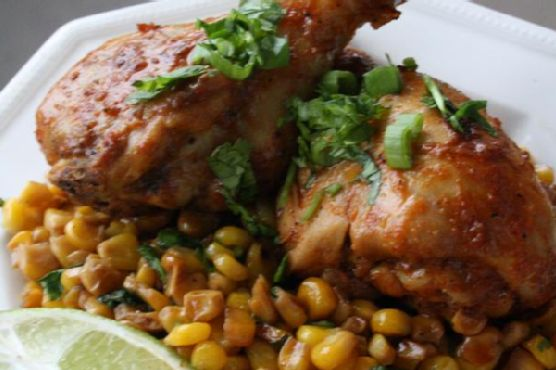
  7. Serve hot, accompanied by sautéed corn with garlic, chili, and green onions, garnished with fresh cilantro and spring onion greens.

Tips

To enhance the flavor, consider marinating the chicken overnight in the refrigerator. This allows the spices to penetrate deeper into the meat. Also, be sure not to overcrowd the pan, as this ensures even cooking and a nice crispy exterior.

Variations & Substitutions

If you prefer a milder flavor, reduce the amount of paprika. For a spicier kick, add a pinch of cayenne pepper to the marinade. You can also substitute chicken thighs or wings for the drumsticks, adjusting the cooking time as necessary. If lime isn’t available, lemon juice can be used as a substitute.

Storage

Store any leftovers in an airtight container in the refrigerator for up to 3 days. Reheat in a preheated oven at 300°F (150°C) until warmed through. You can also freeze the cooked chicken for up to 2 months; thaw in the refrigerator before reheating.

FAQ

Can I use bone-in chicken breasts instead of drumsticks?

Yes, you can use bone-in chicken breasts, but you will need to adjust the cooking time. Bake at 400°F for about 20 minutes, then reduce the heat and continue as directed, ensuring the internal temperature reaches 165°F.

What sides go well with this dish?

Aside from the recommended sautéed corn, this chicken pairs beautifully with roasted vegetables, a fresh green salad, or a simple rice pilaf.

Nutrition

This dish offers a healthy balance of protein and spices, with each drumstick containing approximately 180 calories, 12g of fat, 2g of carbohydrates, and 16g of protein, making it a nutritious choice for a fulfilling meal.

Conclusion

Cumin and Paprika Rubbed Chicken Drumsticks are more than just a meal; they’re a gateway to cherished memories and a testament to the power of simple, fresh ingredients. Whether you’re cooking for family or friends, this dish is sure to impress and become a beloved staple in your recipe collection. Enjoy every bite!

Related update: Cumin and Paprika Rubbed Chicken Drumsticks

Related update: Cheesy Cowboy Quesadillas

Oven Roasted Pears With Blackberry Sauce | Made by Meaghan Moineau

Oven Roasted Pears With Blackberry Sauce

Introduction

There’s something magical about the combination of ripe pears and vibrant blackberries, especially when they come together in a warm, comforting dish like Oven Roasted Pears With Blackberry Sauce. This recipe takes me back to my grandmother’s cozy kitchen, where I spent countless afternoons learning the art of dessert making. I vividly remember the sweet, fruity aroma that filled the air each time we roasted pears together, and the way she would tell stories of her childhood as we waited for the dessert to finish. Today, I am thrilled to share this cherished recipe with you, hoping it brings as much joy and warmth to your home as it does to mine.

Why You’ll Love It

This dish is a celebration of flavors and textures. The tender, caramelized pears contrast beautifully with the tangy blackberry sauce, while the crisp meringue kisses add a playful crunch. It’s an elegant dessert that’s surprisingly easy to prepare, making it perfect for both special occasions and casual gatherings. Whether you’re a seasoned cook or a beginner, you’ll appreciate the straightforward steps and the impressive, restaurant-quality result.

Ingredients

  • 4 ripe pears
  • 4 tablespoons unsalted butter
  • 3 1/2 cups fresh blackberries
  • 1/4 cup powdered sugar
  • Juice from 1 lemon
  • 1/2 cup granulated sugar
  • 2 tablespoons confectioners’ sugar
  • 2 ounces bittersweet chocolate
  • 1/4 teaspoon cream of tartar
  • 3 large egg whites

Instructions

  1. Pre-heat the oven to 450 degrees Fahrenheit.
  2. Prepare the pears: Peel, core, and quarter the pears. Melt the butter in a large casserole or baking dish. Add the pears and cook over high heat for about ten minutes or until the pears are golden brown, stirring regularly to ensure even coloring.
  3. Roast the pears: Transfer the dish to the oven and roast for 7-10 minutes until the pears are easily pierced with a knife. Remove the pears from the oven, transfer to a bowl, and let them cool to room temperature.
  4. Prepare the blackberry sauce: Wash and dry the blackberries. Reserve 1/2 cup for garnish. In a food processor, puree the remaining blackberries with powdered sugar and lemon juice. Pour the puree into a bowl and set aside.
  5. Pre-heat the oven to 275 degrees Fahrenheit.
  6. Prepare the meringue kisses: Line a sheet pan with a silpat mat or parchment paper sprayed with cooking spray. In a food processor, blitz the granulated sugar into a fine powder. Transfer to a bowl. Add confectioners’ sugar and chocolate to the processor, and process until the chocolate is finely flecked.
  7. Beat the egg whites: In a mixing bowl, beat the egg whites on low speed until frothy. Add cream of tartar, increase speed to high, and beat until stiff peaks form. Gradually add superfine sugar and continue beating for two minutes.
  8. Pipe the meringues: Fill a pastry bag fitted with a star tip with the egg white mixture. Pipe out meringue kisses onto the lined baking sheet, creating a small point on top with a quick pull away of the bag.
  9. Dry the meringues: Bake for 1.5 hours until the meringues are hard to the touch. Remove from the oven and let cool to room temperature.
  10. Plate and serve: Spoon blackberry sauce into a serving dish, add pear quarters, and arrange meringue kisses on top. Garnish with whole blackberries.

Tips

  • Choose firm, ripe pears for the best texture and sweetness.
  • Use a salad spinner to quickly dry the blackberries after washing.
  • Ensure the egg whites are at room temperature for optimal meringue volume.

Variations & Substitutions

You can experiment with different fruits and flavors to make this dish your own. Try using apples instead of pears or adding a splash of vanilla extract to the blackberry sauce for a unique twist. If bittersweet chocolate isn’t your favorite, feel free to substitute with dark or semi-sweet chocolate.

Storage

Store leftover pears and blackberry sauce in an airtight container in the refrigerator for up to three days. Meringue kisses should be kept in a dry, airtight container at room temperature to maintain their crispness.

FAQ

Can I make this dessert ahead of time?

Yes! You can prepare the pears and blackberry sauce a day in advance. Simply store them in the refrigerator and assemble the dessert just before serving. The meringue kisses can be made several days ahead and stored in an airtight container.

What if I don’t have a pastry bag?

No worries! You can use a plastic sandwich bag with a corner cut off as a makeshift pastry bag. It will work just fine for piping the meringue kisses.

Is this dessert suitable for a gluten-free diet?

Absolutely! This recipe does not contain any gluten, making it a delicious and elegant option for those following a gluten-free diet.

Nutrition

While this dessert is indulgent, it offers a good balance of fruit and light meringue. Each serving contains a modest amount of calories and is a delightful way to enjoy a sweet treat without overindulging.

Conclusion

Oven Roasted Pears With Blackberry Sauce is not just a dessert; it’s an experience that brings together flavors, textures, and memories. It’s a dish that can transform an ordinary meal into a memorable occasion. I hope this recipe becomes a beloved addition to your culinary repertoire, just as it is in my family. Enjoy the warmth and delight it brings to your table!

Related update: Oven Roasted Pears With Blackberry Sauce

Related update: Fresh Tomato Mozzarella Side Salad

Top Ultra‑High‑Yield Dividend Picks 2026 | Analysis by Brian Moineau

These 5 Ultra‑High‑Yield Dividend Stocks Could Power Your 2026 Income Plan

Intro hook

Looking for steady cash flow in 2026 without chasing speculative growth stocks? Dividend yields in the 5%–8% neighborhood are downright rare for large-cap names — and that's exactly why income-hungry investors are paying attention. Below I walk through five ultra‑high‑yield picks highlighted recently by The Motley Fool, explain why their yields are so attractive, and flag the biggest risks to watch before you put money to work.

Why this matters right now

  • The late‑2020s market has been a tug‑of‑war between higher interest rates, resilient corporate profits, and a search for yield as bond returns normalized.
  • Companies in midstream energy, REITs, and BDCs have become go‑to sectors for income because they historically generate predictable cash flows or distribute most of their taxable earnings.
  • But high yields often reflect market skepticism — either the business faces cyclical pressures, elevated leverage, or payout sustainability questions. Knowing which high yields are durable is the difference between a steady income stream and a painful cut.

A short snapshot of the list

  • These five names were recently profiled by The Motley Fool as “ultra‑high‑yield” candidates to consider for 2026: Enterprise Products Partners, Realty Income, Brookfield Infrastructure Partners, Oneok, and MPLX. (fool.com)

What makes each pick interesting

  • Enterprise Products Partners (EPD) — Yield ~6%

    • Why it stands out: A top U.S. midstream operator with an enormous pipeline footprint and a long history of distribution increases. Capex cycling down after big build years can free up cash for distributions or buybacks. (fool.com)
    • Watch out for: Commodity cycles, take‑or‑pay contract mix, and MLP/partnership structures that add tax and payout complexity.
  • Realty Income (O) — Yield ~5%

    • Why it stands out: “The monthly dividend company” — a large, diversified REIT with thousands of properties and a long streak of regular increases (monthly payouts and many consecutive quarters of increases). REITs must distribute most taxable income, which supports predictable income for shareholders. (fool.com)
    • Watch out for: Rising rates that can pressure REIT valuations, tenant credit risk in certain retail segments, and the need to grow funds from operations (FFO) to sustain payout growth.
  • Brookfield Infrastructure Partners (BIP) — Yield ~5%

    • Why it stands out: A diversified global infrastructure platform (utilities, transport, midstream, data) that benefits from long‑dated contracts and regulated or contracted cash flows. Management recycles capital to fund growth in higher‑return areas like data centers. (fool.com)
    • Watch out for: Currency exposure, cyclical asset sales, and the complexity of parent/structure and fee arrangements.
  • Oneok (OKE) — Yield ~5%

    • Why it stands out: A growing U.S. midstream operator that expanded via acquisitions in 2024–2025 and has signaled dividend raises in early 2026. The business model centers on fee‑based cash flow from pipelines and terminals. (fool.com)
    • Watch out for: Integration risk from large acquisitions and higher leverage following deal activity.
  • MPLX (MPLX) — Yield ~7.7%

    • Why it stands out: One of the highest yields among large‑cap midstream names. Backing from Marathon Petroleum helps provide steady feedstock and contractual relationships; recent basin expansions support near‑term growth. (fool.com)
    • Watch out for: The very high yield signals elevated market concerns — monitor coverage ratios, commodity exposure, and whether special items or one‑time cash flows are propping up the payout.

How to think about yield versus risk

  • High yield is the symptom, not the diagnosis. A 7%+ yield can be attractive, but it’s crucial to ask why the market is pricing that income stream so richly.
  • Evaluate payout coverage: For REITs use FFO/AFFO per share, for midstream look at distributable cash flow (DCF) coverage, and for BDCs examine core net investment income and book value trends.
  • Balance diversification: If your portfolio tilts to energy midstream and REITs for yield, be aware those sectors can correlate during economic slowdowns. Consider mixing in dividend growers, utility names with stronger balance sheets, or high‑quality bond funds to smooth volatility.
  • Tax and structure: MLPs/partnerships and BDCs bring different tax reporting and distribution characteristics than simple dividend‑paying corporations. Factor tax efficiency and account type (taxable vs. retirement account) into allocation decisions.

Practical allocation ideas

  • Income bucket approach: Put a portion of your “income” allocation into higher‑yielding names (like these picks), but cap single‑position exposure to limit the impact if a dividend is cut.
  • Ladder with maturity‑like diversification: Combine monthly/quarterly payers, categorial diversification (midstream, REIT, infrastructure, BDC), and varying yield levels so one sector’s weakness doesn’t derail overall income.
  • Reinvest vs. cash: Decide whether to take dividends as cash for living expenses or reinvest them to compound returns — your choice should match your near‑term liquidity needs.

A few cautionary datapoints from other sources

  • High yields often show up when share prices fall; that can reflect true underlying weakness. Kiplinger and other outlets frequently warn not to buy yield blind — check why a stock is cheap before assuming the dividend’s safe. (kiplinger.com)
  • Third‑party aggregators and exchanges republishing the Motley Fool list help confirm tickers and yield figures but always verify current yields and payout announcements on company filings or reliable market data before trading. (nasdaq.com)

Key takeaways

  • These five names (Enterprise Products Partners, Realty Income, Brookfield Infrastructure, Oneok, MPLX) offer yields in the roughly 5%–7.7% range and are backed by business models that can generate steady cash. (fool.com)
  • Yield alone isn’t a buy signal — check payout coverage metrics, leverage, and the company’s growth pipeline.
  • Diversify across sectors and structures (REIT, midstream, infrastructure, BDC) to reduce single‑sector concentration risk.
  • Confirm yields and recent dividend actions with up‑to‑date company reports or market data before investing.

My take

If your priority for 2026 is steady income, these names deserve a seat at the due‑diligence table. I’m especially drawn to diversified infrastructure and high‑quality REITs for balance, while high‑yield midstream names can make sense if you accept commodity cyclicality and monitor coverage closely. Treat ultra‑high yields like a lead — they can be heavy, useful, and occasionally dangerous if you don’t know why they’re so heavy.

Sources


Related update: We recently published an article that expands on this topic: read the latest post.