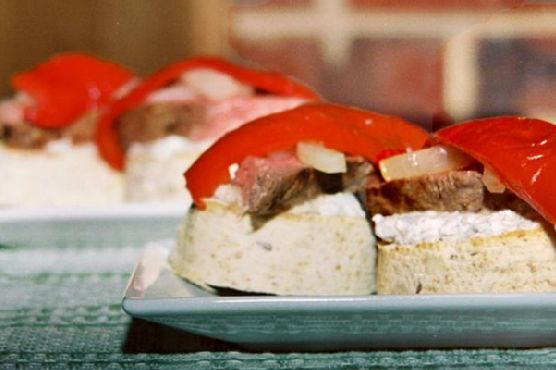
Steak And Pepper Rounds With Rose Horseradish Garlic Creme Sauce | Made by Meaghan Moineau

Steak And Pepper Rounds With Rose Horseradish Garlic Crème Sauce

Intro

There’s something about the aroma of steak sizzling on the grill that transports me back to summer evenings spent in my grandmother’s garden. She had a knack for turning simple ingredients into a feast, and this recipe is a tribute to those cherished memories. As the sun dipped below the horizon, we’d gather around the table, the air filled with laughter and the rich, savory scent of marinated steak. This dish, inspired by those warm, nostalgic evenings, combines tender beef with the vibrant flavors of roasted peppers and a creamy, horseradish-infused sauce, bringing a touch of elegance to any table.

Why You’ll Love It

This recipe is a delightful blend of flavors and textures that’s sure to impress your guests. Whether you’re hosting a summer barbecue or a cozy winter gathering, these steak and pepper rounds are perfect as both appetizers and hearty main courses. The creamy sauce, with its subtle hint of rose wine, perfectly complements the succulent steak and smoky peppers, making each bite a culinary experience. Plus, it’s a versatile dish that can easily be adapted to suit different tastes and dietary needs.

Ingredients

  • 1 tbsp olive oil, plus extra for sautéing
  • 1 whole garlic bulb
  • 1 boneless beef rib steak
  • 1 tbsp Worcestershire sauce
  • 1 tbsp Jack Daniels mustard
  • 1 tsp crushed red pepper flakes
  • 1/2 cup rose syrah wine
  • 1 onion, sliced into 3-inch strips
  • 1 cup red roasted pepper sections
  • 1/2 cup mascarpone cheese
  • 1 tbsp horseradish
  • 4 cloves roasted garlic
  • 1 tsp fresh dried basil
  • 1 tsp fresh dried oregano
  • 1 tbsp fresh lemon juice
  • Salt and pepper, to taste
  • 1 loaf French bread, sliced into 1-inch rounds

Instructions

  1. Preheat your oven to 400°F. Drizzle 1 tbsp of olive oil over the garlic bulb and wrap it in aluminum foil. Place on a cookie sheet and roast for approximately 40 minutes. Once roasted, let it cool to touch.
  2. While the garlic is roasting, marinate the steak in a ziplock bag with Worcestershire sauce, Jack Daniels mustard, crushed red pepper flakes, and 1/2 cup of rose syrah wine. Toss to coat and let it sit while you slice the vegetables.
  3. Heat olive oil in a skillet over medium heat. Add the sliced onion and sauté until slightly browned and caramelized, about 20 minutes. Add the red roasted pepper sections and cook for another 10 to 15 minutes.
  4. Meanwhile, place the marinated steak on a roasting pan and broil in the oven or grill for approximately 5 to 10 minutes per side. Be careful not to overcook, as the steak will continue to cook after being removed from the heat. Let it rest before cutting.
  5. In a food processor, combine the mascarpone cheese, horseradish, and squeeze out 4 cloves of the roasted garlic. (Store the rest of the garlic bulb in an airtight container in the refrigerator for up to one week.) Pulse a few times to blend.
  6. Add the fresh dried basil, oregano, lemon juice, and a pinch of salt and pepper to the mixture and blend well.
  7. Slice the French bread into 1-inch rounds and lightly toast them in the oven or on a grill.
  8. Cut the steak into 1/8 to 1/4-inch strips.
  9. Spread the rose horseradish garlic crème sauce over each warm piece of bread. Top with a slice of steak and a spoonful of the onion and pepper mixture.

Tips

For the best flavor, allow the steak to marinate for at least an hour, or overnight if possible. Ensure your skillet is properly heated before adding the onions to achieve the perfect caramelization. When slicing the steak, always cut against the grain to ensure tenderness. Finally, if you like a bit more kick, feel free to increase the amount of horseradish in the sauce.

Variations & Substitutions

This recipe is highly adaptable. For a lighter version, use chicken breast or portobello mushrooms instead of steak. You can substitute the Jack Daniels mustard with Dijon mustard for a milder taste. If you’re avoiding alcohol, replace the rose syrah wine with beef broth. For a gluten-free option, use gluten-free bread or serve the toppings over a bed of arugula.

Storage

Store any leftover steak and pepper mixture in an airtight container in the refrigerator for up to three days. The sauce can also be refrigerated for up to a week. When ready to serve again, reheat the steak and pepper mixture gently in a skillet, and toast the bread fresh just before serving.

FAQ

Can I prepare the sauce ahead of time?

Yes, the sauce can be prepared up to three days in advance. Just store it in an airtight container in the refrigerator. Before serving, give it a good stir and adjust the seasoning if necessary.

What wine pairs well with this dish?

A glass of the same rose syrah wine used in the recipe would complement the dish beautifully. Alternatively, a full-bodied red like Cabernet Sauvignon would also work well, enhancing the rich flavors of the steak.

Can I use a different type of cheese?

Absolutely! If mascarpone isn’t available, cream cheese or ricotta can be used as substitutes. Keep in mind that cream cheese will yield a slightly tangier sauce.

Nutrition

Each serving contains approximately 250 calories, 18g of fat, 12g of carbohydrates, and 15g of protein. These values may vary slightly based on specific ingredients used and portion sizes.

Conclusion

Steak and Pepper Rounds with Rose Horseradish Garlic Crème Sauce is a delightful appetizer or main dish that brings together a symphony of flavors reminiscent of time-honored traditions and cherished family gatherings. Whether you’re making this for a special occasion or a cozy night in, it’s sure to become a favorite in your culinary repertoire. Enjoy the process of creating and savoring each bite, and feel free to share your own variations and stories in the comments below. Happy cooking!

Related update: Steak And Pepper Rounds With Rose Horseradish Garlic Creme Sauce

Related update: Ginger Chicken Stir-Fry

Related update: Alouette® Stuffed Mushroom Caps

Falcons Quiet GM Search: Long Game Plan | Analysis by Brian Moineau

The Falcons’ GM Search: A Quiet Shuffle with Big Stakes

Hook: The Atlanta Falcons are playing the long game — and the latest from NFL insider Tom Pelissero suggests that what looks like a whisper of interviews today could be the blueprint for the franchise’s next decade.

The short version: the Falcons are methodically interviewing GM candidates while Matt Ryan’s new role atop football operations helps shape the process. Tom Pelissero’s recent update confirms interviews are underway and underscores that Atlanta is being deliberate about pairing a general manager with the new leadership structure.

Where we are and why it matters

  • The Falcons parted ways with Terry Fontenot after the 2025 season, creating one of the NFL’s most consequential front-office openings.
  • Matt Ryan — the former franchise quarterback — is expected to be installed as president of football operations (or head of football operations), which shifts the power dynamic and makes the GM hire as much about chemistry as it is about résumé.
  • The team is interviewing candidates publicly reported (and confirmed by team communications) as part of a process led by Ryan and aided by executive search firms.

Why this matters:

  • A GM hires coaches, builds the roster and controls the draft strategy; with Ryan overseeing football operations, the GM will need to complement Ryan’s vision rather than clash with it.
  • The Falcons already made a headline coaching hire (Kevin Stefanski), so the GM decision is the next major lever that will determine roster construction and the team’s trajectory.

What Pelissero reported

  • Tom Pelissero provided a concise update on NFL Network’s “The Insiders”: the Falcons’ interview process for GM candidates is active and moving forward. The coverage emphasized process and fit over a quick hire. (nfl.com)

  • Local reporting from the Falcons confirmed interviews with at least one candidate (Josh Williams) and framed the search as being guided by Matt Ryan and supported by external search partners. That article highlights the organization’s stated focus on working relationships and alignment as priorities. (atlantafalcons.com)

  • Outside coverage has linked names into the process (reports noting interviews or interest in experienced executives such as Joe Douglas in the broader media cycle), indicating Atlanta is considering both established front-office figures and newer executives. (nypost.com)

The real question: fit over flash

  • The Falcons don’t need a headline-grabbing hire as much as a complementary partner for Ryan and Stefanski.

  • With Stefanski already in place as head coach, the GM must:

    1. Build synergy with Stefanski’s schematic needs (e.g., offensive priorities, roster flexibility).
    2. Share or be adaptable to Ryan’s strategic vision for the roster and organizational culture.
    3. Execute drafts and free-agent strategy that can accelerate competitiveness without destabilizing the cap or long-term plan.
  • That’s why Pelissero’s emphasis on process — interviews, vetting, and fit — is worth noting. The team appears to prefer a careful selection that reduces friction at the top of the organization.

Candidates and context to watch

  • Expect the Falcons to consider:

    • Veterans who’ve previously run or assisted in running a roster (they bring proven processes).
    • Talent evaluators who can identify immediate contributors and long-term building blocks in the draft.
    • Executives who are comfortable in a shared-power structure with a president of football operations (that’s a key filter now).
  • Publicly named interviewees (like Josh Williams) and reported names in the media signal Atlanta is casting a wide net — from league-tested GMs to sharp evaluators who can execute a Stefanski-friendly roster plan. (atlantafalcons.com)

What to expect next

  • More interviews and vetting steps announced in short order (weeks, not months).
  • A hire that will be framed publicly around “fit” — expect statements about alignment with Matt Ryan and Kevin Stefanski.
  • Immediate focus post-hire on roster evaluation, draft board alignment, and free-agent strategy for the coming offseason.

Key points to watch:

  • How closely the GM’s public philosophy matches Stefanski’s scheme.
  • Whether the Falcons clearly define the president/GM boundaries in public communications.
  • Any quick staff moves that hint at the new GM’s priorities (personnel staff hires, scouting structure changes).

My take

Atlanta seems to be learning the lesson many franchises have learned the hard way: putting personalities in compatible seats matters as much as pedigree. Tom Pelissero’s update — short and process-driven — is a signal the Falcons want this right rather than fast. With Matt Ryan now in a leadership role and Stefanski coaching, the GM will likely be judged on how well they knit those pieces together into a coherent, sustainable plan.

If Atlanta lands someone who can both evaluate talent and collaborate at the executive level, this search could be the subtle turning point the franchise needs. If not, tensions at the top could blunt the potential Stefanski brings on the field.

Sources


Related update: We recently published an article that expands on this topic: read the latest post.


Related update: We recently published an article that expands on this topic: read the latest post.

Ryzen 7 9850X3D Sparks AMD Stock Rally | Analysis by Brian Moineau

AMD’s latest play: Ryzen 7 9850X3D lands with a price—and the market noticed

A single tweet, an MSRP, and a launch date: that was enough to nudge AMD shares higher last Friday. The Ryzen 7 9850X3D—an incremental, gaming-focused refresh—was given a January 29, 2026 release date and a $499 price tag, and investors reacted. But why does a modest mid-cycle CPU refresh move a multibillion-dollar chipmaker’s stock, and what should gamers and investors read into this?

Quick snapshot

  • Product: AMD Ryzen 7 9850X3D
  • Release date: January 29, 2026.
  • MSRP: $499 (U.S.).
  • Positioning: Higher-binned, 8-core/16-thread X3D chip with ~5.6 GHz boost and 96–104 MB effective cache (3D V-Cache).
  • Market reaction: AMD stock rose on the announcement as the price and launch cleared uncertainty and reinforced AMD’s product cadence.

Why this mattered to traders

  • Clarity reduces uncertainty. Markets dislike surprises—especially when rumors had floated higher retailer listings ($550–$600). AMD’s official $499 MSRP calmed fears of more aggressive pricing that could squeeze margins or signal weaker demand.
  • Gaming chips still matter for perception. While AMD’s big revenue story in recent years has been data-center GPUs and AI-related products, consumer launches keep the brand momentum and signal healthy product execution across segments.
  • It’s a signal about inventory and pricing strategy. A modest $20 uplift over the prior 9800X3D suggests AMD is managing positioning to avoid undercutting higher-tier SKUs while still offering a clearly tiered lineup for enthusiasts.

What the 9850X3D actually is

  • Not a new architecture. This is a mid-cycle optimization—a “better-binned” 9800X3D—targeted at gamers who value per-core frequency and 3D V-Cache benefits for certain titles.
  • Specs and expected gains. Same 8-core/16-thread configuration, a higher boost clock (~5.6 GHz), and AMD’s stacked 3D cache. AMD’s own messaging suggests modest single-digit percentage uplift compared to the 9800X3D—valuable for esports or frequency-sensitive workloads, less so for general productivity.
  • Compatibility. Slots into AM5 motherboards (600- and 800-series); BIOS updates may be required on older boards.

The broader context

  • CES 2026 timing. The 9850X3D revealed in the CES cycle helps AMD keep headlines during an event when investors and consumers expect product refreshes. That timing often amplifies market reaction.
  • AI and data-center tailwinds remain the core story. Analysts and investors continue to tie AMD’s revenue narrative to server and AI demand—consumer CPU launches are important but secondary to the company’s enterprise trajectory.
  • Pricing comparisons matter. With rumors of higher retailer markups earlier, the $499 MSRP positions AMD competitively against inflated early listings and helps set consumer expectations.

What this means for different audiences

  • Gamers: If you want one of the fastest gaming CPUs and value incremental frame-rate gains in competitive titles, the 9850X3D looks appealing—assuming you can get it near MSRP. If you bought a 9800X3D recently, gains are small enough that regret would be mild.
  • PC builders: Good option for high-end gaming builds, but weigh the CPU vs. GPU spend—gaming performance remains GPU-limited in many real-world scenarios.
  • Investors: The stock bump reflects reduced uncertainty and a tidy product cadence. It’s a positive short-term signal but doesn’t change the long-term thesis that AMD’s data-center and GPU businesses drive most upside.

A few caveats

  • Incremental upgrade: This is not a generational leap. Performance uplifts are modest and mostly frequency-driven.
  • Retail availability vs. MSRP: Early retailer listings can still diverge from MSRP, especially in the first weeks. Buyers should watch actual retail pricing after launch.
  • Market drivers remain diversified: Consumer product announcements help the narrative, but AMD’s valuation will continue to hinge on AI/data-center traction and margins in the server GPU market.

My take

The ripple in AMD’s stock after the Ryzen 7 9850X3D announcement is sensible: the market rewarded clarity. The $499 MSRP undercut some of the pessimism around pricing while confirming AMD continues to execute predictable product steps. For gamers and builders it’s a neat, targeted upgrade; for investors the move matters more as a sign of operational discipline than as a material earnings inflection. Keep watching AMD’s server and AI momentum—consumer chips are a headline, not the headline.

Sources


Related update: We recently published an article that expands on this topic: read the latest post.

Classic Carrot Cake With Cream Cheese Frosting | Made by Meaghan Moineau

Classic Carrot Cake With Cream Cheese Frosting

Intro

There’s something magical about the aroma of a freshly baked carrot cake wafting through the kitchen. It takes me back to my grandmother’s cozy kitchen, where I first learned to bake. I remember the sound of her gentle voice guiding me as we grated the carrots together, my small hands eager to help. She would always let me lick the spoon, a sweet reward that made those afternoons unforgettable. This classic carrot cake with cream cheese frosting is a tribute to those cherished moments, combining tender, moist cake layers with the rich tang of cream cheese frosting.

Why You’ll Love It

This carrot cake is a timeless dessert that never goes out of style. It’s perfect for any occasion, from birthdays to casual get-togethers. Here’s why you’ll fall in love with this recipe:

  • Moist and Flavorful: The combination of buttermilk, vegetable oil, and freshly grated carrots ensures a moist cake that’s bursting with flavor.
  • Simple Ingredients: You likely have most of the ingredients in your pantry already.
  • Rich Cream Cheese Frosting: The tangy frosting perfectly complements the sweetness of the cake.
  • Versatility: Whether you’re making a layer cake or cupcakes, this recipe adapts beautifully.

Ingredients

  • 2 cups all-purpose flour
  • 2 teaspoons baking powder
  • 1 teaspoon baking soda
  • 1/2 teaspoon salt
  • 2 teaspoons ground cinnamon
  • 1 cup vegetable oil
  • 1 cup buttermilk
  • 4 large eggs
  • 2 cups sugar
  • 1 teaspoon vanilla extract
  • 3 cups shredded carrots
  • 1 cup chopped pecans
  • 1/2 cup unsalted butter, softened
  • 8 ounces cream cheese, softened
  • 4 cups confectioners’ sugar
  • 1 teaspoon vanilla extract

Instructions

  1. Preheat your oven to 350°F (175°C). Grease and flour two 9-inch round cake pans.
  2. In a medium bowl, whisk together the flour, baking powder, baking soda, salt, and cinnamon.
  3. In a large bowl, combine the vegetable oil, buttermilk, eggs, sugar, and vanilla extract. Beat until well mixed.
  4. Gradually add the dry ingredients to the wet ingredients, mixing until just combined.
  5. Fold in the shredded carrots and chopped pecans.
  6. Divide the batter evenly between the prepared pans and smooth the tops with a spatula.
  7. Bake for 30 to 35 minutes, or until a toothpick inserted into the center comes out clean.
  8. Allow the cakes to cool in the pans for 10 minutes, then turn them out onto a wire rack to cool completely.
  9. For the frosting, beat the softened butter and cream cheese in a large bowl until creamy and smooth.
  10. Gradually add the confectioners’ sugar, beating until well combined. Stir in the vanilla extract.
  11. Once the cakes are completely cool, spread a layer of frosting on top of one cake. Place the second cake on top and frost the top and sides of the cake.
  12. Decorate with additional pecans if desired. Serve and enjoy!

Tips

  • Make sure the cream cheese and butter are softened to room temperature for a smoother frosting.
  • To prevent the cake from sticking, line the bottom of the cake pans with parchment paper.
  • For extra flavor, toast the pecans before adding them to the batter.

Variations & Substitutions

If you’re looking to switch things up, here are some variations and substitutions:

  • Raisins or Pineapple: Add 1/2 cup of raisins or crushed pineapple for a fruity twist.
  • Whole Wheat Flour: Substitute half of the all-purpose flour with whole wheat flour for a nuttier taste.
  • Walnuts: Use walnuts instead of pecans for a different nutty flavor.

Storage

Store any leftover carrot cake in an airtight container in the refrigerator for up to 5 days. You can also freeze the unfrosted cake layers by wrapping them tightly in plastic wrap and aluminum foil for up to 3 months. Thaw overnight in the refrigerator before frosting and serving.

FAQ

Can I make this carrot cake gluten-free?

Yes, you can replace the all-purpose flour with a gluten-free flour blend. Make sure to choose a blend that contains xanthan gum or add it separately to help bind the cake.

How can I make this recipe vegan?

To make a vegan carrot cake, substitute the eggs with flax eggs (1 tablespoon of flaxseed meal mixed with 2.5 tablespoons of water per egg), use a plant-based milk with a tablespoon of vinegar instead of buttermilk, and replace the cream cheese and butter with vegan alternatives.

Can I make this cake ahead of time?

Absolutely! You can bake the cake layers a day in advance and store them in the refrigerator. Frost the cake just before serving for the best texture.

Nutrition

While I always encourage indulging in moderation, here’s a rough estimate of the nutritional content per serving (based on 12 servings):

  • Calories: 450
  • Protein: 5g
  • Fat: 22g
  • Carbohydrates: 58g
  • Sugar: 43g
  • Fiber: 2g

Conclusion

Our classic carrot cake with cream cheese frosting is more than just a dessert; it’s a celebration of flavors and memories wrapped into one delicious treat. Whether you’re savoring a slice with a cup of tea or sharing it with loved ones, this cake is sure to bring joy and nostalgia to your table. Happy baking!

Related update: Classic Carrot Cake With Cream Cheese Frosting

Related update: Triple Chocolate Whoppers

Microsoft 365 Outage: Lessons for Business | Analysis by Brian Moineau

Is Microsoft Down? When Outlook and Teams Go Dark — What Happened and Why It Matters

It wasn’t just you. On January 22, 2026, a large swath of Microsoft 365 services — notably Outlook and Microsoft Teams — went dark for many users across North America, leaving inboxes and meeting rooms inaccessible at a bad moment for plenty of businesses and individuals. The outage was loud, visible, and a useful reminder that even the biggest cloud providers can suffer outages that ripple through daily life.

Quick snapshot

  • What happened: Widespread disruption to Microsoft 365 services including Outlook, Teams, Exchange Online, Microsoft Defender, and admin portals.
  • When: The incident began on January 22, 2026, with reports spiking in the afternoon Eastern Time.
  • Cause Microsoft reported: A portion of service infrastructure in North America that was not processing traffic as expected; Microsoft worked to restore and rebalance traffic.
  • Impact: Thousands of user reports (Downdetector peaks in the tens of thousands across services), interrupted mail delivery, inaccessible Teams messages and meetings, and frustrated IT admins. (techradar.com)

Why this outage cut deep

  • Microsoft 365 is core business infrastructure for millions. When email and collaboration tools stall, calendar invites are missed, support queues pile up, and remote meetings become impossible.
  • The affected services span both user-facing apps (Outlook, Teams) and backend services (Exchange Online, admin center), so fixes require engineering work across multiple layers.
  • Enterprises depend on predictable SLAs and continuity plans; when a dominant vendor has a broad outage, knock-on effects hit suppliers, customers, and compliance workflows.

Timeline and signals (high level)

  • Afternoon (ET) of January 22, 2026: Users begin reporting login failures, sending/receiving errors, and service unavailability; Downdetector shows a rapid spike in complaints. (tech.yahoo.com)
  • Microsoft acknowledges investigation on its Microsoft 365 status/X channels and identifies a North America infrastructure segment processing traffic incorrectly. (tech.yahoo.com)
  • Microsoft restores the affected infrastructure to a healthy state and re-routes traffic to achieve recovery; normalized service follows after mitigation steps. (aol.com)

Real-world effects (examples of what users saw)

  • Outlook: “451 4.3.2 temporary server issue” and other transient errors preventing send/receive.
  • Teams: Messages and meeting connectivity problems; some users could not join or load chats.
  • Admins: Intermittent or blocked access to the Microsoft 365 admin center, complicating troubleshooting. (people.com)

Broader context: cloud reliability and concentrated risk

  • Outages at major cloud providers are not new, but their scale increases as more organizations consolidate services in a few platforms. A single routing, configuration, or infrastructure fault can affect millions of end users. (crn.com)
  • Microsoft had multiple service incidents earlier in January 2026 across Azure and Copilot components, underscoring that even large engineering organizations face repeated operational challenges. (crn.com)

What organizations (and individuals) can do differently

  • Assume outages will happen. Design critical workflows so a single vendor outage doesn’t halt business continuity.
  • Maintain robust incident playbooks: alternative communication channels (SMS, backup conferencing), clear escalation paths, and status-monitoring subscriptions for vendor health pages.
  • Invest in runbooks for quick triage: know how to confirm whether a problem is local (your network, MFA, conditional access policies) versus a vendor-side outage.
  • Communicate early and often: internal transparency reduces frustration when users know teams are working on it.

Lessons for cloud vendors and platform operators

  • Visibility matters: clear, timely status updates reduce speculation and speed customer response.
  • Isolation and graceful degradation: further architectural isolation between services can limit blast radius.
  • Post-incident reviews should be public enough to build trust and show concrete mitigation steps.

My take

Outages like the January 22 incident are messy and costly, but they’re also useful reality checks. They force organizations to test resilience plans and ask hard questions about risk concentration and recovery. For vendors, they’re a reminder that scale brings complexity—and that transparency and fast mitigation are as valuable as the underlying engineering fixes.

Further reading

  • News roundups that covered the outage and Microsoft’s response. (techradar.com)

Sources


Related update: We recently published an article that expands on this topic: read the latest post.


Related update: We recently published an article that expands on this topic: read the latest post.

Fall Apple Yeast Bread | Made by Meaghan Moineau

Fall Apple Yeast Bread

Intro

As the leaves turn golden and the air becomes crisp, there’s nothing quite like the aroma of freshly baked bread wafting through the house. Growing up, my grandmother’s kitchen was the heart of our home, especially during the fall. She would often prepare her famous apple yeast bread, filling the space with the sweet and spicy scent of cinnamon and baked apples. The warmth of the oven and the comforting smell always signaled that the holidays were near. I carry on this tradition by baking my own version of Fall Apple Yeast Bread. It’s a recipe filled with love, memories, and the delightful flavors of the season.

Why You’ll Love It

This Fall Apple Yeast Bread is a perfect blend of soft, fluffy dough and sweet, spiced apples. The combination of apple cider, cinnamon, and orange zest gives the bread a unique depth of flavor that captures the essence of autumn. Whether you’re enjoying it as a breakfast treat or a cozy afternoon snack, this bread is sure to bring warmth and joy to your table.

Ingredients

  • 1 cup warm water
  • 1/4 cup vegetable oil
  • 1/4 cup runny honey
  • 2 1/4 teaspoons dried/instant yeast
  • 2 large eggs
  • 4 cups all-purpose flour
  • 1 teaspoon salt
  • 1/4 cup sugar
  • 1 teaspoon vanilla extract
  • Zest of one orange
  • 2 teaspoons ground cinnamon
  • 3 cups apples, peeled and chopped
  • 1/4 cup apple cider
  • 1/2 cup powdered sugar

Instructions

  1. Mix the warm water with the vegetable oil, honey, and yeast. Allow it to foam for 10 minutes.
  2. Add the eggs, flour, salt, sugar, vanilla extract, and orange zest to the yeast mixture.
  3. Mix and then knead the dough using a mixer with a bread hook, or by hand, until you have a soft, smooth, and elastic dough (about 8-10 minutes).
  4. Place the dough in an oiled bowl and let it rise, covered, for 2 hours or until it’s puffy and nearly doubled in size.
  5. Lightly grease a 9-inch round cake pan that’s at least 2 inches deep.
  6. Toss the apple chunks with the sugar and cinnamon.
  7. Gently deflate the dough, transfer it to a lightly greased work surface, and flatten it into a rough rectangle, about 8 x 10 inches.
  8. Spread half the apple chunks in the center of the dough.
  9. Fold a short edge of the dough over the apple, patting firmly to seal the apples and spread the dough a bit.
  10. Spread the remaining apple atop the folded-over dough.
  11. Cover the apples with the other side of the dough, patting firmly.
  12. Cut the apple-filled dough into 16 pieces. This will be messy, but don’t worry about making all the pieces the same size.
  13. Lay the dough chunks into the pan, crowding them so they fit in a single tight layer. Tuck in any fallen apple chunks.
  14. Cover the dough with lightly greased plastic wrap or a damp towel and let it rise for about 1 to 1 1/2 hours, until it’s a generous 2 inches high.
  15. Preheat the oven to 325°F twenty minutes before the end of the rising time.
  16. Place the bread in the lower third of the oven and bake for 55 minutes, or until the top is light golden brown.
  17. Remove the bread from the oven, and after 5 minutes, loosen the edges and carefully transfer it to a rack to cool completely.
  18. Whisk together the apple cider and powdered sugar, then brush it over the top of the cooled bread, allowing it to drizzle down the sides.

Tips

For best results, make sure your yeast is fresh and active. If the yeast mixture doesn’t foam, it may be inactive, and you’ll need to start over with new yeast. Additionally, using a kitchen thermometer to check the temperature of your water can help ensure it’s the right warmth to activate the yeast without killing it.

Variations & Substitutions

You can substitute whole wheat flour for up to half of the all-purpose flour for a heartier texture. If you prefer a different spice profile, try adding nutmeg or allspice to the cinnamon. For a nutty twist, fold in a handful of chopped walnuts or pecans with the apple filling.

Storage

Store the Fall Apple Yeast Bread in an airtight container at room temperature for up to three days. For longer storage, wrap the bread tightly in plastic wrap and aluminum foil, then freeze for up to three months. Thaw at room temperature before serving.

FAQ

Can I make this bread ahead of time?

Yes, you can prepare the dough a day in advance. After kneading the dough, cover it tightly and refrigerate overnight. The next day, allow it to come to room temperature before proceeding with the recipe.

What type of apples should I use?

For the best flavor, use a mix of sweet and tart apples, such as Granny Smith and Honeycrisp. This combination provides a nice balance of flavors and textures in the bread.

Can I use fresh apple juice instead of apple cider?

Yes, fresh apple juice can be used as a substitute for apple cider. However, cider typically has a more concentrated flavor, so consider simmering the juice to reduce and intensify its flavor before using it in the recipe.

Nutrition

This Fall Apple Yeast Bread serves approximately 12 slices. Each serving contains around 200 calories, 5g of fat, 35g of carbohydrates, 2g of fiber, and 4g of protein. It’s a delightful treat that offers a comforting taste of fall.

Conclusion

Fall Apple Yeast Bread is more than just a delicious seasonal treat; it’s a way to bring warmth and nostalgia to your home. As you bake this bread, take a moment to savor the process and create new memories with your loved ones. Whether you enjoy it fresh from the oven or as a cozy afternoon snack, this bread is sure to be a favorite in your autumn baking repertoire. Happy baking!

Related update: Fall Apple Yeast Bread

Ground Turkey Stuffed Peppers | Made by Meaghan Moineau

Ground Turkey Stuffed Peppers

Intro

Growing up, Sundays at my grandmother’s house were always filled with the comforting aroma of hearty meals cooking on the stove. One of her signature dishes was stuffed peppers, a recipe she had perfected over decades. The vibrant colors of the peppers, filled to the brim with savory goodness, never failed to bring the whole family to the table. I’ve since adapted this beloved recipe to include ground turkey, making it a bit leaner while still preserving the rich flavors that made it a family favorite. Today, I’m excited to share this cherished recipe with you, hoping it brings warmth and joy to your home as it has to mine.

Why You’ll Love It

This Ground Turkey Stuffed Peppers recipe is more than just a meal; it’s a comforting, wholesome experience. The combination of tender bell peppers filled with a savory mixture of ground turkey, rice, and spices creates a delightful balance of flavors and textures. You’ll love how this dish is not only delicious but also nutritious, making it perfect for a family dinner or a cozy night in. Plus, the ease of preparation in a slow cooker or stove-top pot makes it an accessible recipe for cooks of all levels.

Ingredients

  • 6 large bell peppers
  • 1 teaspoon black pepper
  • 1 can (15 oz) canned tomato sauce
  • 1 can (14.5 oz) diced canned tomatoes
  • 1 tablespoon dried parsley
  • 2 large eggs
  • 3 cloves garlic, minced
  • 1 pound ground turkey
  • 1/2 pound ground beef
  • 1 medium diced onion
  • 1/2 cup grated parmesan cheese, plus more for topping
  • 1 cup cooked rice
  • 1 tablespoon sugar
  • 1 can (10.75 oz) canned tomato soup
  • 2 tablespoons Worcestershire sauce

Instructions

  1. Begin by cooking the rice according to package instructions. Allow it to cool slightly.
  2. In a large mixing bowl, combine the cooked rice, ground turkey, ground beef, diced onion, minced garlic, eggs, black pepper, and half of the grated parmesan cheese. Knead together until evenly mixed.
  3. Prepare the bell peppers by cutting off their tops and removing the seeds and membranes inside.
  4. Stuff each pepper with the meat and rice mixture, pressing it down gently to fill completely.
  5. In a separate bowl, mix together the canned tomato sauce, diced tomatoes, sugar, Worcestershire sauce, and dried parsley. This will be your sauce.
  6. Place the stuffed peppers in your slow cooker or a large stove-top pot. Spoon some of the sauce over each pepper, then pour the remaining sauce around them.
  7. Cover and cook on medium/low heat for about an hour, or until the peppers are tender and the filling is cooked through.
  8. Before serving, top each pepper with a sprinkle of the remaining parmesan cheese and a bit of parsley for garnish.
  9. Serve warm and enjoy the comforting flavors of this classic dish.

Tips

To ensure your peppers stand upright, trim just a small slice off the bottom if necessary. Be careful not to cut too much or the filling may spill out during cooking. If you prefer a bit more spice, consider adding a pinch of red pepper flakes to the filling mixture.

Variations & Substitutions

Feel free to make this recipe your own by trying different variations. Substitute ground turkey with ground chicken or use all ground beef if you prefer a richer flavor. For a vegetarian option, replace the meat with a blend of mushrooms and zucchini. You can also swap white rice for brown rice or quinoa for a healthier twist.

Storage

These stuffed peppers can be stored in an airtight container in the refrigerator for up to 3 days. They also freeze well; just place them in a freezer-safe container for up to 2 months. To reheat, simply thaw overnight in the fridge and warm them in the oven at 350°F (175°C) until heated through.

FAQ

Can I prepare the stuffed peppers ahead of time?

Absolutely! You can prepare the stuffed peppers up to the point of cooking, cover them tightly, and store them in the refrigerator for up to 24 hours before cooking. This makes it an excellent option for meal prepping or entertaining.

What can I serve with stuffed peppers?

Stuffed peppers are quite filling on their own, but they pair wonderfully with a side salad or some crusty bread. You can also serve them with a light soup for a complete and satisfying meal.

Can I use a different type of cheese?

Certainly! While parmesan adds a nice savory touch, feel free to use mozzarella, cheddar, or even feta cheese for a different flavor profile. Just sprinkle it on top before serving for a deliciously cheesy finish.

Nutrition

Each serving of these Ground Turkey Stuffed Peppers is packed with protein from the turkey and beef, fiber from the bell peppers, and essential nutrients from the tomatoes and rice. While exact nutritional values will vary based on portion sizes and specific ingredient brands, this dish is generally low in carbohydrates and fat, making it a healthy choice for a balanced diet.

Conclusion

I hope this recipe for Ground Turkey Stuffed Peppers brings a sense of nostalgia and warmth to your table, just as it has to mine over the years. It’s a simple yet satisfying dish that combines the best of flavors and traditions. Whether you’re making it for a family gathering or a weeknight dinner, these stuffed peppers are sure to delight. Enjoy the process of cooking and, most importantly, the joy of sharing a comforting meal with loved ones.

Related update: Ground Turkey Stuffed Peppers

Microsoft Outage Disrupts Email and Teams | Analysis by Brian Moineau

Was Microsoft Down? Why Outlook and Teams Went Dark (and What That Means)

It wasn’t your Wi‑Fi. On Thursday, January 22, 2026, a large chunk of Microsoft’s cloud stack — Outlook, Microsoft 365 apps and Teams among them — began failing for many users across North America. Emails wouldn’t send, calendar invites stalled, Teams calls hiccuped or refused to connect, and the question “Is Microsoft down?” trended on social media for good reason.

What happened (short version)

  • A portion of Microsoft’s North America service infrastructure stopped processing traffic as expected, causing load‑balancing problems and widespread interruptions to services such as Outlook, Microsoft 365 and Teams.
  • Microsoft acknowledged the incident on its status channels and worked to restore the affected infrastructure by rerouting and rebalancing traffic; recovery was gradual and uneven for some users.
  • Outage trackers like Downdetector showed thousands of reports at the peak, and mainstream outlets covered the disruption while Microsoft posted progressive updates as systems recovered. (people.com)

Why this felt so disruptive

  • Microsoft 365 and Outlook are deeply embedded in work and personal communications for millions of people — when mail and collaboration tools stop, meetings, deadlines and daily workflows stall.
  • The outage hit during business hours for many, amplifying the practical and psychological impact: it’s different to lose a streaming service for an hour than to be unable to send email or join a meeting mid‑day.
  • Even when core services are restored, residual issues (delayed queues, load‑balancing lag, partial restorations) can keep some users waiting and fuel social outcry.

How the company explained it

  • Microsoft reported the problem originated in a subset of infrastructure in North America that wasn’t processing traffic correctly, which in turn caused service availability issues. Their mitigation steps focused on restoring that infrastructure to a healthy state and rebalancing traffic across other regions. (economictimes.indiatimes.com)

Timeline (as reported)

  • Early/mid‑day on January 22, 2026: Reports of failures spike on Downdetector and social channels.
  • Microsoft posts status updates and begins mitigation, including traffic redirection and targeted restarts.
  • Over the following hours: progressive recovery for many users; some edge cases remained slower to recover while load balancing completed. (techradar.com)

Real‑world impacts

  • Businesses and schools experienced missed or delayed communication, forced switches to alternative tools (personal email, Slack, Zoom), and last‑minute manual coordination.
  • IT teams shifted into incident mode: triaging user tickets, monitoring Microsoft status updates, and standing up contingency channels.
  • End users faced anxiety and productivity loss — the social streams showed everything from bemused memes to genuine concern about lost messages. (people.com)

Lessons for organizations and users

  • Expect failure (even from the biggest cloud providers). Design fallback communication paths for critical workflows.
  • Have an outage playbook: status checklists, alternative meeting links (Zoom/Google Meet), and transparent internal communications reduce confusion.
  • For IT: monitor provider status pages and outage trackers, verify if an issue is provider‑side before widespread internal escalations, and communicate early with stakeholders.
  • For individuals: maintain a secondary contact method for urgent communications (phone numbers, alternative email, a team chat fallback).

A few technical notes (non‑deep‑dive)

  • Large cloud platforms rely on regional infrastructure and load balancers. If a subset becomes unhealthy, traffic must be rerouted; that rerouting process can be complex and sometimes slow, leading to partial recoveries rather than an instant fix.
  • Error messages like “451 4.3.2 temporary server issue” were reported by some users during similar incidents and typically indicate a transient server‑side problem in mail delivery systems. (people.com)

My take

Outages like this are reminders that cloud reliability is never absolute — and the cost of that reality has grown as organizations lean harder on a few dominant providers. Microsoft’s quick public acknowledgement and stepwise updates help, but the repeated nature of such incidents (other outages in past years) means businesses should treat provider availability as a shared responsibility: providers must keep improving resilience and transparency, and customers must design for graceful degradation.

Takeaway bullets

  • Major Microsoft services experienced a regionally concentrated outage on January 22, 2026, driven by infrastructure that stopped processing traffic correctly. (techradar.com)
  • Recovery involved rerouting traffic and targeted restarts; service restoration was gradual and uneven for some users. (economictimes.indiatimes.com)
  • Organizations should prepare fallback workflows and a clear incident communication plan to reduce disruption from provider outages. (people.com)

Sources

(Note: headlines and timing above are based on contemporary reporting around the January 22, 2026 outage; consult your IT or Microsoft 365 Status page for the definitive service health record for your tenant.)


Related update: We recently published an article that expands on this topic: read the latest post.


Related update: We recently published an article that expands on this topic: read the latest post.

Markets Rally After Greenland Tariff | Analysis by Brian Moineau

Markets breathe again after the Greenland tariff scare

The opening bell felt less like routine and more like damage control. Stocks went from a rout to a rally in a matter of news cycles after President Donald Trump announced he would not move forward with a set of Europe-targeted tariffs that had been expected to start on February 1. Investors who had been braced for a fresh global trade shock exhaled — and bought the dip. (washingtonpost.com)

Why this mattered so fast

  • Tariff threats are different from ordinary headlines. They hit corporate margins, supply chains and the price of imports — and markets price those risks rapidly. When the president first threatened steep levies tied to his push over Greenland, U.S. indexes plunged and volatility spiked. (washingtonpost.com)
  • The reversal removed an immediate policy overhang: with the tariff threat off the table for now, traders rotated back into cyclical and tech names that had sold off on worries about trade-driven earnings pressure. The result: a sharp, visible rebound in major indices. (investing.com)
  • Wall Street’s sensitivity to abrupt trade-policy moves has been a recurring story — big policy swings can trigger outsized market moves, and sometimes the market’s reaction itself influences policy calibrations. (ft.com)

What happened, step by step

  • Late weekend posts and comments from the White House signaled potential tariffs on a group of European countries in response to their resistance to U.S. pressure over Greenland. Markets immediately priced in the risk. The Dow plunged hundreds of points and the S&P and Nasdaq also gave back significant ground. (washingtonpost.com)
  • As the diplomatic noise intensified — at Davos and in bilateral talks — investors watched for the administration’s next move. When the president announced he would not impose the planned tariffs beginning Feb. 1, major U.S. averages snapped higher within the trading day, recovering much of the prior losses. (investing.com)
  • Traders described these moves as a classic “risk-on” bounce once the policy threat was removed; commentators also noted how rapidly political headlines can be priced in (or out) by markets. (ft.com)

Market implications for investors

  • Short-term: volatility is likely to remain elevated around geopolitical or trade-related headlines. Fast reversals like this one can create opportunity — and risk — for traders who try to time headlines. (washingtonpost.com)
  • Medium-term: corporate planning (sourcing, pricing, guidance) becomes harder when tariffs are used as leverage in foreign-policy disputes. Even when tariffs don’t land, the threat alone can affect decisions and valuations. (ft.com)
  • Portfolio posture: diversification and a focus on fundamentals remain sensible for most long-term investors. For short-term participants, disciplined risk management is key when headline-driven moves dominate. (washingtonpost.com)

What the episode reveals about politics and markets

  • Markets can act as a check — not in a formal way, but practically. Large, rapid sell-offs increase political costs and pressure decision-makers to recalibrate. That dynamic appears to have played out here, with market reactions amplifying the consequences of the tariff threat. (ft.com)
  • At the same time, frequent policy flip-flops create a new baseline for volatility. Investors may grow used to headline swings, but “getting used to it” is not the same as being immune. Tail risks still exist and can surprise complacent portfolios. (washingtonpost.com)

Key takeaways

  • Major U.S. indices rebounded after the administration dropped planned Europe tariffs set for Feb. 1, turning a sell-off into a rally. (investing.com)
  • Tariff talk alone can move markets: the initial threat caused a sharp sell-off and a spike in volatility. (washingtonpost.com)
  • Even when a policy threat is withdrawn, the episode raises longer-term questions about unpredictability, supply-chain risk and how investors price political risk. (ft.com)

My take

This episode is a microcosm of modern market-politics interactions: headlines travel fast, markets react faster, and the political calculus sometimes shifts under the weight of market consequences. For investors, the practical lesson is simple and recurring — respect the headlines, but anchor decisions in company fundamentals and risk management. Short-term traders can profit from volatility, but only with a clear plan and limits.

Sources


Related update: We recently published an article that expands on this topic: read the latest post.


Related update: We recently published an article that expands on this topic: read the latest post.

Pan Seared Lamb Loin With Chimichurri & Roasted Trio Squash Salad With Goat Cheese and Pinenuts | Made by Meaghan Moineau

Pan Seared Lamb Loin With Chimichurri & Roasted Trio Squash Salad With Goat Cheese and Pinenuts

Intro

There’s a certain magic that fills the air when the holidays come around. The aroma of spices, the warmth of the kitchen, and the laughter of family gathered around the table create memories that last a lifetime. I vividly recall the first time I prepared this Pan Seared Lamb Loin with Chimichurri and Roasted Trio Squash Salad for my family. My grandmother, a culinary wizard in her own right, stood beside me, sharing tips and stories from her own kitchen adventures. That day, the recipe became more than just a meal; it became a family tradition.

Why You’ll Love It

This dish is a symphony of flavors and textures that will leave your taste buds dancing. The lamb loin, perfectly seared and seasoned, is juicy and tender, while the chimichurri adds a vibrant, herbaceous punch. Paired with a roasted trio squash salad, creamy goat cheese, and crunchy pinenuts, this meal is a celebration of fresh, wholesome ingredients. Whether you’re hosting a dinner party or simply want to treat yourself, this recipe is sure to impress.

Ingredients

  • Cilantro
  • Extra virgin olive oil
  • Flat leaf parsley
  • Garlic clove
  • Black ground pepper
  • Kosher salt and pepper
  • Lamb loin chops
  • Lemon
  • Mint
  • Pinenuts
  • Red pepper flakes
  • Shallot

Instructions

  1. Preheat your oven to 400°F.
  2. For the chimichurri, combine cilantro, flat leaf parsley, garlic clove, black ground pepper, and red pepper flakes in a large bowl. Mix well and season with kosher salt and pepper to taste.
  3. Heat a large, heavy-bottomed pan with extra virgin olive oil over medium-high heat.
  4. Season each side of the lamb loin chops with salt and pepper generously.
  5. Once the oil is hot and slightly smoking, sear the lamb loin chops for about 2 minutes on each side.
  6. Transfer the pan to the preheated oven to finish cooking. Refer to the following times for your preferred doneness:
    • Rare: 2-3 minutes
    • Medium rare: 6-8 minutes
    • Medium: 9-11 minutes
    • Well done: 12-14 minutes
  7. Remember, the lamb will continue to cook after you remove it from the oven, so plan accordingly.

Tips

To ensure the lamb is perfectly seared, make sure your pan is hot enough before adding the chops. A little smoke is a good indicator. Also, allow the meat to rest for a few minutes after cooking to retain its juices.

Variations & Substitutions

If you’re looking to add a twist to this dish, consider using basil in place of cilantro for a sweeter chimichurri. For a nut-free option, omit the pinenuts or replace them with sunflower seeds. You can also swap the goat cheese for feta or blue cheese for a different flavor profile.

Storage

Store any leftovers in an airtight container in the refrigerator for up to 3 days. The lamb can be reheated gently in a pan over low heat or in a preheated oven at 300°F until warmed through.

FAQ

Can I prepare the chimichurri in advance?

Absolutely! The chimichurri can be made up to 2 days in advance. Store it in the refrigerator in an airtight container to allow the flavors to meld together beautifully.

What can I serve with this dish?

This lamb dish pairs wonderfully with a side of roasted potatoes or a light green salad. A glass of red wine, such as a Cabernet Sauvignon or Malbec, would complement the flavors beautifully.

Is this recipe suitable for a special occasion?

Definitely! This recipe is elegant and flavorful, making it perfect for a special occasion or a festive gathering. Your guests will be impressed by the vibrant flavors and beautiful presentation.

Nutrition

This dish is a good source of protein, essential fatty acids, and various vitamins and minerals from the fresh herbs and vegetables. The use of extra virgin olive oil adds heart-healthy monounsaturated fats.

Conclusion

Bringing together the luscious flavors of pan-seared lamb loin and the refreshing zest of chimichurri, this dish is more than just a meal—it’s an experience. Whether you’re sharing it with loved ones or savoring it in solitude, this recipe is destined to become a favorite. From my kitchen to yours, happy cooking!

Related update: Pan Seared Lamb Loin With Chimichurri & Roasted Trio Squash Salad With Goat Cheese and Pinenuts

Related update: Ground Turkey Stuffed Peppers

Bucs Hire Zac Robinson as Offensive Chief | Analysis by Brian Moineau

The Buccaneers have found their next offensive coordinator

A familiar face is sliding into the Bucs’ offensive driver’s seat. On January 22, 2026, Tampa Bay moved to finalize a deal to hire Zac Robinson as their new offensive coordinator — a hire that reconnects a coach known for Sean McVay-style concepts with a quarterback (Baker Mayfield) he’s worked with before. This isn’t just another line on a staff sheet; it’s a hinge point for an offense that sputtered in 2025 and is hungry to get back to the efficiency and explosiveness it showed in 2024.

Why this matters right now

  • The Buccaneers’ offense dipped from top-5 levels in 2024 to a middle-of-the-pack unit in 2025, prompting a staff reset under head coach Todd Bowles.
  • Zac Robinson brings recent play-calling experience (Atlanta Falcons OC, 2024–25) and a background inside the Rams’ offense, the type of scheming many teams covet for quick, versatile passing attacks.
  • Baker Mayfield and Robinson have previous working history from the Rams in 2022 — that familiarity could accelerate scheme fit and reduce the friction that often comes with new coordinators.

Quick takeaways

  • Robinson is a play-caller with an offensive pedigree linked to Sean McVay’s system and a mixed recent resume in Atlanta (strong total-yard seasons in 2024, regression in 2025).
  • Tampa Bay is prioritizing a coordinator who can tailor the scheme to current personnel — Mayfield, Chris Godwin, a sturdy offensive line, and young weapons like Emeka Egbuka and Bucky Irving.
  • This is Tampa’s fifth OC in five seasons, highlighting instability at the position; success will depend on clear roles, play-calling consistency, and injury luck.

What Zac Robinson brings (and what to watch)

  • Familiar system influences: Robinson’s rise came through Los Angeles under Sean McVay’s coaching staff. Expect spacing, pre-snap motion, and concept-based passing that looks to create easy reads for the QB and leverage matchups.
  • Player-first approach: In Atlanta he emphasized tailoring looks to Bijan Robinson’s strengths and maximizing playmakers. In Tampa, that means designing to Baker Mayfield’s strengths — short-to-intermediate timing, quick reads, rollouts and play-action to buy space for receivers.
  • Play-calling history: Robinson has called plays in the NFL; that experience is a double-edged sword. When the Falcons clicked, the offense performed well (2024 total yards top-10). When it didn’t, efficiency and scoring slipped (2025). The key for the Bucs will be whether Robinson can avoid the pitfalls that led to that inconsistency.
  • Chemistry with Mayfield: The prior Rams connection matters. A coordinator-quarterback rapport can shave weeks off installation, help in-game adjustments, and make the offense more resilient when the playbook needs to be simplified on the fly.

The challenges ahead

  • Stability problem: Robinson becomes the fifth offensive coordinator the Buccaneers have hired in five seasons. That revolving door makes continuity — for both players and scheme — difficult.
  • Personnel realities: Mike Evans enters free agency status and the receiving corps has young talent but questions remain about consistent separation and health. Robinson must build an identity that fits who’s actually on the field.
  • Expectations vs. reality: Tampa Bay’s offense needs a bounce-back, but one coordinator does not fix roster gaps or injuries. Measurable improvement will likely hinge on play-caller freedom, player health, and front-office support in the offseason.

How this could change the Bucs’ offseason and 2026 outlook

  • Scheme tweaks over overhaul: Expect Robinson to lean into what worked in 2024 — more emphasis on quick passing game, creative motion, and establishing the run — while installing wrinkles from his Falcons/Rams background.
  • Quarterback-centric planning: With Robinson’s prior work with Mayfield, the Bucs might prioritize short-window timing routes, rollouts, and play-action to protect the QB and generate big-play opportunities.
  • Coaching staff composition: Robinson’s hire signals Tampa wants an offensive identity that’s modern and adaptable. Look for staff moves (position coaches, pass-game assistants) that mirror that vision.

My take

This hire makes sense on paper: a young, system-savvy play-caller who already knows Baker Mayfield’s tendencies and has experience shaping an NFL offense. The biggest questions aren’t about Robinson’s schematic toolbox — they’re about context. Will the Bucs give him a consistent role and the roster support he needs? Can he avoid repeating the inconsistency that dogged his Falcons tenure? If the front office commits to continuity and the offense stays healthy, Robinson’s familiarity and adaptable approach could spark the kind of rebound Tampa Bay wants. If not, this could be another short chapter in the Bucs’ OC carousel.

Sources


Related update: We recently published an article that expands on this topic: read the latest post.


Related update: We recently published an article that expands on this topic: read the latest post.

Pear and Walnut Coffee Cake | Made by Meaghan Moineau

Pear and Walnut Coffee Cake

Intro

There’s something magical about the aroma of freshly baked goods wafting through the house, especially on a crisp autumn morning. Growing up, Sunday mornings were a special time in my household. My grandmother would put on her well-worn apron and start baking her famous coffee cake. The sweet and spicy scent of cinnamon mingled with the warmth of baked pears would gently coax everyone out of bed. This Pear and Walnut Coffee Cake carries that same nostalgic warmth and is sure to become a cherished favorite in your home.

Why You’ll Love It

Our Pear and Walnut Coffee Cake is a delightful blend of rich flavors and comforting textures. Whether you’re serving it as a breakfast treat or a cozy dessert, this cake is sure to impress. Here’s why you’ll love it:

  • Flavorful Layers: The combination of juicy pears, crunchy walnuts, and a spiced crumble topping creates a symphony of flavors in every bite.
  • Moist and Tender: Thanks to the sour cream and butter in the batter, this cake stays incredibly moist.
  • Perfect for Any Occasion: This cake is versatile enough for a casual brunch or a festive holiday gathering.

Ingredients

  • 1 cup brown sugar
  • 1 teaspoon ground cinnamon
  • 1/2 teaspoon ground ginger
  • 1/4 teaspoon ground cardamom
  • 1/4 teaspoon ground allspice
  • 1/2 cup flour
  • 1/4 cup wheat germ
  • 1/2 cup walnuts
  • 1/2 cup diced unsalted butter
  • 2 cups flour
  • 1 teaspoon baking powder
  • 1/2 teaspoon baking soda
  • 1/4 teaspoon kosher salt
  • 1/2 cup unsalted butter, softened
  • 1 cup brown sugar
  • 2 large eggs
  • 1 teaspoon vanilla extract
  • 1/2 cup sour cream
  • 3 pears, diced
  • Juice of 1 lemon
  • Zest of 1 lemon

Instructions

  1. Start the topping by putting brown sugar, cinnamon, ginger, cardamom, allspice, flour, wheat germ, walnuts, and diced butter in a food processor. Blend until crumbly. Cover and place in the fridge to keep cold.
  2. Grease a 10-inch springform pan with butter, then lightly dust with flour and tap out the excess. Set aside.
  3. Toss diced pears with lemon juice and set aside.
  4. With an electric mixer, beat softened butter, brown sugar, and lemon zest for the cake batter until fluffy, approximately 3-5 minutes.
  5. Add eggs and vanilla extract to the butter mixture and mix until combined.
  6. In a separate bowl, whisk together the flour, baking soda, baking powder, and salt.
  7. Starting with the sour cream, alternately add it to the cake batter along with the dry ingredients, mixing until just combined.
  8. Pour the cake batter into the prepared pan. Top with the lemon-tossed pears and sprinkle the crumble topping over the fruit.
  9. Bake in a preheated oven at 350°F (175°C) for 40-50 minutes or until a tester comes out clean.
  10. Remove from the oven and cool in the pan for at least 20-25 minutes before serving.

Tips

  • Ensure your butter is at room temperature for a smoother batter.
  • Use ripe but firm pears for the best texture and flavor.
  • Toasting the walnuts before adding them to the topping enhances their flavor.

Variations & Substitutions

Feel free to get creative with this recipe! Here are a few ideas:

  • Fruit Variations: Substitute apples or peaches for the pears if desired.
  • Nuts: Pecans can be used in place of walnuts for a different nutty flavor.
  • Spices: Adjust the spices to your liking, or try adding nutmeg for an additional warm note.

Storage

This coffee cake can be stored at room temperature in an airtight container for up to 3 days. For longer storage, keep it in the refrigerator for up to a week. It also freezes well; simply wrap individual slices in plastic wrap and store them in a freezer-safe bag for up to 3 months.

FAQ

Can I use canned pears instead of fresh ones?

While fresh pears are recommended for the best flavor and texture, canned pears can be used in a pinch. Just make sure to drain them well and pat them dry before using.

What is the best way to serve this cake?

This cake is delightful on its own, but you can also serve it with a dollop of whipped cream or a scoop of vanilla ice cream for an extra treat.

Nutrition

This Pear and Walnut Coffee Cake is a treat best enjoyed in moderation. It contains wholesome ingredients like fresh fruit and nuts, but also has butter and sugar. If you’re mindful of your sugar intake, consider reducing the amount of sugar in the topping or cake batter.

Conclusion

Baking this Pear and Walnut Coffee Cake is more than just making a delicious dessert—it’s about creating an experience filled with warmth and joy. Whether you’re looking to impress guests or simply enjoy a quiet moment with a slice and a cup of coffee, this cake delivers in every way. So gather your ingredients, preheat your oven, and let the comforting aroma of spices and baked pears fill your home. Here’s to creating new memories with a recipe that’s sure to become a family favorite!

Related update: Pear and Walnut Coffee Cake

Related update: Fall Apple Yeast Bread

Tex-Mex Burger | Made by Meaghan Moineau

Tex-Mex Burger

Intro

There’s something truly magical about a sizzling burger hot off the grill, bringing back memories of summer nights spent laughing and sharing stories with family and friends. Growing up, my family had a weekly tradition of gathering around the backyard grill, where my father would prepare his famous Tex-Mex burgers. The aroma of spices mingling with beef was irresistible, and the first bite was always a heavenly blend of flavors that danced on the palate. Now, I’m excited to share this beloved recipe with you, so you can create new memories with your loved ones, just as I have.

Why You’ll Love It

This Tex-Mex Burger is a flavor-packed twist on the classic American burger. It’s perfect for anyone who loves a bit of spice and a lot of flavor. The combination of cumin, chili powder, and paprika gives the beef a smoky, spicy depth, while the creamy avocado and pepper jack cheese add richness and a hint of heat. Topped with fresh cilantro and red onion, each bite is a delightful balance of textures and tastes. Whether you’re hosting a backyard barbecue or looking to switch up your weeknight dinner routine, this burger is sure to become a favorite!

Ingredients

  • 1 pound ground beef
  • 1/4 cup salsa
  • 1 teaspoon chili powder
  • 1 teaspoon cumin
  • 1/2 teaspoon paprika
  • 1/2 teaspoon salt
  • 1/4 teaspoon pepper
  • 4 slices pepper jack cheese
  • 1 avocado, sliced
  • 1/2 small red onion, thinly sliced
  • 1/4 cup fresh cilantro, chopped
  • 4 hamburger buns

Instructions

  1. Preheat your broiler to high. This will ensure your buns are perfectly toasted and ready to hold all the delicious fillings.
  2. In a large frying pan, heat to medium-high heat. This is where the magic happens, as the patties get their perfect sear.
  3. Make the patties: In a large bowl, combine ground beef, salsa, chili powder, cumin, paprika, salt, and pepper. Mix until the ingredients are evenly distributed. Be careful not to overwork the meat to maintain tenderness.
  4. Form the mixture into four equal-sized patties, making a slight indentation in the center of each to ensure even cooking.
  5. Place the patties in the heated frying pan. Cook for about 4-5 minutes on each side, or until they reach your desired level of doneness.
  6. During the last minute of cooking, place a slice of pepper jack cheese on each patty. Cover the pan briefly to allow the cheese to melt.
  7. While the patties are cooking, place the hamburger buns under the broiler for about 1 minute, or until they are lightly toasted.
  8. Assemble the burgers: Place each patty on the bottom half of a toasted bun. Top with avocado slices, red onion, and fresh cilantro. Finish with the top half of the bun.
  9. Serve immediately and enjoy the explosion of Tex-Mex flavors!

Tips

For the juiciest burgers, use ground beef with a higher fat content, like 80/20. If your patties shrink during cooking, it means they’re too compact; gently form them to avoid this. Toasting the buns adds a pleasant crunch and prevents them from getting soggy with the juicy toppings.

Variations & Substitutions

If you’re looking to customize your Tex-Mex Burger, consider these variations:

  • Protein Swap: Substitute the ground beef with ground turkey or chicken for a lighter version. Vegetarians can use black bean patties.
  • Cheese Options: Swap pepper jack for cheddar or Monterey Jack for a different cheesy experience.
  • Spice Level: Add a pinch of cayenne pepper for extra heat, or omit the chili powder for a milder taste.
  • Bun Alternatives: Use whole wheat buns or lettuce wraps for a low-carb option.

Storage

If you have leftovers, let the cooked patties cool to room temperature before storing them in an airtight container in the refrigerator for up to three days. To reheat, warm them in a skillet over medium heat or in the microwave, ensuring they’re thoroughly heated. Unfortunately, these burgers are best enjoyed fresh, so try to make just enough for your meal.

FAQ

Can I make the burger patties ahead of time?

Absolutely! You can prepare the patties and store them in the refrigerator for up to 24 hours before cooking. This can help save time during meal prep and allow the flavors to meld together even more.

What can I serve with Tex-Mex Burgers?

These burgers pair well with a variety of sides, such as crispy sweet potato fries, a fresh green salad, or classic coleslaw. For a true Tex-Mex experience, consider serving with a side of Mexican street corn or spicy black bean salad.

Nutrition

While exact nutritional values will vary based on portion sizes and specific ingredients used, each Tex-Mex Burger (including toppings and bun) is approximately 550 calories. This includes 35g of protein, 30g of fat, and 40g of carbohydrates. For a lighter version, consider using leaner meats and reducing the cheese and avocado portions.

Conclusion

There you have it — a delightful Tex-Mex Burger recipe that brings a touch of southwestern flair to your table. Whether you’re reliving cherished memories or creating new ones, this burger is sure to impress with its bold flavors and satisfying textures. I hope this recipe becomes a staple in your home, just as it has in mine. Enjoy the culinary journey, and happy cooking!

Related update: Tex-Mex Burger

Related update: Pan Seared Lamb Loin With Chimichurri & Roasted Trio Squash Salad With Goat Cheese and Pinenuts

GOP-Only Crypto Draft Tests Bipartisan | Analysis by Brian Moineau

A GOP-only crypto draft lands on the Hill — and the bipartisan dream frays

The Senate’s crypto drama just entered a new act. One week after bipartisan talks produced hope for a market-structure bill that would give clearer oversight to digital assets, Senate Agriculture Chair John Boozman’s office circulated a GOP-only draft ahead of a committee markup. The move has industry lobbyists, Democratic negotiators and investors watching closely — because it changes the political math for how (and whether) the U.S. writes rules for crypto markets.

Why this matters now

  • The Senate Agriculture, Nutrition, and Forestry Committee has been the focal point for sweeping crypto market-structure legislation that would, among other things, clarify which regulator oversees which digital assets and set rules for exchanges, custodians and decentralized finance.
  • Lawmakers spent months negotiating a bipartisan discussion draft. That draft left several hot-button areas bracketed, signaling ongoing compromise. But tensions over core policy choices — jurisdictional lines between the Commodity Futures Trading Commission and the SEC, treatment of decentralized finance, and ethics provisions around lawmakers and stablecoins — kept a final agreement out of reach.
  • Facing those unresolved issues, Committee Chair Boozman (R-Ark.) released a Republican-only draft to be considered in an upcoming markup. Boozman’s camp framed the move as necessary to keep the process moving; Democrats portrayed it as a retreat from bipartisan compromise.

Early reactions and the politics beneath the headlines

  • A Senate Agriculture spokesperson told reporters there are “a handful of policy differences” but “many areas of agreement,” and that Boozman “appreciates the good-faith effort to reach a bipartisan compromise.” That phrasing signals two things: Republicans want to show openness to negotiation while also defending a decision to advance their own text. (mexc.com)
  • Democrats — led in these talks by Sen. Cory Booker (D‑N.J.) on the Ag panel — have described continued conversations but remain reluctant to back the GOP-only package if core protections and balance-of-power provisions are missing. Industry players and some bipartisan supporters worry that a partisan markup could produce a bill that’s easier to block in the Senate or that would trigger a messy reconciliation with banking committee efforts. (archive.ph)
  • For crypto businesses, the stakes are practical: clarity and safe harbor. Too much delay or partisan infighting risks leaving unclear custody, listing and compliance rules that keep legitimate firms from offering products and leave consumers exposed.

What’s at stake in the policy fight

  • Regulator jurisdiction: Who gets primary authority over which types of tokens — the CFTC, the SEC, or a newly delineated regime — is the biggest technical and political dispute. This determines enforcement posture, registration requirements and litigation risk.
  • DeFi and developer liability: Whether noncustodial protocols and their developers get exemptions or face new liabilities will shape innovation incentives in decentralized finance.
  • Stablecoin rules and yields: Rules around issuer reserves, permitted activities and how yield-on-stablecoin products are treated could reshape the on‑ramps between traditional finance and crypto.
  • Ethics and quorum issues: Proposals to limit officials’ ability to profit from digital assets, and changes to agency quorum rules, have caused friction because they touch lawmakers’ personal interests and how independent agencies operate.

What this GOP-only draft means practically

  • Moving forward without bipartisan signoff increases the odds the Senate Agriculture Committee will vote on a Republican text that Democrats don’t support. That can expedite a timetable but risks another legislative stalemate on the floor — or a competing bill from the Senate Banking Committee.
  • The GOP draft may signal priorities Republicans think are nonnegotiable — e.g., clearer roles for the CFTC, tougher rules on stablecoin operations, or narrower protections for DeFi developers. For industry players, that’s a cue to mobilize for amendments or for outreach to Democratic offices to restore bipartisan language.
  • For markets, uncertainty often beats clarity short-term. The prospect of competing texts or protracted floor fights could keep firms cautious about product launches or migrations that depend on statutory safe harbors.

Practical timeline notes

  • The Agriculture Committee has postponed and rescheduled markups in recent weeks as talks moved back and forth. At the time this draft circulated, committee leadership signaled a markup was scheduled later in January (committee calendars have shifted during the negotiations). Watch the committee’s public calendar and press statements for firm markup dates. (agriculture.senate.gov)

Key takeaways for readers watching crypto policy

    • The release of a GOP-only draft does not end bipartisan talks, but it does raise the political temperature and shortens the runway for compromise.
    • Regulatory jurisdiction and treatment of DeFi remain the most consequential sticking points for both lawmakers and industry.
    • A partisan committee vote could speed a bill through committee but makes final passage harder unless leaders from both parties find an off-ramp or trading ground elsewhere in the Senate.

My take

This episode is classic Congress: momentum from earnest, cross‑party drafting collides with raw politics. Boozman’s GOP draft is both a procedural nudge and a negotiating move — it forces issues into the open rather than letting them linger in bracketed text. That can be healthy if it clarifies choices and prompts serious amendment work. But if the result is two competing, partisan bills (Agriculture vs. Banking), we could be stuck with months of legal ambiguity instead of clear rules that businesses and consumers need.

For the crypto industry, the best outcome remains a durable, bipartisan statute that clearly assigns jurisdiction, protects consumers, and leaves room for innovation. If lawmakers want to claim wins on both consumer protection and responsible innovation, they’ll need to make meaningful concessions — and fast.

Final thoughts

Lawmakers are juggling technical complexity, industry pressure, and electoral politics. The path to effective crypto law will be messy, but insisting on clarity and enforceability should stay front and center. Watch for amendments during markup and any outreach from mixed House–Senate working groups — those will tell you whether this draft is a negotiating step or the start of partisan trench warfare.

Sources


Related update: We recently published an article that expands on this topic: read the latest post.


Related update: We recently published an article that expands on this topic: read the latest post.


Related update: We recently published an article that expands on this topic: read the latest post.


Related update: We recently published an article that expands on this topic: read the latest post.

Japan Restarts Worlds Largest Nuclear | Analysis by Brian Moineau

A reactor returns after 15 years: what Japan’s restart really means

Japan’s energy landscape flickered back to life this week when Tokyo Electric Power Company (TEPCO) restarted Reactor No. 6 at the Kashiwazaki-Kariwa nuclear power plant — the first time a TEPCO-run reactor has been brought back into operation since the 2011 Fukushima disaster. The move is heavy with symbolism: nearly 15 years after one of the worst nuclear accidents in modern history, Japan is again turning toward large-scale nuclear generation to meet climate and energy-security goals. (ans.org)

Quick takeaways

  • The No. 6 reactor at Kashiwazaki-Kariwa was restarted on 21 January 2026; the operator later suspended operations briefly after a control-rod-related glitch, saying there was no immediate safety impact. (ans.org)
  • Kashiwazaki-Kariwa is the world’s largest nuclear generating complex by capacity; restarting even one unit adds substantial output to Japan’s grid. (ans.org)
  • Restarts reflect a national policy pivot: Japan is re-embracing nuclear power to cut emissions and reduce reliance on imported fossil fuels, even as local opposition and seismic safety concerns persist. (theguardian.com)

The moment and the backdrop

On 21 January 2026 TEPCO withdrew control rods from Unit 6, bringing the reactor to criticality and initiating the carefully staged process of producing steam and testing systems before commercial operation. The plant — located in Niigata prefecture on the Sea of Japan coast — has seven reactors and a combined potential capacity that makes it the largest single nuclear site in the world. (ans.org)

That scale matters politically and practically. Japan’s energy mix has been reshaped by the 2011 earthquake, tsunami and ensuing meltdown at Fukushima Daiichi; nearly all reactors were shut down for safety overhauls, public trust eroded, and the country leaned on imported gas and coal. In recent years, under pressure from high fossil-fuel costs and climate targets, Tokyo has shifted back toward reactivating reactors that meet updated safety rules. (theguardian.com)

Why this restart matters

  • Energy and emissions: Restarting Unit 6 can add gigawatts of low-carbon baseload power to the grid, helping the government pursue carbon neutrality goals while reducing costly fuel imports. That’s a major driver of the policy reversal toward “maximizing” nuclear capacity through 2040. (theguardian.com)
  • TEPCO’s reputation and finances: TEPCO still manages the long, expensive Fukushima decommissioning. Bringing a flagship plant back online helps its bottom line — but also reopens questions about the company’s stewardship and transparency. (apnews.com)
  • Local trust and seismic risk: Many residents near Kashiwazaki-Kariwa oppose the restart; surveys and protests reflect anxieties about earthquakes, evacuation readiness and whether local communities truly consented. Seismic safety remains a top concern in any Japanese nuclear debate. (aljazeera.com)

The hiccup: why the suspension matters

Hours after the restart began, TEPCO suspended operations to investigate an electrical malfunction related to control-rod equipment. The company emphasized the reactor remained stable and there was no release or visible safety threat — but the interruption underlines two realities: nuclear systems require near-perfect coordination of complex controls, and public confidence is fragile; even small technical issues are newsworthy and politically charged. (aljazeera.com)

That suspension won’t be judged solely on engineering grounds. In the court of public opinion, it feeds narratives on whether nuclear restarts truly resolved the problems that followed Fukushima: maintenance rigor, independent oversight, and evacuation planning.

Broader implications

  • Energy security vs. social license: Japan faces a classic policy trade-off: nuclear offers reliable, low-carbon power but requires broad local trust and robust safety culture. The national goal of increasing nuclear’s share by 2040 makes restarts politically attractive — but local opposition and history complicate implementation. (theguardian.com)
  • Global ripple effects: Japan is the world’s third-largest economy. Its nuclear policy choices influence global markets for LNG and coal, and signal how advanced economies balance decarbonization with energy resilience. (theguardian.com)
  • Technical and regulatory watch: The Nuclear Regulation Authority and TEPCO will be scrutinized at every step — from post-restart inspections to the ramp-up to commercial operation — and any further malfunctions could stall public and political support. (ans.org)

My take

Restarting Unit 6 at Kashiwazaki-Kariwa is not just a technical milestone; it’s a test of whether Japan can reconcile climate goals, energy security and community consent after a traumatic chapter in its modern history. The engineering checks and regulatory approvals matter — but so do transparent communication, honest acknowledgement of past failures, and demonstrable local protections. If Japan’s next steps prioritize both rigorous safety and genuine engagement with affected communities, this restart could be part of a pragmatic, low-carbon pathway. If not, it risks reopening the social wounds left by Fukushima while adding political volatility to the energy transition.

What to watch next

  • TEPCO’s investigation results and whether the reactor resumes stable operation and moves to commercial generation (TEPCO had signalled a target for commercial operation after additional checks). (ans.org)
  • Niigata local politics and any legal or regulatory challenges from citizen groups and prefectural bodies. (theguardian.com)
  • Japan’s national energy roadmap and whether the government adjusts timelines or safety conditions in response to operational lessons and public feedback. (theguardian.com)

Sources

Basil Lime White Bean Hummus | Made by Meaghan Moineau

Basil Lime White Bean Hummus

Intro

There’s something about the combination of fresh basil and lime that instantly transports me back to my childhood summers spent in my grandmother’s garden. She grew the most fragrant basil I’ve ever encountered, and we’d often pick a handful to mix into our meals. One of my favorite memories is sitting on her porch, a gentle breeze carrying the scent of fresh herbs as we dipped into a bowl of her homemade hummus. Inspired by those memories, I’ve created a recipe with a zesty twist: Basil Lime White Bean Hummus. It’s a delightful blend of creamy cannellini beans, aromatic basil, and a refreshing burst of lime that will bring a touch of sunshine to any snack or meal.

Why You’ll Love It

This Basil Lime White Bean Hummus is a refreshing take on the classic hummus, perfect for those who love a good twist on traditional flavors. Here are a few reasons why you’ll fall in love with it:

  • Quick and Easy: With just a few simple ingredients, you can whip up this hummus in no time.
  • Flavorful: The combination of basil and lime gives this hummus a unique and vibrant taste that stands out.
  • Healthy: Packed with protein and fiber from the beans, it’s a nutritious choice for any snack or meal.
  • Versatile: Perfect as a dip, spread, or even a salad dressing alternative.

Ingredients

  • 1 can of cannellini beans, drained and rinsed
  • 2 cloves of garlic
  • 1 cup of fresh basil leaves
  • Zest of 1 lime
  • Juice from 1 lime
  • 3 tablespoons of olive oil
  • 1/4 cup of water
  • Salt, to taste
  • Black pepper, to taste

Instructions

  1. In a food processor, combine the cannellini beans, garlic, basil leaves, lime zest, lime juice, and olive oil. Blend until the mixture is smooth.
  2. With the processor on, gradually add water to the mixture until you reach your desired consistency. You may need slightly more or less than 1/4 cup depending on your preference.
  3. Season with salt and black pepper to taste. Blend again to ensure everything is well mixed.
  4. Taste the hummus and adjust the seasoning if needed. If you prefer a more pronounced lime flavor, feel free to add a bit more lime juice.
  5. Transfer the hummus to a serving bowl and serve it with chips or fresh veggies. For the best flavor, allow it to chill before serving, but if you’re eager, enjoy it immediately!

Tips

To make the most of your Basil Lime White Bean Hummus, consider the following tips:

  • Use Fresh Ingredients: Fresh basil and freshly squeezed lime juice make a significant difference in flavor.
  • Adjust Consistency: If you prefer a thicker hummus, add less water. For a smoother, thinner consistency, add a bit more.
  • Garnish: Consider garnishing with a few whole basil leaves or a sprinkle of lime zest for an extra touch of flavor and presentation.

Variations & Substitutions

Feel free to customize the recipe to suit your taste preferences:

  • Herbs: Swap basil with cilantro for a different herbal note.
  • Beans: Substitute cannellini beans with chickpeas for a more traditional hummus base.
  • Spice: Add a pinch of red pepper flakes or a dash of hot sauce for a spicy kick.

Storage

Basil Lime White Bean Hummus can be stored in an airtight container in the refrigerator for up to 5 days. Before serving, you might want to stir it well, as some separation may occur. For longer storage, consider freezing it for up to 3 months. Thaw in the refrigerator and blend again before serving for the best texture.

FAQ

Can I use dried beans instead of canned?

Yes, you can use dried cannellini beans. Just make sure to soak them overnight and cook them thoroughly before using them in the recipe. You’ll need about 1.5 cups of cooked beans to replace a can.

What are the best dippers for this hummus?

This hummus pairs beautifully with a variety of dippers. Try it with fresh veggies like carrots, cucumbers, and bell peppers, or go for pita chips, whole-grain crackers, or even spread it on a sandwich or wrap.

Can I make it ahead of time?

Absolutely! In fact, the flavors tend to meld and improve after a few hours in the fridge. Just be sure to give it a good stir and check seasoning before serving.

Nutrition

This hummus is not only delicious but also nutritious. Each serving is packed with protein, healthy fats, and fiber. While nutritional values can vary based on the exact ingredients used, one serving of this hummus (about 1/4 cup) contains approximately:

  • Calories: 120
  • Protein: 4g
  • Fat: 8g
  • Carbohydrates: 10g
  • Fiber: 3g

Conclusion

Basil Lime White Bean Hummus is a delightful twist on a classic favorite, bringing a burst of fresh flavors that are perfect for any occasion. Whether you’re hosting a gathering, looking for a healthy snack, or simply craving something different, this hummus is sure to please. Easy to make, versatile, and packed with nutrition, it’s a recipe you’ll find yourself returning to time and again. So, gather your ingredients, fire up your food processor, and enjoy a taste of summer with every bite.

Related update: Basil Lime White Bean Hummus

Related update: Steak And Pepper Rounds With Rose Horseradish Garlic Creme Sauce

GameStop’s Trade-In Glitch Sparks Chaos | Analysis by Brian Moineau

Okay, wait, wait…not that much power to the players

Hook: Imagine walking into a store, buying a brand-new console, trading it back immediately, and walking out with more store credit than you paid for it. It sounds like a prank, a movie plot, or something cooked up by internet pirates — but for a few chaotic hours in January 2026, it was very real.

GameStop’s recently patched “infinite money glitch” became the kind of viral moment that makes corporate PR teams sweat and content creators grin. A smaller YouTuber named RJCmedia filmed a simple exploit involving Nintendo’s Switch 2 and a promotional trade-in bonus, and the internet did what it does best: amplified the loophole, turned it into a spectacle, and forced the company to respond faster than a patched video game bug.

How the exploit worked (so we all understand what happened)

  • GameStop had a promotion that applied a 25% bonus to trade-in values when a pre-owned item was included.
  • RJCmedia bought a Switch 2 for about $414.99, then immediately traded it in alongside a cheap pre-owned game. The promo incorrectly applied in a way that momentarily valued the combined pre-owned trade more than the new retail price.
  • That created a window where the trade credit exceeded what was paid, meaning you could buy another Switch 2 with store credit, repeat the process, and compound the credit.
  • The creator repeated this across stores, walking away with hundreds of dollars in value, a new console, and a pile of games — until GameStop publicly said it had patched the issue on January 20, 2026.

Why this felt so deliciously chaotic

  • It’s the perfect internet cocktail: small creator + obvious financial edge case + a company tone that’s part meme and part corporate. People love seeing a system—especially a big retail system—outsmarted by clever individuals.
  • The glitch exposed how brittle promotional logic can be when systems try to handle stacked discounts and odd workflows. Real-world commerce software often assumes rational, intended use; it rarely anticipates someone intentionally “gaming” promotions across transactions.
  • There’s schadenfreude too. GameStop has been a cultural meme for years (from trade-ins to GME stock mania). Watching the company get punked briefly felt like a callback to the days when retail felt less buttoned-up and more accidental theater.

Not everything about “power to the players” is positive

  • The story reads fun, but these playbooks can harm employees. Store associates had to process unusual trades, decide how to respond, and likely faced pressure from management after the PR hit. Systems that reward creativity in customers can punish frontline workers who must resolve the fallout.
  • Exploits like this can collapse quickly into damage: inventory confusion, financial reconciliation headaches, and potential policy changes that hurt normal customers who relied on promotions legitimately.
  • There’s an ethical line: documenting a vulnerability and reporting it is one thing; deliberately extracting value until the system breaks is another. The internet loves the clever hustle, but repeated exploitation has real-world costs and can be labeled fraud depending on company policy and local law.

A small lesson in systems design, promotions, and human behavior

  • Promotions are rules-coded in software. When you stack rules (base value + percent bonus + pre-owned flags + immediate resale logic), edge cases appear. Retail systems must handle transaction states carefully—especially when “pre-owned” status flips within minutes.
  • Companies should run simulated misuse cases, not just happy-path scenarios. The old tech adage applies: users will do things you never expected.
  • From a consumer perspective, the incident is a reminder that “good deals” sometimes come from accidents rather than good design. That can be exciting in the short term, but unstable.

Things people were saying (internet reactions)

  • Some praised the creator’s ingenuity and the thrill of a “real-life glitch.”
  • Others criticized the clip as “ruining” the fun for everyone, since GameStop patched it almost immediately.
  • A subset wondered whether the whole episode was a stealth marketing play — GameStop has leaned into meme-culture before — but available evidence (small creator, quick patch) points to an honest exploit that went viral.

What matters in these reactions is how quickly communities frame any corporate slip as either “victory for the little guy” or “irresponsible grifting.” Both narratives are emotionally satisfying, which is why this story took off.

A few practical takeaways

  • Don’t expect such glitches to last: major retailers monitor outliers and will patch holes once they spread.
  • If you find a promotional anomaly, be mindful of ethics and consequences for store staff.
  • For companies: test stacked promotions against adversarial behavior, and make frontline exceptions simple to resolve without dramatic manual overhead.

My take

This was a fun, perfectly modern internet moment: messy, amusing, and briefly empowering. But I’m wary of the romanticism around “beating the system.” Real people—store workers, managers, and other customers—bear the real costs when exploits are scaled. The magic here wasn’t that players had too much power; it was that an imperfect system briefly amplified smart, opportunistic behavior. That’s entertaining to watch, but not a sustainable model for either consumers or businesses.

Sources


Related update: We recently published an article that expands on this topic: read the latest post.


Related update: We recently published an article that expands on this topic: read the latest post.

Boeuf Bourgignon | Made by Meaghan Moineau

Boeuf Bourguignon: A Timeless Classic

Intro

Boeuf Bourguignon is more than just a dish; it’s an experience that transports you to the heart of French culinary tradition. I remember my first encounter with this rich, flavorful stew during a cozy winter evening at my grandmother’s house. The aroma filled the kitchen, wrapping us in warmth and comfort. As we gathered around the table, each bite was a revelation—tender beef, hearty vegetables, and a sauce so luscious it felt like a hug in a bowl. This recipe is a homage to those cherished memories, and I hope it brings the same joy to your table.

Why You’ll Love It

Boeuf Bourguignon is a celebration of flavors and textures. The tender beef, slow-cooked to perfection, melts in your mouth, while the vegetables add a delightful contrast. The sauce, enriched with cognac and a hint of cocoa powder, is deep and complex, making every bite a new discovery. Whether you’re preparing a special dinner for loved ones or indulging in a cozy night in, this dish is sure to impress.

Ingredients

  • Button mushrooms
  • Butter
  • Un-smoked bacon
  • Vegetable oil
  • Boneless well-trimmed beef chuck
  • Yellow onion
  • Shallots
  • Carrots
  • Black salt and pepper
  • Flour
  • Cognac
  • Beef stock
  • Unsweetened cocoa powder
  • Garlic cloves
  • Fresh thyme
  • Fresh flat-leaf parsley leaves
  • Tomato paste
  • Bay leaf

Instructions

  1. Preheat your oven to 160°C (325°F).
  2. In a pan, sauté the mushrooms in butter until they are brown and soft. Set aside.
  3. In a deep-bottomed pot or casserole, sauté the bacon in 1 tablespoon of oil over moderate heat for 2 to 3 minutes until lightly browned. Remove with a slotted spoon and set aside.
  4. Reheat the pan until the fat is almost smoking, then sauté the beef in batches in the bacon fat. Ensure not to crowd the pieces; they should brown on all sides, not sweat. Transfer the browned beef to the dish with the bacon.
  5. Lower the heat to medium. In the same fat, add the onions, shallots, and carrots. Cook until the carrots are softened.
  6. Add the cooked vegetables to the beef and bacon. Pour out the sautéing fat.
  7. Return the beef mixture to the casserole. Sprinkle the flour over the beef and toss to coat lightly. Stir until the flour is cooked and no white traces remain.
  8. Add the bacon and vegetables back into the pot and season with salt and pepper.
  9. Stir in the cognac and enough beef stock to barely cover the meat.
  10. Add the garlic, thyme, parsley, tomato paste, and bay leaf. Bring to a simmer on the stovetop.
  11. Cover the casserole and place it in the oven. Cook for 2 1/2 to 3 hours.
  12. About 1 hour into cooking, add the mushrooms and stir in the cocoa powder. Return to the oven.
  13. The stew is done when the meat is fork-soft.

Tips

For the best results, use high-quality beef chuck and allow the stew to cook slowly. This ensures the meat becomes incredibly tender. Don’t rush the browning process; it adds depth to the flavor. Also, consider preparing this dish a day ahead, as it often tastes even better after the flavors have had time to meld.

Variations & Substitutions

If you prefer, you can substitute the beef with a different protein, such as lamb or pork, for a unique twist. For a vegetarian version, replace the beef with hearty vegetables like eggplant or zucchini, and use vegetable stock instead of beef stock. You can also add a splash of red wine for an extra layer of flavor.

Storage

Store leftover Boeuf Bourguignon in an airtight container in the refrigerator for up to 4 days. To reheat, gently warm on the stovetop over low heat, stirring occasionally. You can also freeze the stew for up to 3 months. Thaw overnight in the refrigerator before reheating.

FAQ

Can I make Boeuf Bourguignon in a slow cooker?

Absolutely! After browning the meat and vegetables, transfer everything to a slow cooker. Cook on low for 6-8 hours or on high for 3-4 hours. Add the mushrooms and cocoa powder halfway through cooking.

What can I serve with Boeuf Bourguignon?

This dish pairs beautifully with crusty bread, mashed potatoes, or a side of buttered noodles. A fresh green salad or steamed green beans work well to balance the richness of the stew.

Is it necessary to use cognac?

While cognac adds a lovely depth to the sauce, you can substitute it with brandy or omit it altogether if preferred. The stew will still be delicious without it.

Nutrition

This hearty dish is rich in protein and vitamins from the beef and vegetables. Depending on the serving size, it can be a calorie-dense meal, so enjoy it as a part of a balanced diet. For a lighter version, reduce the amount of butter and bacon used.

Conclusion

Boeuf Bourguignon is a timeless classic that embodies the essence of comfort food. It’s a dish that invites you to slow down and savor each moment, whether shared with loved ones or enjoyed in peaceful solitude. I hope this recipe becomes a part of your cherished culinary traditions, bringing warmth and joy to your home.

Related update: Boeuf Bourgignon

Related update: Tex-Mex Burger

Green Tea Fruit Medley Smoothie | Made by Meaghan Moineau

Green Tea Fruit Medley Smoothie

Intro

Welcome to your new favorite morning ritual: the Green Tea Fruit Medley Smoothie. There’s something magical about the quiet moments of dawn, where the world is still waking up and a gentle sun peeks through the curtains. It’s in these moments that I find myself reminiscing about the summers spent at my grandmother’s house. She had an expansive garden filled with vibrant berries and a cozy nook where she would brew fresh teas. The sweet aroma of berries mingling with the earthy scent of tea still lingers in my memory, and it’s this memory that inspired today’s recipe. This smoothie encapsulates those cherished mornings, blending the vibrant flavors of fresh berries and soothing green tea into a refreshing, nutrient-packed delight.

Why You’ll Love It

There are countless reasons to fall head over heels for this Green Tea Fruit Medley Smoothie:

  • Refreshing and Energizing: Start your day or recharge in the afternoon with a burst of natural energy from green tea and fruits.
  • Nutrient-Rich: Packed with antioxidants, vitamins, and fiber, this smoothie is as nutritious as it is delicious.
  • Quick and Easy: With just a few simple ingredients and a blender, you can whip up this delightful treat in minutes.
  • Customizable: Easily tweak the recipe to suit your taste or dietary needs.

Ingredients

  • 1 cup water
  • 3 Bigelow Green tea bags
  • 1 cup fresh berries (such as strawberries, blueberries, or raspberries)
  • 1 cup pineapple juice
  • 1/2 cup vanilla yogurt
  • 1 cup ice cubes

Instructions

  1. Bring 1 cup of water to a boil and pour over 3 Bigelow Green tea bags. Let steep for 5 minutes.
  2. Gently squeeze out the tea bags to extract all the flavor, then discard the bags.
  3. In a blender, combine the brewed green tea, fresh berries, pineapple juice, vanilla yogurt, and ice cubes.
  4. Blend all the ingredients until the mixture is smooth and creamy.
  5. Pour into a glass, serve immediately, and enjoy the refreshing taste of summer.

Tips

  • Choose ripe berries: For the best flavor, use ripe and sweet berries. You can also freeze them beforehand for a thicker smoothie.
  • Adjust sweetness: If you prefer a sweeter smoothie, add a teaspoon of honey or agave syrup.
  • Chill the tea: Prepare the green tea ahead of time and chill it for a colder, more refreshing drink.

Variations & Substitutions

This smoothie is quite versatile, and you can easily modify it to suit your preferences:

  • Different fruits: Swap out the berries for mangoes, peaches, or bananas for a different flavor profile.
  • Dairy-free option: Substitute vanilla yogurt with coconut yogurt or almond milk yogurt for a vegan version.
  • Herbal twist: Add a handful of fresh mint or basil leaves for a unique and refreshing herbal twist.

Storage

While this smoothie is best enjoyed fresh, you can store any leftovers in an airtight container in the refrigerator for up to 24 hours. Give it a good shake or stir before drinking. For longer storage, consider freezing the smoothie in ice cube trays and blending the cubes when you’re ready for another serving.

FAQ

Can I use black tea instead of green tea?

Yes, you can use black tea if you prefer its stronger flavor. Keep in mind that black tea has a higher caffeine content and a more robust taste, which will alter the flavor profile of the smoothie.

Is this smoothie suitable for kids?

Absolutely! This smoothie is a great way to sneak in some extra fruit and antioxidants into your child’s diet. If you’re concerned about caffeine, you can opt for a decaffeinated green tea.

Can I make this smoothie ahead of time?

While fresh is best, you can prepare the smoothie up to a day in advance. Store it in the refrigerator and give it a good shake before serving. For optimal freshness, consider freezing it into smoothie pops for a delightful treat.

Nutrition

This smoothie is a powerhouse of nutrition. Each serving is approximately 150 calories, with a good balance of carbohydrates, protein, and a small amount of fat. It provides a healthy dose of vitamin C, antioxidants from the berries and green tea, and probiotics from the yogurt, making it a well-rounded choice for a nutritious snack or breakfast.

Conclusion

The Green Tea Fruit Medley Smoothie is not just a drink; it’s a celebration of flavors and memories, a bridge connecting the tranquil mornings of the past with the vibrant mornings of today. Whether you’re enjoying it as a quick breakfast, a post-workout refreshment, or an afternoon pick-me-up, this smoothie promises to delight your senses and nourish your body. So, why wait? Gather your ingredients, blend up a glass, and let the refreshing taste remind you of sunlit gardens and peaceful mornings. Cheers to a deliciously healthy journey!

Related update: Green Tea Fruit Medley Smoothie

Related update: Fresh Peach Margarita With Lime Sugar

Mendoza Bros. Spotlight: Alberto to GT | Analysis by Brian Moineau

Georgia Tech lands Alberto Mendoza: the portal move that keeps the Mendoza name in the ACC spotlight

You know that feeling when a plot twist lands faster than the final seconds of a close game? One day Indiana is celebrating a Heisman winner and a national title, the next day Georgia Tech announces a commitment from the Heisman winner’s younger brother. Alberto Mendoza’s decision to transfer to the Yellow Jackets is the kind of offseason moment that redraws depth charts and sparks instant “what if” conversations.

Why this matters beyond a single roster move

  • Alberto isn’t just “Fernando’s little brother.” He’s a 6-2, athletic QB who showed real promise in relief at Indiana — efficient passing, a few timely throws and the kind of dual-threat flashes ACC coaches covet.
  • Georgia Tech just finished 9–4 in 2025 and needs a quarterback to replace Haynes King. Adding a young QB with game experience and a winning pedigree accelerates their timeline.
  • For Georgia Tech, this is both a talent pickup and a recruiting signal: Brent Key is willing to be aggressive in the portal to speed the program’s trajectory.

A quick snapshot of Alberto’s background

  • High school: Christopher Columbus (Miami, FL), the same South Florida pipeline that produced his brother Fernando.
  • At Indiana: Played mostly as a backup in 2025, appearing in nine games. Notable stat line: completed 18-of-24 for 286 yards, five TDs and one interception, plus 190 rushing yards and a rushing TD. Those numbers came in limited opportunities but showed accuracy and playmaking instincts.
  • Transfer timeline: Entered the transfer portal in the winter window following Indiana’s national title run and committed to Georgia Tech on January 20, 2026.

What Georgia Tech gets (and what to watch)

  • Immediate competition: Alberto arrives with college reps and a winning culture close to home. He won’t be an automatic starter — Georgia Tech still has returning players and incoming transfers — but he presents a realistic path to the job if he adapts to the system quickly.
  • Mobility and efficiency: In spot duty, Alberto demonstrated a high completion rate and the ability to pick up yards with his legs. That profile fits well with modern ACC offenses that prize quick decision-making and the threat of QB movement.
  • Development upside: At 6-2 and still young, Mendoza has room to add polish. Georgia Tech’s coaching staff will be judged on how quickly they can turn those flashes into consistent performance against ACC defenses.

Ripple effects for Indiana and the Mendoza family narrative

  • Indiana’s offseason quarterback carousel keeps spinning. With Fernando expected to turn pro after capturing the Heisman and the national title, Indiana had already added portal talent (Josh Hoover). Alberto looking elsewhere is understandable — he’s chasing playing time and a chance to build his own legacy.
  • Storylines sell. Fernando’s Heisman and the Hoosiers’ Cinderella run dominate headlines, and Alberto’s move feeds into the human interest angle: two brothers, two different paths after a shared season of ultimate success.

Where the risk and reward lie

  • Risk for Georgia Tech: Portal commits aren’t guaranteed fits. Chemistry, learning a new offense and adapting to ACC speed are immediate hurdles. If Alberto doesn’t win the job, Tech still needs to replace production at QB.
  • Reward for Georgia Tech: If he develops into a reliable starter, this could be a low-friction, high-upside win — a player with practice-room familiarity with a championship-winning culture and the confidence that comes from being part of a top program.

The broader college-football lens

  • The Mendoza story is another illustration of how transfers and family ties shape roster construction today. Power is shifting toward players who can move for opportunity, and programs that move quickly in the portal gain competitive advantage.
  • It’s also a reminder that star seasons (and Heismans) don’t freeze rosters. Momentous wins often spark roster churn — players reassess their roles, coaches retool, and the cycle repeats.

Final thoughts

Alberto Mendoza’s commitment to Georgia Tech is more than a neat offseason headline. It’s a strategic play by the Jackets to add a young, experienced quarterback with a winning background — and it offers Mendoza a clearer path to carve his own identity away from an inevitable comparison to Fernando. If the coaching staff can accelerate his comfort in the offense, this could be an understated offseason win for both player and school. Either way, the Mendoza name will continue to be one to watch in 2026.

Sources


Related update: We recently published an article that expands on this topic: read the latest post.


Related update: We recently published an article that expands on this topic: read the latest post.