TL;DR
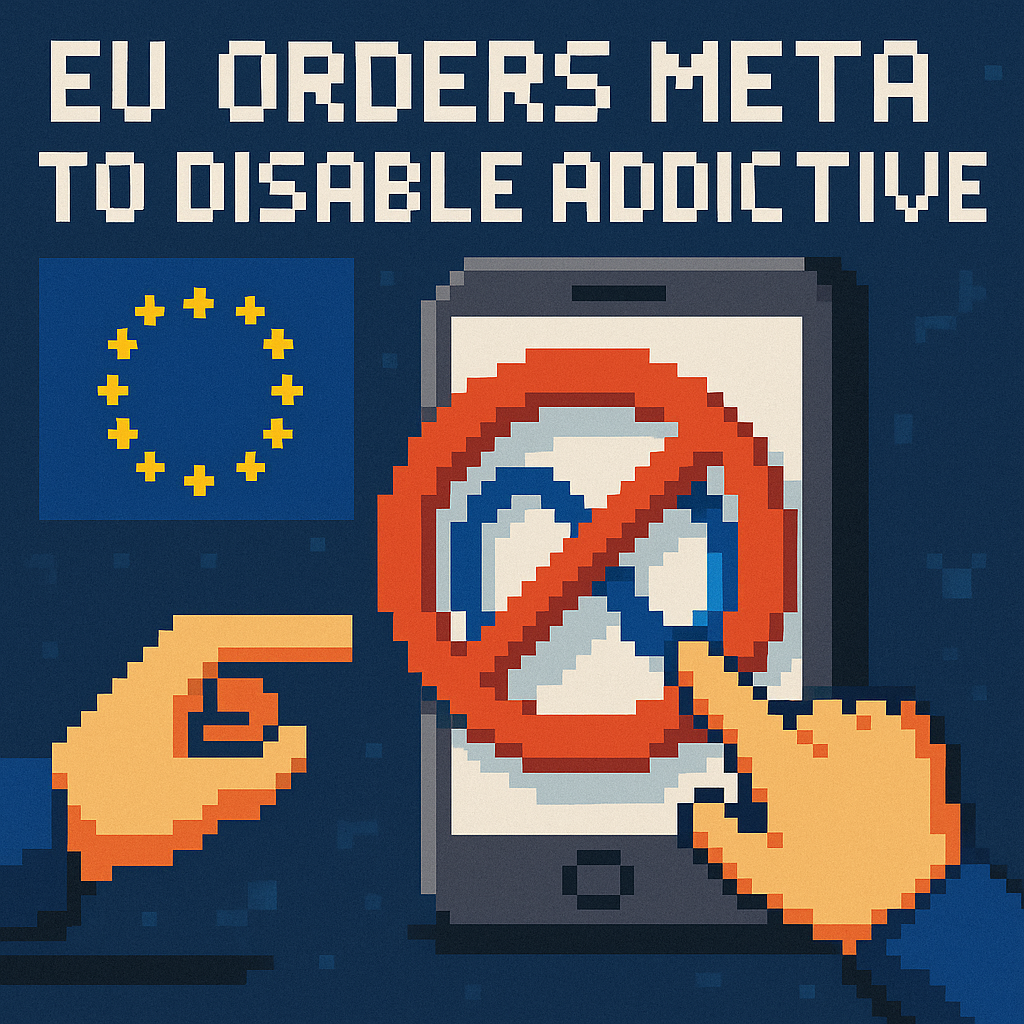
- Brussels ordered Meta to switch off Facebook and Instagram’s “infinite scroll” and “autoplay” by default under the EU’s Digital Services Act (DSA), with penalties up to 6% of global turnover at stake. The European Commission’s preliminary findings arrived on July 10, 2026. [1][2][3]
- The bigger risk than a fine is an EU product fork that slows Meta’s experimentation velocity and trims Reels watch time and ad impressions—the twin growth levers Meta highlighted in its FY2025 report. [4]
- TikTok Lite’s April 2024 EU intervention showed the playbook: the Commission pushes live product changes, not PR or warning labels, when it labels a feature “addictive.” [5]
What the source said
AP reported that on July 10, 2026 the European Commission issued preliminary findings that Facebook and Instagram deploy “addictive design” features—autoplay, infinite scroll, push notifications, and engagement‑maximizing recommendations—that risk users’ physical and mental health, including minors across the EU‑27. The Commission wants Meta to disable those features by default, strengthen break prompts, and reduce the primacy of engagement in recommendations; Meta pointed to “Teen Accounts,” nightly lockouts, and a parent‑set 15‑minute time cap option as safeguards. If the findings become a formal decision, DSA penalties can reach 6% of Meta’s global revenue, and Meta can submit a response before any order is finalized. [1][3][6]
Why it matters
- Stakeholders span EU teens and parents (default safety versus DIY controls), EU ad buyers (fewer impressions per euro if sessions shorten), Meta shareholders (compliance costs, slower growth), and every other “very large online platform” (VLOP) designated under the DSA as Brussels redraws the line between “engaging” and “manipulative” design. [2][3][7]
- A DSA decision that hard‑codes design‑by‑default changes travels fast: it becomes a template for the UK and Australia and a data point for US state attorneys general litigating engagement features. The fine is a one‑off; the product constraints become a standing EU baseline. [2][5]
Original analysis
EU demands Facebook and Instagram dismantle design features it calls addictive for users
Consensus view: This is an EU shot across the bow that ends in a manageable fine and cosmetic tweaks. Contrarian read: The Commission is trying to edit the engagement stack itself, not negotiate labels—its April 2024 TikTok Lite move in France and Spain froze a rewards feature in days, signaling that “addictive design” triggers product shutdowns, not disclosures. [5]
Meta’s exposure is twofold: fines and experimentation friction. Meta’s growth engine depends on high‑throughput A/B tests on feeds, Reels, and notifications; default‑off autoplay and non‑infinite feeds in the EU force region‑specific branches that reduce statistical power and slow ranking rollouts. That drag does not show up in a penalty headline, but it compounds quarter after quarter for EU audiences and any global models trained with EU data in the mix.
Back‑of‑envelope calculation (the fine versus recurring drag):
- Meta FY2025 revenue: $200.966 billion. [4]
- Max DSA fine: 6% of global annual turnover. [3]
- 6% × $200.966B = $12.06B (0.06 × 200.966).
- A 2% ongoing revenue drag from sustained EU design constraints would be ≈$4.02B per year (0.02 × $200.97B), which can outweight a one‑time hit if constraints persist across 2026–2028 as enforcement matures. [4]
Historical analogue (TikTok Lite, 2024):
- In April 2024, the Commission opened DSA proceedings against TikTok Lite’s “rewards for watch time” in France and Spain, signaled interim suspension, and TikTok paused the feature across the EU almost immediately. The lesson from Brussels: if a feature is framed as addictive, the remedy is to disable it by default, not simply warn or label it. [5]
Named‑stakeholder breakdown:
- Meta: In 2025, ad impressions rose 12% year over year and average price per ad rose 9%, both sensitive to session length and video continuity—precisely what autoplay and infinite scroll amplify. Expect an “EU mode” that preserves recommendation quality while trimming endless continuity. [4]
- European Commission: After designating Facebook and Instagram as VLOPs, this becomes a flagship DSA test; a soft settlement undermines the regime, while a hard remedy establishes that “addictive design” can trigger binding defaults across the bloc. [2][7]
- Advertisers in the EU: Shorter sessions and fewer seamless video handoffs mean fewer mid‑scroll and mid‑video impressions; media buyers will seek higher‑quality creative, tighter frequency caps, and may swing incremental short‑form video spend toward YouTube if its defaults remain friendlier—until the Commission looks there, too. [2]
- US regulators and AGs: State AG complaints have argued that engagement‑maximizing defaults harm minors; an EU design mandate—if finalized—becomes fresh evidence that “safe defaults” are technically and commercially viable at scale. [2]
A typology for “engagement engines” under DSA pressure:
- Continuity drivers: autoplay and infinite scroll keep users moving without choices; squarely targeted for default‑off. [2]
- Trigger drivers: push notifications pull users back; expect rate limits, quiet hours, or higher‑friction opt‑ins as defaults. [2]
- Targeting drivers: personalized recommendations steer attention; not banned, but likely tuned for diversity and “breaks,” not pure watch‑through. [2]
- Guardrails: teen accounts, time caps, and break nudges exist today; the Commission says current versions are easy to dismiss and wants enforced, stickier defaults. [1][2][6]
The bottom line: Meta can write a check; it cannot easily replace the automaticity that turns short sessions into long ones, and the DSA aims straight at that mechanic. [2][3]
What others are missing
Coverage centers on fines and teen settings, but the hidden cost is product velocity in the EU‑27. Default‑off autoplay and scroll force Meta to split core feed logic, notification cadence, and Reels playback into a region‑specific branch, which multiplies concurrent experiments, shrinks per‑variant samples, and stretches time to statistical confidence for ranking tweaks. That slows learning loops on video, where small watch‑time deltas drive big ad‑impression gains; Meta’s FY2025 numbers show it leaned on ad impressions (+12% YoY) to grow, so a slower release cycle hits the revenue engine more than a headline penalty. [4]
What to watch next
- By Q4 2026, Meta pilots an “EU mode” on Facebook and Instagram with default‑off autoplay and infinite scroll plus stronger break prompts, and claims in earnings or a blog post that engagement impact is “limited”; independent trackers (e.g., IAB Europe AdEx or SMI) show at least a 2‑percentage‑point EU shift of short‑form video ad spend toward YouTube by Q1 2027 if Reels watch time dips.
- By H1 2027, the European Commission issues a final DSA decision that includes binding design commitments and either a symbolic fine under 2% of FY2025 revenue or a suspended fine contingent on milestones. [2][3]
- By June 30, 2027, at least one other VLOP with heavy video autoplay—TikTok or YouTube—receives a formal DSA action focused on default design settings, confirming that “addictive design” enforcement is cross‑platform. [5][7]
My take
If I ran Meta’s EU product, I would stop litigating defaults and start shipping excellent “opt‑in continuity.” Make autoplay a clear choice with value—“Play next with sound off + topic diversity”—and instrument those opt‑ins for ranking. Treat Brussels as a lab for “engagement without compulsion,” then export wins globally; waiting for courts risks a ~$12.06B headline (6% of FY2025 revenue) and, worse, months of frozen roadmaps while regulators draft your release notes. [3][4]
Sources
-
EU demands Facebook and Instagram dismantle design features it calls addictive for users — AP News (https://apnews.com/article/facebook-instagram-eu-regulators-teens-addictive-b2f0ffd5ffc90721cacef7937e5909d2) — Straight report on July 10, 2026 findings, targeted features, and Meta’s “Teen Accounts.”
-
Commission preliminarily finds the addictive design of Instagram and Facebook in breach of the Digital Services Act — European Commission (https://digital-strategy.ec.europa.eu/en/news/commission-preliminarily-finds-addictive-design-instagram-and-facebook-breach-digital-services-act) — Official description of infinite scroll, autoplay, push notifications, and requested default changes.
-
The enforcement framework under the Digital Services Act — European Commission (https://digital-strategy.ec.europa.eu/en/policies/dsa-enforcement) — Legal basis for fines up to 6% of global annual turnover and the response process.
-
Meta Reports Fourth Quarter and Full Year 2025 Results — Meta Investor Relations (https://investor.atmeta.com/investor-news/press-release-details/2026/Meta-Reports-Fourth-Quarter-and-Full-Year-2025-Results/default.aspx) — FY2025 revenue ($200.966B), ad impressions (+12% YoY), average price per ad (+9% YoY), and regulatory commentary.
-
Commission opens proceedings against TikTok under the DSA regarding the launch of TikTok Lite in France and Spain — European Commission (https://digital-strategy.ec.europa.eu/en/news/commission-opens-proceedings-against-tiktok-under-dsa-regarding-launch-tiktok-lite-france-and-spain) — Precedent for rapid EU intervention and product suspension tied to “addictive” mechanics.
-
Beyond the Headlines: Meta’s Record of Protecting Teens and Supporting Parents — Meta Newsroom (https://about.fb.com/news/2026/01/metas-record-protecting-teens-supporting-parents/amp/) — Meta’s description of teen safeguards, including nightly lockouts and a 15‑minute time cap option.
-
Supervision of the designated very large online platforms and search engines under DSA — European Commission (https://digital-strategy.ec.europa.eu/en/policies/list-designated-vlops-and-vloses) — Confirms that Facebook and Instagram are designated VLOPs subject to enhanced DSA obligations.
Related update: We recently published an article that expands on this topic: read the latest post.