
It was one of those bone-chilling, rainy Thursdays when all you want is to curl up with something warm and soul-soothing. I found myself rummaging through my pantry, longing for something vibrant and comforting that could whisk me away to somewhere warmer. That’s when the idea of Thai Coconut Curry Soup popped into my head. This dish is like a warm hug with its rich coconut base and tangy lime notes, and the best part? It’s a one-pot wonder that’s ready in under 30 minutes. Perfect for when you want something impressive yet easy, offering a burst of flavors without spending hours in the kitchen.
Jump to Recipe
What You’ll Need
The beauty of this recipe is its simplicity. You might find that many of these ingredients are already lounging in your pantry or fridge, just waiting to be turned into something magical.
- Canned light coconut milk
- Canned worth of water
- Red curry paste
- Fresh ginger paste
- Fresh snow peas
- String beans
- Diced carrot
- Fresh whole Thai basil leaves
- Lime juice
- Low sodium soy sauce
- A few dashes of sesame oil
- Chili powder
- Tofu
- Salt
- Red bell pepper
- Black pepper
How to Make Thai Coconut Curry Soup
- In a large pot, combine the canned light coconut milk and an equal amount of water. Bring this mixture just to a boil over medium-high heat, then reduce the heat to a gentle simmer. You want small bubbles and steam, not a volcanic eruption.
- Add in the red curry paste and fresh ginger paste. Whisk them until they’re well-incorporated—your nose should be greeted with a fragrant, spicy aroma.
- Toss in the diced carrot and sprinkle with salt and chili powder, reserving the basil for later. Cover the pot and let it simmer until the carrots are almost tender. Keep an eye on them; we want them to maintain a bit of bite.
- Add the tofu cubes. Allow them to soak up the curry flavor by covering the pot and simmering for a few more minutes.
- Introduce the fresh snow peas, string beans, lime juice, soy sauce, and sesame oil to the pot. Cover and let them mingle until the beans turn a vivid green and are still crisp to the bite. This only takes a few minutes.
- For garnishing, slice the red bell pepper into thin strips and sprinkle them along with freshly ground black pepper on top before serving. If you’re feeling extra, stir in a couple of tablespoons of coconut oil with the tofu for a richer coconut experience.
Cook’s Notes
This soup is all about balance. Keep the heat low when simmering to maintain the integrity of the vegetables—nobody wants a mushy mess. If you’re making it ahead, store it without the basil. Add it fresh when reheating to keep its vibrant flavor. The soup will keep well in the fridge for up to three days, making it an excellent meal prep option. When reheating, do so gently on the stovetop to avoid overcooking the veggies.
Make It Your Own
- Crispy Tofu Swap: Instead of simmering the tofu, try pan-frying it beforehand until golden and crispy. Then add it to the soup just before serving for an extra texture.
- Shrimp Upgrade: Swap tofu for shrimp if you’re in the mood for seafood. Add them with the snow peas and beans for a quick cook.
- Spicy Twist: If you love heat, add a finely chopped Thai chili or more chili powder to the pot with the carrots.
- Veggie Packed: Include other veggies like bell pepper strips earlier in the cooking process, or add mushrooms for an earthier depth.
If you try this, I’d love to hear how it turns out — drop a comment or tag me! Soup’s on, and I can’t wait to hear your thoughts on this cozy, Thai-inspired bowl of happiness.
Related update: Thai Coconut Curry Soup
Related update: A Post Thanksgiving “sopa De Tortilla”

TL;DR
- Apple, Amazon, Reddit, Micron, SK Hynix, and Roblox were the stocks that explained today’s market tape: AWS-driven optimism battled iPhone-margin angst, while AI memory suppliers traded like utilities-in-the-making and ad/social names paid a “Google tax.” [1][3][4][5]
- The real tell: cash flow and contracts. Amazon’s AI push juiced AWS 37% YoY but flipped free cash flow negative; Micron locked in $22B of multi‑year take‑or‑pay deals, shifting memory from cyclical to contracted. [3][6]
- Consumer platforms are now distribution‑fragile. Reddit’s post‑print wobble on search‑referral fears and Roblox’s spring guidance cut show what happens when Google changes the hose. Expect valuation dispersion to widen. [9][10]
What the source said
Barron’s grouped the day’s action around a handful of bellwethers—Apple, Amazon, Reddit, Micron, SK Hynix, and Roblox—to explain why U.S. stocks ended a bruising July on a mixed but improving note. It highlighted a tech rebound that still had to swim against Apple’s drop, while AI‑infrastructure names steadied sentiment. The framing was less about a single earnings print and more about how these companies’ moves mapped onto the market’s push‑pull between AI capex optimism and consumer tech skepticism. In short: Amazon and chips lifted; Apple weighed; social/ad names chopped. [1]
Why it matters
- Stakeholders with the most to win or lose aren’t just the obvious shareholders. Hyperscalers (Amazon and peers), memory suppliers (Micron, SK Hynix), and their debt and equity financiers are tied together by multi‑year AI buildouts. A pause or re‑acceleration cascades instantly through contracts, capex plans, and margins. [3][6][7][8]
- On the other side sit ad‑dependent consumer platforms (Reddit, Roblox) and even Apple’s hardware complex, whose fortunes hinge on distribution and unit economics. One algorithm tweak or one quarter of component inflation can erase a year’s worth of product work—or a quarter’s beat. [4][9][10]
Original analysis
The bifurcated tape behind “stocks that explain today’s market”
The tape split cleanly into two economies: AI infrastructure sellers (Amazon’s AWS and chip supply chain) and consumer‑facing platforms (Apple devices, Reddit/Roblox engagement). Infrastructure got validation; consumer names got questions.
- AWS’s 37% YoY growth and Amazon’s disclosure that AI+chips are already a $25B annualized business tell you demand is real—but the bill is too. Amazon’s 12‑month free cash flow swung to a $7.6B outflow as it front‑loads capacity, which is why the stock can surge and still raise financing eyebrows. [3]
- Memory suppliers have quietly derisked. Micron says customers have committed $22B via five‑year take‑or‑pay deals—language this industry simply didn’t use in past cycles. That’s a structural pivot from “price taker” to “capacity allocator.” [6]
- Apple’s quarter was strong on the surface—$109.4B revenue, EPS $2.02, records across iPhone, Mac, and Services—but management also flagged rising memory costs into September. That pushes investors to ask: how much AI‑era component inflation can Services’ margin cushion offset? [4]
- Social/UGC businesses are distribution‑fragile. Reddit’s results beat, but sentiment turned on search‑referral risk; publishers across the web are considering restricting Google access as AI Overviews cannibalize clicks. That’s not a one‑day story; it’s a potential structural CAC hike for the whole open‑web ad economy. [10]
Back‑of‑envelope calculations (two quick cuts)
- AWS AI+chips scale: If Amazon’s “AI+chips” sub‑business is running at a $25B annualized rate today and grows a conservative 35% in the next 12 months, that’s ~$33.8B by Q2 2027. At a 25% segment‑level operating margin, that implies >$8B of operating income from this sub‑line alone, enough to mask volatility elsewhere—but only if capex intensity tapers. [3]
Calculation: $25B × 1.35 ≈ $33.8B; $33.8B × 0.25 ≈ $8.45B.
- Memory contracts as earnings floor: Micron’s $22B of five‑year, take‑or‑pay commitments average ~$4.4B/yr of revenue visibility. At a 45% memory-cycle gross margin (illustrative), you’ve got ~$2.0B gross profit “pre‑sold” annually—even before spot upside. This is why memory beta has started to compress. [6]
Calculation: $22B ÷ 5 ≈ $4.4B; $4.4B × 0.45 ≈ $2.0B.
A 2×2 that actually predicts behavior
Axes: Demand visibility (high ↔ low) vs. Distribution risk (low ↔ high).
- High visibility / Low distribution risk: Micron, SK Hynix (multi‑year supply deals; ADR broadened ownership). Playbook: raise capex methodically, pre‑sell capacity, manage price discipline. [6][7][8]
- High visibility / High distribution risk: Amazon (visibility on AI demand via backlog; but customers can optimize consumption). Playbook: sprint now, prove ROI later; expect cash flow volatility. [3]
- Low visibility / Low distribution risk: Apple (giant installed base; unit demand tied to macro and BOM inflation). Playbook: squeeze Services and ASPs to buffer input‑cost cycles; watch memory pricing. [4]
- Low visibility / High distribution risk: Reddit, Roblox (ad or bookings funnels exposed to search and policy shifts). Playbook: reduce Google reliance via native search and direct acquisition; reprice ads toward logged‑in, high‑intent inventory. [9][10]
Contrarian read
Consensus: “The AI infrastructure trade is back—own hyperscalers and HBM suppliers; avoid ad‑driven platforms.” My pushback: the market is underpricing the permanence of memory supply contracts and overpricing the linearity of hyperscaler free cash flow. Take‑or‑pay deals make Micron/SK Hynix earnings more utility‑like than the market credits; in contrast, AWS’s stellar growth is already showing up as cash burn. That inversion—contracted suppliers vs. capex‑heavy buyers—means the traditionally “riskier” memory names could deliver steadier EPS beats than the buyers funding them over the next 12 months, even if AI demand stays hot. [3][6][7][8]
What others are missing
The step‑function change isn’t “AI demand up.” It’s contract structure and distribution power. On supply, five‑year take‑or‑pay agreements shift memory from a spot‑exposed commodity to booked capacity—de‑risking earnings through 2027 for Micron and, indirectly, for SK Hynix now that it can tap U.S. capital at scale via ADRs. On demand, open‑web distribution is being rewritten by AI Overviews. Reddit’s wobble is the forward case for any platform leaning on Google for new users: acquisition costs rise, and growth quality tilts to logged‑in, high‑intent cohorts. Coverage that stops at “big movers” misses how these two mechanics—contracts upstream, distribution downstream—will drive multiple expansion for suppliers and a valuation headwind for ad‑dependent platforms. [6][7][8][10]
What to watch next
-
By Q4 2026, Micron lifts disclosed take‑or‑pay/backlog commitments to $30B+ across HBM/DRAM/NAND, confirming a structural derisking of memory earnings. [6]
-
By Q2 2027, Amazon states AI+chips (within AWS and adjacent) at a >$35B annualized revenue run‑rate, even as TTM free cash flow remains below its 2025 level due to continued data‑center buildout. [3]
-
By Q4 2026, Reddit reports flat to negative U.S. DAU YoY but >15% ex‑U.S. DAU growth and rising ad ARPU, reflecting a pivot toward logged‑in, high‑intent traffic as Google referrals dilute. [10]
My take
I’d rather underwrite contracted bandwidth than open‑web eyeballs in this tape. Memory just crossed a one‑way door: multi‑year commitments, ADR access for SK Hynix, and hyperscalers effectively pre‑paying for supply. That is not how the last memory super‑cycle ended. Meanwhile, every consumer platform that can be “answered” by AI will relearn the cost of rented distribution. I’m buying the derisked supplier earnings (Micron/SK Hynix on pullbacks) and treating AWS‑led rallies as proof of demand, not proof of cash discipline. For consumer internet, the burden of proof is now distribution resilience—not last quarter’s beat.
Sources
[1] Apple, Amazon, Reddit, Micron, SK Hynix, Roblox, and More Stocks That Explain Today’s Market — Barron’s (https://www.barrons.com/articles/stock-movers-e7d1ed18) — Sets the day’s framing: tech rebound vs. Apple drag;
Related update: We recently published an article that expands on this topic: read the latest post.
Related update: We recently published an article that expands on this topic: read the latest post.
Related update: We recently published an article that expands on this topic: read the latest post.
The other day, I was in one of those “what’s for dinner” ruts, staring at the contents of my fridge as if they’d magically assemble themselves into something fabulous. I had exactly four pork chops and an assortment of condiments eyeing me back. Inspiration struck when I remembered the combination of sweet and spicy flavors that always hit the spot. That’s how these Pork Carnitas with Chipotle BBQ Sauce and Slaw came to life. The beauty of this dish is how it transforms humble ingredients into a plateful of bold, balanced flavors. It’s one of those recipes that’s perfect for a lazy weekend or a weeknight when you want dinner to do all the hard work for you, thanks to the slow cooker magic.
Jump to Recipe
What You’ll Need
This recipe is a pantry-friendly miracle, loaded with bold flavors you probably already have on hand. Here’s what you’ll need:
- 4 bone-in pork chops
- 1 cup orange juice
- 1/2 cup pineapple juice
- 3 cloves garlic, minced
- 1 teaspoon ground coriander
- 1 teaspoon ground cumin
- 1 tablespoon chili powder
- 1 teaspoon garlic powder
- 1 teaspoon onion powder
- Salt and pepper to taste
- 1 cup ketchup
- 1/4 cup brown sugar
- 2 tablespoons dijon mustard
- 1/4 cup white distilled vinegar
- 1/4 cup orange juice
- 2 tablespoons honey
- 2 tablespoons chipotles in adobo, minced
- 2 cups thinly sliced green cabbage
- 1/2 red onion, thinly sliced
- 1/2 cup shredded cilantro
- Juice of 1 lime
- 1/2 cup plain nonfat Greek yogurt
How to Make Pork Carnitas with Chipotle BBQ Sauce and Slaw
- Place the 4 pork chops snugly in your slow cooker. Pour the orange and pineapple juices over the top, letting them pool and marinate the pork.
- Sprinkle the minced garlic, ground coriander, cumin, chili powder, garlic powder, onion powder, salt, and pepper evenly over the chops. The spices will start to meld into a fragrant blend as they begin to cook.
- Cover with the slow cooker lid and set it on low for 6 hours. Halfway through, rotate the pork chops so they cook evenly. Lean back and let the slow cooker work its magic.
- Once the pork is done, let it cool slightly. Then, get in there with two forks and shred the meat into bite-sized pieces. You’ll know it’s perfect when it falls apart effortlessly.
- For the chipotle BBQ sauce, whisk together the ketchup, brown sugar, dijon mustard, white vinegar, orange juice, honey, and chipotles in adobo in a small saucepan. Simmer over medium heat until it thickens, about 10 minutes. Taste and adjust the heat and sweetness to your liking.
- In a large bowl, toss together the green cabbage, red onion, and cilantro. Squeeze over the lime juice and add a dollop of Greek yogurt. Toss until everything is well coated and vibrantly creamy.
- Serve the shredded pork drenched in chipotle BBQ sauce, topped with the slaw on soft tortillas, or as is if you’re feeling low-carb.
Cook’s Notes
Let’s chat about a few things to make this recipe foolproof. First off, using bone-in pork chops really helps to keep the meat tender and juicy. If you only have boneless, that’s okay, just keep an eye on the cooking time as they might cook faster. The BBQ sauce can be stored in an airtight container in the fridge for up to a week, and trust me, you’ll want to pour it on everything. You can easily make the slaw ahead of time, just hold off on mixing in the yogurt until you’re ready to serve to keep it crisp.
Make It Your Own
Flexibility is the name of the game here. Try these variations to switch things up:
- Swap the pork with boneless chicken thighs for a lighter option.
- Use crispy tofu cubes instead of pork for a vegetarian twist.
- Add a handful of sliced jalapeños to the slaw for extra heat.
- Try serving the carnitas on a bed of Mexican rice for a heartier meal.
If you try this, I’d love to hear how it turns out — drop a comment or tag me! And remember, the only rule in the kitchen is to have fun. Happy cooking!
Related update: Pork Carnitas with Chipotle BBQ Sauce and Slaw
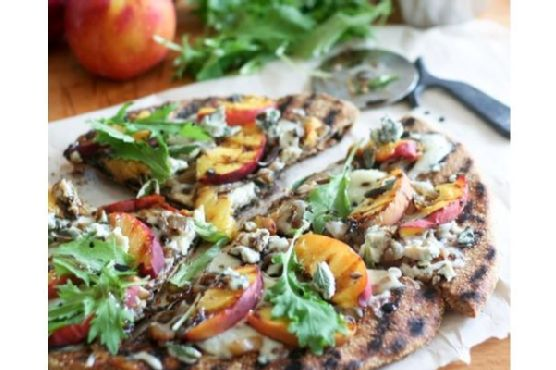
It was one of those late summer evenings when the air is still warm, but you can feel the crispness of fall sneaking up on you. I was rummaging through my fridge, craving something that would capture this seasonal transition. That’s when I stumbled on a few ripe peaches, begging to be used, and a hunk of blue cheese just waiting for its moment. This Rustic Grilled Peaches Pizza was born out of necessity and a hint of culinary curiosity. It’s a little sweet, a little savory, and just the right amount of indulgent. The combination of juicy grilled peaches and the tangy sharpness of blue cheese, all on a crispy crust, is a total game-changer. Plus, this recipe is surprisingly easy and quick to throw together, making it perfect for a weeknight dinner that doesn’t feel rushed or routine.
Jump to Recipe
What You’ll Need
I’m willing to bet you have most of these ingredients hanging around your kitchen. The few you might need to grab are totally worth it for this sweet and savory masterpiece.
- Fresh arugula leaves
- Balsamic vinegar
- Blue cheese
- Fresh sage
- Low fat mozzarella cheese
- Onion
- Peach
- Whole wheat uncooked pizza crust
- Salt and pepper
- Walnuts
How to Make Rustic Grilled Peaches Pizza
- In a large skillet over medium heat, cook the onions with a pinch of salt and pepper. You’ll want them very soft and caramelized, which will take about 20-25 minutes. Stir occasionally and add tablespoons of water to deglaze the pan, but only after the previous batch has fully evaporated.
- Meanwhile, in a small saucepan, bring the balsamic vinegar to a boil. Reduce the heat and let it simmer until it transforms into about a tablespoon of syrupy goodness, roughly 15-20 minutes.
- Preheat your grill to medium-high heat. Roll or stretch your pizza dough into a 10-12 inch disc. Brush one side with olive oil so it’s all prepped and ready.
- Toss your pizza dough onto the hot grill, oil side down, and lower the heat to medium. Arrange your peach slices next to the pizza dough. Close the grill lid and let everything cook for about 2-3 minutes.
- Flip the pizza dough and cover it with the caramelized onions and a generous sprinkle of mozzarella cheese. Flip those peach slices, close the lid again, and cook for another 2-3 minutes, until the cheese is melty.
- Remove the pizza from the grill and artfully place those grilled peach slices on top. Crumble over the blue cheese, scatter toasted walnuts, and sprinkle fresh sage and arugula leaves.
- Finish it off with a drizzle of that balsamic reduction, slice into wedges, and savor each bite!
Cook’s Notes
Don’t rush the onions. Their sweet, caramelized nature is an absolute must for this recipe, and it’s worth every minute. If you’re prepping ahead, you can make the caramelized onions and balsamic reduction a day in advance. Just store them in the fridge and warm them slightly before using. Leftovers? They’re delicious cold or reheated. Just store the pizza in an airtight container in the fridge, and it’ll hold up for a couple of days. Keep in mind grilled pizza tends to lose its crispiness, but the flavors will still be spot on.
Make It Your Own
- Swap the blue cheese for goat cheese if you prefer something milder.
- Use crispy prosciutto instead of walnuts for a savory, salty touch.
- Substitute fresh basil for sage if that’s what you have on hand — it adds a lovely fresh note.
- Try a different stone fruit like nectarines or plums to mix it up.
If you try this, I’d love to hear how it turns out — drop a comment or tag me! This pizza is a little slice of late summer heaven, and I can’t wait for you to experience it. Enjoy every bite!
Related update: Rustic Grilled Peaches Pizza
Related update: Scotch Eggs