
iPhone Selfies Capture Moon Mission View | Analysis by Brian Moineau

A tiny phone, a giant view: why Apple’s “Shot on iPhone” just went to the Moon

They say a picture is worth a thousand words, but when that picture is a selfie of astronauts floating in the Orion capsule with Earth glowing behind them, it suddenly feels priceless. Apple Highlights Photos Shot on iPhone During NASA's Mission to Moon – MacRumors is the headline that did the rounds this week, and for good reason: crew members aboard NASA’s Artemis II used iPhone 17 Pro Max devices to capture intimate, cinematic moments of humanity’s first crewed lunar flyby in over five decades. (macrumors.com)

The images are striking not just because of the scenery — Earth hanging like a marble beyond a tiny window — but because they collapse distance and technology into a single, very human frame. A commercial smartphone, in the hands of astronauts, helped document a milestone in space exploration. That collision of everyday tech and extraordinary context is what makes these photos remarkable.

Why the photos matter beyond the hashtag

  • They prove that modern consumer cameras can work under rigorous spaceflight constraints, at least for documentary purposes. NASA cleared iPhone 17 Pro Max units for extended use aboard Orion, which is a notable operational decision. (nasa.gov)
  • The images humanize the mission. A telescope or telemetry can tell you where the spacecraft is and how it’s operating. A selfie shows who’s in it, how they feel, and what the Earth looks like from their vantage. (macrumors.com)
  • For Apple, this is organic marketing gold: the “Shot on iPhone” narrative now includes literal shots taken near the Moon. For NASA, it’s a practical win — lightweight, familiar devices that let astronauts document life aboard Orion without complex camera rigs. (macrumors.com)

These points are why the story landed with more heat than a typical product-relations mention. It’s not only about specs or brand prestige; it’s about the cultural meaning of a handheld device recording a human story at an extraordinary frontier.

Apple Highlights Photos Shot on iPhone During NASA's Mission to Moon — what actually happened

On April 1, 2026, Artemis II launched and began its roughly 10-day trip around the Moon. During the mission, NASA shared photos from the crew — including shots credited to iPhone 17 Pro Max front cameras — that show astronauts Reid Wiseman, Christina Koch, Victor Glover, and Jeremy Hansen with Earth in the background. NASA posted multiple images and the agency’s Flickr archive lists EXIF metadata indicating the device used in some photos. (nasa.gov)

One of the images that circulated widely, captioned “Home, Seen from Orion,” shows Commander Reid Wiseman peering out a cabin window with Earth luminous beyond him. Other photos include dramatic lunar surface detail captured during the flyby and the crew viewing a rare total solar eclipse from deep space. The phones did not have internet connectivity while deployed — they were acting purely as cameras and documenters. (nasa.gov)

The technical and symbolic layers

Technically, there’s nothing magical going on beyond excellent optics, high-ISO capability, and good composition — all within a phone small enough to float in microgravity. But there are constraints to consider: radiation, thermal cycling, launch vibrations, and strict safety reviews before any consumer device rides inside a crew capsule. That NASA cleared off-the-shelf iPhone 17 Pro Max units for extended onboard use signals trust in the devices’ robustness for non-critical photography and documentation. (nasa.gov)

Symbolically, images like these do a few things at once:

  • They update our visual vocabulary of space. The Apollo-era photos defined generations; these iPhone frames show space as both epic and intimate.
  • They connect everyday users with exploration. Millions of people know how an iPhone works; seeing one in space makes the mission feel more accessible.
  • They shift expectations about who can document extraordinary moments. You no longer need a dedicated film crew or heavy equipment to capture an iconic space image — sometimes, a pocketable device suffices. (macrumors.com)

What this means for brands and science communication

For Apple, the optics are clear: organic association with a historic mission is the sort of earned exposure marketing teams dream about. For NASA and other agencies, allowing familiar consumer tech into the cabin opens doors for more naturalistic storytelling. It’s important, though, to keep expectations realistic: professional scientific imaging and mission-critical cameras remain indispensable for research-grade data. The iPhones function as narrative tools and personal recorders, not replacements for calibrated scientific instruments. (nasa.gov)

Media reactions varied from admiration to amused envy — many pointed out that Apple’s “Shot on iPhone” campaign just gained the ultimate endorsement. Observers also debated whether Apple would capitalize on the moment commercially (billboards, campaign tie-ins), but regardless of what marketing does next, the images already exist as public artifacts in NASA’s photo stream. (macworld.com)

Visual culture and the future of documentation in space

As missions become more routine and more actors — commercial and governmental — operate beyond low Earth orbit, expect to see a widening range of devices used to tell those stories. Phones, action cameras, and small mirrorless systems each have roles. The crucial idea here is accessibility: when anyone aboard a spacecraft can capture and share a moment (within mission rules), we get more varied, immediate, and human documentation of exploration.

There’s also a subtle but real archival question: who curates these images, and how will they be preserved for history? NASA has long been meticulous about archiving; adding consumer-device imagery to official streams requires diligence in metadata, provenance, and storage. The good news is that NASA’s photo release of these iPhone shots already includes useful details and contextual captions. (nasa.gov)

Final thoughts

My take: the story isn’t just that an iPhone took some pretty pictures — it’s that these pictures reframed how we think about presence in space. They make the immense feel intimate and the technical feel personal. Seeing Earth behind astronauts in a casually framed selfie collapses distance in a way raw telemetry never will. Whether you care about smartphones, space exploration, or just plain beautiful photos, these images matter because they remind us why we look up in the first place.

Sources


Related update: We recently published an article that expands on this topic: read the latest post.

Related update: We recently published an article that expands on this topic: read the latest post.

Garlic Lime Grilled Chicken Salad | Made by Meaghan Moineau

Picture this: It’s midweek, and you’re staring into the abyss of your fridge, seeking inspiration for dinner. We’ve all been there, and that’s precisely how this Garlic Lime Grilled Chicken Salad came to life in my kitchen. It’s that perfect holistic mix of tangy, zesty, and fresh that turns a mundane weeknight into a mini feast. The best part? It’s simple yet impressive enough to make you feel like a culinary genius without breaking a sweat. It’s brightened by the citrusy marinade and packed with vibrant, savory flavors that are sure to elevate your salad game. Plus, it’s a great excuse to fire up the grill! So, if you’re looking for a vibrant, flavor-packed dinner that’s also healthy, this one’s for you. Jump to Recipe

What You’ll Need

Chances are you already have most of these in your pantry or fridge, making this dish delightfully low-fuss. Here’s the lineup:

  • Chicken breast
  • Limes
  • Garlic
  • Olive oil
  • Cooked refrigerated black beans
  • Black pepper
  • Cilantro
  • Cumin
  • Frozen corn
  • Kosher salt
  • Shredded Mexican cheese
  • Onions
  • Orange
  • Oregano
  • Red peppers
  • Romaine lettuce
  • Vinegar

How to Make Garlic Lime Grilled Chicken Salad

  1. In a small bowl, mix 1/4 cup of fresh orange juice and 1/4 cup of fresh lime juice with olive oil, a sprinkle of cumin, a dash of oregano, a generous pinch of kosher salt, and minced garlic. Trust me, the aroma is divine!
  2. Pour half of this citrusy concoction over the chicken breasts, ensuring they get a good soak. Save the rest of the marinade for later. Let those flavors mingle for at least an hour—two if you have the time.
  3. Prepare your grill and heat it up to a sizzling 425°F. Once hot, sear the marinated chicken on both sides, about 12 minutes, or until you see those lovely grill marks.
  4. Lower the heat to 350°F and let the chicken cook through for another 7-10 minutes. You’re aiming for juicy, not dry!
  5. Slice up the red peppers into thin strips and give them a quick grill for about 2-3 minutes, so they’re tender but still have a bit of crunch.
  6. Warm up the frozen corn—nothing fancy here, just make sure it’s warm to the touch.
  7. Transform the leftover marinade into a vinaigrette by whisking in 1-2 tablespoons of vinegar. This will be your salad’s secret weapon.
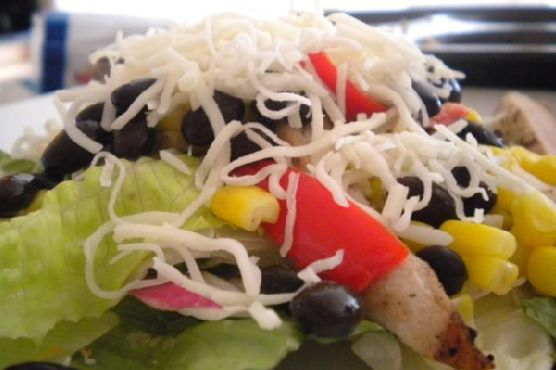
  8. Start your salad assembly: Start with a bed of fresh romaine lettuce, layer on the grilled chicken, sprinkle with black beans, grilled red peppers, cheese, and a drizzle of your vinaigrette. Voilà!

Cook’s Notes

Here’s the scoop: Marinating is key. The longer you let the chicken hang out in that zingy bath, the better. If you’re in a hurry, even 30 minutes can work. Don’t rush the grill time; those grill marks are where the magic happens, giving that smoky, irresistible taste.

Store any extras in separate containers, if possible, to avoid soggy lettuce—nobody likes a wilted salad! This dish holds up beautifully in the fridge for up to three days, so it’s perfect for meal prep, too.

Make It Your Own

  • Swap the chicken for crispy tofu to make it vegetarian-friendly. Just press and marinate the tofu the same way you would the chicken.
  • Add some diced avocado for creamy goodness that pairs perfectly with the citrusy zing.
  • Not a fan of romaine? Spinach or arugula would be fantastic substitutes, bringing their unique flavors to the table.
  • Craving extra crunch? Toss in a handful of tortilla strips or crushed tortilla chips right before serving.

If you try this, I’d love to hear how it turns out—drop a comment or tag me! Whether it’s a weeknight or a weekend grill-out, this salad is a surefire way to brighten up your dinner table. Enjoy!

Related update: Garlic Lime Grilled Chicken Salad

Related update: Swiss Chard Wraps

Related update: Traditional Panzanella

Xbox, Game Pass, and Bethesdas Fallout | Analysis by Brian Moineau

"That shouldn't be a surprise to you": when a veteran blows the whistle on change

When you first read the headline — "'I Saw How It Was Getting Damaged': Ex-Bethesda Exec Goes to Town on Xbox's Mistreatment" — it lands like a complaint you half-expected. The quote slices through nostalgia and corporate gloss: a longtime Bethesda executive, Pete Hines, saying he watched something he loved being “damaged” after the Microsoft acquisition. That shouldn't be a surprise to you, he adds, and that line is the emotional backbone of this debate about studio culture, acquisitions, and what subscription platforms do to creative incentives.

This post looks at what Hines said, where it fits in the bigger picture of Xbox, Game Pass and industry consolidation, and why his words matter beyond one company being “right” or “wrong.”

Why the quote matters

  • Hines speaks from inside decades of Bethesda history. He was a public face for the company for years and left in October 2023.
  • His remarks are not just a gripe — they accuse a shift in values and treatment of teams after Microsoft’s takeover.
  • The comment taps into a larger conversation about how big tech owners influence creative studios, and whether the tradeoffs (stability vs. autonomy) are worth it.

These points are important because they move the story from personality to pattern. When a respected insider frames the changes as “damage,” it reframes layoffs, studio reorganizations, and strategic pivots as consequences, not just corporate housekeeping.

The core claim: what Hines actually said

In a recent interview (April 2026), Hines said he left because he felt powerless to protect Bethesda as it was “being damaged and broken apart and frankly mistreated, abused.” He described the post-acquisition environment as “not authentic and not genuine,” and added, “That shouldn't be a surprise to you.” Those are strong words coming from someone who stayed on for a time after the deal closed. (pushsquare.com)

Put plainly: Hines is saying the acquisition created an ecosystem change — one that shifted incentives and day-to-day realities in ways that eroded what he and many others cherished about Bethesda.

Context: acquisitions, restructuring, and Game Pass dynamics

Since Microsoft acquired Bethesda’s parent ZeniMax, there have been shifts you can point to as background evidence: studio reorganizations, policy changes, and a stronger strategic focus on Game Pass as a distribution model. That model creates clear business benefits — stable revenue, massive user reach — but it also introduces new pressures.

  • Subscription services can compress the lifecycle of content and alter what “success” looks like.
  • Bigger corporate ownership can standardize processes and prioritize platform strategy over studio idiosyncrasies.
  • Layoffs and reorganizations in recent years across the industry have made talent and morale fragile.

Hines’ comments echo other developers’ and execs’ worries about "weird inner tensions" Game Pass can create and whether platform owners sufficiently value the long-term craft of big-budget studios. These tensions have surfaced in public debates and reporting over the past couple of years. (tech.yahoo.com)

What this means for players and creators

For players, the immediate impact is mixed. Game Pass has made a vast library affordable and accessible; entire communities enjoy games they might never have tried otherwise. For creators, however, the calculus can be uglier.

  • Short-term performance metrics can trump long-term IP cultivation.
  • Smaller teams and ambitious projects may find themselves deprioritized in favor of consistent platform content.
  • Creative autonomy can suffer when corporate priorities shift.

Hines’ complaint isn’t merely nostalgia. It’s a caution about how value is distributed inside large ecosystems: who gets resources, whose vision is protected, and which projects survive intact.

Where we should be cautious

That said, we should avoid one-sided conclusions. Large publishers can also offer resources and stability that enable ambitious projects which otherwise might never be funded. Microsoft has funded big games and given studios budgets impossible for many independent publishers.

  • Not every change is deliberate sabotage; some are genuine attempts to integrate and scale.
  • Problems observed at Bethesda had complex roots — not all attributable solely to the acquisition.
  • Public statements from former insiders often mix personal frustration with legitimate industry critique.

Balance matters. The right question isn’t simply “Is Microsoft bad?” but “How can large platform owners structure relationships to protect creative culture while pursuing growth?”

"I Saw How It Was Getting Damaged": what to watch next

  • Will Microsoft or Xbox publicly respond with concrete changes to studio autonomy or developer support?
  • Will other studio leaders come forward with corroborating accounts, or will defenders emphasize the benefits of scale?
  • How will Game Pass evolve its compensation and discovery models to better reward diverse kinds of creative output?

These are the practical policy areas where words like Hines’ should lead to action rather than just headlines.

My take

Hines’ words cut because they come from someone who loved, built, and defended Bethesda. They force a hard, necessary conversation about what we value in games and studios. Consolidation and subscription models are reshaping an industry that once relied on a patchwork of small, independent teams and a few large publishers. Those shifts can produce great things — and ugly consequences.

If you care about creative depth in videogames, don’t treat this as a partisan Xbox story. Treat it as a systems problem: how to design corporate relationships so that commercial success and creative stewardship reinforce each other, not erode one another.

Sources

Greek-Style Baked Fish: Fresh, Simple, and Delicious | Made by Meaghan Moineau

Picture this: It’s midweek, I’ve worked the whole day, and the fridge is looking thin. I peek inside to find some fish fillets, a lonely bell pepper, and a crumbling block of feta cheese. The usual dinner panic begins to set in, but then I remember this Greek-Style Baked Fish recipe. It’s my go-to for those days when I want something fresh and flavorful without the fuss. The beauty of this dish is that it’s both light and deeply satisfying, perfect for when you want a bit of sunshine on your plate, no matter the season. Plus, it comes together faster than you can say “Saganaki!”.

Jump to Recipe

What You’ll Need

This recipe shines with its simplicity and the ingredients you probably already have on hand. Here’s what you’ll need:

  • Fish fillets – Choose your favorite white fish.
  • Red onion – Adds a sweet crunch.
  • Bell pepper – The more colorful, the better.
  • Feta cheese – Crumbly and tangy goodness.
  • Tomato – Juicy and adds a touch of acidity.
  • White wine – For that hint of sophistication.
  • Olive oil – The Greek staple.
  • Dried basil and oregano
  • Salt & pepper
  • Cooked rice – To serve alongside.

How to Make Greek-Style Baked Fish: Fresh, Simple, and Delicious

  1. Preheat your oven to 450 degrees F. You want it hot so the fish cooks quickly and stays tender.
  2. Grab an oven-proof baking dish that will snugly fit your fish fillets without them overlapping. Give it a light spray with cooking spray to prevent sticking.
  3. Lay the fish fillets in the dish in a single layer. Season them generously with salt and pepper, because who likes bland fish?
  4. Top the fish with slices of red onion and bell pepper. The colors should already start to cheer you up.
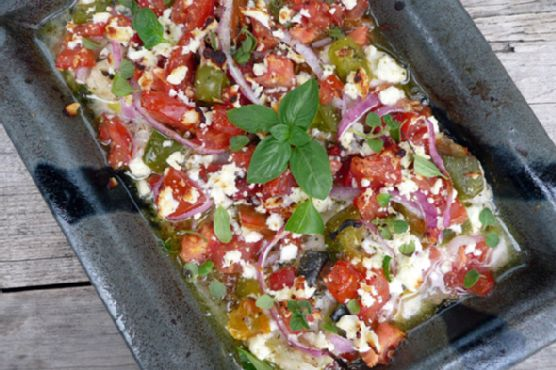
  5. Sprinkle dried basil and oregano over the top, followed by diced tomato and crumbled feta cheese. The feta will melt slightly and get creamy in the oven.
  6. Drizzle the white wine and olive oil over everything. This is the magic moment that brings it all together.
  7. Finish with a grind of fresh pepper, just before putting it in the oven.
  8. Bake uncovered for about 12 – 15 minutes. You’ll know it’s done when the fish flakes easily with a fork and the kitchen smells heavenly.
  9. Once out of the oven, squeeze some lemon wedges over the fish, and if you have fresh basil or oregano, now’s the time to sprinkle them on. Serve immediately with hot cooked rice.

Cook’s Notes

A few things to keep in mind: First, if your fish fillets are particularly thick, you might need a minute or two more in the oven. But keep a watchful eye, overcooked fish is a tragedy! As for leftovers, they’re rare, but if you do have any, this dish microwaves well. Just be gentle, so the fish doesn’t dry out.

If you’re planning ahead, you can chop the vegetables and crumble the feta in advance. Just keep them in the fridge until you’re ready to assemble. This makes an already quick recipe even speedier.

Make It Your Own

This dish is wonderfully versatile. Here are a few ideas to make it your own:

  • Switch the fish fillets for chicken breast. Just adjust the cooking time until the chicken is cooked through.
  • Try tofu instead of fish for a vegetarian twist. Use firm tofu and bake until it’s golden.
  • Throw in some kalamata olives for an extra punch of Mediterranean flavor.
  • Use quinoa instead of rice to up your protein and fiber game.

If you try this, I’d love to hear how it turns out — drop a comment or tag me in your photos. Here’s to less dinner panic and more delicious moments!

Related update: Greek-Style Baked Fish: Fresh, Simple, and Delicious

Related update: Stir Fried Cabbage and Tomatoes

Moroccan Chicken Tagine | Made by Meaghan Moineau

It was one of those nights where everything seemed to take forever. My hair was doing its own thing, there was a pile of laundry giving me the evil eye, and I had exactly zero patience left for the day. You know the feeling? That’s when Moroccan Chicken Tagine decided to swoop in and save my evening. With its warm spices and a touch of sweetness, it felt like a cozy hug in a bowl. This dish comes together quicker than you’d think, especially with the help of my trusty pressure cooker. I promise, it’s the kind of meal that makes you look forward to leftovers.

Jump to Recipe

What You’ll Need

Honestly, you’ve probably got most of this stuff hanging out in your pantry already, and that’s the beauty of it. Just a few special touches make this dish sing.

  • Moroccan spice mixture
  • Almond slivers
  • Dried apricot halves
  • Canned chickpeas
  • Whole canned tomatoes
  • Cilantro
  • Extra virgin olive oil
  • Fat-free chicken broth
  • Flour
  • Fresh ginger root
  • Garlic clove
  • Black salt and ground pepper
  • Honey
  • Onion
  • Skinless boneless chicken breasts

How to Make Moroccan Chicken Tagine

  1. In a pie plate, mix together the flour and Moroccan spice mixture. Toss the chicken pieces in this mixture until they’re well coated.
  2. Heat some olive oil in your pressure cooker over medium-high heat. When it’s nice and hot, add the chicken pieces. Let them brown for about one minute per side, absorbing all that fragrant goodness.
  3. Take the chicken out and set it aside. Lower the heat to medium, then toss in the ginger and onions. Saute for about three minutes until the onions start looking semi-translucent and glossy.
  4. Add the garlic to the pot and cook for another minute. The aroma should fill your kitchen like a dream.
  5. Introduce the apricots, whole tomatoes, chicken broth, and the browned chicken back into the pot. Cover and bring it to low pressure over medium-high heat.
  6. Once you’ve reached pressure, cook for about eight minutes. Then, carefully release the pressure using the quick release method. Open the steam valve and be cautious!
  7. Stir in the chickpeas, almonds, and honey. Let everything warm through for a few minutes, allowing the almonds to soften slightly.
  8. Check the chicken for doneness and taste your tagine. This is your moment to adjust the salt and pepper to perfection. Serve it over fluffy couscous and sprinkle with fresh cilantro leaves for that extra pop of color and flavor.

Cook’s Notes

If you’re using a Dutch oven instead of a pressure cooker, follow steps 1-4 as described. Then bring the mixture to a boil, reduce to a simmer, and let it cook for 20-25 minutes, or until the apricots are tender. Continue with step 6.

  • Feel free to prep some ingredients ahead. You can chop onions and garlic, or even coat the chicken earlier in the day.
  • Leftovers are a dream. Store them in an airtight container in the fridge and savor them for up to three days. The flavors only deepen and become more delicious.
  • Be adventurous with your spice mix. Play around with the ratios to suit your taste, just remember that a little goes a long way.

Make It Your Own

  • Swap the chicken for crispy tofu: A perfect vegetarian option that still holds up to the hearty flavors.
  • Try dried figs instead of apricots: They add a slightly different sweetness and pair wonderfully with the spices.
  • Use quinoa instead of couscous: It offers a lovely, nutty texture and is gluten-free.
  • Add some heat with chili flakes: If you like a bit of spice, a sprinkle of chili flakes will do the trick.

If you try this, I’d love to hear how it turns out — drop a comment or tag me on social media! Cooking is all about sharing and I’d be thrilled to know how this Moroccan Chicken Tagine fits into your week. Enjoy every bite!

Related update: Moroccan Chicken Tagine

Related update: Greek-Style Baked Fish: Fresh, Simple, and Delicious

Tigers Parker Meadows Injured in Collision | Analysis by Brian Moineau

A jarring moment in the outfield

Tigers center fielder Parker Meadows has a broken bone in his left arm and a concussion after an outfield collision with teammate Riley Greene. The image of Meadows being carted off Target Field on April 9, 2026 — stunned, bleeding, and cradling his arm — is one of those sports moments that leaves a clubhouse and a fanbase reeling. (espn.com)

The collision happened late in the eighth inning as both players converged on a fly ball. What began as routine defensive hustle turned into a frightening reminder of how fragile the human body is, even for professional athletes who train for these exact moments. (nbcsports.com)

What happened to Parker Meadows

Meadows and Greene sprinted toward the ball, and their paths crossed in a violent, head-to-head impact. Meadows bore the brunt: medical evaluations showed a fracture of the left radius (a forearm bone), a concussion, and internal facial lacerations that required stitches. He was hospitalized overnight for observation and later placed on the Tigers’ 10-day injured list as the team begins to map his recovery. (mlb.com)

Greene walked away from the collision and remained in the game, but the optics were unsettling — teammates checking on one another, a trainer’s urgency at the edge of the grass, and fans watching the play rewind in slow motion. In many ways, that split-second play raises bigger questions about positioning, communication, and the emotional toll of injuries in team sports. (sports.yahoo.com)

Why this matters for the Tigers now

  • The immediate challenge is roster logistics. Detroit will have to shuffle outfield minutes and lineup construction while Meadows recovers.
  • Beyond numbers, losing a young everyday center fielder affects clubhouse chemistry, outfield coverage, and the subtle defensive metrics that don’t show up on a box score.
  • There’s also the concussion timeline: even when the fracture heals, teams must be cautious — brain injuries aren't measured only in days. Recovery is individualized and can linger. (mlb.com)

Transitioning from strategy to personnel, the Tigers’ decision-makers will weigh short-term replacements and long-term prudence. Conservative timelines for concussions combined with a forearm fracture suggest Meadows could miss substantial time; this isn’t a quick in-and-out placement.

What the injury reveals about outfield play

Outfield collisions are rare but always dramatic because they are preventable through communication — or so we tell ourselves after the fact. Yet even with signals and practice, split-second decisions under speed and angle create risky moments.

  • Players must chase the play; passivity often costs runs.
  • But overcommitment without a clear call invites disaster.
  • Modern teams invest in situational reps and communication protocols, yet human instinct still plays the starring role when a ball hangs in the sky.

This incident will likely spur conversations inside and outside the Tigers’ clubhouse about who calls off whom, whether crew chiefs (center fielders) are being respected, and how teams can better train for these converging-speed scenarios. It also underscores the brutal reality that baseball, often portrayed as less violent than contact sports, can deliver injury with no warning.

The human side: beyond the tally of days

Numbers matter — days on the IL, batting averages, WAR — but the human side is what lingers. Meadows is a young player with promise; this kind of setback can test mental resilience as much as physical healing.

Teammates, coaches, and fans will watch the process: hospital reports, concussion protocol updates, and rehab milestones. The team’s public comments have emphasized caution and full evaluations first, treatment timelines second. That measured approach is important. Rushing a player back — especially after head trauma — has consequences that ripple into careers. (washingtonpost.com)

What fans and fantasy managers should expect

  • Short term: expect Meadows to be unavailable for several weeks, if not longer, because of the broken forearm plus concussion protocols.
  • For fantasy players: Meadows should be moved off active rosters; replacements will see more at-bats and opportunities.
  • For fans: the focus should be on recovery updates and respecting both medical confidentiality and the emotional impact on the players involved.

Moving forward, the Tigers will try to steady the outfield rotation and maintain momentum while giving Meadows the space he needs to heal.

What teams can learn going forward

First, invest in communication drills and clarify who “owns” the center. Second, emphasize neck-strength and awareness training — small advantages that can reduce whiplash-like effects in collisions. Third, ensure concussion protocols and follow-up care are non-negotiable. These steps won't eliminate accidents, but they can reduce harm and improve responses when bad luck strikes.

Finally, the public replay of the play reminds organizations that player safety and public perception are linked. Teams must show competence in both treatment and transparency without turning a medical situation into a media spectacle.

My take

This collision was a hard, visceral jolt — for Meadows, for Greene, and for Tigers fans. The immediate focus has to be on careful, patient medical care and a realistic recovery timetable. On the baseball side, the Tigers will be tested in how they adapt roster-wise and how they maintain cohesion. On the human side, the organization and fanbase will measure their support by how they respond in the weeks ahead.

For now, wish Parker Meadows a full recovery: a healed arm, cleared concussion tests, and a return to playing without hurry. The game will wait; the player’s long-term health should not.

Sources


Related update: We recently published an article that expands on this topic: read the latest post.


Related update: We recently published an article that expands on this topic: read the latest post.